Showing posts with label obsolescence. Show all posts

Monday, February 10, 2025

HMS Dreadnaught Led the Race for Naval Dominance and to a World War

HMS Dreadnaught and the Home Fleet under steam.

On February 10, 1906 the Royal Navy launched the Battleship HMS Dreadnaught.  She was the sixth ship of the line to carry that name but she represented a revolution in naval armament.

When John “Jacky” Fisher became First Lord of the Sea of the Board of the Admiralty in 1904 he set out to toughly reform and rebuild a hidebound institution.  He was heavily influenced, as were top naval officers in Germany, Italy, and Japan by the theories of the American officer Captain Alfred Thayer Mahan whose 1890 book The Influence of Sea Power Upon History, 1660–1783 and subsequent studies of more modern conflicts set forth a new doctrine of achieving world dominance by the extension of naval power.  Mahan’s book, now known only to military and naval historians, has been called one of the five most influential books of the 19th Century because it helped to set off a worldwide naval arms race.

First Sea Lord Jackie Fisher was inspired by the work of American Navy Captain Alfred Thayer Mahan whose 1890 book The Influence of Sea Power Upon History was called one of the five most influential books  of the 19th Century alongside such tomes as Charles Darwin's Origin of the Species, Carl Marx's Das Kapital, Leo Tolstoy's War and Peace, and  Harriet Beecher Stowe's Uncle Tom's Cabin.
 

Fisher was also impressed by the technological advances of the U.S. Navy and it Maine class battleships that had made mincemeat of the old fashion Spanish Navy in 1898.  The Japanese, adopting the same model, had crushed the Russians in 1905.  All the major sea powers now had battleships of roughly equal capacity, armament, and speed.

Fisher sent 150 obsolete ships to scrap and began an ambitious modernization and construction program that included the creation of a new class of vessel, the destroyer, fast light cruisers, and experiments with submarines.  But at the heart of his reforms were a whole new class of battleships, of which the Dreadnaught was the first.

The main innovation was the switch from mixed batteries of light and heavy guns to batteries of exclusively heavy guns capable of lethal fire at 5,000 or more yards.  This long range capacity was important as rapid advances in torpedo technology had put battleships at risk of that kind of attack at the 2000 yard ranges and under at which the Japanese engaged at the Battle of the Yalu River against the Chinese in 1894 and the U.S. Navy defeated the Spanish at Manila Bay in 1898.


American Maine class battleships had destroyed the antiquated Spanish fleet at firing at 2000 yards the Battle of Manila Bay during the Spanish American War, but the development of effective long-range torpedoes meant that the Royal Navy's Dreadnaught class had to carry guns effective at twice that range.

 
The Dreadnaught featured a main battery of ten 12-inch guns, along with twenty-two 12 pounders as her secondary armament.  The revolutionary ship was also the first be powered by steam turbine instead of reciprocal engines greatly increasing her speed.  The ship was also more heavily armored than previous battleships, and armor extended further under the water line in defense of torpedoes.

Fisher knew that his efforts were not alone.  Both the Americans and Japanese laid keels for similar ships about the same time.  Using techniques he had mastered earlier as Second Sea Lord, Fisher put pressure on the ship yard at Portsmouth to speed production.  He wanted to prove to the world, but particularly to the ambitious Germans, that the Royal Navy would be capable of quickly converting virtually its whole main battle line to the new class, thus discouraging, he hoped, attempts to catch up.  The keel was laid in October 1905 and she was launched the following February, an astonishingly short time. 

She was soon fitted, armed, and completed sea trials and was commissioned in December of 1906.  She was made flagship of the Home Fleet.


First Lord of the Sea, John "Jackie" Fisher (left) reviewing the modern Home Fleet that he had built on the eve of the Great War.

Far from discouraging a naval arms race, the Dreadnaught set off a frenzied new round of construction.  In Germany Kaiser Wilhelm II ordered the Kaiserliche Marine (Imperial Navy) to step up its own building program.  Most historians agree that tensions between the two empires caused by this naval arms race were a significant contributing cause of the First World War.

The Dreadnaughts actual service life was brief.  She was quickly rendered obsolete by second generation ships.  She missed the only battle between the main German and British fleets in the war, the Battle of Jutland on May 13, 1916 because she was laid up at base in Scapa Flow for refitting. 


HMS Dreadnaught was laid up at Scapa Flow for re-fitting and missed the Battle of Jutland, the only confrontation by the main British and German fleets in World War I.  Although the Kaiselich Marine inflicted more damage, it was unable to destroy the Home Fleet and was compelled to return to base--an essential tie that had no effect whatsoever on the outcome of the war.

Her only combat action of the war was the sinking of the submarine U-29 by ramming her in March of 1915.  In the summer of 1916 she was posted to the Thames in protection of London and fired her anti-aircraft guns at German bombers.  It was the only time she ever fired any of her guns in anger.

Shortly after the war she was placed in reserve and then sold for scrap in 1921 and broken up in Scotland in January, 1923.  

The age of the great battleships, often called Dreadnaughts in her honor, was itself short lived.  Their effectiveness for fleet to fleet combat was effectively ended in the age of the aircraft carrier.  The last such combat was the Battle of Surigao Strait, part of the larger Battle of Leyte Gulf in October, 1944 when an American task force destroyed a Japanese force.

The U.S. Navy took its World War II era battle wagons like the USS Wisconsin out of mothballs to once again serve as floating artillery platforms against land targets in Operation Desert Storm.  They also fired Tomahawk cruise missiles.  It was the last hurrah of the battleship.  They were official decommissioned after the Gulf War

The Royal Navy decommissioned its last battle ship, HMS Vanguard in 1960.  The U. S. Navy used the big ships essentially as floating artillery batteries against land targets in the Korean and Vietnam Wars.  Some were brought out of moth balls to be used again in the same capacity in Lebanon in 1984 and with the addition of Tomahawk missiles in the Gulf War.  The final four Iowa Class battleships, the last active dreadnaughts in the world, were decommissioned for the last time between 1989 and 1991.


Monday, February 10, 2020

HMS Dreadnaught—The Race for Naval Dominance and World War

HMS Dreadnaught and the Home Fleet under steam.

On February 10, 1906 the Royal Navy launched the Battleship HMS Dreadnaught.  She was the sixth ship of the line to carry that name but she represented a revolution in naval armament.

When John “Jacky” Fisher became First Lord of the Sea of the Board of the Admiralty in 1904 he set out to toughly reform and rebuild a hidebound institution.  He was heavily influenced, as were top naval officers in Germany, Italy, and Japan by the theories of the American officer Captain Alfred Thayer Mahan whose 1890 book The Influence of Sea Power Upon History, 1660–1783 and subsequent studies of more modern conflicts set forth a new doctrine of achieving world dominance by the extension of naval power.  Mahan’s book, now known only to military and naval historians, has been called one the five most influential books of the 19th Century because it helped to set off a worldwide naval arms race.

First Sea Lord Jackie Fisher was inspired by the work of American Navy Captain Alfred Thayer Mahan whose 1890 book The Influence of Sea Power Upon History was called one of the five most influential books  of the 19th Century alongside such tomes as Charles Darwin's Origin of the Species, Carl Marx's Das Kapital, Leo Tolstoy's War and Peace, and  Harriet Beecher Stowe's Uncle Tom's Cabin.
Fisher was also impressed by the technological advances of the U.S. Navy and it Maine class battleships that had made mincemeat of the old fashion Spanish Navy in 1898.  The Japanese, adopting the same model, had crushed the Russians in 1905.  All the major sea powers now had battleships of roughly equal capacity, armament, and speed.

Fisher sent 150 obsolete ships to scrap and began an ambitious modernization and construction program that included the creation of a new class of vessel, the destroyer, fast light cruisers, and experiments with submarines.  But at the heart of his reforms were a whole new class of battleships, of which the Dreadnaught was the first.

The main innovation was the switch from mixed batteries of light and heavy guns to batteries of exclusively heavy guns capable of lethal fire at 5,000 or more yards.  This long range capacity was important as rapid advances in torpedo technology had put battleships at risk of that kind of attack at the 2000 yard ranges and under at which the Japanese engaged at the Battle of the Yalu River against the Chinese in 1894 and the American’s in Manila Bay.

American Main class battleships had destroyed the antiquated Spanish fleet at firing at 2000 yards the Battle of Manila Bay during the Spanish American War, but the development of effective long-range torpedoes meant that the Royal Navy's Dreadnaught class hat to carry guns effective at twice that range.
The Dreadnaught featured a main battery of ten 12-inch guns, along with twenty-two 12 pounders as her secondary armament.  The revolutionary ship was also the first be powered by steam turbine instead of reciprocal engines greatly increasing her speed.  The ship was also more heavily armored than previous battleships, and armor extended further under the water line in defense of torpedoes.

Fisher knew that his efforts were not alone.  Both the Americans and Japanese laid keels for similar ships about the same time.  Using techniques he had mastered earlier as Second Sea Lord, Fisher put pressure on the ship yard at Portsmouth to speed production.  He wanted to prove to the world, but particularly to the ambitious Germans, that the Royal Navy would be capable of quickly converting virtually its whole main battle line to the new class, thus discouraging, he hoped, attempts to catch up.  The keel was laid in October 1905 and she was launched the following February, an astonishingly short time. 

She was soon fitted, armed, and completed sea trials and was commissioned in December of 1906.  She was made flagship of the Home Fleet.

First Lord of the Sea, John "Jackie" Fisher (left) reviewing the modern Home Fleet that he had built on the eve of the Great War.

Far from discouraging a naval arms race, the Dreadnaught set off a frenzied new round of construction.  In Germany Kaiser Wilhelm II ordered the Kaiserliche Marine (Imperial Navy) to step up its own building program.  Most historians agree that tensions between the two empires caused by this naval arms race were a significant contributing cause of the First World War.

The Dreadnaught’s actual service life was brief.  She was quickly rendered obsolete by second generation ships.  She missed the only battle between the main German and British fleets in the war, the Battle of Jutland on May 13, 1916 because she was laid up at base in Scapa Flow for refitting

HMS Dreadnaught was laid up at Scapa Flow for re-fitting and missed the Battle of Jutland, the only confrontation by the main British and German fleets in World War I.  Although the Kaiselich Marine inflicted more damage, it was unable to destroy the Home Fleet and was compelled to return to base--an essential tie that had no effect whatsoever on the outcome of the war.

Her only combat action of the war was the sinking of the submarine U-29 by ramming her in March of 1915.  In the summer of 1916 she was posted to the Thames in protection of London and fired her anti-aircraft guns at German bombers.  It was the only time she ever fired any of her guns in anger.

Shortly after the war she was placed in reserve and then sold for scrap in 1921 and broken up in Scotland in January, 1923. 

The age of the great battleships, often called Dreadnaughts in her honor, was itself short lived.  Their effectiveness for fleet to fleet combat was effectively ended in the age of the aircraft carrier.  The last such combat was the Battle of Surigao Strait, part of the larger Battle of Leyte Gulf in October, 1944 when an American task force destroyed a Japanese force.

The U.S. Navy took its World War II era battlewagons out of mothballs to once again serve as floating artillery platforms against land targets in Operation Desert Storm.  They also fired Tomahawk cruise missiles.  It was the last hurrah of the battleship.  They were official decommissioned after the Gulf War.

The Royal Navy decommissioned its last battle ship, HMS Vanguard in 1960.  The U. S. Navy used the big ships essentially as floating artillery batteries against land targets in the Korean and Vietnam Wars.  Some were brought out of moth balls to be used again in the same capacity in Lebanon in 1984 and with the addition of Tomahawk missiles in the Gulf War.  The last four Iowa Class battleships, the last active dreadnaughts in the world, were decommissioned for the last time between 1989 and 1991.


Monday, May 20, 2013

When Woodstock Illinois Changed the World

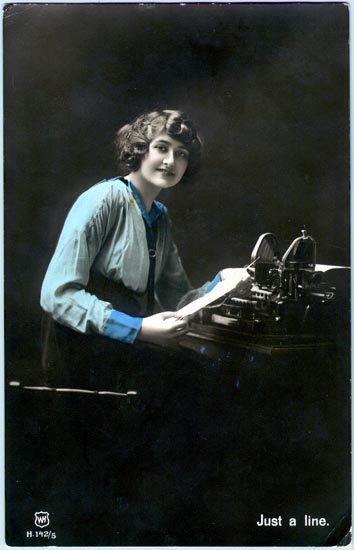
A Woodstock made Oliver Typewriter and one of the new class of women officer workers it helped make possible.


Note:  Running late today so here is a goody from the archives inspired by a post on Facebook of an old Oliver Typewriter ad.

I bet you didn’t know that Woodstock, Illinois was once the Silicon Valley of the first half of the Twentieth Century.  Just as previously obscure California towns boomed when the technological innovations fostered there blossomed into industries seemingly over night and changed forever the way we communicate with each other, so did this once sleepy county seat less than a two hour train ride from Chicago help transform the world a century ago.
Woodstock was once known as Typewriter City.  In 1922 nearly half the world’s typewriters were produced in two bustling factories here.  The machines produced in Woodstock were landing on business desks, in government offices, newspaper city rooms, schools and homes.  And they changed everything. 
Long rows of high clerks’ desks attended by young men in green eye shades and sleeve garters laboriously hand copying documents in fine Palmer Method script were replaced by mechanical devises and a few young women—both originally called “typewriters”—who could be hired at half the wages.  With the addition of carbon paper and tissue-like onion skin paper up to a half dozen perfectly identical copies of any document could be made at one time.  The machines could be used to cut a stencil for another new invention—the Mimeograph—and hundreds of copies could be made cheaply and quickly without having to send anything to a job printer.
The result was an explosion of paper—and of information.  Businesses and government ran smoother.  Productivity soared.
In 1894 a tinkering local Methodist minister, Rev. Thomas Oliver, started the Oliver Typewriter Company and produced a unique machine in which type bars were mounted to strike the platen from the top making the impressions on the page clearly visible to the typist.  Previously the type bars of most machines struck the platen from the rear and the typist could not see the result until the paper was removed. Talk about a technological breakthrough! Oliver machines were especially favored as stencil cutters for business and because of a unique marketing program became the first typewriters widely used in homes.  Production in Woodstock ended in 1928 and was shifted to Great Britain.  British Olivers of the same design as produced here became the backbone of the war effort with tens of thousands put to use by the military, government, and contractors during World War II.
Meanwhile, in 1910, the Emerson Typewriter Company relocated from Momence, Illinois into a state of the art factory building occupying a whole city block near the Woodstock railroad station.  When the Emerson company foundered it was acquired by its largest distributor and main creditor, Sears, Roebuck and Company.  Alvah C. Roebuck himself took over management of the firm.  By 1914 he had personally completely redesigned the typewriter into a sturdy machine on the modern model.  He retired the Emerson name and from then on Woodstock Typewriters were very successfully marketed by Sears.  Over the years Woodstock Typewriters introduced many innovations including the 1925 introduction of the first successful electric machine.
In 1950 the company was bought out by R. C. Allen and the machines re-branded and modernized. 

Allen already had a line of desk calculators and wanted to expand into a comprehensive office machine provider.  The new Allen electrics were among the most advanced machines available.  The company produced over a million and a half typewriters until the company closed operations in 1967 ending more than seventy years of typewriter production in Woodstock. 

Three generations of Woodstock working people responded to the whistles of these factories every morning.  Business was good.  Even during the Depression demand for typewriters remained high.  World War II sent demand through the roof as a complex world wide conflict required legions of typists pounding away in offices and Quonset huts from Washington, D.C. to the most obscure Pacific atoll.  Those workers considered their jobs as secure any in America.  After all, wasn’t business done on typewriters?  Wouldn’t it always be?
But marketing changes were challenging independent firms like R. C. Allen.  The introduction of innovations like the IBM Selectric machines with their easily interchangeable ball fonts made the Allen models passé. 
Today most people under the age of 40 have never even used a mechanical typewriter.  By the early 1980’s even the electric models were being replaced by new electronic “Word Processors.” By the ‘90’s computers were ubiquitous and only the most hidebound traditionalists clung to the old machines.
And some day, surely, those same computers, the whiz bang internet, and the industries that sustain them will fade, replaced by what we can only imagine.  Maybe it’s just as well to say that Silicone Valley may become the Woodstock of the future.

Sunday, February 10, 2013

Racing to World War--HMS Dreadnaught Set it Off

HMS Dreadnaught and the Home Fleet under steam.


On February 10, 1906 the Royal Navy launched the Battleship HMS Dreadnaught.  She was the sixth ship of the line to carry that name but she represented a revolution in naval armament.

When John “Jacky” Fisher became First Lord of the Sea of the Board of the Admiralty in 1904 he set out to toughly reform and rebuild a hidebound institution.  He was heavily influenced, as were top naval officers in Germany, Italy, and Japan by the theories of the American officer Captain Alfred Thayer Mahan whose 1890 book The Influence of Sea Power Upon History, 1660–1783 and subsequent studies of more modern conflicts set forth a new doctrine of achieving world power by the extension of naval power.  Mahan’s book, now known only to military and naval historians, has been called one the five most influential books of the 19th Century because it helped to set off a worldwide naval arms race.

Fisher was also impressed by the technological advances of the U.S. Navy and it Maine class battleships that had made mincemeat of the old fashion Spanish Navy in 1898.  The Japanese, adopting the same model, had crushed the Russians in 1905.  All the major sea powers now had battleships of roughly equal capacity, armament, and speed.

Fisher sent 150 obsolete ships to scrap and began an ambitious modernization and construction program that included the creation of a new class of vessel, the destroyer, fast light cruisers, and experiments with submarines.  But at the heart of his reforms were a whole new class of battleships, of which the Dreadnaught was the first.

The main innovation was the switch from mixed batteries of light and heavy guns to batteries of exclusively heavy guns capable of lethal fire at 5,000 or more yards.  This long range capacity was important as rapid advances in torpedo technology had put battleships at risk of that kind of attack at the 2000 yard ranges and under at which the Japanese engaged at the Battle of the Yalu River against the Chinese in 1894 and the American’s in Manila Bay.

The Dreadnaught featured a main battery of ten 12-inch guns, along with twenty-two 12 pounders as her secondary armament.  The revolutionary ship was also the first be powered by steam turbine instead of reciprocal engines greatly increasing her speed.  The ship was also more heavily armored than previous battleship, and armor extended further under the water line in defense of torpedoes.

Fisher knew that his efforts were not alone.  Both the Americans and Japanese laid keels for similar ships about the same time.  Using techniques he had mastered earlier as Second Sea Lord, Fisher put pressure on the ship yard Portsmouth to speed production.  He wanted to prove to the world, but particularly to the ambitious Germans, that the Royal Navy would be capable of quickly converting virtually its whole main battle line to the new class, thus discouraging, he hoped, attempts to catch up.  The keel was laid in October 1905 and she was launched the following February, an astonishingly short time.  

She was soon fitted, armed, and completed sea trials and was commissioned in December of 1906.  She was made flagship of the Home Fleet.

Far from discouraging a naval arms race, the Dreadnaught set off a frenzied new round of construction.  In Germany Kaiser Willhelm II ordered the Battle of Surigao Strait (Imperial Navy) to step up its own building program.  Most historians agree that tensions between the two empires caused by this naval arms race were a significant contributing cause of the First World War.

The Dreadnaught’s actual service life was brief.  She was quickly rendered obsolete by second generation ships.  She missed the only battle between the main German and British fleets in the war, the Battle of Jutland on May 13, 1916 because she was laid up at base in Scapa Flow for refitting. 

Her only combat action of the war was the sinking of the submarine U-29 by ramming her in March of 1915.  In the summer of 1916 she was posted to the Thames in protection of London and fired her anti-aircraft guns at German bombers.  It was the only time she ever fired any of her guns in anger.

Shortly after the war she was placed in reserve and then sold for scrap in 1921 and broken up in Scotland in January, 1923.  

The age of the great battleships, often called Dreadnaughts in her honor, was itself short lived.  Their effectiveness for fleet to fleet combat was effectively ended in the age of the aircraft carrier.  The last such combat was the Battle of Surigao Strait, part of the larger Battle of Leyte Gulf in October, 1944 when an American task force destroyed a Japanese force.

The Royal Navy decommissioned its last battle ship, HMS Vanguard in 1960.  The U. S. Navy used the big ships essentially as floating artillery batteries against land targets in the Korean and Vietnam Wars.  Some were brought out of moth balls to be used again in the same capacity in Lebanon in 1984 and with the addition of Tomahawk missiles in the Gulf War.  The last four Iowa Class battleships, the last active dreadnaughts in the world, were decommissioned for the last time between 1989 and 1991.