Showing posts with label propaganda. Show all posts

Tuesday, October 12, 2021

A Red, White and Blue Propaganda Coup—The Scary Ogre With the Shoe

Photoshop was far in the future in 1960 when a loafer was maladroitly manipulated into a photo of Soviet leader Nikita Khrushchev's pounding fist at the podium of the United Nations General Assembly.

For those of us of a certain vintage, the image of the evil dictator of Communist Russia, an ugly little man who resembled a pig, pounding his shoe on a table at the United Nations confirmed our worst fears that the possibility of a nuclear World War III was in the hands of a crude mad man.  And that’s exactly what we were supposed to think.

According to most of the almanacs I consult regularly in preparation of these blog posts, it was October 12 1960 when Nikita Khrushchev, First Secretary of the Communist Party and Premier of the Soviet Union threw that famous temper tantrum.

But it turns out that it may have been September 23 or 29, or October 13 during the Plenary Meeting of the UN General Assembly in New York.  It may have come in protest to a speech by British Prime Minister Harold Macmillan or remarks by Philippine delegate Lorenzo Sumulong.  He was visibly upset by statements of both men.

He may have banged his shoe at the podium…or at his seat in the Soviet delegation…or perhaps not at all.

And the old man was not really a dictator, as in the single, unquestioned authority of the nation in the way of Hitler, Stalin, or Third World generalissimos.

How could we have gotten it so wrong?

The trouble is, there is no documentation of the event in the official records of the United Nations.  In the daily press it was not mentioned in reports on any of the possible dates.  No footage could be found in the archives of NBC and CBC, both of which covered the General Assembly regularly and often broadcast important speeches live.  Nor has any authentic photograph of the episode been found—more on that later. 

Fuzzy accounts of the event have been pieced together from memories and memoirs, many of which don’t agree.

The meeting of the United Nations General Assembly in the fall of 1960 gripped world attention, dominated U.S. news, and attracted top international leaders.  In addition to Khrushchev's temper tantrums the session is remembered for the appearance of Cuba's Fidel Castro and a retinue in fatigue uniforms.

In retrospect, it is astonishing that the leader of one of the most powerful nations on Earth came to the major city of his chief rival to sit for hours daily over a span of weeks for the meeting of the Security Council.  And he wasn’t the only one—Macmillan was only one of the top Western leaders who did the same, as did a parade of presidents, prime ministers, kings, and despots from lesser nations.  If Dwight Eisenhower elected only to attend briefly to make his annual speech and to consult with world leaders in private meetings, the United States was represented at the top level by Secretary of State John Foster Dulles as well as the Cabinet level Ambassador to the world body.  It shows how important the UN was viewed in those distant days.

Most historians now discount the possibility that the shoe came off in September.  He did take to the podium, pounding his fists, in angry denunciation of Macmillan’s speech that day.  Later an AP photo of that diatribe would be altered by someone, and a shoe inserted into Khrushchev’s fist.  It was released and widely circulated by the media within weeks of the alleged event and not questioned at the time.  Who made the alteration and how did get to the media?  No one seems to know, but it has all the earmarks of a classic intelligence service disinformation operation.

The consensus now is that it was Sumulong’s speech on October 12 that was the trigger—if the event happened at all.  The Philippine delegate rose in support of an anti-colonial resolution that had the support of the Soviets and their allies.  The delegate spoke as a representative of a nation with a colonial past which had achieved its independence.  Of course, the Philippines, while independent, were known as a staunch ally of their former colonial master, the United States.  Although the resolution was tailored to the remaining colonial holdings of the Western powers, Sumulong strayed from the topic at hand to offer a slap at the Soviet Union:

 …It is our view that the declaration proposed by the Soviet Union should cover the inalienable right to independence not only of the peoples and territories which yet remain under the rule of Western colonial Powers, but also of the peoples of Eastern Europe and elsewhere which have been deprived of the free exercise of their civil and political rights and which have been swallowed up, so to speak, by the Soviet Union.

An enraged Khrushchev was recognized on a point of order and rushed the podium. He shoved the Philippine diplomat aside and launched an extended diatribe calling Sumulong a “jerk, a stooge, and a lackey…a toady of American imperialism” and demanding that he be ruled out of order.  Assembly President Frederick Boland of Ireland did caution the Sumulong to “avoid wandering out into an argument which is certain to provoke further interventions.”  But Sumulong was permitted to continue his speech and Khrushchev returned to his seat in the Soviet delegation.

At least one person remembers the Soviet premier as using his shoe at the rostrum in this confrontation.

Khrushchev, Foreign Minister Andrei Gromyko, and others in the Soviet delegation pound their fists at their desks in protest.

But most agree that it happened after he sat back down.  As the Filipino continued to speak, Khrushchev pounded both fists angrily on his desk, joined obediently by other members of the Soviet delegation and Eastern Bloc nations.  In fact, he pounded so hard that his watch stopped or flew off his wrist—not speaking well of quality of Soviet consumer goods.  According to a memoir by Khrushchev’s daughter Nina, confirmed by interpreter Viktor Sukhodrev who sat next to him, he looked down and saw his shoe, which he had removed for some reason earlier and spontaneously picked it up and began pounding the table.  He never, as some reports had it, removed the shoe from his foot, a virtual impossibility in the cramped space of the desk and given his girth.

The only evidence of a shoe--it rests on the desk in front of Khrushchev as the delegation listens quietly and evidently with some amusement.

Decorum at the session soon broke down and it was gaveled to adjournment by President Boland, who was being abused and booed from the Soviet bloc seats.

However, other accounts do not remember or mention the shoe at all.

To make matters even more confusing in his own memoirs Khrushchev remembered a shoe pounding incident but placed it in an entirely different context—a protest to remarks by a diplomat from Franco’s Spain.  A later published edition, however, contained a footnote saying that the incident was misremembered.
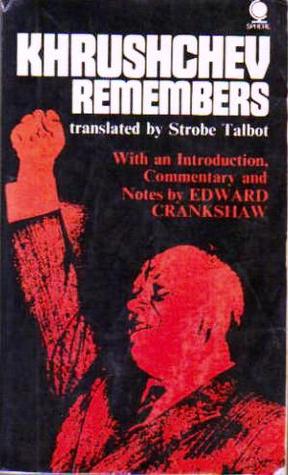
An English translation of Khrushchev's memoirs in which he gave a garbled and erroneous account of the shoe banning.

That United Nations trip is also remembered for Khrushchev’s own address to the world body in which he famously said of the United States, “We will bury you.”  That was played in the U.S. press as a threat of nuclear annihilation.  In fact, translators and linguists are unanimous that he had a different, less threatening meaning.  He was quoting a well-known Russian proverb that means “we will survive you and see you in your grave.”  It was a prediction of the triumph of Communism over capitalism as inevitable, but not a threat of war.

No matter what happened, Americans were soon convinced that Khrushchev was an arch-villain and dictator.  In fact, although he had consolidated considerable power in the Party, Khrushchev was never able to rule alone.  He was answerable to the Presidium of the Party and to the larger Polit Bureau, each of which included powerful rivals who limited his freedom of action.

Moreover, in the Soviet sense, Khrushchev was a liberal and reformer.  He had presided over de-Stalinization of the Party.  He had also loosened economic regulations, liberalized the still restricted freedom of writers and intellectuals to express themselves, and broke with the most aggressive military ambitions of hard liners.  Western intelligence agencies undoubtedly knew all of this.

In fact, four years later Khrushchev was deposed by the hardliners led by Leonid Brezhnev.

But to keep up public support for continued high defense spending and the proclaimed policy of aggressive containment of Communism, it was necessary to paint the Soviet leaders in the same stark terms as the U.S.’s late enemies in World War II.

All of this should be kept well in mind as one after another leaders of small and weak nations are portrayed to the American people as, inevitably, Hitlers.


Sunday, May 3, 2020

In Flanders Fields—The Poem of the Great War

Canadian poet, artilleryman, and medical officer Lt. Colonel John McCrae. 
It’s only been three days since I wrapped up the National Poetry Month series, but here I am already, back to verse.  This time it is history that that, in the immortal words of Sonny Corleone “keeps pulling me back in.”
It was 105 years ago today during World War I that Major John McCrae, a gunnery and medical officer of a front line Canadian regiment scribbled the first draft of the poem while sitting in the back of an ambulance in Flanders, the Dutch speaking region of northern Belgium.  It was just after the long and bitter 17 day Second Battle of the Ypres during which the Germans unleashed one of the first mass uses of poisonous chlorine gas of the war on Canadian positions resulting in heavy and gruesome casualties and one of those battles in the Great War that shattered expectations on all sides of a gallant and romantic display of national glory.  Nearly exhausted from the long battle during which he had never once had a chance to even change his clothes, McCrae had just presided at the burial of one of his closest friends, Alexis Helmer alongside hundreds of other victims of the fighting.  It was a large, open flat meadow and in the spring profusions of bright poppies bloomed between and among the newly dug graves.
With the scene still before him, McCrae sat in the ambulance that had delivered the body of his friend and scribbled a poem.  He lent it to regimental Sargent Major Cyril Allinson and the man was moved to tears.  McCrae, no an amateur but a serious and accomplished poet with extensive publication back home in Canada, was not satisfied with the work.  He crumpled the paper and tossed it aside.  Allinson retrieved the page and later convinced McCrae to submit it to publication.
McCrae relented, but spent weeks tinkering with and revising the poem before sending it off to The Spectator, London’s leading political and literary weekly.  But the paper, then a Liberal Party voice and strong supporter of the Prime Minister H. H. Asquith, who had once been an editor, rejected it.  Perhaps they thought that the theme of mass sacrifice was too depressing and could undermine moral despite the patriotic exhortation with which it ended.  McCrae’s second submission, to the more satirical Punch succeeded and it was published without attribution on December 8, 1915.

The poem and poppy images were widely used in Allied propaganda like this Canadian Bond drive poster.
The poem grabbed the immediate attention of the British public and it was widely reprinted.  The government, recognizing its power, began using it as a recruiting tool.  This was even more true back home in Canada.  Posters featuring the lines from the poem and images of poppy fields were used for both recruiting and  War Bond sales.  The Unionist Party used it in its campaign for re-election in 1916 against the French speaking Quebecois who opposed conscription.
In the United States the poem was used by those, like Theodore Roosevelt, who were eager to get the country into the war on the Allied side.  After President Woodrow Wilson was finally convinced to call for a declaration of War in 1917 U.S. propagandists also used the poem for recruitment.
John McCrae was born in Guelph, Ontario on November 30, 1872.  The grandson of Scottish immigrants, his father, Lieutenant Colonel David McCrae, was a professional soldier and strong Empire loyalist.  He attended high school at Guelph Collegiate Vocational Institute where he also rose to captain in the corps of cadets.  After graduation he joined the Army and trained in gunnery at Royal Military College of Canada in Kingston, Ontario.
Placed on reserve status, McCrae worked in 1894 as a Master of English and Mathematics at the Ontario Agricultural College in Guelph before enrolling at the University of Toronto to complete his B.A. and to study medicine.  His first poems were published while at the University.
After graduation from Medical School in 1898 he served his residency at Toronto General Hospital, and then in 1899, at Johns Hopkins Hospital in Baltimore, Maryland.  

Officers of the 1st Brigade Royal Canadian Field Artillery, circa 1901. John McCrae is in the top row, far left.

He interrupted his studies in 1900 in to command of the left section of D Battery of the Royal Canadian Artillery attached to the Second Canadian Contingent during the Second Boer War.  The contingent returned to Canada in 1901 after participating in several major campaigns.
In 1902, he was appointed resident pathologist at Montreal General Hospital and later became assistant pathologist to the Royal Victoria Hospital in Montreal. In 1904, he was appointed an associate in medicine at the Royal Victoria Hospital. Later that year, he went to England where he studied for several months and was admitted to membership in the Royal College of Physicians.
After establishing himself in private practice he continued to lecture as several institutions.  His reputation and social connections both grew.  He was invited to accompany Lord Gray, the Governor General of Canada, on a canoe trip to Hudson Bay as expedition physician.
He was appointed professor of pathology at the University of Vermont, where he taught until 1911 and also taught at McGill University in Montreal.   During these years he publish poetry, short stories—some of them illustrated by his own skillful drawings–and essays in addition to co-authoring the then definitive Canadian text on pathology.
When war broke out, McCrae was eager to join Canada’s Dominion forces in service of the Empire.  He turned down an offer of a high commission in the Medical Corps preferring active service with a front line unit.  He shipped out as Brigade Surgeon and a Major and second in command of the 1st Brigade, Canadian Field Artillery.  Not long after arriving in Europe he was in the middle of the Battle of the Ypres exhausting himself by dividing his time between firing his guns and tending the mounting wounded.
A little over a month after writing his famous poem, McCrae was transferred, over his voracious protests, to the Medical Corps where his services as a doctor and administrator were sorely needed.  But as he packed to report to his new duties, he complained to Sgt. Major Allinson that, “all the goddamn doctors in the world will not win this bloody war: what we need is more and more fighting men.”
But he loyally did his duty as ordered.  He was promoted to Lt. Colonel and placed in command  of the No. 3 Canadian General Hospital at Dannes-Camiers near Boulogne-sur-Mer in northern France where he operated out of Durbar tents from India for eight months through the cold misery of frosts, floods, and mud of the winter of 1915-16.  Eventually the hospital was relocated to the old Jesuit College in the town.  McCrae remained in command through most of the rest of the war and watched, with some amusement, as he became famous around the world for his poem.  In what little spare time he had, he prepared the manuscript for a collection of his war poems.

Lt. Colonel McCrae's funeral procession complete with the flag draped coffin--note the Union Jack rather than a Canadian Dominion flag--and being followed by his personal horse with his boots reversed in the stirrups.  All unusual military pomp in the middle of a war with millions of casualties.
But mostly, McCrae literally worked himself to death.  On January 28, 1918 he died of pneumonia and cerebral meningitis.  He was laid to rest the next day with full military honors and even an extra dash of pomp at the Commonwealth War Graves Commission section of Wimereux Cemetery, just a couple of miles up the coast from Boulogne.
His poem was later credited with helping the movement to establish the Remembrance Day holiday in Britain, Canada, and other Commonwealth countries and especially with the use of poppies to commemorate the dead.  That practice spread to the United States when the Veterans of Foreign Wars began selling Buddy Poppies to support the war wounded.
In Canada In Flanders Field has achieved particularly iconic status as patriotic set piece in a nation that holds it war veterans in unusually high regard.  Its words are inscribed on the Ten Dollar Bill and several commemorative quarters have featured the poppy, including one in 2004 with the poppy colored bright red—the first multi-colored circulation coin in the world.

The Lt. Col. John McCrae memorial statue in Ottawa.
In May 2015 on the centennial of the poem, a statue of McCrae by Ruth Abernathy was erected on Green Island in the Rideau River in Ottawa, Ontario. McCrae is dressed as an artillery officer and his medical bag nearby, as he writes. The statue shows the destruction of the battlefield and, at his feet, poppies. A copy was also erected at Guelph Civic Museum
Yet as a work of poetry, it does not get much respect.  Most Canadian literature courses omit it from their text books.  The darker, more bitter anti-war tinged work of soldier poets like Sigfried Sassoon  and Wilfred Owen get much more attention.  In Flanders Field is dismissed as patriotic fluff and propaganda, or worse was denounced by war historian Paul Fussell as “stupid and vicious…. propaganda argument against a negotiated peace.”  That was a bit unfair in that it was written so relatively early in the war that neither side was considering a negotiated peace outside of clear victory.  It is true that later in the war propagandists used the poem that way, however.
There remains to this day controversy over the first line of the poem that has nothing to do with its political use.  In the draft he sent to Punch, McCrae used the word grow at the end of the first line.  But the Punch editor noted that he had used the same word in the second to the last line.  They substituted the word blow in the first usage.  McCrae had no objections and used that form in his manuscript for his collection, In Flanders Fields and Other Poems published posthumously in 1919.  In sending handwritten copies to friends and admirers, however, McCrae used both forms as did some other publications.  The version below is how it appeared in the 1919 collection.

In the post war years Veterans' organizations like the British Legion began selling poppies on Remembrance and Armistice Days.

In Flanders Fields
In Flanders fields the poppies blow

Between the crosses, row on row,
That mark our place; and in the sky
The larks, still bravely singing, fly
Scarce heard amid the guns below.

We are the Dead. Short days ago
We lived, felt dawn, saw sunset glow,
Loved and were loved, and now we lie
In Flanders fields.

Take up our quarrel with the foe:
To you from failing hands we throw
The torch; be yours to hold it high.
If ye break faith with us who die
We shall not sleep, though poppies grow
In Flanders fields.

—John McCrae

Thursday, June 14, 2018

Flag Day in the Midst of a National Embracement


Note:  We’ve been here before but slightly updated to account for current catastrophes.

In case you hadn’t noticed today is officially Flag Day, a demi-holiday easily overlookedIt is celebrated by displaying the American Flag.  Veterans’ groups often organize solemn flag disposal ceremonies.  

No other country on earth makes quite the fetish of its flag as does the United States.  The word idolatry comes to mind.  At its worst it elevates the symbol—the Flag—over the substance—the democratic values espoused in the Declaration of Independence and protected by the Constitution.  It is an absolute truism that those who wrap themselves most in the Flag—and these day that is not just a figurative term—are the most disingenuous and dangerous.  Witness any Donald Trump performance.

Donald Trump practically swaddles himself in flags.  It's a tell--the more and bigger flags, the greater the lies and attacks on fundamental Constitutional and American values.
On the other hand—especially those who served in the Armed Forces or who were raised in a veteran’s household—have been taught to respect the Flag and “the nation for which it stands.”  I still hang the Flag on my house on patriotic holidays and always place my hat over my heart when it passes by in a parade.  It’s just the way I was raised.

Part of the national devotion to the Flag comes from an odd combination of cultural coincidence and calculated political strategy.  Our National Anthem, not officially adopted until 1931 but widely used on patriotic occasions for more than a century prior, may be the only national song about a flag.  

In the years after the Civil War the Grand Army of the Republic promoted flag waving as a triumphant poke-in-the-eye to defeated Confederates and as a test of patriotism in a way virtually unknown in the antebellum years.

Not widely displayed except at military posts, on Navy ships, and on some Federal buildings prior to the Civil War, the Grand Army of the Republic heavily promoted its use after the war in a spirit of triumphalism of the Union over the vanquished South.  For that reason display of the national flag was highly unpopular in the South until World War I.

The Pledge of Allegiance was penned by Francis Bellamy, a Baptist minister and socialist, for use during celebration the 400th anniversary of the supposed discovery of the New World by Christopher Columbus.  Quickly adopted by schools as part of the daily ritual of beginning classes, the Pledge does not swear allegiance to the government—an inclusive tip-of-the-hat to resentful former Rebels—or even to the Constitution, but to a symbol, the Flag.

Immigrant children were taught to salute the flag in public schools like this one in New York City where they would be punished for speaking their native languages.  Photo by Jacob Riis.
By the turn of the 20th Century the Flag was being used as a symbol of assimilation for the waves of emigrants swamping our shores—and as a test of their loyalty.  The most popular composers of the era—the March King John Philip Sousa and Broadway’s George M. Cohan made literal flag waving as popular as moon-June-spoon ballads.

During World War I, the Woodrow Wilson administration used flag imagery as part of their very sophisticated domestic propaganda operation designed to rouse support of the war effort and raise Liberty Loans.  After the war, the Flag was used to rally support for suppression of the labor movement, radicalism, Socialism, and Communism said to represent sinister alien ideologies.
Although the America First movement during the 1930's attracted some genuine anti-war sentiement, much of its leadership, including Charles Lindbergh, were pro-fascist.  Like other right-wing movements before and since they used the flag as "proof" of their patriotism.
Wilson proclaimed the first official Flag Day in 1916.  In 1949, with the country in the grips of yet another Red Scare, Congress made it an official Federal Holiday, although withholding the paid days off for Federal employees standard for other holidays.

June 14 is Flag Day because on this date in 1777 the Continental Congress passed the Flag Act which officially described a new national banner

Resolved: That the flag of the United States be made of thirteen stripes, alternate red and white; that the union be thirteen stars, white in a blue field, representing a new Constellation.
The new official flag—not, by the way, likely first sewn by Philadelphia seamstress Betsy Ross—was based on the unofficial Grand Union flag used by General George Washington during the Siege of Boston.  That flag had the same thirteen alternating red and white stripes but had the British Union flag in its canton.  Of course, that was before Independence was declared in July of 1776.  It wouldn’t do to keep the reference to the British flag.  

We will put it succinctly.  No, Betsy Ross did not sew the first American flag.


The Act was
vague—it did not describe the arrangement of the stars in the field, how the stars should be shaped, or even how large the field should be.  Local flag makers working from the sketchy description produced many variations with five, six, and even twelve pointed stars; with stars of different sizes; and many variations of arrangement.  Also the shade of blue used for the field depended largely on what blue cloth the maker might have at hand

The familiar
thirteen stars in a circle was not only not standard, some historians doubt if it was used at all during the Revolutionary War.  Others believe that it might have been the flag used at the British surrender at Yorktown.

The United States Postal Service is officially celebrating the Bicentennial of the 1818 Flag Act. 
After Vermont and Kentucky were added to the Union two additional stars and two stripes were added.  It was this flag that was the Star Spangled Banner observed still flying over Ft. McHenry in Baltimore harbor after an all-night British naval bombardment in 1815.  It became apparent that with more new states, adding stripes would quickly become clumsy. In 1818, after five more states were added, Congress fixed the number of stripes at thirteen with an added star for each new state making this the 200th Anniversary of the flag codified to its current specifications.

But it still did not specifically designate an arrangement for the stars.  During the Civil War flags with all manner of arrangements were used.  It was not until the creation of the 48 star flag in 1912 that a specific arrangement was established.  The current 50 star flag has been in use since July 4, 1960 after the admission of Hawaii to the Union.  This year will mark the 58th anniversary of that flag, which has been in service longer than any previous national banner.


Today the flag is waved by forces on both sides of the great social and political divide even as the nation for which it stands seems to teeter perilously on the verge of a second civil war.  Both sides claim to love their country but have seemingly irreconcilable notions about what America is, what it means, and what it should become.

I’ve got my flag today and I stand for the belief that it stands for “Liberty and Justice for All  What does your flag mean?