Showing posts with label science. Show all posts

Saturday, April 8, 2023

Murfin Verse—Cosmos, Consciousness, and Creator—Me! National Poetry Month 2023


Some of the things that pop up regularly on my Facebook page are posted from Big Think which popularizes advanced scientific research and speculation for the reasonably literate lay person.  Most often I glance at the summary but delve into the articles from time to time.  Frankly, most sail over my head.  Sometimes articles contradict each other as scientists advance different hypotheses.  An awful lot leaves me mystified.

I am no scientist, philosopher, or theologian—some of the most speculative stuff seems to demand that, too.  I am a humanities major who dropped out of college and spent most of my working life as a blue collar worker, janitor, and gas station clerk—manifestly incompetent to understand much of what I read.

But in my head I strung together a fragile paper chain from different posts unrelated to each other.  Blame me, not science, by my perhaps bizarre take away.  Thus. this verse.

Cosmos, Consciousness, and Creator—Me!

April 6, 2022


Those scientists are at it again!

According to what I read,

            some of them think that maybe

            the cosmos, everything,

            can be explained by quantum mechanics,

            so can consciousness,

            and everything might be

            the creation of the consciousness

            that observes it.


That’s me, if I get this straight.

Whew!


If somehow you are reading this

            I guess it means you too,

            but damned if I know if

            your universe is anything like mine.


It also means I am responsible for the whole shebang—

            the Big Bang, the Milky Way sky

            from a Montana mountain top,

            super novas, and galaxy devouring black holes,

            the extinction of the dinosaurs,

            and Krakatoa East of Java.


And for all the works of Shakespeare,

            even the ones I never read,

            the Mona Lisa and Van Gogh’s Starry Night,

            Hieronymus Bosch, your toddler’s

            finger paint smears.

            Fill in the blanks for the other noble arts.


Then there are the people,

            every blesséd and blasted one of them

            since Lucy in that African gorge,

            all of their stories and quirks

            from knuckle dragging hunters and gathers

            to walking on the Moon.


And if I die, which seems likely,

            will they go pffft with me

            or will they go on screwing and dying

            because having set this thing a-spinning

            it just goes on and on out of habit?


All the beauty and grandeur of all those folks

            but also the Black Death, the Inquisition,

            slavery, the Holocaust,

and every babe mowed down

in yet another school shooting.


It’s all too much.

I can’t stand it.

Which is why I evidently invented God,

            who I don’t really believe in at all,

            just so I would have someone

to point to and say—

“It’s not me,

It’s him/her/they/it.”


Am I off the hook?


—Patrick Murfin

Thursday, April 7, 2022

New Murfin Verse: Cosmos, Consciousness, and Creator—Me! for National Poetry Month 2022


Some of the things that pop up regularly on my Facebook page are posted from Big Think which popularizes advanced scientific research and speculation for the reasonably literate lay person.  Most often I glance at the summary but delve into the articles from time to time.  Frankly, most sail over my head.  Sometimes articles contradict each other as scientists advance different hypotheses.  An awful lot sails right over my head.

I am no scientist, philosopher, or theologian—some of the most speculative stuff seems to demand that, too.  I am a humanities major who dropped out of college and spent most of my working life as a blue collar worker, janitor, and gas station clerk—manifestly incompetent to understand much of what I read.

But in my head I strung together a fragile paper chain from different posts unrelated to each other.  Blame me, not science, by my perhaps bizarre take away.  Thus. this new verse.

Detail from the Fountain of Time, a monumental sculpture by Lorado Taft in Chicago's Washington Park near the University of Chicago.

Cosmos, Consciousness, and Creator—Me!

April 6, 2022


Those scientists are at it again!

According to what I read,

            some of them think that maybe

            the cosmos, everything,

            can be explained by quantum mechanics,

            so can consciousness,

            and everything might be

            the creation of the consciousness

            that observes it.


That’s me, if I get this straight.

Whew!


If somehow you are reading this

            I guess it means you too,

            but damned if I know if

            your universe is anything like mine.


It also means I am responsible for the whole shebang—

            the Big Bang, the Milky Way sky

            from a Montana mountain top,

            super novas, and galaxy devouring black holes,

            the extinction of the dinosaurs,

            and Krakatoa East of Java.


And for all the works of Shakespeare,

            even the ones I never read,

            the Mona Lisa and Van Gogh’s Starry Night,

            Hieronymus Bosch, your toddler’s

            finger paint smears.

            Fill in the blanks for the other noble arts.


Then there are the people,

            every blesséd and blasted one of them

            since Lucy in that African gorge,

            all of their stories and quirks

            from knuckle dragging hunters and gathers

            to walking on the Moon.


And if I die, which seems likely,

            will they go pffft with me

            or will they go on screwing and dying

            because having set this thing a-spinning

            it just goes on and on out of habit?


All the beauty and grandeur of all those folks

            but also the Black Death, the Inquisition,

            slavery, the Holocaust,

and every babe mowed down

in yet another school shooting.


It’s all too much.

I can’t stand it.

Which is why I evidently invented God,

            who I don’t really believe in at all,

            just so I would have someone

to point to and say—

“It’s not me,

It’s him/her/they/it.”


Am I off the hook?


—Patrick Murfin


Saturday, July 21, 2012

John Scopes Found Guilty but Evolution Wins in Monkey Trial

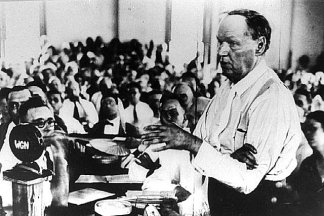
Clarence Darrow speaks in the stifling hot Dayton, Tennessee court room of the "Money Trial."  The defendant, teacher John T. Scopes listens raptly behind the WGN radio microphone that broadcast the proceedings live.

After seeing productions of the still popular play Inherit the Wind or catching the wonderful movie version starring Spencer Tracy and Fredrick March one might conclude that the victory of the Theory of Evolution was complete.  And indeed, for decades it seemed so.  Educated people accepted it in general terms even if they were fuzzy on the details.  It was not only taught in schools, it was the foundation on which much science and all biology instruction.  By in large it was uncontroversial.
Of course a religious minority refused to accept it, but for the most part did not attempt again to remove instruction about it from schools or at most conducted a futile, low grade guerilla campaign against it.
But with the rise of the religious right to real political power through the Republican Party in some states, anti-evolution has come roaring back with a vengeance, sometimes under the guise of something called intelligent design and sometime by advancing the reasonable sounding argument that public schools should offer students the opportunity to examine “all theories” of the origin of life and humanity side-by-side.  They do this by twisting the meaning of the word theory beyond all scientific understanding. 
Texas, which because of the large number of texts sold in that state which much conform to a curriculum approved by the state Board of Education influences text books sold throughout the nation, has eliminated most references to evolution.  Kansas and other states have passed draconian laws about what can and cannot be taught about it.  Out of fear of controversy, school districts across the country quietly remove it or down play it.
Meanwhile tourists flock to a Tennessee theme park that depicts dinosaurs and cavemen living side by side.  Surveys show that close to half of all adults now reject Darwinian evolutionary theory.  Scientists fret that a dark age of ignorance and superstition may be descending on the nation and even some thinking conservatives worry—very quietly—about how modern business dependent of science and technology can thrive when science itself is denied and even vilified.
But on July 21, 1925 when the very real Tennessee school teacher John T. Scopes was found guilty and fined $100 for teaching his high school students about evolution, it did indeed look like modernity had won, just like in the play based on that real trial.  Here’s what happened
On May 25, 1925 Scopes, a high school biology teacher in Dayton, Tennessee was indicted on charges of violating the state’s Butler Act which made it a crime to teach that humans descend from apes or other “lower forms,” a key element in the theory of evolution.  Scopes had been recruited by the American Civil Liberties Union to allow himself to be used as a test case for the recently enacted law.  He was arrested and charged on May 5 for teaching from a state approved text book with a chart illustrating “the descent of Man” on April 7.    Scopes was released on bail of $100 paid for by the publisher of the Baltimore Sun
At his request some of his students testified against him in front of the Grand Jury which returned the indictment. 
Things got out of hand when local attorneys Herbert E. and Sue K. Hicks, brothers friendly to Scopes, were replaced as lead prosecutors by the politically ambitious Tom Stewart who would ride his role in the case all the way to the U. S. Senate.  Still not satisfied, William Bell Riley, the founder and president of the World Christian Fundamentals Association, the leading voice of the still fledgling Fundamentalist movement, recruited three time Presidential nominee William Jennings Bryan to join the team.  That insured, as Scopes himself later acknowledged, that the controversy could never be contained “within the bounds of constitutionality.” 
Bryan was a leading Democratic Party liberal who had most recently served as Woodrow Wilson’s Secretary of State before resigning in protest to Wilson’s increasing moves to enter the First World War.  But the Great Commoner was also intensely religious and a known believer in the “inerrancy of the Bible.”  He was also a very rusty lawyer, having not tried a case in 36 years. 
John R. Neal, a law school professor from Knoxville was nominally the lead for the defense, but was upstaged when Clarence Darrow, the nation’s most famous trial lawyer and most notorious Freethinker volunteered his services.  ACLU attorney Arthur Garfield Hays, and New York society divorce lawyer Dudley Field Malone rounded out the defense team. 
When Darrow arrived he pushed aside the original ACLU plan to attack the case as a violation of teacher’s individual free speech rights and academic freedom and was therefore unconstitutional.  Darrow preferred to try to show that there was no conflict between the Bible and the theory of evolution.  He planned a defense that relied on expert testimony by both scientists and non-fundamentalist religious scholars. 
By the time the trial was underway in July, Dayton had become a three ring circus of Evangelical tent crusades, book peddlers, advocates on both sides, and a press frenzy led by H. L. Menken, the acid penned columnist for the Baltimore Sun, which was underwriting the defense.  Menken dubbed the case the Monkey Trial. There were also newsreel cameras and the microphone of WGN Radio inside the courtroom, making it the most documented court case in history. 
From the outset Judge John T. Raulston, who began his instruction to the jurors with Biblical quotations from Genesis, was hostile to the defense and clashed repeatedly with Darrow.  He disallowed repeated efforts to introduce expert testimony.  Bryan was called upon by the prosecution to argue against the introduction of expert testimony, but strayed far to a mocking taunt to Darrow and evolutionists which played well with gallery, but opened up a can of worms for the prosecution.   Bryan’s arguments were countered by Malone in what most legal historians regard as the high point of the trial. 
Frustrated, Darrow hit upon calling Bryan to the stand as an expert on the Bible based on his earlier argument.  The move stunned the prosecution, but Bryan foolishly accepted thinking that he could best Darrow one-on-one.  Darrow’s relentless demolition of Bryan and his theories is the best remembered part of the trial and is the center piece of Inherit the Wind which quoted directly from the court records in some cases and paraphrased much else.
After two hours of questioning in an open air session on the court house lawn—moved there because of crowding and oppressive heat in the courtroom—Judge Raulston refused to allow it to continue the next day and then ruled the whole thing inadmissible and expunged from the record.  Darrow asked that the jury be called in because the judge’s conduct of the trial made it a waste of time to conduct a defense. 
He expected a guilty verdict, but rested his case after telling the jury, “We came down here to offer evidence in this case and the court has held under the law that the evidence we had is not admissible, so all we can do is to take an exception and carry it to a higher court to see whether the evidence is admissible or not. . . . we cannot even explain to you that we think you should return a verdict of not guilty. We do not see how you could. We do not ask it.” 
It took the jury 9 minutes to reach a guilty verdict.  Judge Raulston imposed a $100 fine before even allowing Scopes to speak.  Upon objection he let Scopes have his only say of the trial, “…I have been convicted of violating an unjust statute. I will continue in the future, as I have in the past, to oppose this law in any way I can…” 
It was generally believed that despite the outcome, Darrow and the Theory of Evolution won the case in the court of public opinion.  Dayton and the Bible Belt were widely mocked.  Exhausted and demoralized the Bryan died of a heart attack in Dayton at the age of 65 just five days after the trial ended. 
The Tennessee Supreme Court overturned Scope’s conviction on a technicality and did not rule on the Butler Law’s Constitutionality.  The ACLU was unable to find another teacher willing to be a test case and the law remained on the books until the 1970s. 
Frightened publishers stripped evolution from almost all text books issued for the next ten years.  Evolution was only slowly re-introduced.  By the 1950’s, however, the tide had turned and evolution was back almost unchallenged, even where local laws forbad it, across the country. 
On a final personal note, back in 1967 I played Mathew Harrison Brady, the character based on Bryan, in a production of Inherit the Wind at Niles West High School in the Chicago suburbs.  It is doubtful that any public school in America would dare present that play today.

Friday, May 18, 2012

Born in 1852 Universal Free Public Education in the U.S. is Under Attack


Public Education is under concerted attack on multiple fronts across the United States.  Tea Baggers, Libertarians, religious zealots, money hungry sharpies hustling for-profit schools, old fashion racists and xenophobes, Republican politicians on the make, climate change deniers and dinosaurs-just-missed-the-Arc crowd, anti-labor crusaders, and the usual I-don’t-wanna-pay-no-stinkin’-taxes crowd combine on wave after wave of attacks on the Federal, state, and Local levels.

The attacks come in many forms—promotion of alleged school choice; slashing budgets; demonizing teachers as a profession; attacking collective bargaining rights, benefits, and pensions; attacking affirmative action and continued desegregation efforts; attempting to exclude children of undocumented immigrants; banning bi-lingual education; promoting aggressive zero tolerance discipline policies that result in wide spread suspensions and expulsion;  dismantling special services for the disabled and at-risk students;  micro-managing texts and curricula to exclude certain scientific knowledge and often to encourage out-right lies about evolution, climate change, sexuality, and history.

The motivations and tactics of the various players may vary.  But they are united in a single aim—discredit public education and drive as many students as possible out of the system leaving behind only the poorest who have no other alternatives.  That generally means minorities and other despised populations.  With upper and middle class students stripped away, support for public education will evaporate, funding further whither until the remnant collapses.

The very wealthy will do what they have always done—provide lavish private education with the best available teachers, equipment, and facilities.  Their children will get full educations—including the scientific knowledge that religious zealots want to deny the rest of the population.  Their children will be able to seamlessly maintain their position of privilege and dominance.

The dwindling middle class will be driven to charter, parochial, or for-profit private academies. Catholic and so-called Christian schools are already well established over much of the country and with potential new pools of students can be established everywhere.  Ideologically driven secular private schools and for-profit operations will be willing to pedal approved versions of the “truth.”  Moderate and liberal families of modest means have few such options.  They will either have to gin up whole new school systems, or send their children to the traps laid for them.  If they do manage to establish their own schools, look for state and local authorities to try to force their preferred curriculum on them.  For these folks choice always means their choice.

Of course, folks are awakening to all of this.  It is not too late to head off catastrophe.  

But maybe it would be good to look back at the origins of the free public education system that empowered generations. 

On May 18, 1852 Massachusetts became the first state to require education for all children.

Although the Puritans in 1647 established rules that every town maintain a school and levying  fines on parents who failed to enroll children, the law was never really enforced and the Bay State, like others, came to rely on a patchwork of private academies and tutors to serve the needs of its children.  With a high social value placed on reading, writing and ability to do basic “ciphers” Massachusetts still had the highest literacy rate among the states. 

But the influx of poor, largely Irish and Catholic immigrants in the 1840’s alarmed authorities in two ways.  First, they feared that an “ignorant rabble” would be a threat to domestic tranquility and republican virtue.  Second, they feared the parochial schools being established by Catholics would entrench an “alien religion” in their midst.  

Unitarian social reformer Horace Mann, who was made the first Secretary of the Massachusetts Board of Education in 1837, retired from a successful political career and dedicated himself to working tirelessly to establish a Common School system.  He visited every existing school in the state, established a Normal School system for the training of teachers, instituted reforms where he could, opposed corporal punishment, and constantly wrote and lectured on the need for compulsory public education. 

In his magazine The Common School Journal he laid out six principles:  that the public should no longer remain ignorant; that such education should be paid for, controlled, and sustained by the public; that education best be provided in schools that embrace children from a variety of backgrounds;  that education must be non-sectarian; that students should be taught by the spirit, methods, and discipline of a free society; and that instruction be provided by well-trained, professional teachers. 

In 1843 he toured Europe at his own expense to inspect educational developments there.  He became enthusiastic for the Prussian System of mandatory public education. 
 
Although Mann was elected to Congress, taking the seat vacated by the death of John Quincy Adams in 1848, he remained a steadfast booster of public education.  Despite being narrowly defeated for Governor in 1852, Mann was able to finally see his Common School program adopted by the Commonwealth.  

He then left to assume the presidency of Antioch College in Ohio, where he served until his death in 1859. 
He did live to see his idea spread.  New York adopted the system in 1854 and it spread slowly over Northern, Mid Western, and Western states.  Resistance was hardest in the South which argued that children were necessary for labor on the farm, and later in the growing textile industry.  

After the Civil War Southern states were also reluctant to adopt a system that would require them to educate Black children. 

None the less, by 1919 all states had adopted compulsory education rules. 

The new public education systems never did completely supplant either Catholic parochial schools or private academies. Public schools in the 19th Century often followed Mann’s dream of being “non-sectarian” only in that they were not Catholic.  They often acted as a broad transmitter of the dominant Protestant culture which was enshrined in staple texts like McGuffey’s Readers and in regular prayer. 

The tensions between these public and private systems are still being played out in controversies over school funding and the right wing ideological movement to replace “government schools.” If Mann failed to establish universal public education, at least compulsory education laws required that all children get some form of instruction.  That made the United States by the mid 20th Century the most universally literate society the world had ever known.

Alas, many nations, including some considered to be in the Third World have now surpassed the United States in literacy, in no small measure because of the concerted attacks on public education.