 |
Labor activist and artist Ralph Fasanella's painting shows a column of Militia marching to confront a mass march during the 1912 Lawrence Strike.
The Lawrence Textile Strike began when thousands of skilled and unskilled workers alike walked off their jobs on January 11,
1912. Two months later one of the largest employers in the city caved
into the demands of mere women, children, and immigrants. One by one over
the next couple of weeks the others fell into line. Something astonishing had happened,
something, dare we say it, revolutionary.
Lawrence was founded in 1845 to take
advantage of water power of the Merrimack River in Massachusetts by Abbott
Lawrence, a wealthy Unitarian from
Boston who built the first woolen textile mill there. He was soon
joined by others of his class. Within decades the river was lined with
massive mills which produced much of the nation’s cloth.
Originally Lawrence and the others
imported skilled craftsmen from England and
Scotland to build, maintain and set
up the complex machines. But cheap, unskilled hands were needed to tend them and keep them operating. That labor at first was recruited from the
young women of New England, mostly
the daughters of famers and working men. They were
housed in clean dormitories and
their “moral character” was well
attended to. The wages were considered
fair—enough to send home to help the family and still save for a self-earned dowry to start off a married life. Most of the girls—they usually entered the
mills at 16—worked for five years or so and then left to start families.
But beginning with the Civil War, this system was unable to
supply enough workers for burgeoning demand.
Mill owners also found the altruism
of uplifting young women less appealing than maximizing profits by seeking cheaper sources of labor. That labor would soon be found in the flood
of immigrants in the later 19th Century,
mostly from Southern and Eastern Europe.
By 1900 the Town of Lawrence and its neighbors was teeming with Italian, Slavic, Hungarian, Portuguese and Syrian immigrants who made up most of the unskilled workforce. The mills employed not only the men, but
their children, as young as eight,
and their women. Half of the workers at
the four giant American Textile
mills were girls between 14 and 18.

Children at the loom in an early 20th Century textile mill.
Gone were the tidy dorms of
old. In their place were tenements and virtual shanty towns. Twelve and fourteen hour days, six days a
week in lint filled air around
dangerous moving machinery meant that 36% of mill workers died by the time they
were 25 years old.
If there was a hell on earth, Lawrence may have been it. The bosses knew they were sitting on a powder keg, but depended on keeping
their workers divided by nationality,
religion, and sex to prevent wide spread labor
trouble.
Native Yankees, English, Scottish, Irish
(mostly Scots-Irish Protestants),
and Germans dominated the skilled
trades. Many of them belonged to three local unions of the A.F.L.'s United Textile Workers, but
only about 208 of these were in good standing in 1912. Various unskilled jobs were divided by
ethnicity.

The American Woolen Company's Washington Mill was one of the largest in Lawrence.
By 1905 the mills employed over
40,000 workers. The introduction of the two loom system in the cotton mills, in which a single worker
had to attend two machines, sped up work, made it more dangerous and held costs
down. Real wages began to be cut. The average wage in the industry by 1911, including
skilled workers, foremen, and office workers was only $8.76 for a work week of
up to 56 hours a week. The vast majority
of unskilled workers made barely half of that.
Conditions were becoming a public scandal. Do-gooders were demanding reform. Responding to public pressure,
the Massachusetts legislature passed
a law limiting the work week to 54 hours for women and children effective on
January 1, 1912. But the law did not
guarantee the same wages as the longer work week, which were barely enough to
live on as it was.
Beginning in December, mill
operators began to speed up the machines to make sure production remained at
the same levels as before. Then they
unilaterally decreed that male workers would also be limited to the 52 hour
week.
The Industrial Workers of the World (IWW) had been organizing
among the unskilled workers of Lawrence since 1907. Like the AFL locals, it had relatively few
dues paying members in 1912—maybe 800 or so.
Most workers simply could not afford even the modest dues charged by the
IWW Textile Workers Union. But unlike the AFL, the IWW had organized
with language sections for each
major ethnic group. Newspapers, pamphlets,
and leaflets were circulated by the
IWW in French, Spanish, Italian, Portuguese, Polish, and Hungarian. Some material was available in Arabic for the Syrians and in Yiddish for the relatively small
numbers of Eastern European Jews.
Meetings conducted in these languages included not only paid up members,
but all who were interested.
The small English language section
of the IWW often represented all language groups in communicating with the
bosses and authorities. It drafted a
letter to the President of American
Woolen Company demanding to know if wages would be reduced when the reduced
hours went into effect. When they got no
response, all IWW language groups were alerted to be prepared for cuts.
When Polish women workers at the Everett Company mills discovered their
pay packets short by 32 cents on
January 11, they dropped their tools
and walked out with shouts of “Short
Pay! Short Pay!” Other workers
followed. The next day the strike spread
to the most of the other mills.

Women and Children on the picket line in the snow earl in the strike.
Late in the afternoon a mass meeting was held in the Franco-Belgian hall. Although the strike
had not been called by the IWW, most
of the workers were aware of the radical
union and sympathetic to
it. They knew they could not count on
the support of the AFL, which had instructed
its members to stay on the job. The
meeting resolved to send a telegram
to Joseph Ettor, an IWW organizer,
editor, General Executive Board member
in New York. Ettor had earned a
reputation leading one of the first great IWW strikes, the 1909 strike against
the Pressed Steel Car Company in McKees Rocks, Pennsylvania. Most importantly, Ettor had experience working with
foreign born workers and could speak Italian and Polish fluently and get by in
Hungarian and Yiddish.
Upon speedy arrival, Ettor quickly
helped organize the chaotic walk-out into a well-disciplined strike.
Mass meetings were held in the morning and late afternoon to plot
strategy and formulate demands. Those
demands eventually included a 15 percent wages boost for a 54 hour work week, double time for overtime work, and no
discrimination against any workers for their strike participation. Mass
pickets, the first ever seen in Lawrence, began in front of all of the
mills. Even most of the AFL men now came
out.
Despite an AFL attempt to wrest
leadership from the IWW, the strikers had confidence only in Ettor and the One Big Union.

A labor cartoon protested the police brutality in Lawrence.
The mayor of Lawrence called out a local Militia company to support police
against the picketers. The Fire Department turned their hoses on strikers in the sub-freezing January temperatures. 33 picketers were promptly arrested and quickly sentenced by a
local magistrate to a year in jail.
From the beginning, the Boston press
raged against the strikers and called for severe measures against them. The leading clergymen of Boston, Unitarian and Congregationalist alike echoed the sentiments. The Governor
ordered out the State Police and
more units of Militia. That included a
company of Harvard students,
including the sons of the Unitarian Brahmin
elite, who were among the most eager to “have at” the strikers.
Another leading Italian, Arturo Giovannitti, editor of the Italian Socialist Federation paper Il
Prolitorio arrived to bolster IWW strike leadership. Giovannitti went
to work organizing strike kitchens
and relief and sending off furious
letters pleading for support and money to Socialist ethnic federations and IWW
locals alike.
In the early weeks of the strike, it
held firm against daily assaults on the picket lines and harassment by troops
and police. Giovannitti’s relief efforts
set up medical clinics staffed by
sympathetic doctors, minimal strike pay,
and food rations.
Observers like labor reporter Mary Heaton Vorse noted that the
strikers seemed almost gay, “always marching and singing. The tired, gray
crowds ebbing and flowing perpetually into the mills had waked and opened their
months to sing.”
Early in the strike local police
found dynamite in three locations,
including a shoemakers shop next to
the print shop Ettor used as his mailing address. The Boston American actually
reported the story before the explosives were supposedly located. Despite efforts to tie Ettor and strike
leaders to it, a local school board
member was eventually arrested and charged with planting the dynamite in an
effort to discredit the strikers.

The funeral of Anna LoPizzo, shot by police on January 29.
On January 29 Ettor led one of the
largest marches yet through the center of the Lawrence business district. Before
the march he addressed the workers and urged them to avoid violence at any cost.
When the Militia blocked a main road, Ettor simply steered the marchers
onto side streets to avoid a confrontation. Later that afternoon as Ettor and Giovannitti
addressed a regular strike meeting, a young woman, Anna LoPizzo, was shot and
killed during a police charge on a regular picket line. Witnesses saw a police officer fire the shot.
Despite this Ettor and Giovannitti
were arrested and charged in LoPizzo’s murder.
They were held without bail. In April they were joined by a local striker,
Joseph Caruso, who police alleged
actually fired the shot that killed her.

Strike leaders Joseph Ettor and Arturo Giavaniti were addressing a mass march when Anna LoPizzo was shot and killed on a picket line blocks away, but both were charged with her murder.
Martial Law
was declared and all public meetings and marches officially banned. The governor called out 22 more Militia
companies. Two days later a 15 year old
Syrian boy was bayoneted to death.
If Authorities thought jailing the
leaders would end the strike, they were mistaken. The IWW General
Secretary Treasurer, the legendary Big
Bill Heywood himself, arrived. He
brought with him veteran unionist William
Trautman and a slip of an 18 year old Irish
girl, Elizabeth Gurly Flynn
already noted for her fiery oratory. Her work in Lawrence would catapult her to
fame. She would be memorialized by IWW troubadour Joe Hill himself as the original Rebel Girl. A few days later
the Italian anarcho-syndicalist Carlo Tresca arrived to bolster the IWW
team.
15,000 strikers met Heywood and
company at the railway station and conducted illegal parade to Lawrence Common where they all gave
rousing speeches. In all of his
addresses Heywood counseled peaceful resistance and against violence. He also determined to demonstrate the
strikers’ patriotism for their
adopted nation by making sure that they carried plenty of American Flags. The most
widely circulated photograph of the strike shows Militia with leveled bayonets
at massed flag carrying strikers.

Massachusetts Militia met a flag carrying mass march of strikers with leveled bayonets.
Women and girls represented more
than half of all of the strikers. They
often took the lead on picket lines and were creative in their actions. One parade of women was led by a large
placard reading, “We Want Bread but We Want Roses Too!” The women probably were inspired by the poem
by James Oppenheim that was
published in December 1911 in The American Magazine, although
popular mythology has it that the strike inspired the poem which was set to
music by Caroline Kohlsaat a few
years later and became an IWW and later feminist
classic.
The turning point of the strike came when strike leaders decided to
send children of strikers to be
safely cared for by IWW members and supporters in New York. Margaret Sanger, a
volunteer nurse, accompanied the
first 120 children to the city on February 10.
Their train was met by
thousands of members of the Italian
Socialist Federation and the Socialist
Party who escorted them through the streets singing The Internationale and Les
Marsaillaise. A second group of 90 children received a
similar welcome a few weeks later. The
image of the half-starved children
dressed in tatters against the
winter chill helped swing public sentiment away from the mill owners and to the
strikers. Alarmed, Lawrence officials
announced that no more children would be allowed to leave town.

Children evacuated from Lawrence were escorted by Elizabeth Gurly Flynn and Big Bill Haywood to union foster homes in New York City. The publicity and sympathy generated by the move drove employers into a frenzy.
On February 24 150 children escorted
by their mothers attempted to board a train to take them to supporters in Philadelphia. Local police and three companies of
Militia charged the orderly line beating the women and children
indiscriminately. They tried to tear
children from their mothers. Dozens of
women and many children were thrown into the backs of Militia trucks where they
continued to be beaten. Thirty of the
women, most of them seriously injured were jailed. Children were removed from the custody of
their parents. The attack was observed
by several reporters and was soon widely publicized.
Public outrage at the brutality
erased most support for the bosses. Wisconsin Socialist Congressman Victor Berger and Democrat William Wilson from Pennsylvania
demanded a Congressional investigation,
which got under way in March. Public
testimony by child workers to the inhumane conditions of the mills stirred the
conscience of the Country.
At the urging of his wife, who
attended the hearings, President William
Howard Taft announced a nationwide investigation into conditions at
industrial plants across the country.
There was talk of stripping the mills of the heavy tariff protections that kept the companies competitive with
European producers.
On March 12 the American Woolen
Company acceded to all of the strikers’ demands. By the end of the month even the most
recalcitrant owners had fallen into line.
The great Lawrence Strike ended with an unprecedented total victory for
the strikers and huge prestige for the IWW.

The Striker's victory parade on March 13, 1912.
There were still loose ends. Ettor, Giovannitti, and Caruso remained in
jail and no trial date seemed to be coming.
Ettor read voraciously, making a study of the philosophy of organization. The theatrical Giovannitti staged daily
readings from Shakespeare and European poets for the entertainment
of fellow prisoners and guards alike.
Heywood threatened a general strike unless they were released and the
IWW organized its General Defense
Committee to raise funds for their legal team and to support their
families.

A Giovanitti and Ettor pin sold to raise money for their defense.
$600,000 was raised, mostly in
nickels and dime donations and inexpensive dues and assessment stamps in GDC
membership books. Mass rallies in New
York City and Boston addressed by Heywood and Flynn drew thousands.
In August Ernest Pitman, a Lawrence contractor who had built the Wood mill of
the American Woolen Company, confessed
to a district attorney that the dynamite frame-up
had been planned in the Boston offices of Lawrence textile corporations. Pitman
committed suicide shortly after he
was served papers ordering him to appear and testify before a grand jury. American Wool Chairman William Wood was eventually cleared of charges against him—only
because Pitman was dead.
On September 30 Lawrence workers
went out on a one day demonstration
strike after John Breen, the local
man who tried to frame union leadership by planting dynamite was released with
just a $500 fine. Thousands of other
workers at mills in nearby towns joined them.
An attempt to organize a counter
demonstration by “Loyal Americans” wearing little American flags as boutonnieres largely fizzled. But it was memorialized as heroic by the
Lawrence establishment and “re-enacted by schools and civic organization during
the 50th and 75th anniversaries of the strike during which the IWW was
denounced as “the Red blight.” In 2013
for the centennial, however, with much new research published on the strike,
the workers and even the IWW got the attention and respect they deserved.
Despite this authorities pressed on
with the murder trial of the Italians, which began in Salem at the end of the month.
It dragged on for two months. The
highlight of the trial was a long speech by Giovannitti, the first he ever gave
in English that was so eloquent that
it drove hardened reporters to
tears.
On November 12, to almost no one’s
surprise all three defendants were acquitted and released.
By the end of the year the IWW local
in Lawrence had grown to 10,000 members.
But the union had a hard time sustaining
that over the long haul. A depression later in the decade threw
many out of work and experienced IWW unionists turned their attention to other
battle grounds. Within four years only 400 dues payers remained, although the
influence of the union continued to extend well beyond its reduced membership.
|
Showing posts with label textile industry. Show all posts
Showing posts with label textile industry. Show all posts
Sunday, January 12, 2020
Waifs, Wops, and Women Led IWW Triumph in Lawrence


Monday, February 3, 2014
Patterson—The Strike that Came to Broadway

On
February 3, 1913 workers were one week into of one of the most storied battles
of the ruthless pre-World War I class
war.
Just
a year after cotton and woolen mill workers in Lawrence, Massachusetts launched their epic Bread and Roses struggle over assigning workers to tend more
machines, workers in the specialized silk
industry in Patterson, New Jersey found
themselves faced with a similar problem.
Local employers announced the impositions of the four loom system in January, 1913.
Previously
the mostly women workers tended two looms with children helping by winding
bobbins, sweeping scrap, and pushing heavy carts of finished materials. Men, mostly immigrants filled more skilled
jobs maintaining and setting up the delicate machinery. The new system not only put people out of
work, but those who kept their jobs got no additional compensation for
essentially double the work. And hours
were lengthened to make up for lost time as machines were fouled and shut down
as exhausted workers could not keep up. Those
additional hours came at not raise to daily pay.
As
in Lawrence, there were skeleton organizations of AFL craftsmen and a small IWW
branch engaged mostly in education and general agitation but workers had no
effective recognition. Weavers at the Doherty Silk Mill got together and
elected a four man grievance committee to lay out the hardships to the
bosses. When they presented themselves
at the mill office, committee members were peremptorily fired. The next day, January 27, 800 workers at the
mill went out on strike.
By
the end of the week the strike had spread to 300 mills large and small in
Patterson and its immediate vicinity. Recognizing
the need for experienced leadership, the strikers call on the Industrial Workers of the World.
Many
of the same figures who energized the Lawrence Strike came to do the same in
Patterson including IWW General
Secretary-Treasurer William D. “Big Bill” Heywood, the Italian IWW leader and anarchist Carlo Tresca, the fiery young
speaker Elizabeth Gurley Flynn. They joined the seasoned German IWW organizer Adolf
Lessing who was already on the ground.
The
Wobbly leadership empowered the strike committee and helped it organize mass
pickets at the mill gates as well as provide logistical support for the
strikers. Flynn organized special
meetings of women, both strikers and the wives of strikers. As in Lawrence, the strikers were met with
mass attacks by police and assaults, even gunfire, from harmed thugs employed
as guards by the larger mills. Over the
course of the strike three workers would be killed by the gun thugs, and two more
later died of their injuries.
The
IWW leaders recognized that they had to make the strike broader. Another 1000 mills and dye houses in the area
were still working. And new silk centers
in Pennsylvania with more modern equipment, many owned by the same companies
that controlled the Paterson mills, could continue to meet the commercial
needs. They called a general strike of
the industry for the end of February. It
was successful in the Patterson area where virtually all shops downed tools and
joined the strike. Eventually more than
20,000 were out.
Authorities
responded with mass arrests, Heywood, Tresca, and Flynn were all nabbed as were
hundreds of rank and file members. Over
the course of the trial over 3,000 were arrested and most sentenced to ten day
jail terms. The IWW’s General Defense Committee went into
overdrive trying to raise money for lawyers and to support the families of
jailed strikers.
The
spreading strike naturally attracted the attention of the press. While mainstream newspapers and magazines
were almost universal in providing scare headlines and condemning the strikers,
left wing journalists came to tell the other side, including Jack Reed, the renegade socialite and
future patron of the avante guarde Mabel
Dodge, and a young Walter
Lippmann. Reed was swept up in the
street arrests and sentenced to jail. He
wrote columns on the inhumane conditions in the hellishly crowded jails which
were smuggled out and printed in leading New
York newspapers. Exasperated
authorities released him early.
Returning
to New York Reed and Dodge, who were having an affair, hatched a plan to bring
the stirring story of the Patterson Strike to the stage to raise popular
support for the struggle and money for the strike fund. They did not think small. They rented Madison Square Garden. Dodge
provided seed money and prevailed on her circle of artistic friends to
help. Reed, one of the founding members
of the Provincetown Players, put
together the program and wrote most of the script. His close friend Eugene O'Neill,
who had joined the IWW Marine
Transport Workers Union during his days as sailor on tramp steamers, is
thought to have written some of the dialogue.
An
enormous electric light bulb sign was erected over the Garden featuring the
shirtless figure of a worker, one arm raised, rising above a skyline of smoking
mills. The same figure, drawn by IWW
poet, illustrator and editor Ralph
Chaplain also adorned the program book.
For many years it would be used as the cover for the union’s famous Little Red Songbook.
More
than a thousand strikers—men, women, and children, came to the city to bring
the strike stunningly to life on stage on June 7. The city had never seen anything like
it. The Patterson Pageant ran four
days. It succeeded in getting the strike
talked about. Dodge would later recall,
For a few electric moments there
was a terrible unity between all of these people. They were one: the workers
who had come to show their comrades what was happening across the river and the
workers who had come to see it. I have never felt such a pulsing vibration in any
gathering before or since.
Unfortunately the
Pageant was not a financial success. In
fact it was a disaster. There were not
enough limousine liberals to fill
the expensive one and two dollar seats in the enormous building. Instead the seats were filled at the last
minute by working people who paid a dime or were even let in free. The program lost money for the Strike Fund.
Reed and Dodge did
not stick around to try and clean up the mess.
The day after the show closed, they boarded an ocean liner for a trip to Europe.
The IWW had exhausted
virtually its entire treasury on the strike.
Socialist Party locals had
also raised money, but by midsummer they were tapped out as well. Without the support of a strike fund to keep
food on the table, workers began to drift back to work. The bulk of them returned in July. The IWW Textile
Workers Industrial Union, which had never been able to spread the strike
into an industry wide action that it knew was key to winning, officially called
an end to the strike and sent the last stragglers back to work in September.
None of the strikers
economic demands were met. More over the
larger companies used the prolonged strike to force smaller, “less efficient”
mills into bankruptcy. There were fewer
jobs to go back to. On top of that, the
country was sliding into another one of its periodic financial panics.
There were plenty of
recriminations to go around. The AFL
accused the IWW of “using” the Patterson workers to advance their revolutionary
cause. Elizabeth Gurley Flynn defended
the strike in her memoirs:
What is a labor victory? I maintain
that it is a twofold thing. Workers must gain economic advantage, but they must
also gain revolutionary spirit, in order to achieve a complete victory. For
workers to gain a few cents more a day, a few minutes less a day, and go back
to work with the same psychology, the same attitude toward society is to
achieve a temporary gain and not a lasting victory. For workers to go back with
a class-conscious spirit, with an organized and determined attitude toward
society means that even if they have made no economic gain they have the
possibility of gaining in the future.
The strike was a
virtual last hurrah for the Textile Workers IU.
There were a few other scattered actions during the balance of 1913 then
the financial panic made calling strikes an exceptionally risky business. By 1916 the IWW General Administration suspended the charter of the Industrial
Union for lack of membership. Active
local branches continued with a direct affiliation to the GA. There would be precious little further
activity in what had been a key IWW industry.
Instead the union
turned its attention more and more to the extractive industries of the west—the
wheat and grain harvests, California
agriculture, Pacific Northwest
fruit, copper and other hard rock mining, coal mining, large scale construction
projects, and the lumber industry. With
the exception of the mining industries, most of the workers in these industries
were single transient men moving from job to job, even from industry to
industry. These were tough, militant
men, but the absence of home guard workers
with families and large numbers of women dramatically changed the legendary
fighting union.
Sunday, January 12, 2014
Waifs, Wops, and Women—the One Big Union Triumphed in Lawrence
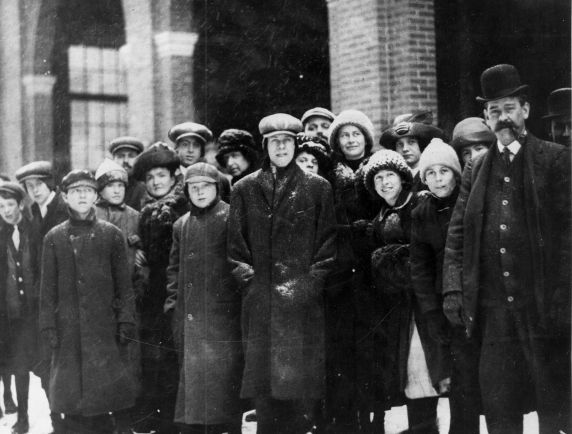 |
| Faces of the Lawrence Strikers--mostly women and children--in the biter cold on a mass picket outside one of the the great mills. |
Note: Adapted
from earlier posts, but this story can never be told often enough
The Lawrence Textile Strike began when thousands of workers, skilled
and unskilled alike walked off their jobs on January 11, 1912. Two months later one of the largest employers
in the city caved into the demands of mere women, children, and
immigrants. One by one over the next
couple of weeks the others fell into line.
Something astonishing had happened, something, dare we say it, revolutionary.
Lawrence was founded in 1845 to take
advantage of water power of the Merrimack
River in Massachusetts by Abbott Lawrence, a wealthy Unitarian from Boston who built the first woolen textile mill there. He was soon
joined by others of his class. Within
decades the river was lined with massive mills which produced much of the
nation’s cloth.
Originally Lawrence and the others
imported skilled craftsmen from England and
Scotland to build, maintain and set
up the complex machines. But cheap,
unskilled hands were needed to tend them and keep them operating. That labor at first was recruited from the
young women of New England, mostly
the daughters of famers and working men.
They were housed in clean dormitories and their “moral character” was
well attended to. The wages were
considered fair—enough to send home to help the family and still save for a
self-earned dowry to start off a married life.
Most of the girls—they usually entered the mills at 16—worked for five
years or so and then left to start families.
But beginning with the Civil War, this system was unable to
supply enough workers for burgeoning demand.
Mill owners also found the altruism of uplifting young women less
appealing than maximizing profits by seeking cheaper sources of labor. That labor would soon be found in the flood
of immigrants in the later 19th Century,
mostly from south and Eastern Europe.
By 1900 the Town of Lawrence and its neighbors was teeming with Italian, Slavic, Hungarian, Portuguese and Syrian immigrants who made up most of the unskilled workforce. The mills employed not only the men, but
their children, as young as eight, and their women. Half of the workers at the four giant American Textile mills were girls
between 14 and 18.
Gone were the tidy dorms of
old. In their place were tenements and
virtual shanty towns. Twelve and
fourteen hour days, six days a week in lint filled air around dangerous moving machinery
meant that 36% of mill workers died by the time they were 25 years old.
If there was a hell on earth,
Lawrence may have been it. The bosses
knew they were sitting on a powder keg, but depended on keeping their workers
divided by nationality, religion, and
sex to prevent wide spread labor trouble.
Native Yankees, English, Scottish, Irish
(mostly Scots-Irish Protestants),
and Germans dominated the skilled
trades. Many of them belonged to three
local unions of the A.F.L.'s United
Textile Workers, but only about 208 of these were in good standing in
1912. Various unskilled jobs were
divided by ethnicity.
By 1905 the mills employed over
40,000 workers. The introduction of the two loom system in the cotton mills, in which a single worker
had to attend two machines, sped up work, made it more dangerous and held costs
down. Real wages began to be cut. The average wage in the industry by 1911,
including skilled workers, foremen, and office workers was only $8.76 for a
work week of up to 56 hours a week. The
vast majority of unskilled workers made barely half of that.
Conditions were becoming a public
scandal. Do-gooders were
demanding reform. Responding to public pressure, the Massachusetts legislature
passed a law limiting the work week to 54 hours for women and children
effective on January 1, 1912. But the
law did not guarantee the same wages as the longer work week, which were barely
enough to live on as it was.
Beginning in December, mill
operators began to speed up the machines to make sure production remained at
the same levels as before. Then they
unilaterally decreed that male workers would also be limited to the 52 hour
week.
The Industrial Workers of the World (IWW) had been organizing among the unskilled workers of Lawrence
since 1907. Like the AFL locals, it had
relatively few dues paying members in 1912—maybe 800 or so. Most workers simply could not afford even the
modest dues charged by the IWW Textile Workers Union. But unlike the AFL, the IWW had organized
with language sections for each major ethnic group. Newspapers, pamphlets, and leaflets were
circulated by the IWW in French, Spanish, Italian, Portuguese, Polish, and
Hungarian. Some material was available
in Arabic for the Syrians and in Yiddish for the relatively small numbers
of Eastern European Jews. Meeting conducted in these languages included
not only paid up members, but all who were interested.
The small English language section
of the IWW often represented all language groups in communicating with the
bosses and authorities. It drafted a
letter to the President of American Woolen Company demanding to know if wages
would be reduced when the reduced hours went into effect. When they got no response, all IWW language
groups were alerted to be prepared for cuts.
When Polish women workers at the Everett Company mills discovered their
pay packets short by 32 cents on January 11, they dropped their tools and
walked out with shouts of “Short Pay! Short Pay!” Other workers followed. The next day the strike spread to the most of
the other mills.
Late on the afternoon a mass meeting
was held in the Franco-Belgian
hall. Although the strike had not been
called by the IWW, most of the workers were aware of the radical union and
sympathetic to it. They knew they could
not count on the support of the AFL, which had instructed its members to stay
on the job. The meeting resolved to send
a telegram to Joseph Ettor, an IWW
organizer, editor, General Executive
Board member in New York. Ettor had
earned a reputation leading one of the first great IWW strikes, the 1909 strike
against the Pressed Steel Car Company
in McKees Rocks, Pennsylvania. Most importantly, Ettor
had experience working with foreign born workers and could speak Italian and
Polish fluently and get by in Hungarian and Yiddish.
Upon speedy arrival, Ettor quickly helped
organize the chaotic walk-out into a well disciplined strike. Mass meetings were held in the morning and
late afternoon to plot strategy and formulate demands. Those demand eventually included a 15 percent
wages boost for a 54 hour work week, double time for overtime work, and no
discrimination against any workers for their strike participation. Mass pickets, the first ever seen in
Lawrence, began in front of all of the mills.
Even most of the AFL men now came out.
Despite an AFL attempt to wrest
leadership from the IWW, the strikers had confidence only in Ettor and the One Big Union.
The mayor of Lawrence called out a
local Militia company to support
police against the picketers. The Fire Department turned their hoses on
strikers in the sub-freezing January temperatures. 33 picketers were promptly arrested and
quickly sentenced by a local magistrate to a year in jail.
From the beginning, the Boston press
raged against the strikers and called for severe measures against them. The leading clergymen of Boston, Unitarian
and Congregationalist alike echoed
the sentiments. The Governor ordered out
the State Police and more units of
Militia. That included a company of Harvard students, including the sons of
the Unitarian Brahmin elite, who were among the most eager to “have at” the
strikers.
Another leading Italian, Arturo Giovannitti, editor of the Italian Socialist Federation paper Il
Prolitorio arrived to bolster IWW strike leadership. Giovannitti went
to work organizing strike kitchens and relief and sending off furious letters
pleading for support and money to Socialist ethnic federations and IWW locals
alike.
In the early weeks of the strike, it
held firm against daily assaults on the picket lines and harassment by troops
and police. Giovannitti’s relief efforts
set up medical clinics staffed by sympathetic doctors, minimal strike pay, and
food rations.
Observers like labor reporter Mary Heaton Vorse noted that the
strikers seemed almost gay, “always marching and singing. The tired, gray
crowds ebbing and flowing perpetually into the mills had waked and opened their
months to sing.”
Early in the strike local police
found dynamite in three locations,
including a shoemakers shop next to the print shop Ettor used as his mailing
address. The Boston American actually reported the story before the
explosives were supposedly located.
Despite efforts to tie Ettor and strike leaders to it, a local school
board member was eventually arrested and charged with planting the dynamite in
an effort to discredit the strikers.
On January 29 Ettor led one of the
largest marches yet through the center of the Lawrence business district. Before the march he addressed the workers and
urged them to avoid violence at any cost.
When the Militia blocked a main road, Ettor simply steered the marchers
onto side streets to avoid a confrontation.
Later that afternoon as Ettor and Giovannitti addressed a regular strike
meeting, a young woman, Anna LoPizzo
was shot and killed during a police charge on a regular picket line. Witnesses saw a police officer fire the shot.
Despite this Ettor and Giovannitti
were arrested and charged in LoPizzo’s murder.
They were held without bail. In
April they were joined by a local striker, Joseph
Caruso, who police alleged actually fired the shot that killed her.
Marshall Law was declared and all
public meetings and marches officially banned.
The governor called out 22 more Militia companies. Two days later a 15 year old Syrian boy was
bayoneted to death.
If Authorities thought jailing the
leaders would end the strike, they were mistaken. The IWW General
Secretary Treasurer, the legendary Big
Bill Heywood himself, arrived. He
brought with him veteran unionist William
Trautman and a slip of an 18 year old Irish girl, Elizabeth Gurly Flynn already noted for her fiery oratory. Her work in Lawrence would catapult her to
fame. She would be memorialized by IWW
troubadour Joe Hill himself as the
original Rebel Girl. A few days later the Italian anarcho-syndicalist Carlo Tresca arrived to bolster the IWW
team.
15,000 strikers met Heywood and
company at the railway station and conducted illegal parade to Lawrence Common where they all gave
rousing speeches. In all of his
addresses Heywood counseled peaceful resistance and against violence. He also determined to demonstrate the
strikers’ patriotism for their adopted nation by making sure that they carried
plenty of American Flags. The most widely circulated photograph of
the strike shows Militia with leveled bayonets at massed flag carrying strikers.
Women and girls represented more
than half of all of the strikers. They
often took the lead on picket lines and were creative in their actions. One parade of women was led by a large
placard reading, “We Want Bread but We Want Roses Too!” The women probably were inspired by the poem
by James Oppenheim that was
published in December 1911 in The American Magazine, although
popular mythology has it that the strike inspired the poem which was set to
music by Caroline Kohlsaat a few
years later and became an IWW and later feminist classic.
The turning point of the strike came
when strike leaders decided to send children of strikers to be safely cared for
by IWW members and supporters in New
York. Margaret Sanger, a volunteer
nurse, accompanied the first 120 children to the city on February 10. Their train was met by thousands of members
of the Italian Socialist Federation and the Socialist Party who escorted them through the streets singing The
Internationale and Les Marsaillaise. A second group of 90 children received a
similar welcome a few weeks later. The
image of the half starved children dressed in tatters against the winter chill
helped swing public sentiment away from the mill owners and to the
strikers. Alarmed, Lawrence officials
announced that no more children would be allowed to leave town.
On February 24 150 children escorted
by their mothers attempted to board a train to take them to supporters in Philadelphia. Local police and three companies of
Militia charged the orderly line beating the women and children
indiscriminately. They tried to tear
children from their mothers. Dozens of
women and many children were thrown into the backs of Militia trucks where they
continued to be beaten. Thirty of the
women, most of them seriously injured were jailed. Children were removed from the custody of
their parents. The attack was observed
by several reporters and was soon widely publicized.
Public outrage at the brutality erased
most support for the bosses. Wisconsin Socialist Congressman Victor Berger and Democrat William Wilson from
Pennsylvania demanded a Congressional investigation, which got under way in
March. Public testimony by child workers
to the inhumane conditions of the mills stirred the conscience of the
Country.
At the urging of his wife, who
attended the hearings, President William
Howard Taft announced a nationwide investigation into conditions at
industrial plants across the country.
There was talk of stripping the mills of the heavy tariff protections that kept the companies competitive with
European producers.
On March 12 the American Woolen
Company acceded to all of the strikers’ demands. By the end of the month even the most
recalcitrant owners had fallen into line.
The great Lawrence Strike ended with an unprecedented total victory for
the strikers and huge prestige for the IWW.
There were still loose ends. Ettor, Giovannitti, and Caruso remained in
jail and no trial date seemed to be coming.
Ettor read voraciously, making a study of the philosophy of
organization. The theatrical Giovannitti
staged daily readings from Shakespeare and European poets for the entertainment
of fellow prisoners and guards alike.
Heywood threatened a general strike unless they were released and the
IWW organized its General Defense
Committee to raise funds for their legal team and to support their
families.
$600,000 was raised, mostly in
nickels and dime donations and inexpensive dues and assessment stamps in GDC membership
books. Mass rallies in New York City and
Boston addressed by Heywood and Flynn drew thousands.
In August Ernest Pitman, a Lawrence contractor who had built the Wood mill of
the American Woolen Company, confessed to a district attorney that the dynamite
frame-up had been planned in the Boston offices of Lawrence textile
corporations. Pitman committed suicide shortly after he was served papers
ordering him to appear and testify before a grand jury. American Wool Chairman William Wood was eventually cleared of charges against him—only
because Pitman was dead.
On September 30 Lawrence workers
went out on a one day demonstration
strike after John Breen, the local
man who tried to frame union leadership by planting dynamite was released with
just a $500 fine. Thousands of other
workers at mills in nearby towns joined them.
An attempt to organize a counter
demonstration by “Loyal Americans” wearing little American flags as
boutonnieres largely fizzled. But it was
memorialized as heroic by the Lawrence establishment and “re-enacted by schools
and civic organization during the 50th and 75th anniversaries of the strike
during which the IWW was denounced as “the Red blight.” Last year for the centennial, however, with
much new research published on the strike, the workers and even the IWW got the
attention and respect they deserved.
Despite this authorities pressed on
with the murder trial of the Italians, which began in Salem at the end of the
Month. It dragged on for two
months. The highlight of the trial was a
long speech by Giovannitti, the first he ever gave in English that was so eloquent that it drove
hardened reporters to tears.
On November 12, to almost no one’s
surprise all three defendants were acquitted and released.
By the end of the year the IWW local
in Lawrence had grown to 10,000 members.
But the union had a hard time sustaining that over the long haul. A depression later in the decade threw many
out of work and experienced IWW unionists turned their attention to other
battle grounds. Within four years only 400 dues payers remained, although the
influence of the union continued to extend well beyond its reduced membership.
Subscribe to:
Posts (Atom)