Showing posts with label war crimes. Show all posts

Friday, October 14, 2022

Sobibór Death Camp and a Case of Impossible Resistance and Escape

A rare photo of the Sobibór camp--a vest pocket operation compared to the industrial scale of the Auschwitz camps, but ruthlessly efficient.

It has always chapped my ass to hear people who don’t know what the hell they are talking about wonder aloud about why “there was no resistance” when the Nazis rounded up Jews and other “undesirables” or in the labor and extermination camps.  First, it is another example of blaming the victim, that always popular parlor game.  And secondly it doesn’t take into account the information that Jews had—early on even they could not imagine industrial scale murder and genocide, a term that had not yet even been conceived—or the overwhelming, highly organized force arrayed against them.  These comments come most prominently, but not exclusively, from right wingers who want to promote an armed-to-the-teeth citizenry to resist jack booted thugs and who think concentration camp escapes could be played out like in The Great Escape and other movies.

In fact, many Jews who were able attempted to escape.  Others famously went into hiding, and some joined or created resistance unitsIndividuals committed—and were executed for, often along with family or community members—attacks on Nazi police, troops, and local collaborators.  There were famously organized uprisings in Warsaw and other ghettos

But most Jews swept up in the machinery of death were unprepared, confused, and needed to be protective of family.  Once in the camps those not immediately killed were worked nearly to death, starved, frozen, and subject to disease and within weeks were too physically weakened to resist.

There were at least three attempts at mass breakouts from the camps—at Treblinka on August 2, 1943 and at Auschwitz-Birkenau on October 7, 1944 which included an uprising which resulted in one of the crematoriums being blown up.  In those two cases almost all the attempted escapees were killed.  But on October 14, 1943, about 600 prisoners tried to escape from the Sobibór camp in eastern Poland.  About half got beyond the wire and about 50 survived to the end of the war.  This is their story.

Sobibór was a village in a sparsely populated region of eastern Poland.  The Nazis had established 18 labor camps in the region.  The new camp near the village was constructed in the spring of 1942 to receive Jews from Poland, France, Germany, the Netherlands, Czechoslovakia, the Soviet Union, and Soviet POWs and to screen them for assignment to the labor camps—and to quickly dispose of those deemed unsuitable or unusable.  Fewer than 1,000 inmates were held there at any time.  Many of those selected for the labor camps were there for only hours or days.  The life expectancy of the rejects was days or short weeks.

S.S. officers and a railroad official at the Sobibór railway station where incoming prisoners were quickly sorted out--and many immediately shot.

The camp was mostly built by local villagers and a Sonderkommando, a group of about eighty Jews from ghettos in the vicinity of the camp guarded by a squad of Ukrainians trained at Trawniki.  Upon completion of construction, these Jews were shot.  The gas chambers at the new camp were hooked up to large internal combustion engines which pumped in carbon monoxide rich exhaust to smother the victims.  Similar technology had been used on a smaller scale with closed busses, but this was the first major application on a large scale.  The chambers were tested in April on twenty-five Jews from Krychów who were satisfactorily asphyxiated.  After that the camp went into full operation and the nearby rail platform became a busy place.

To give an idea of how efficient the operation was, it was active from May 1942 to October 1943 when it was closed and replaced by larger and more modern camps.  But in less than 18 months at least 200,000 and perhaps as many as 250,000 men, women, and children were murdered there, the vast majority of them Jews.

Sobibór is shown in relation to major German death camps on this map showing today's borders.  Many guards were recruited from neighboring Ukraine where antisemitism ran high along with anti-Soviet feeling.

Jews from Poland and the USSR knew what was going to happen to them.  They arrived in packed freight cars often hysterical with fear and grief.  Many were shot on the platform when they did not respond quickly to orders.  On the other hand, at least in the early going Jews from Western Europe arrived in overcrowded passenger coaches.  They had been assured that they were going to labor camps and were allowed to bring some luggage.  Their own doctors and nurses were allowed to attend the ill in transitFood and water during the journey were at least adequate.  These folks received the shock of a lifetime arriving on the same platform.  Because many were in better health than Eastern Jews, able bodied men and women were often separated immediately from their families and sent to the work camps even before they entered Sobibór.

Attractive young women and girls were often singled out and sent to the secluded forester house run as a brothel for the camp’s SS contingent Post war trials highlighted the experience of two Austrian actresses, Ruth and Gisela who were gang raped there over a period of days before being taken outside and shot.  Others befell the same fate.

Some prisoners were held at the camp for longer periods as laborers including attending the gas chambers and crematoria.  Some were assigned, under heavy guard, to wood cutting beyond the camp wire for fuel for the crematoria pyres.  From time to time, one would melt away into the forest and make an escape.  Some of those who did managed to find and join resistance units operating from the nearby wilderness.

In the spring and summer of 1943 rumors began to circulate in the camp that it was to be shut down.  This was based on a reduction in the numbers of incoming prisoners.  In actuality, this was due to new camps being opened.  At this point SS officials actually had plans to expand Sobibór.  Fear of what might happen to them seemed confirmed when survivors of the Bełżec camp, one of the first extermination camps on Polish soil, was closed, arrived at the Sobibór rail station only to be immediately shot in mass.

Polish Jews on some of the labor gangs began to organize an escape committee by late summer.  They knew that they would have to act quickly before it inevitably became their turn in the gas chambers.  In September several Jewish Red Army prisoners from Minsk arrived.  Although there was initial distrust between the Poles and the Soviets, several of the POWs joined the plot and provided some military experience and leadership

The plan was brutal in its simplicity.  On signal, prisoners would overpower and kill all of the SS men and Ukrainian guards in the camp, using hidden homemade weapons and then taking the arms of the Nazis.  They would go from barracks to barracks liberating the inmates and march out the front gates.  The Soviets and those who wished to join them would head east to try to link up with Russian troops.  Others would scatter and make their way as best they could.

The two main leaders of the Sobibór uprising--Red Army Lt. Alexander Pechersky and Polish Jew Leon Feldhendler.

On October 14, 1943 under the leadership of Polish prisoner Leon Feldhendler and Soviet POW Alexander Pechersky they quickly managed to quietly overcome and kill 11 SS men and unknown number of guards.  But they were discovered, and the alarm went out. Under intense fire inmates ran for their lives scrambling over, under and through the fences as they were able.  About 300 out of the 600 prisoners in the camp made it out, but they had lost cohesion.

158 inmates were killed by the guards during the escape attempt or died in the minefield surrounding the camp.  107 others were captured over the next few days as SS troops, guards, and police swept the woods.  All were immediately executed.   Of the remaining survivors 53 died of other causes before the end of the war—many of starvation, freezing to death, or illness as they hid out in the forests.   About 50 eluded capture, made it to Soviet lines, and survived the war.

Sobibór survivors at the end of the war.  Leon Feldhendler top right.

After the uprising a furious Heinrich Himmler ordered the remaining prisoners killed, the camp closed, dismantled, and the ground planted with trees.  The gas chambers and crematoria were destroyed, buried, and covered over with an asphalt roadway.  They were rediscovered in archeological excavations in 2012.   

The site of the camp is now Polish historic site.  Monuments on the grounds and at the railway station and a small museum commemorate the dead and the uprising.  The Dutch, who lost more than 36,000 citizens at Sobibór famously including Helena ‘Lea’ Nordheim the Jewish Gold Medal womens gymnasts from the 1928 Olympics and the team’s coach, Gerrit Kleerekoper have contributed funds to the upkeep and maintenance of the site as well as newly installed signage.

A memorial at the site of the Sobibór camp now a Polish historical site was partially built and is maintained by the Dutch who lost 36,000 citizens in the camp.

After the war SS commandants, officers, and guards were tried for war crimes.  One of the most celebrated cases took years.  John Demjanjuk had been a Ukrainian POW when he was recruited along with many others as a camp guard.  He was trained at the Trawniki concentration camp.  He served as a tower guard at Sobibór.  And would have been among those who opened fire at the fleeing escapees.  After the war Demjanjuk made his way to the United States as a displaced person.  He became an American citizen, married, and raised a family, settled in a suburb of Cleveland where he worked as a mechanic at a Ford plant.

In 1975 Demjanjuk was finally identified as a Ukrainian collaborator and his Nazi ID from Trawniki turned over the Justice Department, which began deportation proceedings against him two years later.  He fought his deportation for years, claiming at first that he was misidentified, and later that he was a guard but had taken no part in executions or shootings.  Israel issued an extradition request for him in 1983 and he was deported to trial there in 1986.  Despite controversy over the authenticity of the SS identification card and other issues, on April 18, 1988 Demjanjuk was convicted in the Israeli court of being the notorious guard known to prisoners as Ivan the Terrible.  He was sentenced to death.

                                        An undisputed photo of John Demjanjuk in his guard uniform.

After serving more than 5 years in solitary confinement during appeals, the Israeli Supreme Court overturned the conviction on the grounds of new evidence that identified the real Ivan the Terrible as another Ukrainian, Ivan Marchenko.

Demjanjuk was released to return to the United States. In 1993, the Sixth Circuit Court of Appeals ruled that he was a victim of fraud on the court, as lawyers with the Office of Special Investigations had recklessly failed to disclose evidence. In a report submitted to the Sixth Circuit prior to the Israeli acquittal, Federal Judge Thomas A. Wiseman, Jr. concluded that Federal officials had erred in asserting that Demjanjuk was Ivan the Terrible, but that evidence instead pointed to Demjanjuk playing a lesser role as an SS guard. After the Court of Appeals remanded the matter to Judge Wiseman, Judge Wiseman dismissed a denaturalization petition in 1998, effectively restoring Demjanjuk’s citizenship.

In 1999 the government filed a new civil complaint against Demjanjuk asking again for denaturalization on the grounds that he was a guard at the Sobibór and Majdanek camps in Poland under German occupation and at the Flossenburg camp in Germany. It also accused Demjanjuk of being a member of an SS-run unit that took part in capturing nearly two million Jews in the General Government of Poland.  In a new trial in 2002 he was again stripped of citizenship.  He lost an appeal in 2004 and the U.S. Supreme Court declined to hear the case.

In December 2005 an immigration judge ordered Demjanjuk’s deportation to Germany, Poland, or the Ukraine. He sought protection under the United Nations Convention Against Torture, claiming that he would be prosecuted and tortured if he were deported to Ukraine. Chief U.S. Immigration Judge Michael Creppy ruled there was no evidence to substantiate Demjanjuk’s claim.

Demjanjuk lost more appeals in his lengthy battles, finally exhausting them all.  Then Germany served extradition papers seeking custody of him.  Finally, after another round of appeals seeking relief from the extradition, Demjanjuk was finally deported on May 11, 2009.

Aged and infirm John Demjanjuk sat for an ID photo in German custody after his trial and conviction.

On July 13 prosecutors charged him with 27,900 counts of accessory to murder.  The aging and ill man could only briefly attend court sessions each day and his lawyers asserted that due to the complexity of the case it would take up to five years to try the case.  They ask that the case be dismissed due to his age, infirmity, and unlikelihood that he would survive the trial.  Then the Ukrainian government interceded on his behalf arguing for mercy.  None the less, the trial got underway in November.

On May 12, 2011, Demjanjuk, then 91, was convicted and sentenced to five years in prison.  He was released pending appeal and died in a German nursing home on March 17, 2012.  The German high court then invalidated the conviction since the appeal could not be heard.

Justice ground slowly for the accused guard.  It ground not at all for the dead of Sobibór.

                                Escape from Sobibor was a 1887 made for TV movie starring Rutger Haure and Alan Arkin.

In 1987 Escape from Sobibor was filmed as a British made-for-TV movie starring Rutger Hauer and Alan Arkin which was also shown on CBS TV in the United States.  Hauer won a Golden Globe for his portrayal of Soviet POW leader Lieutenant Aleksandr Pechersky.


Saturday, October 14, 2017

Sobibór Death Camp—The Case of “Impossible” Resistance and Escape

A rare photo of the Sobibór camp--a vest pocket operation compared to the industrial scale of the Auschwitz camps, but ruthlessly efficient.


Note:  When a version of this entry ran in this blog back in 2014 it elicited a furious and verbose response from outraged Poles and/or Polish Americans.  Although it was clear in the article that I was discussing Nazi German operated concentration and death camps located in occupied Poland and there were no disputes to the accuracy of my accounts, in paragraph 11 I made one passing reference to “one of the first Polish extermination camps.”  That was evidently an unforgivable offence to Polish national honor.  In their lengthy complaints all commentators, whose complaints I duly posted pointed out that there were no Polish camps because the camps were built and operated by Germans, not Poles.  Fair enough.  In the revised text below the offending passage has been amended,  But this has not been the first time I have aroused the indignation of some Poles, who evidently spend hours a day surfing the internet to find any possible insult to the national honor.  And there is evidently an organized campaign of such monitors to squelch any indignities.  A few years ago an entry on the Warsaw Ghetto uprising drew comments because it was thought not to be respectful of the Polish Resistance in some way that was never clear to me—the very real and brave Polish Resistance was simply not the topic at hand.  And way back before I had a blog, and possibly even before I had a computer, a long, comic poem that I wrote about a very real and historically verifiable deal between Black and Polish politicians in Illinois which led to the recognition of both the Martin Luther King and Pulaski Day holidays in the state was published in the “Poets Corner” section of my local newspaper in the Northwest Chicago boonies.  That drew a five page long, single spaced, marginless epistle excoriating me for dishonoring the noble Father of the American Cavalry and for my supposed self-evident anti-Polish bigotry.  Sigh. I imagine this introduction will not make those industrious critics happy either.

It has always chapped my ass to hear people who don’t know what the hell they are talking about wonder aloud about why “there was no resistance” when the Nazis rounded up Jews and other “undesirables” or in the labor or extermination camps.  First it is another example of blaming the victim, that always popular parlor game.  And secondly it doesn’t take into account the information that Jews had—early on even they could not imagine industrial scale murder and genocide, a term that had not yet even been conceived—or the overwhelming, highly organized force arrayed against them.  These comments come most prominently, but not exclusively, from right wingers who want to promote an armed-to-the-teeth citizenry to resist jack booted thugs and who think concentration camp escapes could be played out like in The Great Escape and other movies.

In fact many Jews who were able attempted to escape.  Others famously went into hiding, and some joined or created resistance units.  Individuals committed—and were executed for, often along with family or community members—attacks on Nazi police, troops, and local collaborators.  There were famously organized uprisings in Warsaw and other ghettos. 

But most Jews swept up in the machinery of death were unprepared, confused, and needed to be protective of family.  Once in the camps those not immediately killed were worked nearly to death, starved, frozen, and subject to disease and within weeks too physically weakened to resist.

There were at least three attempts at mass breakouts from the camps—at Treblinka on August 2, 1943 and at Auschwitz-Birkenau on October 7, 1944 which included an uprising which resulted in one of the crematoriums being blown up.  In those two cases almost all of the attempted escapees were killed.  But on October 14, 1943, about 600 prisoners tried to escape from the Sobibór camp in eastern Poland.  About half got beyond the wire and about 50 survived to the end of the war.  This is their story.

Sobibór was a village in a sparsely populated region of eastern Poland.  The Nazis had established 18 labor camps in the region.  The new camp near the village was constructed in the spring of 1942 to receive Jews from Poland, France, Germany, the Netherlands, Czechoslovakia, the Soviet Union, and Soviet POWs and to screen them for assignment to the labor camps—and to quickly dispose of those deemed unsuitable or unusable.  Fewer than 1,000 inmates were held there at any time.  Many of those selected for the labor camps were there for only hours or days.  The life expectancy of the rejects was days or short weeks.

S.S. officers and a railroad official at the Sobibór railway station where incoming prisoners were quickly sorted out--and many immediately shot.

The camp was largely built by local villagers and a Sonderkommando, a group of about eighty Jews from ghettos in the vicinity of the camp guarded by a squad of Ukrainians trained at Trawniki.  Upon completion of construction, these Jews were shot.  The gas chambers at the new camp were hooked up to large internal combustion engines which pumped in carbon monoxide rich exhaust to smother the victims.  Similar technology had been used on a smaller scale with closed busses, but this was the first major application on a large scale.  The chambers were tested in April on twenty-five Jews from Krychów who were satisfactorily asphyxiated.  After that the camp went into full operation and the nearby rail platform became a busy place.

To give an idea of how efficient the operation was, it was active from May 1942 to October 1943 when it was closed and replaced by larger and more modern camps.  But in less than 18 months at least 200,000 and perhaps as many as 250,000 men, women, and children were murdered there, the vast majority of them Jews.

Jews from Poland and the USSR knew what was going to happen to them.  They arrived in packed freight cars often hysterical with fear and grief.  Many were shot on the platform when they did not respond quickly to orders.  On the other hand at least in the early going Jews from Western Europe arrived in overcrowded passenger coaches.  They had been assured that they were going to labor camps and were allowed to bring some luggage.  Their own doctors and nurses were allowed to attend the ill in transit.  Food and water during the journey were at least adequate.  These folks received the shock of a life time arriving on the same platform.  Because many were in better health than Eastern Jews, able bodied men and women were often separated immediately from their families and sent to the work camps even before they entered Sobibór.

Attractive young women and girls were often singled out and sent to the secluded forester house run as a brothel for the camp’s SS contingent.  Post war trials highlighted the experience of two Austrian actresses, Ruth and Gisela who were gang raped there over a period of days before being taken outside and shot.  Other befell the same fate.
 
Some prisoners were held at the camp for longer periods as laborers including attending the gas chambers and crematoria.  Some were assigned, under heavy guard, to wood cutting beyond the camp wire for fuel for the crematoria pyres.  From time to time one would melt away into the forest and make an escape.  Some of those who did managed to find and join resistance units operating from the near wilderness.
 
In the spring and summer of 1943 rumors began to circulate in the camp that it was to be shut down.  This was based on a reduction in the numbers of incoming prisoners.  In actuality this was due to new camps being opened.  At this point SS officials actually had plans to expand Sobibór.  Fears of what might happen to them seemed confirmed when survivors of the Bełżec camp, one of the first extermination camps on Polish soil, was closed, arrived at the Sobibór rail station only to be immediately shot in mass.

Sobibór is shown in relation to major German death camps on this map showing today's borders.  Many guards were recruited from neighboring Ukraine where antisemitism ran high along with anti-Soviet feeling.

Polish Jews on some of the labor gangs began to organize an escape committee by late summer.  They knew that they would have to act relatively quickly before it inevitably became their turn in the gas chambers.  In September several Jewish Red Army prisoners from Minsk arrived.  Although there was initial distrust between the Poles and the Soviets, several of the POWs joined the plot and provided some military experience and leadership. 

The plan was brutal in its simplicity.  On signal, prisoners would overpower and kill all of the SS men and Ukrainian guards in the camp, using hidden homemade weapons and then taking the arms of the Nazis.  They would go from barracks to barracks liberating the inmates and march out the front gates.  The Soviets and those who wished to join them would head east to try to link up with Russian troops.  Others would scatter and make their way as best they could.

The two main leaders of the Sobibór uprising--Red Army Lt. Alexander Pechersky and Polish Jew Leon Feldhendler.
On October 14, 1943 under the leadership of Polish prisoner Leon Feldhendler and Soviet POW Alexander Pechersky they quickly managed to quietly overcome and kill 11 SS men and unknown number of guards.  But they were discovered and the alarm went out. Under intense fire inmates ran for their lives scrambling over, under and through the fences as they were able.  About 300 out of the 600 prisoners in the camp made it out, but they had lost cohesion.

158 inmates were killed by the guards during the escape attempt or died in the minefield surrounding the camp.  107 others were captured over the next few days as SS troops, guards, and police swept the woods.  All were immediately executed.   Of the remaining survivors 53 died of other causes before the end of the war—many of starvation, freezing to death, or illness as they hid out in the forests.   About 50 eluded capture, made it to Soviet lines, and survived the war.

Sobibór survivors at the end of the war.
 
After the uprising a furious Heinrich Himmler ordered the remaining prisoners killed, the camp closed, dismantled, and the ground planted with trees.  The gas chambers and crematoria were destroyed, buried, and covered over with an asphalt road way.  They were rediscovered in archeological excavations in 2012.   

The site of the camp is now Polish historic site.  Monuments on the grounds and at the railway station and a small museum commemorate the dead and the uprising.  The Dutch, who lost more than 36,000 citizens at Sobibór famously including Helena ‘Lea’ Nordheim the Jewish Gold Medal women’s gymnasts from the 1928 Olympics  and the team’s coach, Gerrit Kleerekoper have contributed funds to the upkeep and maintenance of the site as well as newly installed signage.

A memorial at the site of the Sobibór camp now a Polish historical site was partially built and is maintained by the Dutch who lost 36,000 citizens in the camp.

After the war SS commandants, officers, and guards were tried for war crimes.  One of the most celebrated cases took years.  John Demjanjuk had been a Ukrainian POW when he was recruited along with many others as a camp guard.  He was trained at the Trawniki concentration camp.  He served as a tower guard at Sobibór.  And would have been among those who opened fire at the fleeing escapees.  After the war Demjanjuk made his way to the United States as a displaced person.  He became an American citizen, married and raised a family, settled in a suburb of Cleveland where he worked as a mechanic at a Ford plant.

In 1975 Demjanjuk was finally identified as a Ukrainian collaborator and his Nazi ID from Trawniki turned over the Justice Department, which began deportation proceedings against him two years later.  He fought his deportation for years, claiming at first that he was misidentified, and later that he was a guard but had taken no part in executions or shootings.  Israel issued an extradition request for him in 1983 and he was deported to trial there in 1986.  Despite controversy over the authenticity of the SS identification card and other issues, on April 18, 1988 Demjanjuk was convicted in the Israeli court of being the notorious guard known to prisoners as Ivan the Terrible.  He was sentenced to death.

An undisputed photo of John Demjanjuk in his guard uniform.

After serving more than 5 years in solitary confinement during appeals, the Israeli Supreme Court overturned the conviction on the grounds of new evidence that identified the real identified Ivan the Terrible as another Ukrainian, Ivan Marchenko.

Demjanjuk was released to return to the United States. In 1993, the Sixth Circuit Court of Appeals ruled that he was a victim of fraud on the court, as lawyers with the Office of Special Investigations had recklessly failed to disclose evidence. In a report submitted to the Sixth Circuit prior to the Israeli acquittal, Federal Judge Thomas A. Wiseman, Jr. concluded that American federal officials had erred in asserting that Demjanjuk was Ivan the Terrible, but that evidence instead pointed to Demjanjuk playing  a lesser role as an SS guard. After the Court of Appeals remanded the matter to Judge Wiseman, Judge Wiseman dismissed a denaturalization petition in 1998, effectively restoring Demjanjuk’s citizenship

In 1999 the government filed a new civil complaint against Demjanjuk asking again for denaturalization on the grounds that he was a guard at the Sobibór and Majdanek camps in Poland under German occupation and at the Flossenburg camp in Germany. It also accused Demjanjuk of being a member of an SS-run unit that took part in capturing nearly two million Jews in the General Government of Poland.  In a new trial in 2002 he was again stripped of citizenship.  He lost an appeal in 2004 and the U.S. Supreme Court declined to hear the case.

In December 2005 an immigration judge ordered Demjanjuk’s deportation to Germany, Poland, or the Ukraine. He sought protection under the United Nations Convention against Torture, claiming that he would be prosecuted and tortured if he were deported to Ukraine. Chief U.S. Immigration Judge Michael Creppy ruled there was no evidence to substantiate Demjanjuk's claim.

Demjanjuk lost more appeals in his lengthy battles, finally exhausting them all.  Then Germany served extradition papers seeking custody of him.  Finally after another round of appeals seeking relief from the extradition, Demjanjuk was finally deported on May 11, 2009. 

On July 13 prosecutors charged him with 27,900 counts of accessory to murder.  The aging and ill man could only briefly attend court sessions each day and his lawyers asserted that due to the complexity of the case it would take up to five years to try the case.  They ask that the case be dismissed due to his age, infirmity, and unlikelihood that he would survive the trial.  Then the Ukrainian government interceded on his behalf arguing for mercy.  None the less the trial got underway in November.

Aged and infirm John Demjanjuk sat for an ID photo in German custody after his trial and conviction.

On May 12, 2011, Demjanjuk, then 91, was convicted as an accessory to the murder of 27,900 Jews and sentenced to five years in prison.  He was released pending appeal and died in a German nursing home on March 17, 2012.  The German high court then invalidated the conviction since the appeal could not be heard.

Justice ground slowly for the accused guard.  It ground not at all for the dead of Sobibór.

In 1987 Escape from Sobibor was filmed as a British made-for-TV movie starring Rutger Hauer and Alan Arkin which was also shown on CBS TV in the United States.  Hauer won a Golden Globe for his portrayal of Soviet POW leader Lieutenant Aleksandr Pechersky.


Friday, September 30, 2011

The Horror, The Horror—Babi Yar

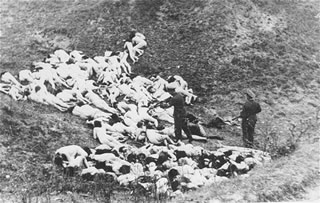
Women executed at Babi YaR
Seventy years ago on September 29 and 30, 1941 most of the Jews of the Ukrainian capital of Kiev were transported to an isolated ravine named Babi Yar.   

Over the course of those two days we know by the meticulous records kept by the Nazis that 33,771 men, women, and children were shot and killed.  It was the greatest mass execution of the Holocaust and as far as anyone has been able to determine the perhaps biggest single mass execution in all of history.

The Germans occupied Kiev on September 19.  Within days the Nazi military governor, Major General Kurt Eberhard decided to eradicate the Jews of Kiev in retribution to partisan attacks on German soldiers. On September 25 posters were put up in the Jewish quarter commanding Jews to report with their baggage, papers, and valuables for deportation on the 29th on pain of death.

S.S. commanders ordered to carry out the planned execution estimated that about 6000 would voluntarily show up and that they would have to conduct raids to secure the rest.  But almost the entire population obeyed the order.  

The Jews assembled as ordered near the Jewish Cemetery.  They expected to be taken to rail yards for further transportation.  They were continually re-assured that everything would be fine. They were loaded in trucks and driven down a long corroder lined with German troops.  When unloaded they were told to strip all of their clothes.  One of the truck drivers described the scene:

…they had to remove their luggage, then their coats, shoes, and over garments and also underwear … Once undressed, they were led into the ravine which was about 150 meters long and 30 meters wide and a good 15 meters deep … When they reached the bottom of the ravine they were seized by members of the Schutzpolizei [battalions of ordinary German Police mobilized for service under the SS] and made to lie down on top of Jews who had already been shot … The corpses were literally in layers. A police marksman came along and shot each Jew in the neck with a submachine gun … I saw these marksmen stand on layers of corpses and shoot one after the other … The marksman would walk across the bodies of the executed Jews to the next Jew…
Units of Ukrainian collaborators also assisted the S.S. in maintaining order among the Jews as they were led to the slaughter.  Considering that the operation had to be conducted in such a primitive manor—as opposed the industrial gas chambers later in use—it was remarkably efficient.

The Babi Yar ravine continued to be an execution site as long as the Germans remained in the area.  Concentration camps were eventually constructed nearby.  Victims included not only more Jews rounded up from smaller cities and villages, but Roman (Gypsies), Soviet prisoners of war, occupants of mental hospitals, Communists, Ukrainian nationalists, and hostages of every sort.  Estimate run to 100,000 to 150,000 more executions in and around Babi Yar, most of them dumped in that seemingly bottomless ravine.

As Soviet forces closed in on the Germans in Kiev, they began systematically trying to destroy evidence of their crimes.  In August and September of 1943 about 300 chained prisoners from the nearby concentration camp were put to work exhuming bodies from the gorge.  The bodies were burned in makeshift crematoriums and the ashes scattered over surrounding farm land.  It is believed that up to 90% of the bodies were disposed of in this way.

The identities of most of the dead remain unknown.  Despite years of painstaking research Yad Vashem and other Jewish organizations has recorded the names of only around 3,000 Jews killed at those days Babi Yar and 10,000 killed in the area for the course of the war. 

Following the war, S.S. commanders were sentenced to death and long prison sentences for their part in the killings.

Several monuments to various victims of Babi Yar have been erected there forming a kind of memorial park.  The largest, a monumental statue to all Soviet Citizens and POWs killed, presumably including by not specifically mentioning the Jews, was erected in 1971.  On the 50th anniversary of the killings a large Menorah was erected to commemorate all of the Jewish victims killed there during the war.  It was damaged by vandals in 2006.  There are two large wooden crosses, one for 621 Ukrainian nationalists shot in 1942 and another for two Orthodox priests executed for spreading anti-German propaganda.  By a subway station a memorial to the children of Babi Yar was installed in  2001.  

As the horror story of the two days at Babi Yar got out, the mass murder gripped the attention of the public and of artists.  A censored version of the Russian/Ukrainian writer Anatoly Kuznetsov first hand memoirs, Babi Yar: A Document in the Form of a Novel was published in a Soviet literary magazine in 1956.  In 1971 Kuzetsov defected to Britain and brought out with him his original manuscript on film.  It was published 1970 under the pseudonym A. Anololi. Expurgated text was inserted in the original Russian version and highlighted in bold text.  The new edition became an international sensation.

The best known literary memorial is the one by Russian poet Yevgeny Yevtushenko.  In it he decried not only the original crime itself, but the Soviet policy of refusing to acknowledge that Jews were the special victims of the Nazis and its general encouragement of semi-official anti-Semitism.  Written in 1956, the poem circulated in the Soviet union via underground  Samizdat—copies, usually carbon-paper typescripts, surreptitiously passed hand to hand.  Copies also found their way to the West where the poem was translated and reprinted to lavish praise.  It was not until the beginning of the glasnost era that the poem was officially published in the USSR.  Yevtushenko developed an international reputation as a dissenter based on this and a 1961 poem denouncing the continuing vestiges of Stalinism.  But dissident writers who were imprisoned in the Gulag have charged him with making many compromises with authorities pointing out that he continued to be a member of the Communist Party and was protected by top leaders.  He only criticized what was safe to criticize, his critics said.

None the less Yevtushenko’s poem Babi Yar remains a powerful expression.  Another Soviet era artist, composer Dmitri Shostakovich, set the poem to music in a movement of his choral Symphony #13 which premiered in Moscow in 1961 during a brief period of internal liberalization under Nikita Khrushchev.

Here is Yevtushenko’s poem, written before the Soviet monument was erected:  


Babi Yar
By Yevgeny Yevtushenko,  Translated by Ben Okopnik

No monument stands over Babi Yar.
A steep cliff only, like the rudest headstone.
I am afraid.
Today, I am as old
As the entire Jewish race itself.

I see myself an ancient Israelite.
I wander o'er the roads of ancient Egypt
And here, upon the cross, I perish, tortured
And even now, I bear the marks of nails.

It seems to me that Dreyfus is myself.
The Philistines betrayed me - and now judge.
I'm in a cage. Surrounded and trapped,
I'm persecuted, spat on, slandered, and
The dainty dollies in their Brussels frills
Squeal, as they stab umbrellas at my face.

I see myself a boy in Belostok
Blood spills, and runs upon the floors,
The chiefs of bar and pub rage unimpeded
And reek of vodka and of onion, half and half.

I'm thrown back by a boot, I have no strength left,
In vain I beg the rabble of pogrom,
To jeers of "Kill the Jews, and save our Russia!"
My mother's being beaten by a clerk.

O, Russia of my heart, I know that you
Are international, by inner nature.
But often those whose hands are steeped in filth
Abused your purest name, in name of hatred.

I know the kindness of my native land.
How vile, that without the slightest quiver
The anti-Semites have proclaimed themselves
The “Union of the Russian People!”

It seems to me that I am Anna Frank,
Transparent, as the thinnest branch in April,
And I'm in love, and have no need of phrases,
But only that we gaze into each other's eyes.
How little one can see, or even sense!
Leaves are forbidden, so is sky,
But much is still allowed - very gently
In darkened rooms each other to embrace.

-“They come!”

-“No, fear not - those are sounds
Of spring itself. She's coming soon.
Quickly, your lips!”

-"They break the door!”

-“No, river ice is breaking...”

Wild grasses rustle over Babi Yar,
The trees look sternly, as if passing judgment.
Here, silently, all screams, and, hat in hand,
I feel my hair changing shade to gray.

And I myself, like one long soundless scream
Above the thousands of thousands interred,
I'm every old man executed here,
As I am every child murdered here.

No fiber of my body will forget this.
May Internationale thunder and ring
When, for all time, is buried and forgotten
The last of anti-Semites on this earth.

There is no Jewish blood that's blood of mine,
But, hated with a passion that's corrosive
Am I by anti-Semites like a Jew.
And that is why I call myself a Russian!