
During a lull in the post-attack chaos in Paris a stunned survivor surveys the carnage.
Note—Ten years ago on unlucky Friday the 13th the terrorist
attack on Paris nightspots teeming with attractive young people including those
getting down to a loud American death metal band both shocked the world and set
off a controversy over the relative worth of some victims vs. those from
swarthier or more remote parts of the world and internet bickering over the
propriety of selective grief. On the
next Sunday I scribbled a poem before church services which I read to
semi-stunned silence. This is the post I
put up reflecting on the terror, telling that story, and, of course, the poem.
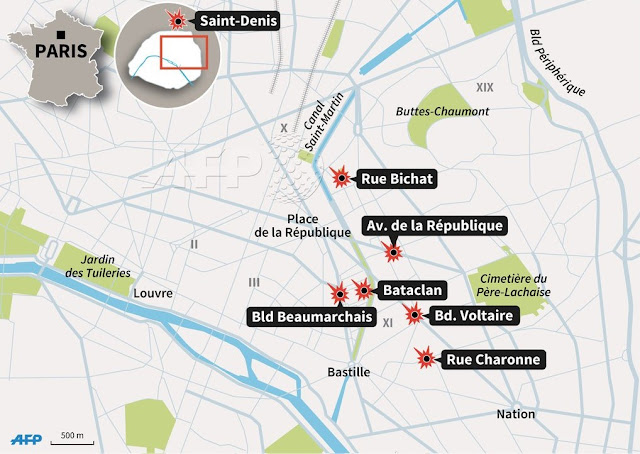
Coordinated ISIS shootings and bomb
blasts left 130 people dead and hundreds wounded across Paris, most of
them young people out for a night on the town.
What
a depressing collection it will
make. So many poems written about war and terror, murder and stupid
death. So much outrage, pity, sorrow, and confusion. Poems written after the gore and red splatter. Watching the coverage from Paris unfold
on TV that Friday night in
2000 with waves of disgust and horror, I swore not again! I have nothing left to say. All my previous words flayed at the howling darkness and
were swept away with no notice or effect. Murfin,
thy name is futility.

The Facebook profile picture that set off a storm of criticism and controversy.
So,
I simply added a commemorative graphic
meme to my Facebook timeline and shortly after
used that gizmo that layered the
French Tri-Color over my profile photo. I kept my council and I grieved.
Then
I found myself scolded and shamed, along with others who had
expressed sorrow and solidarity. And
not just from the Right Wing vampires who tried to paint our
hands with blood because we had not cheered and endorsed the pre-emptive murder of
millions. I expected that. No, this sneering scorn was
turned on us by allies, some much beloved, some with Reverend before their names.
Why,
they asked accusingly, did you
not decorate your page with the Cedar of
Lebanon for the dead in Beirut just
the day before, or weep for Baghdad the week before that, or the
plane load of Russian tourists scattered over the Sinai, or the Nairobi university students last spring? Curiously they failed to add the Doctors Without Borders hospital, refugee camps, or wedding parties blown up by
American drones.

The
day before the Paris attacks, ISIS terrorists also bombed Shia
neighborhoods in Beirut killing 43 and maiming hundreds. American and
European media reacted to the atrocity with much less attention. Far
fewer social media posts expressed solidarity with the people or
Lebanon. Was the difference racism, anti-Muslim bias, or
simply empathetic failure?
For
our sympathy for Paris we were
accused of, at best, hypocrisy
and at worst with a flagrant display White
privilege if not outright racism. When others protested the characterization, they were charged with the new silencer of displaying White
fragility.
Look,
I get it. I have written similar things, made similar charges when my self-righteous indignation was in full
display, usually just after some ignored
outrage. This is a case where all lives certainly matter. Night clubbing young Parisians are no more worthy than a Lebanese
grandmother, or even of a masked
militant. All have earned their mourning. All deserve more than just our passing pity.
But denying our particular sorrow is
like telling us we cannot weep for our mothers because a homeless person has been laid in a potter’s field un-mourned. Beirut, Baghdad, and Nairobi all are written on the hearts of those who loved and knew them. They are not
more worthy than Paris. I would be a
better man, perhaps, if I knew those cities as I have known Paris from afar.

Gustave Caillebtte, Paris Street, rainy day 1877.
I
can’t help it. I know Paris. Not that I
have ever been there or have any realistic hope of ever going there. I am the most provincial of
Americans. I cannot
speak the language and stumble helplessly over its fluid words when I encounter them. I
have no intimate French friends
or family. But to my surprise, I know
the eternal Paris of the imagination.
So, the
next Sunday, the Ides of November,
digesting all of this, I sat down to write what I know. It is less a poem than a litany.
Allow
me the grace to grieve for this without your haughty disapproval.

Le Dome café on Boulevard Montparnasse in 1920, hangout for Hemingway and expat writers and artists.
The Eternal Paris of the Imagination
The Ides of November 2015
Oh the eternal Paris of the
imagination!
of Notre Dame, hunchbacks, and Gypsy girls
of
Cyrano and balconies
of D’Artagnan,
Athos, Aramis, and Porthos.
The Paris of the Bastille, Liberté,
égalité, fraternité
of
mobs, Marat, Robespierre, and tumbling heads,
of
Bonaparte and Imperial bees,
of
Empire waists and décolletage.
The Paris of the barricades and
sewers
of
Jean Val Jean and Javert,
of
Republicans and Monarchists,
of
June Days and Bonaparte the Second.
The Paris of goose stepping
Prussians in spiked helmets
of
the Communards and National Guard,
of
Louise Michel and firing squads,
of
corpses with calloused hands.
The Paris of the Exposition
Universelle and Gustave Eiffel
of
La Belle Epoque, beauty and gaiety,
of
Bernhardt and La Comédie-Française,
of
Mimi and La Boheim.
The Paris of Dreyfus and Zola,
of
Balzac and Jules Verne,
of
Renoir, Monet, and Degas,
of
Le Grande Jatte and Rodin.
The Paris of Lavoisier, Pasture,
and Curie
of the brothers
Montgolfier, Lumière, and Renault,
of daguerreotypes
and other marvels
of Louis Blériot
and monoplanes.
The Paris of the Moulon Rouge and
le Chat Noir,
of
the Can-Can and Apache,
of
the Folies Bergère,
of Collette and
Gigi.
The Paris of the Poilus, blue
overcoats and helmets,
of
the Taxis de la Marne in long lines,
of
Lafayette, we are here,
of
Versailles and the carving of the World.
The Paris of the Moveable Feast
of
expatriates, Stein and Alice B.,
of
Hemingway, Fitzgerald, and Joyce,
of
cubists and surrealists.
The Paris of Chevalier and
Josephine Baker,
of
Quintette du Hot Club de France,
of
Dajango Reinhardt and Stéphane Grappelli,
of
Piaf, the Little Sparrow.
The Paris that Rick and Elsa will
always have,
of
Nazis and collaborators,
of
the Resistance, berets, and submachine guns,
of
Liberation and flowers.
The Paris of Existential angst,
of
Sartre and Anais Nin,
of
an American in Paris,
of Belmondo,
dangling Gauloises, and Bardot.
The Paris of Haute Couture and
Haute Cuisine,
of
Channel and Dior,
of
cafés and bistros,
of
discotheques and punk rock.
The
Paris of DeGaulle and OAS bombs,
of
strikes and marches,
of
festivals and fireworks,
of
flags and fantasy.
Paris of the eternal imagination
let
me weep with you today.
—Patrick
Murfin


