Showing posts with label witchcraft. Show all posts

Thursday, November 2, 2023

Are There Really More Witches than Presbyterians?


An all female coven practices a ritual.  Although there are male Wiccan, adherents are predominantly women--and overwhelmingly White.  Other neo-pagan traditions appeal to Women of Color.

The story with the dramatic headline is a few years old and based on research on religion in America on even older data collected by the Pew Research Center in 2014 and additional studies by conservative religious think tanks, but it made the rounds again on social media as Halloween rolled around again.  Depending on your perspective the news was shocking, appalling, or an encouraging sign of a broadening of America spirituality.

Of course, the Pew Center never made the claim that there are now more witches than Presbyteriansjournalists extrapolated the claim because it made an eye catching headline and guaranteed click bait.  Then pundits and bloggers ran with the story giving it their own spin.  The original research simply noted that Wicca, the largest new-pagan group had exploded with claimed adherents.   From 1990 to 2008, Trinity College in Connecticut ran three large, detailed religion surveys that showed Wicca grew tremendously from an estimated 8,000 in 1990, to about 340,000 practitioners in 2008.

Pew found eight years later that there were about 1.5 million people identifying as Wiccan, but that many, if not most of these did not belong to any coven or claim to be sole practitioners.  Most of the rest might best be described as spiritual seekers attracted to the mythology, connection to the earth and environment, and to a female-centric religion but who do not seriously practice Wiccan rituals.

The Pew study also noted a general decline in both membership and identification with Christian churches both Protestant and Catholic even including Evangelicals who had showed sharp growth in the previous two decades.  Mainline Protestant denominations showed the steepest declines.

The religiously and socially progressive Presbyterian Church (USA) is the largest Presbyterian denomination in America.

Sifting through Pew’s count of membership by denomination, reporters noted that claimed Wiccan adherents outnumbered the enrolled membership of the Presbyterian Church (USA), the largest Presbyterian denomination in America but does not include the membership of more than a half dozen small Presbyterian bodies who cleave to the rigid Calvinism of their Scottish roots or the many who profess to be Presbyterians out of family attachment but do not belong to any church and infrequently worship.

So not only do the headlines mislead—taken all together, there are still more U.S. Presbyterians than Wiccans—but compares apples to oranges.  Unlike Christian denominations, Wiccans an amorphous and de-centralized structure, keep few if any membership records beyond individual covens, and have few buildings of their own.  Self-defined adherents can’t be usefully equated with solid membership data. According to a 2016 Gallup Poll, 2% of Americans self-identify as Presbyterian—about 6.6 million or 5 times as many Wiccans

Presbyterians trace their origins to the Protestant Reformation in the mid-16th Century from the theology of John Calvin via Scotlands John Knox and spread to some English dissenters.  They came to America with 18th Century Scottish, English, and especially Scotch Irish immigrants.  They became a major force in the Middle Colonies and were the original religion of the Scotch-Irish who led pioneer settlement throughout the trans-Allegany West and South.  Like their cousins, the Congregationalists of New England, they prized a highly educated clergy who were loath to follow their frontier settlers into primitive conditions.  Most of the Scotch-Irish except for a landed elite drifted away to the Methodists with their lay preachers and saddle bag circuit riders or to the Baptists whose congregations freely ordained their own ministers with little formal training.

During and after the American Revolution, many Northern and urban Presbyterian ministers also became influenced by the Scottish Enlightenment which was also a leading influence on many of this country’s founders.  That began a long, slow but steady shucking of much Calvinist doctrine.  These Presbyterians became influenced by the Social Gospel movement. By the post-World War II era the largest Presbyterian denominations were mostly liberal and cultural progressives.  Demographically they were considered a faith of the educated and elite right behind the Episcopalians and alongside the Congregationalists who became the United Church of Christ. 

The PC(USA) was established by the 1983 merger of the Presbyterian Church in the United States, whose churches were located in the Southern and Border States, with the United Presbyterian Church in the United States of America, whose congregations could be found in every state.  It has shed most vestiges of Calvinism except for its unique governance and polity.  Since then, social issues including the ordination of women and LGBTQ status within the denomination, disinvestment in South Africa to protest apartheid, and harsh criticism of Israeli abuse of Palestinian rights has led to some member churches to leave the denomination and individuals to resign membership or simply fade away.  Undaunted, the PC(USA) remains committed to social justice.

The Ridgefield-Crystal Lake Presbyterian Church dating before the Civil War is one of the oldest churches in McHenry County and a social justice champion.

I think of our friends from the Ridgefield-Crystal Lake Presbyterian Church whose members were long active in the local McHenry County Peace movement, actively engage in hands-on support for the poor and oppressed in Central America, have a vigorous environmental ministry, and are currently working with Tree of Life Unitarian Universalist Congregation and Faith Leaders of McHenry County on our Compassion for Campers program for the homeless.

Despite claims to deep roots in pre-Christian Celtic or Druid practice, Wicca is much younger.  It was created in its present form by Gerald Gardner, an English civil servant and amateur anthropologist who died in 1964 who was influenced by Masonic ritual and occult lore to hang an elaborate structure on the barely understood elements of an ancient culture.

In America that was greatly elaborated on and popularized by The Spiral Dance: A Rebirth of the Ancient Religion of the Great Goddess; a book by the poet and mystic Miriam Simos known as Starhawk.  The book was widely influential well beyond the still small and idiosyncratic world of neo-paganism.  It was avidly read by feminists, those interested in deep ecology, and women in small towns and cities who had felt isolated and alone.  

Decades after she helped define Wicca in America Starhawk remains the most influential elder or crone of feminist neo-paganism.

Starhawk was an early and influentially active member of the Covenant of Unitarian Universalist Pagans (CUUPS).  Her influence contributed heavily to the adoption of the Unitarian Universalist Associations Seventh Principle, “Respect for the Interdependent Web of All Existence of Which We Are a Part” in 1983, a move led by the faith’s growing eco-feminist movement.  That inclusion has in many ways profoundly changed traditional Unitarian Universalism broadening its roots form radical Christianity and modern Humanism, influencing the way the faith acts in the world, and being a major catalyst for a revival of spirituality in the liberal faith. 

When the history of religion and spirituality in the late 20th Century America is written it is possible that the most influential person might not be some mega-church pastor with a perfect pompadour and dazzling white smile, a learned theologian with a break-out idea, a prelate or president of some denomination, or the guru of some eastern mysticism, but Starhawk a nice Jewish girl from St. Paul, Minnesota with wild hair and a penchant for colorful flowing robes.

Most of Wicca’s adherents realize that the creation of Gardner and Starhawk is not a literally accurate re-creation of an ancient religion.  It doesn’t matter.  The mythology surrounding any religion is equally questionable.   What is important is how that mythology usefully informs an understanding about the world, humanity, and morality.  While some practicing Wiccans may believe they are actually invoking real gods and spirits in their rituals and incantations, the vast majority do not.  They understand the power of metaphor.
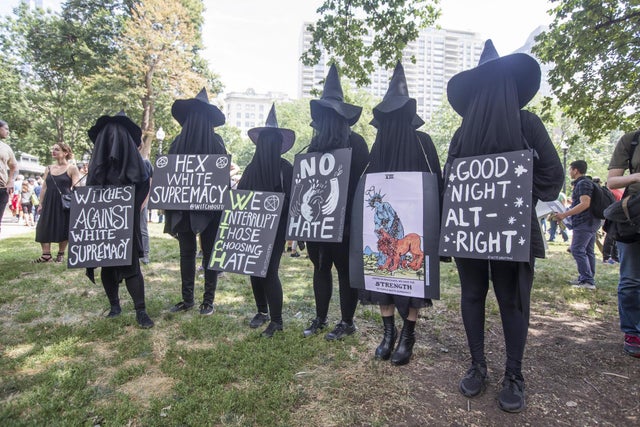
Feminism and the environment are just two of the concerns that have led modern Wiccans to social justice activism.

Modern Wiccans have generally been successful in separating their brand of witchcraft from Satanism except among the most conservative Christians.  Many are now attracted to a faith that proclaims a wholesome connection to nature, the cycle of the seasons, and the divine feminine.

That’s a trend that is apt to continue as more and more Americans describe themselves as “spiritual but not religious.”  But don’t worry, the Presbyterians will still be around.


Monday, November 2, 2020

More Witches than Presbyterians?

An all female coven practices a ritual.  Although there are male Wiccan, adherents are predominantly women--and overwhelmingly White.  Other neo-pagan traditions appeal to Women of Color.

The story with the dramatic headline is two years old and based on research on religion in America on even older data collected by the Pew Research Center in 2014 and additional studies by conservative religious think tanks, but it made the rounds again on social media as Halloween rolled around again.  Depending on your perspective the news was shocking, appalling, or an encouraging sign of a broadening of America spirituality.

Of course the Pew Center never made the claim that there are now more witches than Presbyterians, journalists extrapolated the claim because it made an eye catching headline and guaranteed click bait.  Then pundits and bloggers ran with the story giving it their own spin.  The original research simply noted that Wicca, the largest new-pagan group had exploded with claimed adherents.   From 1990 to 2008, Trinity College in Connecticut ran three large, detailed religion surveys that showed Wicca grew tremendously from an estimated 8,000 in 1990, to about 340,000 practitioners in 2008.

Pew found eight years later that there were about 1.5 million people identifying as Wiccan, but that many, if not most of these did not belong to any coven or claimed to be sole practitioners.  Most of the rest might best be described as spiritual seekers attracted to the mythology, connection to the earth and environment, and to a female-centric religion but who do not seriously practice Wiccan rituals.

The Pew study also noted a general decline in both membership and identification with Christian churches both Protestant and Catholic even including Evangelical who had showed sharp growth in the previous two decades.  Mainline Protestant denominations showed the steepest declines.

The religiously and socially progressive Presbyterian Church (USA) is the largest Presbyterian denomination in America.

Sifting through Pew’s count of membership by denomination, reporters noted that claimed Wiccan adherents outnumbered the enrolled membership of the Presbyterian Church (USA), the largest Presbyterian denomination in America but does not include the membership of more than a half dozen small Presbyterian bodies who cleave to the rigid Calvinism of their Scottish roots the many who profess to be Presbyterians out of family attachment but do not belong to any church and infrequently worship.

So not only do the headlines mislead—taken all together, there are still more U.S. Presbyterians than Wiccans—but compares apples to oranges.  Unlike Christian denominations, Wiccans an amorphous and de-centralized structure, keep few if any membership records beyond individual covens, and have few buildings of their own.  Self-defined adherents can’t be usefully equated with solid membership data. According to a 2016 Gallup Poll, 2% of Americans self-identify as Presbyterian—about 6.6 million or 5 times as many Wiccans

Presbyterians trace their origins to the Protestant Reformation in the mid-16th Century from the theology of John Calvin via Scotland’s John Knox and spread to some English dissenters.  They came to America with 18th Century Scottish, English, and especially Scotch Irish immigrants.  They became a major force in the Middle Colonies and were the original religion of the Scotch-Irish who led pioneer settlement throughout the trans-Allegany West and South.  Like their cousins, the Congregationalists of New England, they prized a highly educated clergy who were loath to follow their frontier settlers into primitive conditions.  Most of the Scotch-Irish except for a landed elite drifted away to the Methodists with their lay preachers and saddle bag circuit riders or to the Baptists whose congregations freely ordained their own ministers with little formal training.

During and after the American Revolution, many Northern and urban Presbyterian ministers also became influenced by the Scottish Enlightenment which was also a leading influence on many of this country’s founders.  That began a long, slow but steady shucking of much Calvinist doctrine.  These Presbyterians became influenced by the Social Gospel movement. By the post-World War II era the largest Presbyterian denominations were mostly liberal and cultural progressives.  Demographically they were considered a faith of the educated and elite right behind the Episcopalians and alongside the Congregationalists who became the United Church of Christ. 

The PC(USA) was established by the 1983 merger of the Presbyterian Church in the United States, whose churches were located in the Southern and Border States, with the United Presbyterian Church in the United States of America, whose congregations could be found in every state.  It has shed most vestiges of Calvinism except for its unique governance and polity.  Since then social issues including the ordination of women and LGBTQ status with in the denomination, disinvestment in South Africa to protest apartheid, and harsh criticism of Israeli abuse of Palestinian rights has led to some member churches to leave the denomination and individual to resign membership or simply fade away.  Undaunted, the PC(USA) remains committed to social justice.

The Ridgefield-Crystal Lake Presbyterian Church dating before the Civil War is one of the oldest churches in McHenry County and a social justice champion.

I think of our friends from the Ridgefield-Crystal Lake Presbyterian Church whose members were long active in the local McHenry County Peace movement, actively engage in hands-on support for the poor and oppressed in Central America, have a vigorous environmental ministry, and are currently working with Tree of Life Unitarian Universalist Congregation and Faith Leaders of McHenry County on our Compassion for Campers program for the homeless.

Despite claims to deep roots in pre-Christian Celtic or Druid practice, Wicca is much younger.  It was created in its present form by Gerald Gardner, an English civil servant and amateur anthropologist who died in 1964 who was influenced by Masonic ritual and occult lore to hang an elaborate structure on the barely understood elements of an ancient culture.

In America that was greatly elaborated on and popularized by The Spiral Dance: A Rebirth of the Ancient Religion of the Great Goddess; a book by the poet and mystic Miriam Simos as Starhawk.  The book was widely influential well beyond the still small and idiosyncratic world of neo-paganism.  It was avidly read by feminists, those interested in deep ecology, and women in small towns and cities who had felt isolated and alone. 

Decades after she helped define Wicca in America Starhawk remains the most influential elder or crone of feminist neo-paganism.

Starhawk was an early and influentially active member of the Covenant of Unitarian Universalist Pagans (CUUPS).  Her influence contributed heavily to the adoption of the Unitarian Universalist Association’s Seventh Principle, “Respect for the Interdependent Web of All Existence of Which We Are a Part” in 1983, a move led by the faith’s growing eco-feminist movement.  That inclusion has in many ways profoundly changed traditional Unitarian Universalism broadening its roots form radical Christianity and modern Humanism, influencing the way the faith acts in the world, and being a major catalyst for a revival of spirituality in the liberal faith. 

When the history of religion and spirituality in the late 20th Century America is written it is possible that the most influential person might not be some mega-church pastor with a perfect pompadour and dazzling white smile, a learned theologian with a break-out idea, a prelate or president of some denomination, or the guru of some eastern mysticism, but Starhawk a nice Jewish girl from St. Paul, Minnesota with wild hair and a penchant for colorful flowing robes.

Most of Wicca’s adherents realize that the creation of Gardner and Starhawk is not a literally accurate re-creation of an ancient religion.  It doesn’t matter.  The mythology surrounding any religion is equally questionable.   What is important is how that mythology usefully informs an understanding about the world, humanity, and morality.  While some practicing Wiccans may believe they are actually invoking real gods and spirits in their rituals and incantations, the vast majority do not.  They understand the power of metaphor.

Feminism and the environment are just two of the concerns that have led modern Wiccans to social justice activism.

Modern Wiccans have generally been successful in separating their brand of witchcraft from Satanism except among the most conservative Christians.  Many are now attracted to a faith that proclaims a wholesome connection to nature, the cycle of the seasons, and the divine feminine.

That’s a trend that is apt to continue as more and more Americans describe themselves as “spiritual but not religious.”  But don’t worry, the Presbyterians will still be around.


Wednesday, April 24, 2013

National Poetry Month—Val Kirkham "Romans in My Garden"


Today we skip across the Pond to include a poet quite unknown over here but who has established herself in England by virtue of a wild, willful, and defiantly sexual life, all of which she recorded faithfully and without flinching in a lifetime of poetry.  Under the pen name Val Kirkham she published The Collected Works in 2008 which encompasses 11 short chapbooks published on line from the time she was a struggling young single mother to her reflective maturity as a full time writer in Lancashire.
I encountered her through her real, not so secret identity, Geraldine Murfin-Shaw, a far distant kinswoman, thought the tireless genealogical efforts Ed Murfin, whose stated mission is to get all of the far flung Murfins across the globe in contact.

Geraldine proved to be a true delight, a blithe and indomitable spirit.  Growing up in Yorkshire she became an embodiment of swinging England in the ‘60’s, reveling in sexual freedom and entirely frank about it—a lifelong trait.  She will not mince words about sex, it joys and peccadilloes spelled out frankly in real world language.  Not for her the gentile masks of literary devices to hint at glorious hedonism.  In ever repressed America—no matter how swamped in cheap pornography we are—her frankness will startle even sophisticated readers.  She would have it no other way.
Trailing lovers and four husbands, she raised two children alone and returned to college in her 30s.  Becoming an accomplished chef, she took jobs as far flung as at a zoo, an island resort, a medieval castle, and even an American college.  That led to the publications of cook books in which tales intertwined with the recipes.
In her middle years she took up an interest in witchcraft, traditional Celtic/Druid religion and what we sometimes dismiss as the occult.  That infused a new richness into her work, as did a bent toward history and scholarship, including tackling translations from Latin sources.
In the ‘80’s she established herself as a performance poet appearing mostly in the Northwest of England and also featured on the BBC.  Her readings were lively, shocking, controversial, and evidently quite entertaining wining her a devoted following. The editor of Lancashire Life called her “the predatory sexual voice cruising in the fast lane of poetry.”


These days she lives singly with her beloved dog, tends her garden, watches out for her nearby aged mother and continues to write.  More cook books and new material are in the pipeline. Her more recent books are published under her current name Geraldine Murfin-Shaw.  Part 1 of her autobiography has been published  and part 2 being written now. 

Americans can find copies of The Collected Works and other books under both names can be found o on Amazon.com and other sources.  I recommend it. 


For a sample of what she does and is up to visit her web page, The life, loves and literature of Geraldine Murfin-Shaw.

There was a lot to choose some, and I was sorely tempted to give you a full on blast of her wanton sexuality, but I was utterly charmed by this piece.  We’ll save the bawdy stuff for a return engagement.

Romans in My Garden


There are Romans in my garden
they lie beneath the sod
in leather-thonged  armour
safe with their alien god.
They fell here in some battle
launched from the neighbouring hill,
deep in their throat death' s rattle
catches at them still.
I Love you, ancient Romans.
How can I find a way
to journey down the ages
a thousand years away?
The distance in between us
is measured in mere feet,
yet all the longlost ages
lie buried in the peat.
0, Romans in my garden,
rise up at noon today·.
put on your tarnished armour
and lead me far away.
I’ll journey to your hilltop
windswept and bleak and cold,
I’ll cook food at your campfire
as women did of old.
I’ll follow you into battle,
bind up your jagged wounds,
I’ll sleep on skins beside you
Among the burial mounds.
O rise up, ancient Romans.
March down the silent street
and I will march home with you
on fantasy winged feet

—Val Kirkham