Tuesday, December 27, 2011

A Hatchet Job

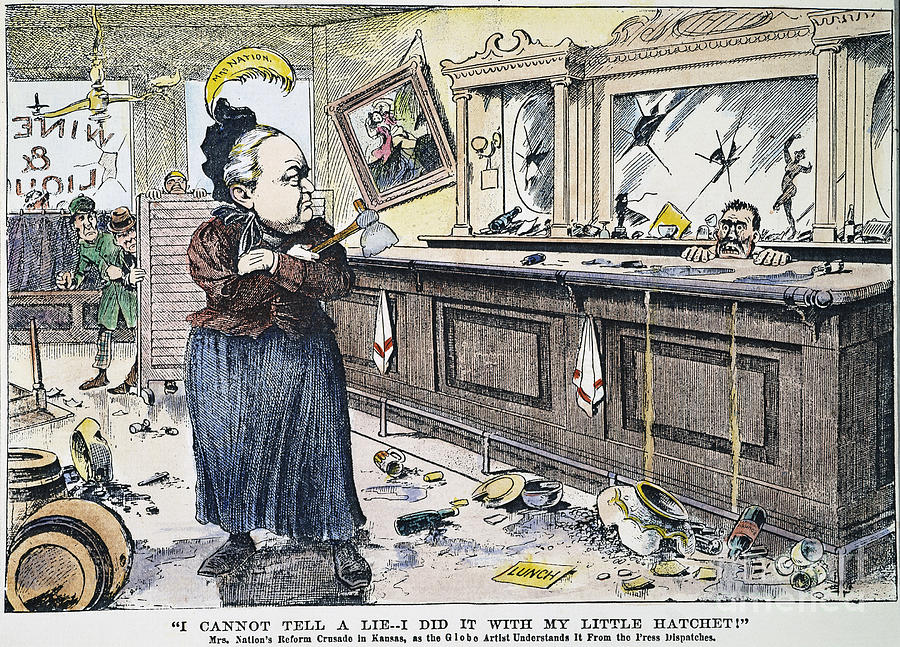
It was on this day in 1900 that Carrie Nation, a/k/a Carry A. Nation, all 6 foot, 180 pounds of her, stormed into a Kansas saloon shouting for the Lord and wielding a hatchet to break up the bar and smash the bottles.  Terrified customers fell over themselves trying to flee the carnage and the obviously deranged giantess.

The militant teetotaler had vandalized saloons before, hurling rocks through windows.  But her husband made an offhand comment that what she really needed was a hatchet.  She thought it was a brilliant idea.  And it was.  Within days news of her rampage spread across the country and she was suddenly famous. 
Encouraged, she went on to smash more taverns.

She recognized the symbolic importance of the hatchet as a trade mark and later sold souvenir reproductions and post cards of herself with the “tool of God.”  She even toured on the American vaudeville stage and in English music halls with the trusty blade.  She had to give that up, however when outraged Brits pelted her onstage with eggs.

She was born Carrie Amelia Moore in 1841 to a slave holding family with a small plantation in Gerrard County, Kentucky.  Thus her background was very different from most of the women who later became Temperance leaders, who tended to come from comfortable Northern families with connections to abolitionism and other social reform movements, especially women rights.

Her family was beset by health woes, including several cases of mental illness.  Her mother suffered from periodic delusions that she was Queen Victoria.  Carrie herself, despite her robust frame, was often sickly.  With the continuing illness the family fell into poverty and want, although they retained at least some of their slaves.

By the time of the Civil War, the family was in Cass County, Missouri and were Southern partisans in a state racked by its own bloody civil strife.  Union troops forced them to vacate their farm.  Evacuated first Kansas City, young Carrie volunteered as a nurse following a Union raid on Independence.

In 1865 despite her Rebel sympathies, Carrie met and fell in love with a Yankee Army doctor, Charles Gloyd.  The couple wed in 1867.  But Gloyd was a heavy drinker.  The marriage was not a happy one.  Before the birth of their daughter Charlien the next year, they had separated.  Gloyd died a few months later.  This tragic episode was the experience that eventually thrust her into the Temperance movement.

A widow with a small child, Carrie attended Normal School to get a teaching certificate that would make her able to hold one of the few jobs open to women.  After graduation she taught for four years in Holden, Missouri.  But she was fired for reasons not entirely clear, but which may have been related to erratic behavior.

In 1874 Carrie met and married David A. Nation, a preacher, lawyer and occasional newspaper editor.  Nation was 19 years older than his 28 year old wife and had the care of several children from a previous marriage.

The couple bought a cotton plantation in Texas, but was soon brought to ruin by their total ignorance of agriculture and the expense of field hands in the post-war south.  They kicked around Texas. David practicing law, Carrie managing hotels, a job at which she turned out to be successful.  In 1889 after David’s involvement in a Reconstruction era battle for control of local government known as the Jaybird/Woodpecker War, the couple fled to Medicine Lodge, Kansas.  David became preacher of the local Christian Church and Carrie managed the local hotel.

She also took up serious temperance work for the first time, founding the local chapter of the Women’s Christian Temperance Union (WCTU).  She launched a personal campaign of persuasion and shaming against local saloon keepers, bar tenders, and public drunks.  She greeted them on the street and at the doors of their establishments with sarcastic comments like,  “Good Morning, Destroyer of Men’s Souls!”  She also became a leader in a campaign to turn the state dry.

A word about the Temperance movement is in order.  America was undeniably a hard drinking country.  It always had been.  Partly this was due to the fact that most water was unpotable.  Beer and cider were the table drinks of even the most respectable families and served even to children since colonial times.  The wealthy always enjoyed the fine wines that they could have imported from Europe.

But drinking to excess was always a problem.  The famous stocks of colonial New England were most frequently filled by public drunks.  The problem of families being abandoned by drunken men was a common story.  The Temperance movement began to take shape at the turn of the 19th Century as a reform movement spearheaded by Protestant clergy.  At first it was about temperance—moderation.  It preached voluntary moderation in drinking.  It did not necessarily demand that all liquor consumption stop.  

The movement took off with the waves of German and Irish immigrants swamping the slums of the big cities.  These people were rowdy, public drinkers—and Catholic.  In fact zeal by Protestant ministers becoming ever more absolutist grew in direct proportion to the swelling of Catholics in the midst.

By the 1840’s a well established web of social reform movements spread out from New England and New York across much of the country.  The same folks who advocated the abolition of slavery, prison reform, public education, and women’s rights were also frequently involved in the temperance movement.  After the Civil War, many former Abolitionists shifted their attention to alcohol.  In their minds the saloon was the den of vice that impoverished families.

By the time that the WCTU was formed in 1872, the movement was being spearheaded by reformist Evangelical women, who were evolving a program of governmental Prohibition coupled with the uplifting moral reform of Protestantism.  As even greater waves of dirty, drunken Papists and Jews washed up upon American shores, they became ever more determined.

Although her southern background and her husband’s Democratic politics were different than most leaders on the lecture platform, Carrie was ready to bring zealous, crusading Protestantism to even greater heights.
Then on June 5, 1899 she got her marching orders directly from God.  She later described the experience:

 The next morning I was awakened by a voice which seemed to me speaking in my heart, these words, "GO TO KIOWA," and my hands were lifted and thrown down and the words, "I'LL STAND BY YOU." The words, "Go to Kiowa," were spoken in a murmuring, musical tone, low and soft, but "I'll stand by you," was very clear, positive and emphatic. I was impressed with a great inspiration, the interpretation was very plain. It was this: "Take something in your hands, and throw at these places in Kiowa and smash them.

Two days later she was heaving rocks through the window of Dobson's Saloon in the town of Kiowa.  She went on to damage two more that first day.  After the Almighty showed his approval by having a tornado touched down nearby, she took the show on the road across Kansas.  She was frequently arrested, but undeterred.

It was after a particularly wild raid in Wichita, her husband made the offhand remark that for maximum damage she should use a hatchet.  “That is the most sensible thing you have said since I married you.”  She went out and bought the hatchet.  The rest is history.

It is perhaps understandable that a year later he filed for divorce. 

Carrie continued chopping up saloons and taking to platforms to talk about it.  She was a strong advocate for total prohibition.  She was a celebrity and perhaps the most famous woman in America.

She collapsed in 1911 giving a temperance address at a park near the home she built in Eureka Springs, Arkansas.  Transported by to Kansas for treatment, she died in a Leavenworth hospital and laid in an unmarked grave in nearby Benton.  Some years later the WCTU paid for a monument.
 

Monday, December 26, 2011

It’s Boxing Day in Much of a Former Empire


Ask an American of a certain age about Boxing Day and he will tell you about the gym class when they made you lace up the gloves back in the day when it was considered both good healthy exercise and a character builder—“don’t be a pansy, it’s only a split lip!”—to let children wail the daylights out of each other.  Since those days have long past, younger Yanks probably thinks it’s just the day before the moving van arrives.

But in Britain and the scattered remnants of her former Empire Boxing Day is a treasured tradition and a legal holiday.  It traditionally falls on the day after Christmas, December 26.  Since becoming an official holiday if it falls on the weekend, the official observance is pushed over into the next week.

The celebration had its roots with the aristocracy, gentry, and wealthy townsmen and their households.  The master would give presents to his servants and staff, who would also have the day off work.  Sometimes the master’s family would even serve meals to their inferiors!  Needless to say, this custom was very popular among the servants, and sometimes observed resentfully by those unaccustomed to either manual labor or generosity.

The day is a remnant of an ancient tradition that may—or may not—go back to the Roman celebration of Saturnalia, when there was a carnival like “turn around” with slaves lording over masters for a day.  The tradition continued into the Middle Ages on into Elizabethan times, where it took on the wild excesses of street revelry.

That revelry doomed the whole season when Oliver Cromwell and his Puritans took over.  Eventually, Boxing Day restored a controlled dollop of the old festival.  The Church of England gave a religious cover to the day as St. Stephen’s Day.  Stephen was the Deacon of Jerusalem the earliest days of Christianity known for his charities to the poor.  He was also the first Christian martyr, stoned to death for allegedly preaching the Trinity in the Temple.

The familiar carol Good King Wenceslas is a St. Stephen’s Day song meant for street begging.  In Ireland, the day is still officially called St. Stephen’s Day.

In the Bank Holidays Act of 1871, Parliament recognized Boxing Day as a Bank Holiday—an officially recognized public holiday.  While time off from work was not originally mandatory, but has become nearly universal.

The holiday spread across the Empire and is still official in Canada, Australia, New Zealand, and other Commonwealth countries.  In South Africa it was re-named The Day of Goodwill in 1994.

Today small gifts are still given trades people and service workers, but in Britain the day has become all about shopping.  It is the biggest shopping day of the year and has been compared to American Black Friday, the day after Thanksgiving.  Stores mark the day with huge sales.

It is also a day of sport.  Football—that’s soccer Americansand Rugby leagues hold full schedules of on that day, teams usually playing their most serious rivals.  There are also prestige horse races and the country gentry mount Fox Hunts.  The toffs are no longer allowed to chase real fox, but still get to ride to the hounds chasing a scented bait.

So for my friends across the pond and around the world who celebrate, happy Boxing Day!  This year, by accident of the calendar even we American’s have a holiday today, observing Christmas which fell on Sunday.

Sunday, December 25, 2011

Let Us Be That Stable—My Annual Christmas Poem


 Hieronymus Bosch's  Nativity. 15th Century.

It’s Christmas Day and time to reflect on the Christian religious origins of this holiday with traditions borrowed from pagan times and which has been overlaid by more than one secular celebration. 
In 1223 St. Francis of Assisi is said to have created the first recreation of the birth scene in a cave near Greccio in Italy.  He was inspired by a recent trip to the Holy Land.   

It was a living Nativity tableau, with people representing the Holy Family, shepherds, Magi, and angels and live animals, including an ass and an ox for realism.  The custom quickly caught on and spread across Europe.  

Soon the scene was being reproduced in religious art, both paintings in sets of figurines to be displayed in the Nave of a Church or, eventually, in the manors of the wealthy.  By the early days of the Renaissance the scene was somewhat standardized.  Instead of St. Francis’s Grotto, the birth place was usually portrayed as a stable, often with a thatched roof and skeletal or broken walls, the participants garbed as peasants’ or lords of the day. 

It is this familiar scene, often erected in religious homes, and adorning countless Christmas cards that most of us have firmly in our mind when we hear a reading of the Biblical nativity story.

With that in mind, I composed a poem for a Christmas Eve service at what was then still called the Congregational Unitarian Church in Woodstock, Illinois more than ten years ago.  I used the classical crèche as a metaphor for the Congregation.  The poem was included in my 2004 collection of poetry, We Build Temples in the Heart and has frequently been used in Unitarian Universalsit and other worship setting since.  

LET US BE THAT STABLE 
Today, let us be that stable
            Let us be the place
            that welcomes at last
            the weary and rejected,
            the pilgrim stranger,
            the coming life.

Let not the frigid winds that pierce
            our inadequate walls,
            or our mildewed hay,
            or the fetid leavings of our cattle
            shame us from our beckoning.

Let our outstretched arms
            be a manger
            so that the infant hope,
swaddled in love,
may have a place to lie.

Let a cold beacon
            shine down upon us
            from a solstice sky
            to guide to us
            the seekers who will come.

Let the lowly Shepard
            and all who abide
            in the fields of their labors
            lay down their crooks
            and come to us.

Let the seers, sages, and potentates
            of every land
            traverse the shifting dunes
            the rushing rivers,
            and the stony crags
            to seek our rude frame.

Let herdsmen and high lords
            kneel together
            under our thatched roof
            to lay their gifts
            before Wonder.

Today, let us be that stable.

--Patrick Murfin

Saturday, December 24, 2011

My Gift to You this Christmas Eve


I was a bright, shiny new step father on Christmas Eve of 1981.  Kathy and I had been married all of one week.  With foolish enthusiasm, I wanted to establish our own family traditions for the holiday that, hopefully, would endear me to hearts of my new daughters.  Carolynne was nine years old, Heather only seven.

One night earlier that week I rushed from my job repairing football shoulder pads to a bookstore on Lincoln Avenue conveniently located near a favorite saloon.  Undoubtedly fueled by a couple of shots of Christian Brothers with beer backs, I plunged into the store.  I found what I was looking for—a nice small edition of one of my own favorite Christmas stories with some charming illustrations.

After dinner on Christmas Eve, and some negotiations between the girls and their mother over whether they would be able to open any “under the tree’ presents that night—she let them open one—I asked them to settle next to me on the couch.  Kathy played some carols softly on the on the stereo.

I was as excited as I could be.  I could picture the girls, all grown up, reading this same story to their children fondly remembering me, of course.  I opened the book and in my most mellifluous voice began to read.

I think I read four lines before they began to squirm.  After the second paragraph, just as the story was getting going, Heather bleated out pitifully, “Mom!  This is boring!  Do we have to!”  Carolynne seconded the anguish.

Since it was not my intention to actually torture any children, I reluctantly shut my book and let them clamor down to play with the plastic pin ball game that they had opened.  I was heartbroken, but did my best to keep up a brave front.  

The evening got better.  I, notorious heathen in those days, was exposed to my first ever Christmas midnight mass with a half an hour of caroling by the congregation before the service.  We walked home from church in the sparkling cold and tucked in the girls—who woke us about 3 AM to open presents.  We made them go back to sleep, but could not delay Christmas morning for long.

I never again tried to inflict my children with the story.  From Christmas to Christmas they would remind me of my foolishness.  It comes up even to this day, so I guess I did start a tradition of sorts.

Anyway, I still love the story and privately, when no one is looking, read it for myself every year.

This year, I decided to try to share it again.  This time with you.  I hope it doesn’t make you squirm.

A Child’s Christmas in Wales
By Dylan Thomas


One Christmas was so much like another, in those years around the sea-town corner now and out of all sound except the distant speaking of the voices I sometimes hear a moment before sleep, that I can never remember whether it snowed for six days and six nights when I was twelve or whether it snowed for twelve days and twelve nights when I was six.

All the Christmases roll down toward the two-tongued sea, like a cold and headlong moon bundling down the sky that was our street; and they stop at the rim of the ice-edged fish-freezing waves, and I plunge my hands in the snow and bring out whatever I can find. In goes my hand into that wool-white bell-tongued ball of holidays resting at the rim of the carol-singing sea, and out come Mrs. Prothero and the firemen.


It was on the afternoon of the Christmas Eve, and I was in Mrs. Prothero's garden, waiting for cats, with her
son Jim. It was snowing. It was always snowing at Christmas. December, in my memory, is white as Lapland,
though there were no reindeers. But there were cats. Patient, cold and callous, our hands wrapped in socks, we waited to snowball the cats. Sleek and long as jaguars and horrible-whiskered, spitting and snarling, they
would slink and sidle over the white back-garden walls, and the lynx-eyed hunters, Jim and I, fur-capped and
moccasined trappers from Hudson Bay, off Mumbles Road, would hurl our deadly snowballs at the green of their eyes. The wise cats never appeared.

We were so still, Eskimo-footed arctic marksmen in the muffling silence of the eternal snows - eternal, ever
since Wednesday - that we never heard Mrs. Prothero's first cry from her igloo at the bottom of the garden. Or, if we heard it at all, it was, to us, like the far-off challenge of our enemy and prey, the neighbor's polar
cat. But soon the voice grew louder. "Fire!" cried Mrs. Prothero, and she beat the dinner-gong.

And we ran down the garden, with the snowballs in our arms, toward the house; and smoke, indeed, was pouring out of the dining-room, and the gong was bombilating, and Mrs. Prothero was announcing ruin like a town crier in Pompeii. This was better than all the cats in Wales standing on the wall in a row. We bounded into the house, laden with snowballs, and stopped at the open door of the smoke-filled room.

Something was burning all right; perhaps it was Mr. Prothero, who always slept there after midday dinner with a newspaper over his face. But he was standing in the middle of the room, saying, "A fine Christmas!" and
smacking at the smoke with a slipper.

"Call the fire brigade," cried Mrs. Prothero as she beat the gong.
"There won't be there," said Mr. Prothero, "it's Christmas."
There was no fire to be seen, only clouds of smoke and Mr. Prothero standing in the middle of them, waving his slipper as though he were conducting.
"Do something," he said. And we threw all our snowballs into the smoke - I think we missed Mr. Prothero - and ran out of the house to the telephone box.
"Let's call the police as well," Jim said. "And the ambulance." "And Ernie Jenkins, he likes fires."

But we only called the fire brigade, and soon the fire engine came and three tall men in helmets brought a hose
into the house and Mr. Prothero got out just in time before they turned it on. Nobody could have had a noisier
Christmas Eve. And when the firemen turned off the hose and were standing in the wet, smoky room, Jim's Aunt, Miss. Prothero, came downstairs and peered in at them. Jim and I waited, very quietly, to hear what she would say to them. She said the right thing, always. She looked at the three tall firemen in their shining helmets, standing among the smoke and cinders and dissolving snowballs, and she said, "Would you like anything to read?"

Years and years ago, when I was a boy, when there were wolves in Wales, and birds the color of red-flannel
petticoats whisked past the harp-shaped hills, when we sang and wallowed all night and day in caves that smelt like Sunday afternoons in damp front farmhouse parlors, and we chased, with the jawbones of deacons, the English and the bears, before the motor car, before the wheel, before the duchess-faced horse, when we rode the daft and happy hills bareback, it snowed and it snowed. But here a small boy says: "It snowed last year, too. I made a snowman and my brother knocked it down and I knocked my brother down and then we had tea."

"But that was not the same snow," I say. "Our snow was not only shaken from white wash buckets down the sky, it came shawling out of the ground and swam and drifted out of the arms and hands and bodies of the trees; snow grew overnight on the roofs of the houses like a pure and grandfather moss, minutely -ivied the walls and settled on the postman, opening the gate, like a dumb, numb thunder-storm of white, torn Christmas cards."

"Were there postmen then, too?"
"With sprinkling eyes and wind-cherried noses, on spread, frozen feet they crunched up to the doors and
mittened on them manfully. But all that the children could hear was a ringing of bells."
"You mean that the postman went rat-a-tat-tat and the doors rang?"
"I mean that the bells the children could hear were inside them."
"I only hear thunder sometimes, never bells."
"There were church bells, too."
"Inside them?"
"No, no, no, in the bat-black, snow-white belfries, tugged by bishops and storks. And they rang their tidings
over the bandaged town, over the frozen foam of the powder and ice-cream hills, over the crackling sea. It
seemed that all the churches boomed for joy under my window; and the weathercocks crew for Christmas, on our fence."

"Get back to the postmen"
"They were just ordinary postmen, found of walking and dogs and Christmas and the snow. They knocked on the doors with blue knuckles ...."
"Ours has got a black knocker...."
"And then they stood on the white Welcome mat in the little, drifted porches and huffed and puffed, making
ghosts with their breath, and jogged from foot to foot like small boys wanting to go out."
"And then the presents?"
"And then the Presents, after the Christmas box. And the cold postman, with a rose on his button-nose, tingled down the tea-tray-slithered run of the chilly glinting hill. He went in his ice-bound boots like a man on
fishmonger's slabs.
"He wagged his bag like a frozen camel's hump, dizzily turned the corner on one foot, and, by God, he was
gone."

"Get back to the Presents."
"There were the Useful Presents: engulfing mufflers of the old coach days, and mittens made for giant sloths;
zebra scarfs of a substance like silky gum that could be tug-o'-warred down to the galoshes; blinding tam-o'-
shanters like patchwork tea cozies and bunny-suited busbies and balaclavas for victims of head-shrinking
tribes; from aunts who always wore wool next to the skin there were mustached and rasping vests that made you wonder why the aunts had any skin left at all; and once I had a little crocheted nose bag from an aunt now, alas, no longer whinnying with us. And pictureless books in which small boys, though warned with quotations not to, would skate on Farmer Giles' pond and did and drowned; and books that told me everything about the wasp, except why."

"Go on the Useless Presents."
"Bags of moist and many-colored jelly babies and a folded flag and a false nose and a tram-conductor's cap and a machine that punched tickets and rang a bell; never a catapult; once, by mistake that no one could explain, a little hatchet; and a celluloid duck that made, when you pressed it, a most unducklike sound, a mewing moo that an ambitious cat might make who wished to be a cow; and a painting book in which I could make the grass, the trees, the sea and the animals any colour I pleased, and still the dazzling sky-blue sheep are grazing in the red field under the rainbow-billed and pea-green birds. Hardboileds, toffee, fudge and allsorts, crunches, cracknels, humbugs, glaciers, marzipan, and butterwelsh for the Welsh. And troops of bright tin soldiers who, if they could not fight, could always run. And Snakes-and-Families and Happy Ladders. And Easy Hobbi-Games for Little Engineers, complete with instructions. Oh, easy for Leonardo! And a whistle to make the dogs bark to wake up the old man next door to make him beat on the wall with his stick to shake our picture off the wall. And a packet of cigarettes: you put one in your mouth and you stood at the corner of the street and you waited for hours, in vain, for an old lady to scold you for smoking a cigarette, and then with a smirk you ate it. And then it was breakfast under the balloons."

"Were there Uncles like in our house?"
"There are always Uncles at Christmas. The same Uncles. And on Christmas morning, with dog-disturbing whistle and sugar fags, I would scour the swatched town for the news of the little world, and find always a dead bird by the Post Office or by the white deserted swings; perhaps a robin, all but one of his fires out. Men and women wading or scooping back from chapel, with taproom noses and wind-bussed cheeks, all albinos, huddles their stiff black jarring feathers against the irreligious snow. Mistletoe hung from the gas brackets in all the front parlors; there was sherry and walnuts and bottled beer and crackers by the dessertspoons; and cats in their fur-abouts watched the fires; and the high-heaped fire spat, all ready for the chestnuts and the mulling pokers. Some few large men sat in the front parlors, without their collars, Uncles almost certainly, trying their new cigars, holding them out judiciously at arms' length, returning them to their mouths, coughing, then holding them out again as though waiting for the explosion; and some few small aunts, not wanted in the kitchen, nor anywhere else for that matter, sat on the very edge of their chairs, poised and brittle, afraid to break, like faded cups and saucers."

Not many those mornings trod the piling streets: an old man always, fawn-bowlered, yellow-gloved and, at this time of year, with spats of snow, would take his constitutional to the white bowling green and back, as he
would take it wet or fire on Christmas Day or Doomsday; sometimes two hale young men, with big pipes blazing, no overcoats and wind blown scarfs, would trudge, unspeaking, down to the forlorn sea, to work up an appetite, to blow away the fumes, who knows, to walk into the waves until nothing of them was left but the two furling smoke clouds of their inextinguishable briars. Then I would be slap-dashing home, the gravy smell of the dinners of others, the bird smell, the brandy, the pudding and mince, coiling up to my nostrils, when out of a snow-clogged side lane would come a boy the spit of myself, with a pink-tipped cigarette and the violet past of a black eye, cocky as a bullfinch, leering all to himself.

I hated him on sight and sound, and would be about to put my dog whistle to my lips and blow him off the face of Christmas when suddenly he, with a violet wink, put his whistle to his lips and blew so stridently, so high, so exquisitely loud, that gobbling faces, their cheeks bulged with goose, would press against their tinsled
windows, the whole length of the white echoing street. For dinner we had turkey and blazing pudding, and after dinner the Uncles sat in front of the fire, loosened all buttons, put their large moist hands over their watch
chains, groaned a little and slept. Mothers, aunts and sisters scuttled to and fro, bearing tureens. Auntie
Bessie, who had already been frightened, twice, by a clock-work mouse, whimpered at the sideboard and had some elderberry wine. The dog was sick. Auntie Dosie had to have three aspirins, but Auntie Hannah, who liked port, stood in the middle of the snowbound back yard, singing like a big-bosomed thrush. I would blow up balloons to see how big they would blow up to; and, when they burst, which they all did, the Uncles jumped and rumbled. In the rich and heavy afternoon, the Uncles breathing like dolphins and the snow descending, I would sit among festoons and Chinese lanterns and nibble dates and try to make a model man-o'-war, following the Instructions for Little Engineers, and produce what might be mistaken for a sea-going tramcar.

Or I would go out, my bright new boots squeaking, into the white world, on to the seaward hill, to call on Jim
and Dan and Jack and to pad through the still streets, leaving huge footprints on the hidden pavements.
"I bet people will think there's been hippos."
"What would you do if you saw a hippo coming down our street?"
"I'd go like this, bang! I'd throw him over the railings and roll him down the hill and then I'd tickle him
under the ear and he'd wag his tail."
"What would you do if you saw two hippos?"

Iron-flanked and bellowing he-hippos clanked and battered through the scudding snow toward us as we passed Mr. Daniel's house.
"Let's post Mr. Daniel a snow-ball through his letter box."
"Let's write things in the snow."
"Let's write, 'Mr. Daniel looks like a spaniel' all over his lawn."
Or we walked on the white shore. "Can the fishes see it's snowing?"

The silent one-clouded heavens drifted on to the sea. Now we were snow-blind travelers lost on the north hills, and vast dewlapped dogs, with flasks round their necks, ambled and shambled up to us, baying "Excelsior." We returned home through the poor streets where only a few children fumbled with bare red fingers in the wheel-rutted snow and cat-called after us, their voices fading away, as we trudged uphill, into the cries of the dock birds and the hooting of ships out in the whirling bay. And then, at tea the recovered Uncles would be jolly; and the ice cake loomed in the center of the table like a marble grave. Auntie Hannah laced her tea with rum, because it was only once a year.

Bring out the tall tales now that we told by the fire as the gaslight bubbled like a diver. Ghosts whooed like
owls in the long nights when I dared not look over my shoulder; animals lurked in the cubbyhole under the
stairs and the gas meter ticked. And I remember that we went singing carols once, when there wasn't the shaving of a moon to light the flying streets. At the end of a long road was a drive that led to a large house, and we stumbled up the darkness of the drive that night, each one of us afraid, each one holding a stone in his hand in case, and all of us too brave to say a word. The wind through the trees made noises as of old and unpleasant and maybe webfooted men wheezing in caves. We reached the black bulk of the house. "What shall we give them? Hark the Herald?"

"No," Jack said, "Good King Wencelas. I'll count three." One, two three, and we began to sing, our voices high and seemingly distant in the snow-felted darkness round the house that was occupied by nobody we knew. We stood close together, near the dark door. Good King Wencelas looked out On the Feast of Stephen ... And then a small, dry voice, like the voice of someone who has not spoken for a long time, joined our singing: a small, dry, eggshell voice from the other side of the door: a small dry voice through the keyhole. And when we stopped running we were outside our house; the front room was lovely; balloons floated under the hot-water-bottle- gulping gas; everything was good again and shone over the town.
"Perhaps it was a ghost," Jim said.
"Perhaps it was trolls," Dan said, who was always reading.
"Let's go in and see if there's any jelly left," Jack said. And we did that.

Always on Christmas night there was music. An uncle played the fiddle, a cousin sang "Cherry Ripe," and another uncle sang "Drake's Drum." It was very warm in the little house. Auntie Hannah, who had got on to the parsnip wine, sang a song about Bleeding Hearts and Death, and then another in which she said her heart was like a Bird's Nest; and then everybody laughed again; and then I went to bed. Looking through my bedroom window, out into the moonlight and the unending smoke-colored snow, I could see the lights in the windows of all the other houses on our hill and hear the music rising from them up the long, steady falling night. I turned the gas down, I got into bed. I said some words to the close and holy darkness, and then I slept.


Friday, December 23, 2011

The Forgotten Martyr of Unitarianism

Things did not turn out well for Johann Sylvan.

We Unitarian Universalists tend to pump up our martyrs.  The Catholics have so many martyr saints, that they can barely keep track and just to keep the liturgical calendar from being overrun by them, periodically jettisons a bunch of unused or questionable ones.   

The Protestants have plenty, too, which they are eager to pin on the bloody Papists.  And the Jews, don’t get me started!  They have 6 million or so in just one sitting!  How to compete with that?

By contrast we have just a handful who have paid the ultimate price for their religious convictions, and several more who took it in the shorts for standing up for justice.  The big name, of course is Michael Servetus who got himself burned at the stake in Geneva by John Calvin himself.  Francis David rotted to death in a dank prison.  Norbert Capek met his end in a Nazi extermination camp alongside some of those Jews. Some English radical dissenters met unpleasant ends.  As far as I can tell, no American or Canadian ever was killed for just being a Unitarian or a Universalist.   But maybe I missed something.

So it was interesting to discover today a real unitarian (small u) martyr I had never heard of.

Johann Sylvan had his head severed from his body on December 23, 1572 in Heidelberg.   Unlike Servetus, he had recanted his heretical anti-trinitarianism in hopes of mercy.  Fat lot of good it did him.

Sylvan was a Lutheran preacher who rose from humble origins to prestigious pulpits and a reputation as a leading theologian.  At the time traditional Lutheranism was coming under pressure from more radical reformers, including the followers of Calvin.  Sylvan drifted into the Reform camp although Lutheranism remained the state religion.

But the reformers had powerful allies in high places.  Among them was Frederick III, Elector Palatine of the Rhine, the local ruler within the feeble Kingdom of Germany and the still Catholic Holy Roman Empire.  Eventually he proclaimed Reform.

Fredrick named Sylvan to his personal service and named him the posts of pastor and church superintendent of Kaiserslautern.  He did diplomatic service for the princeling in the Netherlands.  By 1567 he had been rewarded the even better job as pastor in Ladenburg.  He was regarded as a leading voice of the Reformers.

Things started to unravel for him the next year when a theological dispute over Church discipline erupted within Calvinist circles. Sylvan became a leader of a faction opposed to the imposition of rigorous discipline—expulsion from the “body of Christ” over matters of theology open to interpretation.  Rigid Calvinists, including his patron, favored strict application of discipline to squelch inroads of any possible dissension or heresy.

Despite his perilous position on these issues, he was still so highly regarded as a theologian that he was asked to refute a book by the Italian anti-trinitarian Giorgio Biandrata whose work was stirring up un-orthodox sentiments.  Sylvan gamely accepted the assignment, confident that he could quickly demolish the heretic’s arguments.  Instead, he found that he could not.  He could find no evidence supporting the Trinity in the Gospels.

Deeply troubled, he did further reading and even took the radical step of consulting with a famed Jewish scholar, Immanuel Tremellius who assured him that there was no basis in Hebrew texts either.  This consultation laid him open to accusations of being a Judaizer.

Sylvan joined a secret anti-trinitarian cell that included other leading Reform dissidents, Adam Neuser, Matthias Vehe-Glirius, Jakob Suter and Johann Hasler. In 1570 he drafted a manifesto entitled True Christian Confession of the Ancient Faith of the One True God and of Messiah Jesus of the True Christ, against the Three-Person Idol and the Two-Natured False Deity of the Antichrist.

Sylvan and his compatriots knew that when the treatise got out, their lives would be in jeopardy.   He and Neuser wrote to the prince of Transylvania, where the world’s first Unitarian church was flourishing.  But already under suspicion, the letter was intercepted.  Neuser was able to escape, but Sylvan was arrested.

His old sponsor, Frederick III, had died and his heir and son Louis VI had restored Lutheranism as the religion of state.  A Lutheran court proved to be no more merciful than a Calvinist one.  Despite recanting, Sylvan was condemned.  Mercifully, he was executed by being beheaded by the stroke of a broadsword, instead of being burned, a la Servetus.

On the eve of the eve of Christmas, let my fellow Unitarian Universalists take a moment to light a candle for one whom, no matter how reluctantly, gave his life for faith.