Showing posts with label nativity. Show all posts

Thursday, December 16, 2021

Pedir Posadas—The Murfin Winter Holidays Music Festival


                                                    Pedir Posadas, a traditional Mexican Posadas song with Spanish lyrics.

Today is the first day of the traditional Mexican celebration of Las Posadas, a novenario or novena—an extended nine day devotional prayer observed between December 16 and Christmas Eve December 24.  The more than 400 year-old custom has spread to other Latin American nations and to the Mexican diaspora in the United States.

A neighborhood Posada procession in a painting by Carmen Lomas Garza in the National Museum of Mexican Art in Chicago.

Las Posadas derives from the Spanish word posada for a lodging, or inn and during the nine-day period during Advent it re-enacts the Holy Family’s search for shelter in Bethlehem.

Typically, in villages and city neighborhoods two people are dressed as María and José and certain houses are designated to be inns.  They are led by a procession carrying luminariacandles inside a paper shade or bag.  They actors travel to one house each night for nine nights. At each house, the resident responds by singing a song, the pair are recognized and allowed to enter; the guests come into the home and kneel around the Nativity scene to pray, usually, the Rosary. The final location may be a church instead of a home.

A Posada procession with José and María riding on a burro in search of shelter.

Mary usually rides a burro if one is available.  Attendants such as angels and shepherds join the procession and along the way, or pilgrims may carry icons of the holy personages instead.  Children often carry poinsettias The procession is followed by musicians, with the entire procession singing posada songs like Pedir Posada. At the end of each night, carols are sung, children break open star-shaped clay piñatas laden with sweets, and everyone sits for a feast.  In Mexico and in Mexican neighborhoods in the U.S. homemade tamales are featured.

A Posada procession at the Alamo in San Antonio, Texas.

In many cities there are even larger and more elaborate public processions.  In the U.S. the largest and most notable of these takes place along the River Walk of San Antonio, Texas where landmarks like the Alamo, Arneson River Theater, Museo Alameda, and the Spanish Governor’s Palace replace private homes and ends at the Cathedral of San Fernando. The River Walk is lined with luminarias in addition to elaborate Christmas light displays.

In Chicago the Pilsen and Little Village neighborhoods have notable Posadas and many Latino Catholic parishes and Protestant congregations stage their own, often ending with a living Nativity on Christmas Eve.

In the U.S. the Posada tradition has taken on new significance as an allegory for the search of refugees, asylum seekers, and undocumented residents for a safe haven.

                            The Holy Family as modern refugees and asylum seekers. 

There are many Posada songs.  Pedir Posada is probably the best known.  Here it is presented with Spanish lyrics and images of celebrations. 

Friday, December 25, 2015

Murfin’s Christmas Verse—Let Us Be That Stable

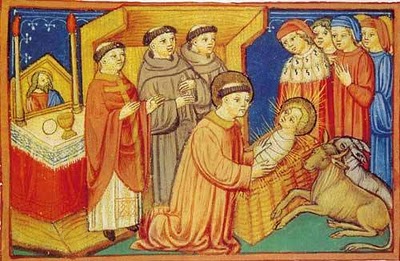
A very early church fresco, attributed by some to the early Master Giotto, depicts the Mass in the Grotto at Grecio at which a living Nativity scene was created.  St. Francis is depicted holding the Christ Child in adoration.


It’s Christmas Day and time to reflect on the Christian religious origins of this holiday with traditions borrowed from pagan times and which has been overlaid by more than one secular celebration. 
In 1223 St. Francis of Assisi is said to have created the first recreation of the birth scene in a cave near Greccio in Italy.  He was inspired by a recent trip to the Holy Land.  It was a living Nativity tableau, with people representing the Holy Family, shepherds, Magi, and angels and live animals, including an ass and an ox for realism.  The custom quickly caught on and spread across Europe. 
Soon the scene was being reproduced in religious art, both paintings and in sets of figurines to be displayed in the Nave of a Church or, eventually, in the manors of the wealthy.  By the early days of the Renaissance the scene was somewhat standardized.  Instead of St. Francis’s Grotto, the birth place was usually portrayed as a stable, often with a thatched roof with skeletal or broken walls, the participants garbed as peasants and lords of the day.  

A Renaissance  Nativity by German Martin Schongauer typified the  developing conventions of depicting a simple stable with a thatched roof and open or broken walls.
It is this familiar scene, often erected in religious homes and adorning countless Christmas cards, that most of us have firmly in our mind when we hear a reading of the Biblical nativity story.
With that in mind, I composed a poem for a Christmas Eve service at what was then still called the Congregational Unitarian Church in Woodstock, Illinois a more than a dozen years or so ago.  I used the classic crèche as a metaphor for the Congregation.  The poem was included in my 2004 collection of poetry, We Build Temples in the Heart and has frequently been used in Unitarian Universalist and other worships setting since. 

A typical home crèche
Let Us Be That Stable

Today, let us be that stable
            Let us be the place
            that welcomes at last
            the weary and rejected,
            the pilgrim stranger,
            the coming life.

Let not the frigid winds that pierce
            our inadequate walls,
            or our mildewed hay,
            or the fetid leavings of our cattle
            shame us from our beckoning.

Let our outstretched arms
            be a manger
            so that the infant hope,
swaddled in love,
may have a place to lie.

Let a cold beacon
            shine down upon us
            from a solstice sky
            to guide to us
            the seekers who will come.

Let the lowly Shepard
            and all who abide
            in the fields of their labors
            lay down their crooks
            and come to us.

Let the seers, sages, and potentates
            of every land
            traverse the shifting dunes
            the rushing rivers,
            and the stony crags
            to seek our rude frame.

Let herdsmen and high lords
            kneel together
            under our thatched roof
            to lay their gifts
            before Wonder.

Today, let us be that stable.

—Patrick  Murfin


Thursday, December 25, 2014

Let Us Be That Stable— My Annual Christmas Poem

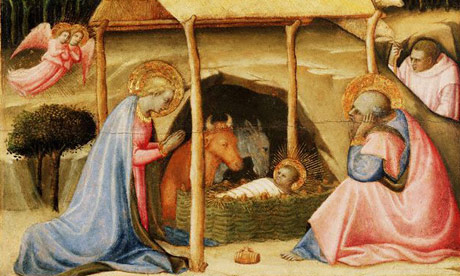
A 15th Century Italian Renaissance nativity by Paolo Shiavo


It’s Christmas Day and time to reflect on the Christian religious origins of this holiday with traditions borrowed from pagan times and which has been overlaid by more than one secular celebration. 
In 1223 St. Francis of Assisi is said to have created the first recreation of the birth scene in a cave near Greccio in Italy.  He was inspired by a recent trip to the Holy Land.  It was a living Nativity tableau, with people representing the Holy Family, shepherds, Magi, and angels and live animals, including an ass and an ox for realism.  The custom quickly caught on and spread across Europe. 
Soon the scene was being reproduced in religious art, both paintings and in sets of figurines to be displayed in the Nave of a Church or, eventually, in the manors of the wealthy.  By the early days of the Renaissance the scene was somewhat standardized.  Instead of St. Francis’s Grotto, the birth place was usually portrayed as a stable, often with a thatched roof with skeletal or broken walls, the participants garbed as peasants or lords of the day.  

A traditional home creche.  
It is this familiar scene, often erected in religious homes and adorning countless Christmas cards, that most of us have firmly in our mind when we hear a reading of the Biblical nativity story.
With that in mind, I composed a poem for a Christmas Eve service at what was then still called the Congregational Unitarian Church in Woodstock, Illinois a dozen years or more ago.  I used the classical crèche as a metaphor for the Congregation.  The poem was included in my 2004 collection of poetry, We Build Temples in the Heart and has frequently been used in Unitarian Universalist and other worships setting since.  

By William Bell Scott--19th Century Scottish.

Let Us Be That Stable

Today, let us be that stable
            Let us be the place
            that welcomes at last
            the weary and rejected,
            the pilgrim stranger,
            the coming life.

Let not the frigid winds that pierce
            our inadequate walls,
            or our mildewed hay,
            or the fetid leavings of our cattle
            shame us from our beckoning.

Let our outstretched arms
            be a manger
            so that the infant hope,
swaddled in love,
may have a place to lie.

Let a cold beacon
            shine down upon us
            from a solstice sky
            to guide to us
            the seekers who will come.

Let the lowly Shepard
            and all who abide
            in the fields of their labors
            lay down their crooks
            and come to us.

Let the seers, sages, and potentates
            of every land
            traverse the shifting dunes
            the rushing rivers,
            and the stony crags
            to seek our rude frame.

Let herdsmen and high lords
            kneel together
            under our thatched roof
            to lay their gifts
            before Wonder.

Today, let us be that stable.

—Patrick  Murfin