Showing posts with label Alexander Hamilton. Show all posts

Saturday, October 18, 2025

The World Was Turned Upside Down When the Band Played at Yorktown


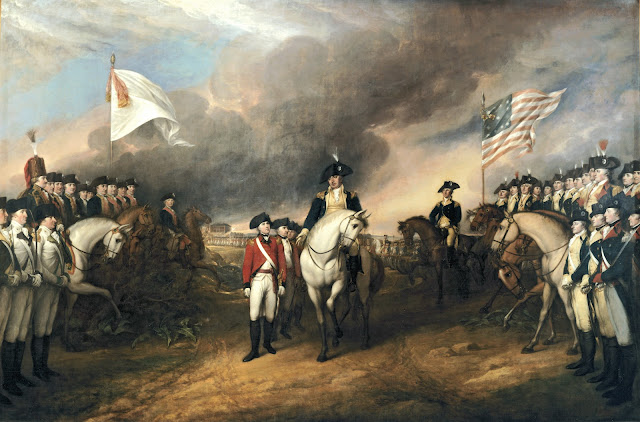
John Turnbull's famous 1820 painting of the surrender at Yorktown.  General Benjamin Lincoln accepted the sword from Brigadier Charles O'Hara as Washington looked on.  The French army was on the left and the Continental Army on the right.  The band played The World Turned Upside Down. 

The English musicians had it right when they played The World Turned Upside Down on October 19, 1781.  On that day British forces commanded by Lieutenant General Lord Cornwallis marched out of their fortifications at Yorktown, Virginia between ranks of Continental Army and French troops. Cornwallis, feigning illness, dispatched Irish born Brigadier General Charles O’Hara to do the distasteful duty.  O’Hara attempted to offer the sword of surrender to the senior French officer, the Comte de Rochambeau who declined pointing to General George Washington.  Washington, irked at Cornwallis’s breach of decorum, likewise refused to accept the sword from an inferior officer.  He chose his subordinate, General Benjamin Lincoln, who was humiliated at the surrender of Savannah, Georgia, to accept the sword.  7,087 British and German mercenary officers and enlisted men and 840 sailors from the British fleet in the York River laid down their arms.

By the terms of the surrender worked out in delicate negotiations since the British advanced a white flag across the front on October 17, rank and file troops became prisoners of war with a promise of humane treatment.  Officers were allowed to swear parole and disembark for England.  Washington had curtly refused a proposed article 10 of the surrender document that would have given protection to Loyalists and Cornwallis knew that he could not contest the issue, leaving local Tories unprotected.

The surrender was not the end of the war but was clearly a blow from which the British could not recover.  Both sides avoided major clashes of their main armies for nearly two years as negotiations dragged on in Paris until a treaty was finally signed recognizing American independence on September 3, 1783.

Modern historians accurately emphasize that the victory at Yorktown would have been impossible except for the large French Army under Rochambeau and the presence of the French Fleet under the Comte de Grasse at sea.  After the patriotic hagiography of Washington in the 19th Century, it has become fashionable to decry the Continental commander’s generalship, particularly considering his long string of battlefield losses to the British—especially the disastrous Long Island campaign.  But Washington was masterfully in command of the operation from the time the allies reached agreement on a plan in Newport, Rhode Island. 

In July of 1780 a French fleet under Admiral Destouches brought Rochambeau and 5,500 troops to join the Americans at Newport.  Washington and the French General soon reached a rapport and encouraged the Admiral to sail south to support American troops under the Marquis de Lafayette in contesting a large British force under the traitor Benedict Arnold in Virginia.  The Admiral was reluctant to test his fleet against the British and sent only a small squadron of three ships in February 1781.  When those proved ineffective he took a larger force of 11 ships in March 1781 and fought a tactically inconclusive battle with the British fleet under Marriot Arbuthnot at the mouth of the Chesapeake Bay. Destouches withdrew due to the damage sustained to his fleet, leaving Arbuthnot and the British fleet in control of the bay’s mouth.

Meanwhile Arnold’s raiding troops were reinforced by 2,300 troops under Major General William Phillips, who took command. Phillips easily defeated the Virginia Militia and burned the tobacco warehouses at Petersburg on April 25. Just as Richmond laid exposed Lafayette’s 1,200 Continental Troops of the Line arrived, and the British withdrew to Petersburg on May 10. 


Driven out of the Deep South by an American campaign of attrition, Lord Charles Cornwallis "invaded" Virginia which was defended by ill organized militia and a small force of Continental troops playing a clever game of tag under Washington's favorite, the young Marquis de Lafayette.  Painting by John Singleton Copley.

On May 20 Cornwallis arrived at Petersburg with the Southern army that had masterfully been driven out of Georgia and the Carolinas by an American campaign of attrition that succeeded even without winning a major battle.  Despite technically winning a battle at Guilford Court House in Greensboro, North Carolina against the American army under General Nathaniel Green, Cornwallis  lost nearly a quarter of his men.  He decided, against General Henry Clinton’s orders to hold the Deep South, to turn north to “invade” Virginia.

Cornwallis took command of the united troops at Petersburg since Phillips died of swamp fever.  He received further reinforcements from Clinton in New York bringing his total forces to 7,200 men.  Lafayette fell back on Richmond, where he was reinforced by troops under Baron von Steuben and Anthony Wayne.  Now with 4,200 men, Lafayette played cat-and-mouse with half of Cornwallis’s men as the other half raided to the south.  Clinton issued contradictory orders but finally directed Cornwallis to Yorktown where he was to build strong fortifications, create a deep water port for the Royal Navy and await further reinforcement from New York.

Meanwhile Washington and Rochambeau convinced de Grasse, a more aggressive officer than Destouches, to move with his powerful West Indies Fleet to the mouth of the Chesapeake to block reinforcement of Cornwallis. The French and Continental Armies assembled at White Plains north of New York to determine a course of action.  At first Washington proposed an assault on the city and began probing British defenses with reconnaissance raids.  But after de Grasse confirmed that he would be sailing to Virginia with a fleet of 29 ships and additional troops, the two commanders agreed to march their armies, in as much secrecy as possible, south to join Lafayette in trapping the British on the Yorktown peninsula. 

Washington, a master of counterintelligence and misdirection, allowed dispatches to be “captured” by the British that indicated that the joint armies planned an assault on New York, made all the more believable by Washington’s probes. 

On August 19 4,000 French and 3,000 American troops began the march in Newport while a large number were left in White Plains to continue pressure on Clinton in New York and defend the Hudson Valley.  The Armies arrived at Philadelphia on September 2.  Continental troops threatened not to cross into Virginia unless they were paid, and Congress hastily authorized immediate payment of one months wages. 

On September 5 Washington got word that de Grasse arrived off of Virginia, disembarked troops to reinforce Lafayette, and was sending his empty transports north to pick up his army.  The same day de Grasse heavily damaged a British relief fleet under Rear Admiral Sir Thomas Graves at Battle of the Capes sending the British limping back to New York and preventing any interference with the movements of Continental and French forces.


French commander the Comte de Rochambeau quickly established a rapport with Washington and together they mapped out plans for a campaign.  The French officer was always careful to acknowledge and honor the Continental General as the senior commander.

Washington and Rochambeau made a hasty march to the Head of Elk on the northern tip of the Chesapeake Bay where most of the troops were picked up by de Grasse’s transports.  Others were picked up in Baltimore on the way south.  Washington arrived in Williamsburg on September 14.  His artillery, baggage, and siege tools arrived with more French assault troops days later.  Washington now commanded a combined force of 8,000 Continentals, 7,800 French, and 3,100 militia.  In addition, he had an impressive artillery train including heavy siege guns.

On September 28 Washington led his army out of Williamsburg and surrounded the British on the Yorktown peninsula.  The French fleet prevented reinforcements or evacuation.  Cornwallis was trapped.  With the French under Rochambeau on the left and the Continentals in the “place of honor” on the right, Washington closed in.  For the next two weeks he brilliantly conducted a classic siege campaign.  


  Rochambeau and Washington giving their last orders before the battle in the Siège de Yorktown by Auguste Couder.

As Washington slowly tightened the noose, Cornwallis abandoned his outer defenses except for a Fusilier’s redoubt on the west side of the town and Redoubts 9 and 10 in the east on September 30.  The allies occupied the abandoned defense line and set up guns to pound British emplacements.  Cornwallis had his men occupy earthwork defenses just outside the city of Yorktown and awaited promised reinforcements from Clinton.  Amid regular skirmishing and artillery exchanges, Washington advanced construction of a series of siege parallelstrenchesever closer to the British positions. On the 3rd, the foraging party, led by Tory Col. Banastre Tarleton, tried to make a break but were met by Lauzuns Legion, and John Mercers Virginia militia under the command of the Marquis de Choisy who sent the cavalry quickly reeling back behind their lines, with 50 men lost.


On the night of October 6, troops moved out in stormy weather to dig the first parallel. Washington ceremonially struck several blows with his pickax to begin the trench. The trench was to be 2,000 yards long, running from the head of Yorktown to the York River. 

By October 9, all of the considerable allied artillery was in place in the parallel.  The French guns opened the barrage and drove the British frigate, HMS Guadeloupe across the York River, where she was scuttled to prevent capture. Then the Americans opened up with the first gun ceremonially fired by Washington himself.  The British line was pounded unmercifully.  Fire continued into the night so that the British could get not rest and while  miners and sappers could begin construction of a second parallel.

 
Washington fires the first gun of the siege. 

The British never discovered that a second line was being dug.  They were surprised on the morning of October 12 when fire erupted from the second line.  By the October 14 the trenches had reached within 150 yards of the British Redoubts 9# and 10#.  The allies prepared assaults to take these critical defenses.  Both redoubts were heavily fortified with rows of abatis (sharpened log stakes) surrounding them, and muddy ditches that surrounded the redoubts at about 25 yards.  A French diversionary attack on the Fusilier’s redoubt at 6:30 am sent much of the British line into a panic. 

At seven the 400 elite light infantry with Colonel Alexander Hamilton in the lead launched a bayonet assault on 10#.  Hamilton sent Laurens around to the rear of the redoubt to prevent the British from escaping while his men hacked through the abatis, crossed a ditch, and climbed the parapet into the redoubt, despite recieving heavy fire, Hamilton took the fortress by storm.  The French under German Lieutenant Colonel Wilhelm von Zweibrücken bogged down in the abatis for a while but then crested the parapets and forced the defending Hessian troops to withdraw to an interior line behind some barrels before forcing them to surrender.


Alexander Hamilton spent most of his war as aide de camp and a surrogate son to George Washington but he ached to prove himself in  battle.  The General allowed him to take command of the critical assault on  Redoubt #10.  He earned the glory that he craved and that he knew would boost his post war ambitions.


With these two positions now in his hands, Washington’s artillery was in complete command of British positions in the city and in the harbor.  American and French gunners kept up relentless fire. In a desperate attempt to break out on October 15 British troops managed to take a small portion of the American line and spike six guns before retreating under heavy fire.  By evening the six guns were repaired and pounding the enemy once again.

The next day Cornwallis attempted to evacuate his troops across the York River to Gloucester Point.  One wave of boats made it across, but a squall hit, making further evacuation impossible.

Cornwallis convened a council of war and his officers agreed that their situation was now hopeless.  On the morning of October17 he dispatched a drummer followed by an officer waving a white handkerchief.  The bombardment ceased, and the officer was blindfolded and led behind the Allied lines.  After two days of negotiations, the formal surrender was conducted.

Washington seldom gets credit, but he had sole command of the entire operation, while consulting regularly with his French allies.  His conduct of the siege was masterful.

Five days later the British fleet sent by Clinton to rescue the British army finally arrived off Yorktown.  They could do nothing but pick-up frightened Tories and sail back to New York before the French fleet overtook them. 


Saturday, March 15, 2025

The Day George Washington Stared Down a Coup

Washington's Newbugh Address quashed a coup d' etat against Congress and military rule. 

The American Revolution in the military sense was essentially over in March of 1783 except for minor skirmishes and associated Indian warfare on the far western frontier. Everyone was waiting for Benjamin Franklin and John Adams in faraway Paris to conclude a final peace treaty. George Washingtons victorious Continental Army had to be held together just in case talks broke down or a change in ministry in London decided to take another crack at subduing the wayward former colonies.
 
A dysfunctional government run collectively by a fractious Congress under the terms of the Articles of Confederation and without direct power of taxation was unable to pay its troops—even its officers, and scarcely able to deliver to the Army basic provisions for survival. The Army was idle and hungry. An idle, hungry army is a very dangerous thing. 
 
Afterwards other revolutions won by rebel armies after protracted wars would come to similar cross roads. It almost never ended well. Usually the victorious General would place himself at the head of his troops and overthrow what civil revolutionary authority there was, declaring himself President, Dictator, or Monarch and consolidating his power by lavishing the spoils of war on his officers and men. Other times revolution devolved into bitter civil war. Almost never did it end with civil government intact and hardly a shot fired in anger. One man, General Washington himself, prevented calamity in one of the most important acts of his distinguished career and one that is little remembered today. This is what happened. 
 
Washington's Headquarters at Newburgh.
 
The bulk of the Army had been encamped at Newburgh, New York to keep the British Army under close surveillance and bottled up in New York City since March of 1782. As another winter approached, all eyes turned to Congress where proposals to provide pensions when the Army was disbanded were being debated. 
 
In 1780, to squelch earlier discontent among the troops, Congress had pledge to, on the model of the British, put all officers on half-pay for the rest of their lives. Now the treasury, such as it was, was empty and with no power to compel the states to fund the Confederation government, there was no way to make good on that promise. Worse, in January Superintendent of Finance Robert Morris announced that the coffers were empty and that he was suspending paying the Army. Previously Morris, a financier and one of the wealthiest men in the new nation, had met such emergencies by personally guaranteeing notes—and buying many of them himself. That he refused to do so at this juncture was part a plan of a faction of Congress known as the Nationalists to put pressure on the new government to assert limited powers of taxation, notably the ability to levy an import duty or impost. This was bitterly opposed by a larger block of Congress and many states had passed instructions to their delegates forbidding them to vote in favor of payments of pensions fearing that it would force the adoption of taxation. 
 
The Nationalists who included Morris, Gouverneur Morris of New York, James Madison, and Alexander Hamilton who had left the Army to take a seat in Congress from New York, backed the impost plan not only to meet obligations to the Army, but to pay the many debts of Congress amassed during the Revolution. They hoped that a possible crisis involving the Army might force Congress to move. They were in more or less confidential communication with officers in the Army, including some senior commanders. 
 
Among those was one of Washington’s favorite officers, General Henry Knox, who was encouraged to draft a memorial to Congress signed by other senior officers of such impressive stature that they could not be dismissed as mere malcontents. After expressing dissatisfaction with the suspension of pay, the memorial offered a compromise on the pension issue. Instead of half pay for a life time, they indicated the Army would be satisfied with a lump sum payment. It concluded with a not very veiled threat that “that any further experiments on their [the army’s] patience may have fatal effects.” Private messages were also sent to Secretary of War Benjamin Lincoln, himself recently out of the Army and the officer delegated by Washington to receive the surrender of the British at Yorktown, which made clear the dangerous state of moral in the Army. 
 
The memorial was delivered to Congress by General Alexander McDougall and Colonels John Brooks and Matthias Ogden in late December 1782. McDougall and Brooks lingered in Philadelphia to lobby Congress and monitor the situation. They met with a special committee in early January to explain the seriousness of the situation. That committee reported to the whole body on January 22 at which time Robert Morris shocked Congress by announcing his resignation in despair of the body acting. The nationalists twice tried to pass legislation calling for pensions at full pay to end on a specific date as an alternative to the original lifetime half pay or the Army’s immediate lump sum. On February 4 Congress rejected the proposal for the second time. 
 
Brooks hastened back to Newburgh to rally the officer corps for more decisive action. McDougall wrote Knox under the significant pseudonym Brutus suggested that the Army refuse to disband when peace was announced until their demands were met. That action would be virtual mutiny in the face of an order from Congress to demobilize. Knox was sympathetic but non-committal. 
 
Meanwhile other dissenting forces in the Army became involved. That included the staff of Washington’s chief rival General Horatio Gates, the victor at Saratoga and a clique of younger officers long dissatisfied with Washington’s leadership and outside the thrall of the cult of personal loyalty to him. Nationalists in Congress may have believed that these officers might be the core of a coup d’état should it become necessary. 
 
By mid-February rumors that a peace treaty was at hand swirled around both the capital in Philadelphia and the camp in Newburgh, bring the situation closer to crisis. Hamilton wrote privately to Washington, his patron in the Army and who was said to regard him like the Marquis de Lafayette as a son. Taking advantage of the relationship, Hamilton warned the General of the dangers in his camp and urged him to “take the direction” of the army’s anger—in other words be ready to assume command of a coup against Congress. Shocked, Washington wrote back that he sympathized with the plights of both the Army and of Congress but flatly said that he would be no part of a plan to use the Army as a threat to the civil government in contradiction to the republican principles on which the war had been conducted.
 
Washington's trusted and loyal chief of artillery, Major General Henry Knox dashed plotters' hopes when he refused to participate in or lead a refusal of the Army to disband and menace Congress.
 
On February 21 Knox dashed the hopes of Congressional Nationalists who had hoped that he would lend his prestige to a threat not to disband the Army undoubtedly after consultation with Washington. In letters he expressed again sympathy for the Army’s plight but declared he would not participate in any mutiny or revolt and expressed the hope that the Army would only be used “against the Enemies of the Liberties in America.” 
 
Without the support of Washington and Knox—indeed with their declared opposition—the Nationalists turned their attention to Gates as their best bet for a man on a white horse. They sent Gates a signal of their support should he decide to move with Pennsylvania Colonel Walter Stewart, returning to duty after an illness. He arrived at camp on March 8 and met with Gates. Rumors about an impending demonstration of some kind swirled through the camp. On March 10 an unsigned letter, later attributed to Major John Armstrong, Jr. who was an aide to Gates, began circulating in camp calling for a meeting of field grade officers the next day, March 11 at 11 am. 
 
As soon as Washington got wind of it he denounced the “disorderly... and irregular nature” of the anonymously called meeting in his general orders of the day the morning of the 11th. Without explicitly banning the meeting, he proposed his own meeting of officers on March 15. The letter was carefully worded to give the impression that Washington himself would not attend. Instead, he directed the meeting to be chaired by the “senior officer present” knowing full well that would be Gates. 
 
Major General Horatio Gates, the victor at the turn-the-tide Battle of Saratoga, chaired the Newbugh meeting of rebellious officers and was apparently prepared to assume command of a mutinous Army if Washington would not. 
 
The next day a second anonymous letter appeared claiming that Washington’s endorsement of a meeting on the 15th was a signal the General would support a threat in force to Congress. Washington was furious. 
 
For the next three days the camp was awash in rumors and whispered plot. On the appointed time on Saturday, March 15 the officers assembled in the New Building or Temple which had just been constructed and was the largest facility in camp capable of holding such a meeting. As expected, Gates took the chair. Shortly after he called the meeting to order, Washington suddenly and unexpectedly appeared and asked permission to address the assembly. 
 
His sudden appearance caused quite a stir—and for one of the few times in his experience in the Army the greeting was not unanimously adulatory. Younger officers and those who had not personally served close to him hooted and jeered. Gates must have been none to glad to see his commander but had no choice but to allow him to speak. 
 
Washington asked for permission to address the meeting--he could hardly have been denied.
 
Washington came to the front of the room and turned to face his officers. He gave a short speech with unusual heat and passion, a departure from his carefully cultivated image of lofty probity. He had carefully drafted the statement but gave it without notes as if extemporaneously. He called upon the assembly to oppose anyone “who wickedly attempts to open the floodgates of civil discord and deluge our rising empire in blood.” 
 
Then he drew sheets of paper folded in half length-wise from inside his coat. It was a letter from a member of Congress. He fumbled with the paper and seemed to have difficulty reading it. He then drew from another pocket a new pair of spectacles. Almost no one except his closest aides had yet seen him wear them. He slowly unfolded them and perched them unsteadily on his nose. 
 
“Gentlemen, you will permit me to put on my spectacles, for I have not only grown gray but almost blind in the service of my country.” Many of the officers wept. The sympathy and sentiment of the room swung immediately to Washington. After reading the letter, which really added little to the issue at hand, the General bowed and left the building without waiting for a response. He didn’t have to wait.
 
The conspiracy or potential coup or whatever had been afoot collapsed. A motion was made to denounce the anonymous letters. It passed virtually unanimously with only Colonel Timothy Pickering protesting. Other motions affirmed the loyalty of the Army. A committee consisting of General Knox and Colonel Brooks was appointed to draft a final resolution which expressed the “utmost confidence” of the Army in Congress and the “disdain and abhorrence” for the irregular proposals circulated earlier. 
 
Washington's spectacles--the key prop in a bit of business that swung sympathy and loyalty to him. 
 
How much of the proceedings that morning was carefully stage-managed in advance by Washington and Knox and how much was happy accident is hotly debated by historians. I am in the camp that recognizes Washington as a brilliant tactician. The old fox knew exactly what he was doing. The speech went down in history as the Newburgh Address, but it was a bit of stage business that carried the day.
 
Meanwhile Washington sent copies of both the anonymous letters and his address to Congress, which was debating, yet again, the pension issue. Even steadfast opponents now realized how narrowly disaster had been averted. The Nationalists saw an opportunity. They advised the creation of a committee to study the intelligence and come up with a solution. Shrewdly, they stacked the committee with steadfast opponents of any pension plan. But presented with mounting evidence of deep dissatisfaction in the Army and the prospect that in the future Washington might not be able to so deftly turn aside open rebellion, one anti-pension delegate, Eliphalet Dyer of Connecticut,  came forward with a proposal for a lump-sum payment, including arrears pay. 
 
As finally approved, the pension plan called for half-pay for five years, mirroring the solution proposed by Knox and twice rejected before. The payment was not in cash, but in government bonds, highly speculative securities many thought would be worthless. Many officers sold their bonds to speculators for pennies on the dollar. But those who held onto the bonds were made whole. Thanks to the adoption of the Constitution, the new ability of the nation to levy import duties and taxes, and Secretary of the Treasury Alexander Hamilton’s determination to fully pay off all of the Revolutionary War debt, the bonds were redeemed by the government at full value in 1790. 
 
But Congress was not yet out of the woods. Discontent spread to the still uncompensated non-commissioned officers and there was some minor rioting in camp and talk of marching on Philadelphia to claim their back pay. Once again the specter of the Army refusing to disband was raised. 
 
 
Robert Morris stepped up with $800,000 in personal notes to pay non-commissioned officers and enlisted men three months pay to encourage them to obey and order to disband after victory was concerned.  His sacrifices contributed to his financial failure  and he was sent to debtor's prison after the war.
 
On April 19, eight years to the day since the Battles of Lexington and Concord, with news of a final Peace Treaty confirmed, Washington declared the war over. Congress quickly ordered him to disband the Army and voted each enlisted man and non-commissioned officer three months’ pay. Since there were still no funds in the treasury, Robert Morris stepped up $800,000 in notes on his personal accounts to the troops. 
 
Many soldiers, in need of cash just to get home, sold their notes to speculators at deep discounts. The notes, whether retained by the soldiers or by the speculators were also paid off by Hamilton. Soldiers left camp over the next few months either on a furlough from which they never expected to be recalled or outright discharged. 
 
The notes were given them upon their separation. This caused difficulties when a Pennsylvania regiment was swept by rumors that they would be discharged before getting their notes. They departed camp and marched on Philadelphia in June, sending Congress scurrying to Princeton, New Jersey. There is evidence that some supporters of the Newburgh plot also had a hand in this dangerous mini-uprising including Walter Stewart, John Armstrong, and Gouverneur Morris. 
 
But the crisis passed. The Army was formally disbanded in November except for small garrisons at West Point and on the frontier. Washington went to New York City where he was given a hero’s public welcome and met for one last time with his officers, including many of the players in the Newburgh affair, for an emotional farewell at the Fraunces Tavern. Then he retired to his Virginia plantation, disappointing those who hoped he would become king and they his hereditary nobles.
 
Robert Morris stepped up with $800,000 in personal notes to pay non-commissioned officers and enlisted men three months pay to encourage them to obey and order to disband after victory was concerned.  His sacrifices contributed to his financial failure  and he was sent to debtor's prison after the war. 
 
Perhaps the saddest fate of all of those involved, except for Hamilton who died in that infamous duel with Vice President Aaron Burr, was that of Robert Morris. He had expended much of his personal wealth for the cause. To recoup his losses in 1791 he contracted with Massachusetts to purchase what is now essentially all of Western New York west of the Genesee River for $333,333.33. There were other deals involving land in and around Washington, DC and in the South, as well as contracts on Virginia tobacco for sale in France. First the French Revolution erupted destroying his market there and leaving him deeply in debt for annual commitments to purchase the tobacco. Then a financial panic in 1797 left him land rich and cash poor, unable to pay his many creditors. He lost most of his land and was actually held for two and a half years in debtor’s prison. 
 
Congress passed the temporary Bankruptcy Act of 1800, in part, to get Morris out of prison. In ill health, he spent the rest of his life in a modest Philadelphia home in retirement. He died in 1809.
 
The United States of America got and kept, for what it is worth, a Constitutional republic and a military subservient to an elected civilian government. But it was a closer thing than you probably imagined.

Tuesday, February 4, 2025

No Need to Stay Up All Night for the Results of the First Presidential Election

George Washington was the totally unsurprising winner of the first U.S. Presidential election.  This is the first portrait painted from life after taking office in 1798 by John Ramage in New York City, the temporary capital.  Interestingly Washington still chose to be painted in his Continental Army uniform wish his Order of Cincinatus medal.

The least exciting Presidential Election in United States history was held on February 4, 1789.  On that day the votes of the first Electoral College under the shiny new Constitution were opened, read, and counted before the House of Representatives in the new temporary capital of New York City. Earlier, the Electors of each participating state had assembled in their capitals to cast their votes.  Of the 69 Electors who voted, 68 were Federalists—not yet a party but avowed supporters of the new Constitution—and one, from Georgia, was an Anti-Federalist.

Electors were chosen in a variety of ways.  A minority were directly elected either state-wide or by Congressional or special electoral districts.  Most were elected by state legislatures, usually by a state’s upper chamber or Senate.  Because of that, property restrictions on voting, exclusion of Blacks slave or free, and of women, less than 1.3% of the adult population of the nation got to cast a popular vote for an elector, and thus indirectly for President.  The total popular vote was only 38,818.

 The first campaign buttons were literally clothing buttons like these brass ones for George Washington.

Only 10 of the 13 states participated in the election.  North Carolina and Rhode Island could not because they had not yet ratified the Constitution.  In New York Anti-Federalists led by Governor George Clinton and Federalists controlled by Alexander Hamilton deadlocked in the state legislature and failed to select their allotted eight Electors.  In addition, one Virginia district failed to report returns and thus had no Elector.  One Virginia and two Maryland Electors did not vote. A total of 12 candidates were nominated for the Presidency, led by Revolutionary War Commander-in-Chief George Washington.  


A map showing Washington's sweep of the Electoral College--the only President ever elected unanimously.

But at first it was not certain that Washington would accept the post.  Other candidates either hoped that Washington would stay in Virginia or hoped to be selected Vice President.  The candidates included the well-known—Minister to Great Britain John Adams, Governor John Hancock of Massachusetts, Secretary of Foreign Affairs under the Articles of Confederation John Jay, General Benjamin Lincoln, and governors of  Connecticut, South Carolina, and Georgia.  New York Governor Clinton was the best known Anti-Federalist.  And there were less well known candidates—Robert H. Harrison of Maryland, Georgia Secretary of State John Milton, and James Armstrong who was so obscure that historians are not entirely sure about who he was or if he was from Pennsylvania or from Georgia, where one Elector pledged to him was elected.

In fact all of the secondary candidates had at least one pledged Elector, with Adams leading the pack.

John Adams was elected Vice President by coming in second in the Electoral College.  Alexander Hamilton engineered several votes to be withheld from Adams resulting in a very narrow margin of victory.  That would set the two future leaders of the emerging Federalist Party at bitter odds with each other. 

When Washington finally signaled his willingness to serve, all participating Electors cast their votes for him, making him the only man ever unanimously elected president with 69 votes.  But under the new Constitution, each Elector cast two votes for President.  The top total vote-getter—if he achieved a majority in the College—would be President and the second place finisher would be Vice President.  Although locked out of the procedure by New York’s stalemate, Alexander Hamilton, acting as a Federalist whip, made sure that votes were withheld from Adams to ensure a clear victory for Washington.  Other electors cast their second vote among the other candidates.  Adams won with 36 votes, only one more than the needed 35.

Adams felt slighted by Hamilton’s work to keep his support down among Federalists.  It was the beginning of a long, bitter rivalry for leadership of the Federalists as they morphed into a real political party.


Thursday, July 11, 2024

Alexander Hamilton’s Very Bad Day at Weehawken

You think politics today is a vicious contact sport?  Sissy stuff.  On July 11, 1804 the sitting Vice President of the United States plugged a Founding Father in the gut leaving him to die in agony a day later.  It was the most famous Affair of Honor in American Historythe fatal meeting between Aaron Burr and Alexander Hamilton on the dueling grounds at Weehawken, New Jersey, a bluff overlooking the Hudson River and the City of New York beyond. 

The men, so alike in temperament and ambition, were long-time bitter political rivals.  

Alexander Hamilton--the bastard son of small time Barbados merchant and certified Founding Father at the peak of his career in 1792 as the first Secretary of the Treasury and George Washington's most trusted advisor.  Detail from a full length portrait by John Trumbull.

Hamilton, of course, was George Washington favorite, the virtual son he never had.  After distinguished service as Washington’s aide-de-camp in the Revolution, he became the principal author of the Federalist Papers.  As Secretary of the Treasury, he famously paid off American war debt and established the First Bank of the United States.  Thomas Jeffersons bitter personal and political rival, Hamilton founded and was the chief architect and organizer of the Federalist Party.  In New York he was a successful lawyer and businessman who married into the wealthy and powerful Patroon dynasty, the Schuylers.

Yet despite his wealth, success, and fame, he was humiliated by the humble circumstances of his birth as the bastard child of a Scottish clerk on the island colony of Barbados.  He would be haunted by rumors that his mother was a mulato creole.  He knew that he was not by rights a gentleman and his foreign birth forever precluded him from becoming truly Washington’s heir as President.

Aaron Burr is commemorated for his service as the third Vice President by this bust in the Senate chamber.

Burr was born in more privileged circumstances, the son and namesake of a leading Presbyterian divine and the second president of the College of New Jersey (now Princeton.)  He served with distinction in the Revolution displaying battlefield bravery and shrewd tactical acumen many times.  He achieved the rank of Lieutenant Colonel, but despite his notable achievements was not elevated to higher rank by Washington—a cause of personal bitterness.  After the war Burr married the daughter of a British officer and moved to New York where he became the leading criminal defense attorney in the city.  After a turn in the State Assembly, Burr’s political fortunes rose under the sponsorship of Governor George Clinton, the leading northern ally of Jefferson in his emerging Democratic Republican Party.  Clinton appointed young Burr state Attorney General and backed him in 1791 when Burr beat incumbent Phillip SchuylerHamilton’s father-in-law—to take a U.S. Senate seat. 

Although their previous personal relations were cordial much of their mutual enmity grew from this confrontation.  In the end Burr grew restless in a Senate dominated by Federalists and prolonged absences hurt his income as an attorney on which he was dependent since he was not personally wealthy.  He resigned his seat to return to the state Assembly.  Officially an independent with Republican leanings, Burr also drew support from moderate Federalists who became alarmed at Hamilton’s attacks on President John Adams.  In the city Burr assembled his own political organization, considered by many one of the first political machines.  He enlisted the support of a local patriotic society, The Sons of St. Tammany, in addition to Jefferson loyalists. 

In the election of 1800, New York and its rich electoral vote was considered pivotal.  Burr was named running mate to Jefferson on the Democratic Republican ticket in the hope that he could deliver New York, although the Assembly was in Federalist hands before the election.  Federalists in the city under Hamilton were in disarray, divided by his tepid support of the President.  A private letter by Hamilton highly critical of Adams’ character was published causing considerable damage and Burr was suspected—but never proven—to be behind the dirty trick.  Meanwhile his new machine paid off handsomely.  Republicans swept the city taking with it the Assembly which in turn selected Republican electors. 

Under the Constitution at the time the candidate with a majority of electors won the presidency and the second place finisher became vice president.  This system was in place before the development of parties.  There was no provision for tickets or a designated vice presidential candidate.  There was a plan for one elector to withhold a vote to Burr, but mysteriously none did so, resulting in a 73-73 tie vote between Jefferson and Burr.  The decision was thrown into the House of Representatives where Federalists held a substantial edge.  

The election of 1800 was thrown into the House of Representatives when Jefferson and Democratic-Republican running mate both received 73 Electoral College votes.

The House soon deadlocked.  Despite public and private statements deferring to Jefferson, ever ambitious, Burr privately courted friends of John Adams among the Federalists to block Jefferson.  Hamilton sprang into action himself, unleashing a flurry of letters urging the election of Jefferson who he considered the “far less dangerous of the two.”  However, much he detested Jefferson, he despised Burr more.  On the 36th ballot Hamilton convinced two of his supporters to abstain.  Recognizing defeat, Burr’s moderate Federalist support fell in line behind Jefferson.  Needless to say, after the intrigue relations between the new President and Vice President were icy. 

Against this festering background, things came to a head in 1804 as it became apparent that Jefferson would dump Burr as Vice President.  He turned his eyes to a comeback in Albany as Governor. These plans were squashed when Hamilton threw his support behind another Republican, Morgan Lewis.  During the campaign an ardent supporter of Hamilton sent a letter to his father-in-law Philip Schuyler excoriating Burr and alluding to “a still more despicable opinion which General Hamilton has expressed of Mr. Burr.”  The letter indiscreetly found publication in the Albany Register.  Burr whipped off a letter demanding of Hamilton an “explanation and apology.”  Hamilton professed ignorance of any such statement and refused to apologize. 

After subsequent exchanges through intermediaries, Burr formally challenged Hamilton.  At many points in this exchange either party could have diffused the situation over a slight which many historians believe did not rise to the occasion of an affair of honor even among the prickly.  But they did not.  Hamilton may have been suffering depression over the downturn of his political fortunes—the defeat of Adams had destroyed the Federalists as a national party leaving behind only a sectional rump in New England.  He had also been humiliated by a sexual blackmail scandal which had caused him to issue a public letter admitting to indiscretions.  And he was also deeply in debt.  Most of all, he mourned the loss of his son Philip who had been killed on the Weehawken dueling ground in 1801 in a fight at least partly over his father’s honor. 

Plans were laid for the duel, which would be held in secret in New Jersey because dueling had been outlawed in New York State and because both men, despite participation in earlier duels, were publicly opposed to the practice.  In a document written to be found in event he was killed, Hamilton wrote that:

I have resolved, if our interview is conducted in the usual manner, and it pleases God to give me the opportunity, to reserve and throw away my first fire, and I have thoughts even of reserving my second fire. 

This was a common, honorable, practice which was usually, but not universally, honored in turn by the second party refusing to fire or “wasting his shot.”  In this manner most duels ended bloodlessly but honorably.  But Burr had no way of knowing that this was Hamilton’s intention.  

Only fanciful pictures of the duel exist.  This one at least shows Hamilton wasting his shot in the air.  But all the seconds and witnesses stood apart with their back turned so as not to be able to testify as eye witnesses.  The men arrived by boat across the Hudson, not by carriage.  And Burr would have broken his wrist and probably his nose had he discharged his pistol in such a ridiculous manner.

There was no eyewitnesses testimony to the shooting itself.  The seconds to both men and the hired oarsmen who had ferried them across the Hudson were positioned with their backs to the action so that if called to court they could truthfully testify that they did not “witness fire.”  The best reconstruction of the events goes as follows—although a minority historians debate virtually every single particular to this day. 

The men faced each other at a distance of less than twenty feet.  Hamilton faced east, across the river with the morning sun in his eyes.  There was a slight, rising mist.  Hamilton ostentatiously practiced aiming and sighting his pistol and polished his glasses for better vision, which would have indicted to Burr that he intended to shoot.  By lot, Hamilton had the first shot.  He raised his pistol and fired high into the air, the bullet lodging in a tree limb high above and to the left of Burr.  But this was not the common way to “waste a bullet” which was to fire into the ground. 

Burr may have concluded that he had simply come under incompetent fire.  At any rate, he leveled his matched pistol and fired, striking Hamilton in the stomach.  The bullet grazed his liver and diaphragm before becoming lodged in his spine, likely paralyzing him below the wound.  He crumpled to the ground immediately. 

Turning around witnesses describe Burr as looking shocked and starting toward Hamilton before his second rushed him away, hiding him behind an umbrella.  Hamilton told Dr. David Hosack, “The wound is fatal” before collapsing into unconsciousness.  The doctor soon lost trace of a pulse or sign of respiration.  Seconds hurriedly carried the wounded man to the boat, where he revived. 

Carried to the home of an acquaintance Hamilton lingered until the next day, much of the time awake but delirious with pain. 

Burr must have known that his political career was as dead as Hamilton.  Public outrage was great.  He was indicted for murder in both New Jersey and New York.  Burr fled the city to the South Carolina plantation of his beloved daughter Theodosia.  The murder charges in New Jersey were eventually dismissed. 

Burr returned to Washington to finish his term as Vice President, dutifully presiding over sessions of the Senate.  His final days were marked as the presiding officer in the impeachment of Federal Judge Samuel Chase with what a contemporary said was, “with the dignity and impartiality of an angel and the rigor of a devil.”  Soon after he summoned all of his considerable charm in an emotional farewell to the Senate that had even some of his old enemies in tears. 

Burr turned his attention to adventurous schemes in the West including a filibustering campaign to liberate Texas from the Spanish—or possibly to set himself up a ruler of an inland empire.  Unfortunately for Burr one of his fellow plotters was the Commanding General of the U.S. Army James Wilkinson, who was also a long-time secret agent of the Spanish (can’t make this kind of stuff up, folks.)  As authorities began to uncover the plot, Wilkinson saved himself in a letter to President Jefferson putting the whole thing in Burr’s lap.   

Burr defends himself at his treason trial presided over by Chief Justice John Marshall.

Jefferson was eager for revenge on Burr and had him prosecuted for treason.  The President was foiled at the 1807 trial presided over by Federalist Chief Justice of the Supreme Court John Marshall sitting as a circuit judge who directed a verdict of acquittal on the grounds that no eyewitnesses to any overt acts could be found.

Fleeing notoriety and creditors Burr went to Europe where he tried to raise money for further western adventures.  He lived for a while with noted British Unitarian Jeremy Bentham.  He was eventually ordered out of England and Napoleon Bonaparte refused to entertain him to hear about his plot to seize Spanish Florida and/or British Caribbean islands. 

In 1812 Burr returned to New York, where he was tried for murdering Hamilton but acquitted.  He resumed the practice of law and his charm ensured a wide circle of friends.  One feeble attempt at a political comeback failed.  His heart and health were broken when his beloved daughter Theodosia and his grandson perished in a shipwreck.  A long-time widower, he married a wealthy heiress late in life, but she walked out after only four months after discovering that Burr was siphoning her riches to support Western land investment schemes.  She was granted a divorce on the day he died.  September 14, 1836 at the age of 80 after a paralyzing stroke.  

Hamilton is more kindly remembered by history,  His bust stands on the old Weehawken Dueling Grounds in New Jersey overlooking the Hudson River.

The Burr-Hamilton Duel spurred opposition to dueling in the North.  Burr, with his reputation for shady dealings and political opportunism is generally cast as the villain of the story by historians.  But he had his supporters, including liberal novelist Gore Vidal, who made Burr the hero of one of the novels in his multi-volume American history arc.  

Following the duel Anti-dueling sentiment spread, laws against the practice were more scrupulously enforced and new ones were enacted where they had not previously been enforced.  By 1830 most of the nation outlawed dueling, and it was rapidly disappearing in the North. It long remained common, however, among the Southern Planter class and in the military, two places in which honor depended on the acknowledgement of others and could be irretrievably lost if not defended.

The climatic duel in Lin-Manuel Miranda's Hamilton. 

Most contemporary Americans, of course, owe everything they know about Hamilton, Burr, and the duel to Lin-Michal Miranda’s phenomenally successful Broadway sensation Hamilton.