Showing posts with label coup d' etat. Show all posts

Saturday, March 15, 2025

The Day George Washington Stared Down a Coup

Washington's Newbugh Address quashed a coup d' etat against Congress and military rule. 

The American Revolution in the military sense was essentially over in March of 1783 except for minor skirmishes and associated Indian warfare on the far western frontier. Everyone was waiting for Benjamin Franklin and John Adams in faraway Paris to conclude a final peace treaty. George Washingtons victorious Continental Army had to be held together just in case talks broke down or a change in ministry in London decided to take another crack at subduing the wayward former colonies.
 
A dysfunctional government run collectively by a fractious Congress under the terms of the Articles of Confederation and without direct power of taxation was unable to pay its troops—even its officers, and scarcely able to deliver to the Army basic provisions for survival. The Army was idle and hungry. An idle, hungry army is a very dangerous thing. 
 
Afterwards other revolutions won by rebel armies after protracted wars would come to similar cross roads. It almost never ended well. Usually the victorious General would place himself at the head of his troops and overthrow what civil revolutionary authority there was, declaring himself President, Dictator, or Monarch and consolidating his power by lavishing the spoils of war on his officers and men. Other times revolution devolved into bitter civil war. Almost never did it end with civil government intact and hardly a shot fired in anger. One man, General Washington himself, prevented calamity in one of the most important acts of his distinguished career and one that is little remembered today. This is what happened. 
 
Washington's Headquarters at Newburgh.
 
The bulk of the Army had been encamped at Newburgh, New York to keep the British Army under close surveillance and bottled up in New York City since March of 1782. As another winter approached, all eyes turned to Congress where proposals to provide pensions when the Army was disbanded were being debated. 
 
In 1780, to squelch earlier discontent among the troops, Congress had pledge to, on the model of the British, put all officers on half-pay for the rest of their lives. Now the treasury, such as it was, was empty and with no power to compel the states to fund the Confederation government, there was no way to make good on that promise. Worse, in January Superintendent of Finance Robert Morris announced that the coffers were empty and that he was suspending paying the Army. Previously Morris, a financier and one of the wealthiest men in the new nation, had met such emergencies by personally guaranteeing notes—and buying many of them himself. That he refused to do so at this juncture was part a plan of a faction of Congress known as the Nationalists to put pressure on the new government to assert limited powers of taxation, notably the ability to levy an import duty or impost. This was bitterly opposed by a larger block of Congress and many states had passed instructions to their delegates forbidding them to vote in favor of payments of pensions fearing that it would force the adoption of taxation. 
 
The Nationalists who included Morris, Gouverneur Morris of New York, James Madison, and Alexander Hamilton who had left the Army to take a seat in Congress from New York, backed the impost plan not only to meet obligations to the Army, but to pay the many debts of Congress amassed during the Revolution. They hoped that a possible crisis involving the Army might force Congress to move. They were in more or less confidential communication with officers in the Army, including some senior commanders. 
 
Among those was one of Washington’s favorite officers, General Henry Knox, who was encouraged to draft a memorial to Congress signed by other senior officers of such impressive stature that they could not be dismissed as mere malcontents. After expressing dissatisfaction with the suspension of pay, the memorial offered a compromise on the pension issue. Instead of half pay for a life time, they indicated the Army would be satisfied with a lump sum payment. It concluded with a not very veiled threat that “that any further experiments on their [the army’s] patience may have fatal effects.” Private messages were also sent to Secretary of War Benjamin Lincoln, himself recently out of the Army and the officer delegated by Washington to receive the surrender of the British at Yorktown, which made clear the dangerous state of moral in the Army. 
 
The memorial was delivered to Congress by General Alexander McDougall and Colonels John Brooks and Matthias Ogden in late December 1782. McDougall and Brooks lingered in Philadelphia to lobby Congress and monitor the situation. They met with a special committee in early January to explain the seriousness of the situation. That committee reported to the whole body on January 22 at which time Robert Morris shocked Congress by announcing his resignation in despair of the body acting. The nationalists twice tried to pass legislation calling for pensions at full pay to end on a specific date as an alternative to the original lifetime half pay or the Army’s immediate lump sum. On February 4 Congress rejected the proposal for the second time. 
 
Brooks hastened back to Newburgh to rally the officer corps for more decisive action. McDougall wrote Knox under the significant pseudonym Brutus suggested that the Army refuse to disband when peace was announced until their demands were met. That action would be virtual mutiny in the face of an order from Congress to demobilize. Knox was sympathetic but non-committal. 
 
Meanwhile other dissenting forces in the Army became involved. That included the staff of Washington’s chief rival General Horatio Gates, the victor at Saratoga and a clique of younger officers long dissatisfied with Washington’s leadership and outside the thrall of the cult of personal loyalty to him. Nationalists in Congress may have believed that these officers might be the core of a coup d’état should it become necessary. 
 
By mid-February rumors that a peace treaty was at hand swirled around both the capital in Philadelphia and the camp in Newburgh, bring the situation closer to crisis. Hamilton wrote privately to Washington, his patron in the Army and who was said to regard him like the Marquis de Lafayette as a son. Taking advantage of the relationship, Hamilton warned the General of the dangers in his camp and urged him to “take the direction” of the army’s anger—in other words be ready to assume command of a coup against Congress. Shocked, Washington wrote back that he sympathized with the plights of both the Army and of Congress but flatly said that he would be no part of a plan to use the Army as a threat to the civil government in contradiction to the republican principles on which the war had been conducted.
 
Washington's trusted and loyal chief of artillery, Major General Henry Knox dashed plotters' hopes when he refused to participate in or lead a refusal of the Army to disband and menace Congress.
 
On February 21 Knox dashed the hopes of Congressional Nationalists who had hoped that he would lend his prestige to a threat not to disband the Army undoubtedly after consultation with Washington. In letters he expressed again sympathy for the Army’s plight but declared he would not participate in any mutiny or revolt and expressed the hope that the Army would only be used “against the Enemies of the Liberties in America.” 
 
Without the support of Washington and Knox—indeed with their declared opposition—the Nationalists turned their attention to Gates as their best bet for a man on a white horse. They sent Gates a signal of their support should he decide to move with Pennsylvania Colonel Walter Stewart, returning to duty after an illness. He arrived at camp on March 8 and met with Gates. Rumors about an impending demonstration of some kind swirled through the camp. On March 10 an unsigned letter, later attributed to Major John Armstrong, Jr. who was an aide to Gates, began circulating in camp calling for a meeting of field grade officers the next day, March 11 at 11 am. 
 
As soon as Washington got wind of it he denounced the “disorderly... and irregular nature” of the anonymously called meeting in his general orders of the day the morning of the 11th. Without explicitly banning the meeting, he proposed his own meeting of officers on March 15. The letter was carefully worded to give the impression that Washington himself would not attend. Instead, he directed the meeting to be chaired by the “senior officer present” knowing full well that would be Gates. 
 
Major General Horatio Gates, the victor at the turn-the-tide Battle of Saratoga, chaired the Newbugh meeting of rebellious officers and was apparently prepared to assume command of a mutinous Army if Washington would not. 
 
The next day a second anonymous letter appeared claiming that Washington’s endorsement of a meeting on the 15th was a signal the General would support a threat in force to Congress. Washington was furious. 
 
For the next three days the camp was awash in rumors and whispered plot. On the appointed time on Saturday, March 15 the officers assembled in the New Building or Temple which had just been constructed and was the largest facility in camp capable of holding such a meeting. As expected, Gates took the chair. Shortly after he called the meeting to order, Washington suddenly and unexpectedly appeared and asked permission to address the assembly. 
 
His sudden appearance caused quite a stir—and for one of the few times in his experience in the Army the greeting was not unanimously adulatory. Younger officers and those who had not personally served close to him hooted and jeered. Gates must have been none to glad to see his commander but had no choice but to allow him to speak. 
 
Washington asked for permission to address the meeting--he could hardly have been denied.
 
Washington came to the front of the room and turned to face his officers. He gave a short speech with unusual heat and passion, a departure from his carefully cultivated image of lofty probity. He had carefully drafted the statement but gave it without notes as if extemporaneously. He called upon the assembly to oppose anyone “who wickedly attempts to open the floodgates of civil discord and deluge our rising empire in blood.” 
 
Then he drew sheets of paper folded in half length-wise from inside his coat. It was a letter from a member of Congress. He fumbled with the paper and seemed to have difficulty reading it. He then drew from another pocket a new pair of spectacles. Almost no one except his closest aides had yet seen him wear them. He slowly unfolded them and perched them unsteadily on his nose. 
 
“Gentlemen, you will permit me to put on my spectacles, for I have not only grown gray but almost blind in the service of my country.” Many of the officers wept. The sympathy and sentiment of the room swung immediately to Washington. After reading the letter, which really added little to the issue at hand, the General bowed and left the building without waiting for a response. He didn’t have to wait.
 
The conspiracy or potential coup or whatever had been afoot collapsed. A motion was made to denounce the anonymous letters. It passed virtually unanimously with only Colonel Timothy Pickering protesting. Other motions affirmed the loyalty of the Army. A committee consisting of General Knox and Colonel Brooks was appointed to draft a final resolution which expressed the “utmost confidence” of the Army in Congress and the “disdain and abhorrence” for the irregular proposals circulated earlier. 
 
Washington's spectacles--the key prop in a bit of business that swung sympathy and loyalty to him. 
 
How much of the proceedings that morning was carefully stage-managed in advance by Washington and Knox and how much was happy accident is hotly debated by historians. I am in the camp that recognizes Washington as a brilliant tactician. The old fox knew exactly what he was doing. The speech went down in history as the Newburgh Address, but it was a bit of stage business that carried the day.
 
Meanwhile Washington sent copies of both the anonymous letters and his address to Congress, which was debating, yet again, the pension issue. Even steadfast opponents now realized how narrowly disaster had been averted. The Nationalists saw an opportunity. They advised the creation of a committee to study the intelligence and come up with a solution. Shrewdly, they stacked the committee with steadfast opponents of any pension plan. But presented with mounting evidence of deep dissatisfaction in the Army and the prospect that in the future Washington might not be able to so deftly turn aside open rebellion, one anti-pension delegate, Eliphalet Dyer of Connecticut,  came forward with a proposal for a lump-sum payment, including arrears pay. 
 
As finally approved, the pension plan called for half-pay for five years, mirroring the solution proposed by Knox and twice rejected before. The payment was not in cash, but in government bonds, highly speculative securities many thought would be worthless. Many officers sold their bonds to speculators for pennies on the dollar. But those who held onto the bonds were made whole. Thanks to the adoption of the Constitution, the new ability of the nation to levy import duties and taxes, and Secretary of the Treasury Alexander Hamilton’s determination to fully pay off all of the Revolutionary War debt, the bonds were redeemed by the government at full value in 1790. 
 
But Congress was not yet out of the woods. Discontent spread to the still uncompensated non-commissioned officers and there was some minor rioting in camp and talk of marching on Philadelphia to claim their back pay. Once again the specter of the Army refusing to disband was raised. 
 
 
Robert Morris stepped up with $800,000 in personal notes to pay non-commissioned officers and enlisted men three months pay to encourage them to obey and order to disband after victory was concerned.  His sacrifices contributed to his financial failure  and he was sent to debtor's prison after the war.
 
On April 19, eight years to the day since the Battles of Lexington and Concord, with news of a final Peace Treaty confirmed, Washington declared the war over. Congress quickly ordered him to disband the Army and voted each enlisted man and non-commissioned officer three months’ pay. Since there were still no funds in the treasury, Robert Morris stepped up $800,000 in notes on his personal accounts to the troops. 
 
Many soldiers, in need of cash just to get home, sold their notes to speculators at deep discounts. The notes, whether retained by the soldiers or by the speculators were also paid off by Hamilton. Soldiers left camp over the next few months either on a furlough from which they never expected to be recalled or outright discharged. 
 
The notes were given them upon their separation. This caused difficulties when a Pennsylvania regiment was swept by rumors that they would be discharged before getting their notes. They departed camp and marched on Philadelphia in June, sending Congress scurrying to Princeton, New Jersey. There is evidence that some supporters of the Newburgh plot also had a hand in this dangerous mini-uprising including Walter Stewart, John Armstrong, and Gouverneur Morris. 
 
But the crisis passed. The Army was formally disbanded in November except for small garrisons at West Point and on the frontier. Washington went to New York City where he was given a hero’s public welcome and met for one last time with his officers, including many of the players in the Newburgh affair, for an emotional farewell at the Fraunces Tavern. Then he retired to his Virginia plantation, disappointing those who hoped he would become king and they his hereditary nobles.
 
Robert Morris stepped up with $800,000 in personal notes to pay non-commissioned officers and enlisted men three months pay to encourage them to obey and order to disband after victory was concerned.  His sacrifices contributed to his financial failure  and he was sent to debtor's prison after the war. 
 
Perhaps the saddest fate of all of those involved, except for Hamilton who died in that infamous duel with Vice President Aaron Burr, was that of Robert Morris. He had expended much of his personal wealth for the cause. To recoup his losses in 1791 he contracted with Massachusetts to purchase what is now essentially all of Western New York west of the Genesee River for $333,333.33. There were other deals involving land in and around Washington, DC and in the South, as well as contracts on Virginia tobacco for sale in France. First the French Revolution erupted destroying his market there and leaving him deeply in debt for annual commitments to purchase the tobacco. Then a financial panic in 1797 left him land rich and cash poor, unable to pay his many creditors. He lost most of his land and was actually held for two and a half years in debtor’s prison. 
 
Congress passed the temporary Bankruptcy Act of 1800, in part, to get Morris out of prison. In ill health, he spent the rest of his life in a modest Philadelphia home in retirement. He died in 1809.
 
The United States of America got and kept, for what it is worth, a Constitutional republic and a military subservient to an elected civilian government. But it was a closer thing than you probably imagined.

Friday, March 15, 2019

George Washington Stares Down a Coup

Washington's Newbugh Address quashed a coup d' etat against Congress and military rule.

The American Revolution in the military sense was essentially over in March of 1783 except for minor skirmishes and associated Indian warfare on the far western frontier.   Everyone was waiting for Benjamin Franklin and John Adams in faraway Paris to conclude a final peace treaty.  George Washington’s victorious Continental Army had to be held together just in case talks broke down or a change in ministry in London decided to take another crack at subduing the wayward former colonies.  A dysfunctional government run collectively by a fractious Congress under the terms of the Articles of Confederation and without direct power of taxation was unable to pay its troops—even its officers, and scarcely able to deliver to the Army basic provisions for survival.  The Army was idle and hungry.  An idle, hungry army is a very dangerous thing.
Afterwards other revolutions won by rebel armies after protracted wars would come to similar cross roads.  It almost never ended well.  Usually the victorious General would place himself at the head of his troops and overthrow what civil revolutionary authority there was, declaring himself President, Dictator, or Monarch and consolidating his power by lavishing the spoils of war on his officers and men.  Other times Revolution devolved into bitter civil war.  Almost never did it end with civil government intact and hardly a shot fired in anger.
One man, General Washington himself, prevented calamity in one of the most important acts of his distinguished career and one that is little remembered today.  This is what happened.

Washington's Headquarters at Newburgh.
The bulk of the Army had been encamped at Newburgh, New York to keep the British Army under close surveillance and bottled up in New York City since March of 1782.  As another winter approached, all eyes turned to Congress where proposals to provide pensions when the Army was disbanded were being debated.
In 1780, to squelch earlier discontent among the troops, Congress had pledge to, on the model of the British, put all officers on half-pay for the rest of their lives.  Now the treasury, such as it was, was empty and with no power to compel the states to fund the Confederation government, there was no way to make good on that promise.  Worse, in January Superintendent of Finance Robert Morris announced that the coffers were empty and that he was suspending paying the Army. Previously Morris, a financier and one of the wealthiest men in the new nation, had met such emergencies by personally guaranteeing notes—and buying many of them himself.  That he refused to do so at this juncture was part a plan of a faction of Congress known as the Nationalists to put pressure on the new government to assert limited powers of taxation, notably the ability to levy an import duty or impost.  This was bitterly opposed by a larger block of Congress and many states had passed instructions to their delegates forbidding them to vote in favor of payments of pensions fearing that it would force the adoption of taxation.
The Nationalists who included Morris, Gouverneur Morris of New York, James Madison, and Alexander Hamilton who had left the Army to take a seat in Congress from New York, backed the impost plan not only to meet obligations to the Army, but to pay the many debts of Congress amassed during the Revolution.  They hoped that a possible crisis involving the Army might force Congress to move.  They were in more or less confidential communication with officers in the Army, including some senior commanders.
Among those was one of Washington’s favorite officers, General Henry Knox who was encouraged to draft a memorial to Congress signed by other senior officers of such impressive stature that they could not be dismissed as mere malcontents.   After expressing dissatisfaction with the suspension of pay, the memorial offered a compromise on the pension issue.  Instead of half pay for a life time, they indicated the Army would be satisfied with a lump sum payment.  It concluded with a not very veiled threat that “that any further experiments on their [the army’s] patience may have fatal effects.”  Private messages were also sent to Secretary of War Benjamin Lincoln, himself recently out of the Army and the officer delegated by Washington to receive the surrender of the British at Yorktown, which made clear the dangerous state of moral in the Army.
The memorial was delivered to Congress by General Alexander McDougall and Colonels John Brooks and Matthias Ogden in late December 1782.  McDougall and Brooks lingered in Philadelphia to lobby Congress and monitor the situation.  They met with a special committee in early January to explain the seriousness of the situation.  That committee reported to the whole body on January 22 at which time Robert Morris shocked Congress by announcing his resignation in despair of the body acting.  The nationalists twice tried to pass legislation calling for pensions at full pay to end on a specific date as an alternative to the original lifetime half pay or the Army’s immediate lump sum.  On February 4 Congress rejected the proposal for the second time.
Brooks hastened back to Newburgh to rally the officer corps for more decisive action.  McDougall wrote Knox under the significant pseudonym Brutus suggested that the Army refuse to disband when peace was announced until their demands were met.  That action would be virtual mutiny in the face of an order from Congress to demobilize.  Knox was sympathetic but non-committal.
Meanwhile other dissenting forces in the Army became involved.  That included the staff of Washington’s chief rival General Horatio Gates, the victor at Saratoga and a clique of younger officers long dissatisfied with Washington’s leadership and outside the thrall of the cult of personal loyalty to him.  Nationalists in Congress may have believed that these officers might be the core of a coup d’état should it become necessary.
By mid-February rumors that a peace treaty was at hand swirled around both the capital in Philadelphia and the camp in Newburgh, bring the situation closer to crisis.  Hamilton wrote privately to Washington, his patron in the Army and who was said to regard him, like the Marquis de Lafayette as a son.  Taking advantage of the relationship, Hamilton warned the General of the dangers in his camp and urged him to “take the direction” of the army’s anger—in other words be ready to assume command of a coup against Congress.

Washington's trusted and loyal chief of artillary, Major General Henry Knox dashed plotters' hopes when he refused to participate in or lead a refusal of the Army to disband and menace Congress.
Shocked, Washington wrote back that he sympathized with the plights of both the Army and of Congress but flatly said that he would be no part of a plan to use the Army as a threat to the civil government in contradiction to the republican principles on which the war had been conducted.  On February 21 Knox dashed the hopes of Congressional Nationalists who had hoped that he would lend his prestige to a threat not to disband the Army undoubtedly after consultation with Washington.  In letters he expressed again sympathy for the Army’s plight but declared he would not participate in any mutiny or revolt and expressed the hope that the Army would only be used “against the Enemies of the Liberties in America.”
Without the support of Washington and Knox—indeed with their declared opposition—the Nationalists turned their attention to Gates as their best bet for a man on a white horse.  They sent Gates a signal of their support should he decide to move with Pennsylvania Colonel Walter Stewart, returning to duty after an illness.  He arrived in camp on March 8 and met with Gates.  Rumors about an impending demonstration of some kind swirled through the camp.
On March 10 and unsigned letter, later attributed to Major John Armstrong, Jr. who was an aide to Gates, began circulating in camp calling for a meeting of field grade officers the next day, March 11 at 11 am.
As soon as Washington got wind of it he denounced the “disorderly... and irregular nature” of the anonymously called meeting in his general orders of the day the morning of the 11th.  Without explicitly banning the meeting, he proposed his own meeting of officers on March 15.  The letter was carefully worded to give the impression that Washington himself would not attend.  Instead, he directed the meeting to be chaired by the “senior officer present” knowing full well that would be Gates.

Major General Horatio Gates, the victor at the turn-the-tide Battle of Saratoga, chaired the Newbugh meeting of rebelious officers and was apprently prepared to assume command of a mutinous Army if Washington would not.
The next day a second anonymous letter appeared claiming that Washington’s endorsement of a meeting on the 15th was a signal the General would support a threat in force to Congress.  Washington was furious.
For the next three days the camp was awash in rumors and whispered plot.  On the appointed time on Saturday, March 15 the officers assembled in the New Building or Temple which had just been constructed and was the largest facility in camp capable of hold such a meeting.  As expected, Gates took the chair.  Shortly after he called the meeting to order, Washington suddenly and unexpectedly appeared and asked permission to address the assembly. 
His sudden appearance caused quite a stir—and for one of the few times in his experience in the Army the greeting was not unanimously adulatory. Younger officers and those who had not personally served close to him hooted and jeered.  Gates must have been none to glad to see his commander, but had no choice but to allow him to speak.

Washington asked for pemission to adress the meeting--he could hardly have been denied.
Washington came to the front of the room and turned to face his officers.  He gave a short speech with unusual heat and passion, a departure from his carefully cultivated image of lofty probity.  He had carefully drafted the statement, but gave it without notes as if extemporaneously.   He called upon the assembly to oppose anyone “who wickedly attempts to open the floodgates of civil discord and deluge our rising empire in blood.”
Then he drew sheets of paper folded in half length-wise from inside his coat. It was a letter from a member of Congress, he said.  He fumbled with the paper and seemed to have difficulty reading it.  He then drew from another pocket a new pair of spectacles.  Almost no one except his closest aides had yet seen him wear them.  He slowly unfolded them and perched them unsteadily on his nose.
“Gentlemen, you will permit me to put on my spectacles, for I have not only grown gray but almost blind in the service of my country.”  Many of the officers wept.  The sympathy and sentiment of the room swung immediately to Washington.  After reading the letter, which really added little to the issue at hand, the General bowed and left the building without waiting for a response.  He didn’t have to wait.  The conspiracy or potential coup or whatever had been afoot collapsed.
A motion was made to denounce the anonymous letters.  It passed virtually unanimously with only Colonel Timothy Pickering protesting.  Other motions affirmed the loyalty of the Army.  A committee consisting of General Knox and Colonel Brooks was appointed to draft a final resolution which expressed the “utmost confidence” of the Army in Congress and the “disdain and abhorrence” for the irregular proposals circulated earlier.

Washington's spectacles--the key prop in a bit of buisness that swung sympathy and loyalty to him.
How much of the proceedings that morning was carefully stage-managed in advance by Washington and Knox and how much was happy accident is hotly debated by historians.  I am in the camp that recognizes Washington as a brilliant tactician.  The old fox knew exactly what he was doing.  The speech went down in history as the Newburgh Address, but it was a bit of stage business that carried the day.
Meanwhile Washington sent copies of both the anonymous letters and his address to Congress which was debating, yet again, the pension issue.  Even steadfast opponents now realized how narrowly disaster had been averted.  The Nationalist now saw an opportunity.  They advised the creation of a committee to study the intelligence and come up with a solution.  Shrewdly, they stacked the committee with steadfast opponents of any pension plan.  But presented with mounting evidence of deep dissatisfaction in the Army and the prospect that in the future Washington might not be able to so deftly turn aside open rebellion, one anti-pension delegate, Eliphalet Dyer of Connecticut, now came forward with a proposal for a lump-sum payment, including arrears pay.
As finally approved, the pension plan called for half-pay for five years, mirroring the solution proposed by Knox and twice rejected before.  The payment was not in cash, but in government bonds, highly speculative securities many thought would be worthless.  Many officers sold their bonds to speculators for pennies on the dollar.  But those who held onto the bonds were made whole.  Thanks to the adoption of the Constitution, the new ability of the nation to levy import duties and taxes, and Secretary of the Treasury Alexander Hamilton’s determination to fully pay off all of the Revolutionary War debt, the bonds were redeemed by the government at full value in 1790.
But Congress was not yet out of the woods.  Discontent spread to the still uncompensated non-commissioned officers and there was some minor rioting in camp and talk of marching on Philadelphia to claim their back pay.  Once again the specter of the Army refusing to disband was raised.

Robert Morris stepped up with $800,000 in personal notes to pay non-commissioned officers and enlisted men three months pay to encourage them to obey and order to disband after victory was concered.  His sacrifices contributed to his financial failure  and he was sent to debtor's prison after the war.
On April 19, eight years to the day since the Battles of Lexington and Concord, with news of a final Peace Treaty confirmed, Washington declared the war over.  Congress quickly ordered him to disband the Army and voted each enlisted man and non-commissioned officer three months’ pay.  Since there were still no funds in the treasury, Robert Morris stepped up $800,000 in notes on his personal accounts to the troops.  Many soldiers, in need of cash just to get home, sold their notes to speculators at deep discounts.  The notes, whether retained by the soldiers or by the speculators were also paid off by Hamilton.
Soldiers left camp over the next few months either on a furlough from which they never expected to be recalled or outright discharged.  The notes were given them upon their separation.  This caused difficulties when a Pennsylvania regiment was swept by rumors that they would be discharged before getting their notes.  They departed camp and marched on Philadelphia in June, sending Congress scurrying to Princeton, New Jersey.  There is evidence that some supporters of the Newburgh plot also had a hand in this dangerous mini-uprising including Walter Stewart, John Armstrong, and Gouverneur Morris.

The Mutiny of the Pennsylvania Line--a final crissis averted.
But the crisis passed.  The Army was formally disbanded in November except for small garrisons at West Point and on the frontier.  Washington went to New York City where he was given a hero’s public welcome and met for one last time with his officers, including many of the players in the Newburgh affair, for an emotional farewell at the Fraunces Tavern.  Then he retired to his Virginia plantation, disappointing those who hoped he would become king and they his hereditary nobles.
Perhaps the saddest fate of all of those involved, except for Hamilton who died in that infamous duel with Vice President Aaron Burr, was that of Robert Morris.  He had expended much of his personal wealth for the cause.  To recoup his losses in 1791 he contracted with Massachusetts to purchase what is now essentially all of Western New York west of the Genesee River for $333,333.33.  There were other deals involving land in and around Washington, DC and in the South, as well as contracts on Virginia tobacco for sale in France.  First the French Revolution erupted destroying his market there and leaving him deeply in debt for annual commitments to purchase the tobacco.  Then a financial panic in 1797 left him land rich and cash poor, unable to pay his many creditors.  He lost most of his land and was actually held for two and a half years in debtor’s prison. 
Congress passed the temporary Bankruptcy Act of 1800, in part, to get Morris out of prison.  In ill health, he spent the rest of his life in a modest Philadelphia home in retirement.  He died in 1809.
The United States of America got and kept, for what it is worth, a Constitutional republic and a military subservient to an elected civilian government.  But it was a closer thing than you probably imagined.

Friday, February 19, 2016

World Record for Shortest Presidency Belongs to Mexico

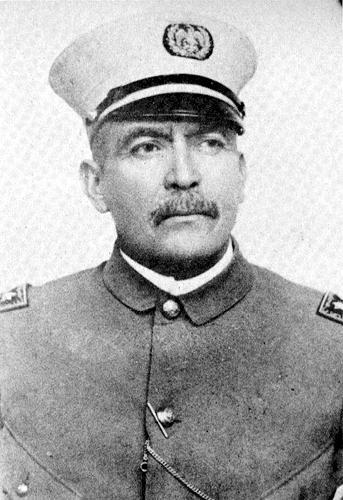
The distinguished Pedro Lascuráin looked presidential.


Pedro Lascuráin was in the office on February 19, 1913—the office of President of Mexico.  He dawdled for about 45 minutes before departing.  In the process he set the unchallenged world’s record for the shortest term in office by any national president.
Lascuráin was a distinguished looking gentleman, a lawyer from one of the impeccable old families of Mexico.  No drop of mere Indio or Meztizo blood ran through his veins.  Yet he was not, as you might imagine, an irredeemable reactionary.

Born in 1856 and educated at the Escuela Nacional de Jurisprudencia he was mayor of Mexico City in 1910 when he threw his support to Francisco I. Madero and his Anti-Reelectionist Party.  

Francico Madero, the short man  in the center, led the Revolution then won the Presidency in fairly honest election,

Madero opposed the sham re-election—for the sixth time—of long time President/dictator Porfirio Diaz.  For his trouble, Diaz had him arrested.  But he escaped to the United States and from there launched the Mexican Revolution.  It was as if a great damn burst.  All over Mexico peons and middle class reformers alike rose up.  Portions of the military, reading the tea leaves, joined them.  By May 25, 1911 Diaz was forced to resign.  Madero rose to power first as caldillo de la revolución and was then elected as President by nearly 90% of the vote in what for Mexico was a fairly honest election. 

Madero tapped his fellow patrician Lascuráin as his Foreign Secretary.  The former Mayor was perfect for the striped pants formality of the Diplomatic service.  His main job was to keep American Ambassador Henry Lane Wilson placated.   It was assumed that Lascuráin’s respectability and obvious innate conservatism would re-assure a skeptical Wilson that the new government was moderate and responsible.  Alas Wilson listened more to American business interests scared of the avowed leftism of many Revolutionary figures and to the promises of certain generals that if allowed to come to power they would protect those interests.

From the beginning despite his enormous personal popularity, Madero was in trouble.  His policy of reconciliation, including leaving many Diaz supporters in power and in control of Congress, angered radicals led by Emilio Zapata in the south and Pancho Villa in Chihuahua.  They were also upset by foot dragging on promised land reforms.  On the other hand reactionary generals launched several rebellions.  Madero came to rely on General Victoriano Huerta to put down rebellions like that of Pascual Orozco.  That was a mistake.

General Victoriano Huerta--Madero's bad choice.

Huerta and other generals were in contact with Ambassador Wilson, who encouraged them to oust Madero and promised that the U.S. Government would not interfere in support of the constitutionally elected government.

A clueless Madero recalled Huerta to the capital to take command of forces in the Federal District trusting him for support against both more reactionaries and potential leftist rebellions.

In February 1913 things came to a head when Huerta with the support of two of the rebel generals previously disposed of, Bernardo Reyes, and Félix Díaz, Porfirio Díaz’s nephew, launched a coup d’ ėtat.  After a few days of fighting, on February 18 Huerta captured Madero and Vice President José Maria Pino Suárez and held them at the National Palace.

At the insistence of Wilson, Huerta, Reyes, and Díaz met at the American Embassy.  The ambassador informed him that President William Howard Taft had grown squeamish about the coup and insisted that some veneer of constitutionality had to be in place to save the administration from embarrassment.  All parties then signed el Pacto de la Embajada (the Embassy Pact) promising a legal transfer of power and the safe conduct of Madero and Suárez out of the country in exchange for recognizing Huerta as the new President.

The Mexican National Palace.

Huerta then proceeded to the National Palace.  He had a plan.  Under the Mexican Constitution of 1857, the Foreign Minister stood third in line for the presidency behind the vice-president and attorney general.  The attorney general was disposed of.  Lascuráin under what can be assumed was extreme duress, was then sworn in as President.  He had time for just two official acts.  The first was to appoint Huerta Interior Minister—the next officer in the line of succession.  The second was to write out his resignation as President, making Huerta his legal successor.  The whole process took about 45 minutes—some say less.

Lascuráin was politely shown the door and departed alive and not under arrest.  On the way out he declined Huerta’s offer for a high post in the new government.

Huerta’s troops surrounded the national Congress which later that night rubber-stamped the charade.  Huerta was officially president.

Four days later a contingent of Ruarles—paramilitary police and not part of the Mexican Army, took Madero and Suárez from prison and riddled them full of bullet holes, claiming that they were attempting to escaped.  The thin cover of the troops not being under Huerta’s direct command and patently unbelievable story aroused international condemnation.

The Mexicans call the whole affair la Decena Tragica—the Ten Tragic Days.

In Washington incoming President Woodrow Wilson was not amused.  He recalled the other Wilson—the conspiratorial ambassador.  Relations with the Huerta government steadily deteriorated with reports of his routine brutality and his refusal to step down and allow democratic elections.  After a minor dust up between Huerta forces in the port of Tampico, which was being besieged by revolutionaries, and sailors from the U.S. Navy Squadron stationed off shore to protect oil interests, Wilson ordered the Navy and Marines to occupy the city.

Meanwhile Huerta enemies, north and south, gained ground and inflicted loss after loss on his army.  On July 15, 1915 he was forced to resign and flee the country.

In exile Huerta would continue to plot a comeback.  He found support in the German Embassy in the U.S. which offered him arms and support in the hope that a hot war on America’s southern border would keep the US out of World War I.  The plot was easily discovered.  Huerta was arrested and later died of cirrhosis of the liver in an American prison.

 As for the hapless Lascuráin, he was reviled by many for his reluctant part in Madero’s ouster and death.  He retired from public life and resumed the practice of law.  Later he served for 17 years as the president of a small, conservative law school in the capital.  He died in relative obscurity on July 21, 1952 at the age of 92.