Showing posts with label Amiri Baraka. Show all posts

Friday, April 1, 2016

Kicking off National Poetry Month 2016 With Everett Hoagland


It’s National Poetry Month Again!  If you have been visiting here for a while, you know what that means—it’s our sixth annual round up of daily doses of verse!  If you are new, here’s the scoop.  Every day all month I will feature poets and their poems.  I aim to be as broad and inclusive as possible to style, subject, period, gender, race, and neglected voices.  I don’t want just a parade of the usual dead white men, but a lot of them did write some damn fine poetry, so they have their place here to.  As always, selections follow my own tastes and whims.  Yours may be different.  But I am open toeager for—suggestions, especially for contemporary writers.  I do not subscribe to dozens of little magazines or prowl the internet for poetry posts.  I often only stumble on new and unknown poets and I am sure I miss some great stuff.  Please feel free to turn me on to some—or be bold and submit your own.  I don’t and can’t promise to use everything.
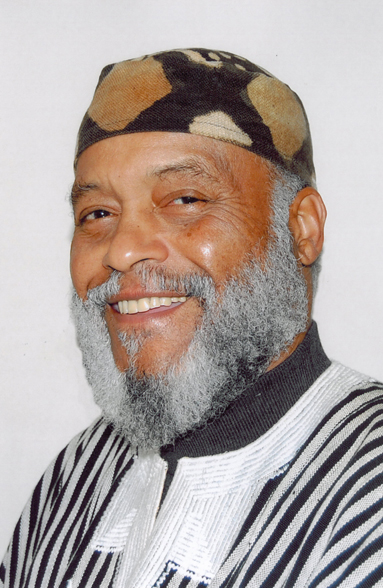
Everett Hoagland.

A great place to start is with one of my favorite working poets, Everett Hoagland.  I first encountered Hoagland in the pages of UUWorld magazine back in 2011 when he knocked my socks off with a series of poems dealing with returning to his African roots including the horrors of the slave trade, Middle Passage and the ambiguity and paradox of being African and American at the same time.  I was so impressed with his long form poetry that I wrote a laudatory letter to the editor about it.  Hoagland responded warmly and personally and we have remained in contact.  Last May, just after the conclusion of the Poetry Month series on the blog he was kind enough to send me an autographed copy of his brand new collection, The Music and Other Selected Poems.  I was pleased to see that he excerpted my letter for a back cover blurb:
Everett Hoagland’s…is...substantial poetry… I commend the essential bravery of Hoagland’s work, which connects the intimate and personal now to the vastness of a historic and global outrage… This is self-knowledge on an epic scale. All of us, regardless of our origins would do well to come to such grips with the long shadows of our own histories.
I was even happier to find the poems I had admired included in the new volume—poems that I shared in a Poetry Month posting back in 2012.
Hoagland was coming off of a very good stretch after retiring as a professor of English at the University of Massachusetts at Dartmouth and finishing his tenure as the poet laureate of New Bedford, Massachusetts, the historic whaling and fishing port which has been his long-time home.  In 2012 he published his wonderful book Ocean Voices: An Anthology of Ocean Poems which included some of his gems.  He had just been awarded the 2015 Langston Hughes Award joining the ranks of eminent black poets including Sonia Sanchez, Amiri Baraka, and Gwendolyn Brooks. 
The award was especially meaningful to him in light of special connection to Hughes, the Godfather of African-American verse.  Hoagland was a senior at Hughes’s alma mater Lincoln University in Pennsylvania when the great man visited the school in 1964 and met with selected students.  Hoagland showed up with two poems in hand.  In an interview given to Lauren Daley in South Coast Today, Hoagland recalled:
He was nice enough not to say anything about the cornier of the two, and made concrete suggestions on the other, and that one went on to win the creative writing award at the University. So this whole experience has come full circle.  Hughes helped me win that award, and now I’ve gotten an award for my life’s work in his name. 
Hoagland was deeply influenced by Hughes, but also by other Black poets, especially his personal friend Amiri Baraka.  He explores their voices and influences in The Music which contains work spanning the 1960’s to today.  He also considers music, especially jazz and blues but all forms of expression of the African-American experience including rap.  He touches on historic context not only including slavery and its aftermath, but the labor and civil rights movements and currents of Black Nationalism from Marcus Garvey on.  He weaves all of it together in the collection reflecting a deep and mature understanding of what it means to be Black and American.
Hoagland was born on December 18, 1942 in Philadelphia.  He graduated from Lincoln University, perhaps.   He came of age in the Civil Rights era and matured into a community coming to grips with its identity manifesting itself in the Black Power movement.
He went to work as a teacher in the Philadelphia public school system before returning to academia to get his master’s degree at Brown University and to become a professor of English at the University of Massachusetts at Dartmouth.  He settled with his wife and children in New Bedford.
He has been a prolific poet and writer, highly regarded as a leading voice of new Black literature while, perhaps unsurprisingly, escaping much acclaim among the White poetry establishment.  Among his books are, Ten Poems: A Collection, 1968; Black Velvet, 1970; Scrimshaw, 1976; This City and Other Poems, 1997; and Here: New and Selected Poems, 2002.  He has also been widely anthologized and along the way also picked up the Gwendolyn Brooks Award for Fiction in 1974 and a National Endowment for the Humanities Fellowship in 1984.

The cover of Hoagland's most recent book features a photo of his great grandfather musician Benjamin William Hoagland showing cultural roots that run deep.

The Music
After reading All God’s Dangers:  The Life of Nate Shaw


Your archival voice,
our long blues song,
life’s story
coughed up
the blood-soaked cotton
gag.  Blue blood,

book-long,
blue steel guitar blues,

Your Smith and Wesson
.32 gun metal voice.

What did they call you
when you resisted?

“If you were
a white man: principled,
mule: stuborn,
nigger: crazy.”

You were a blue steel guitar.

and your wife was
a fiddle and a tambourine,
Hannah.  Soft as cotton
and as strong.
And your wife was
a fiddle and a tambourine
and your sons are
canefifes,
we your daughters
banjoes,
playing your gun metal voice,
playing your blue steel
guitar book-long song

CRAZY!

Note:  Shaw was a heroic sharecropper organizer in early 20th Century Alabama.  All God’s Dangers, his transcribed oral autobiography, won the National Book Award for its editor/transcriber, Theodore Rosengarten.

—Everett Hoagland  1974

From The Music and Other Selected Poems by Everett Hoagland, North Star Nova Press.  Copyright Everett Hoagland, 2015.


Monday, April 28, 2014

National Poetry Month—And All that Jazz


Music and poetry are twins.  Born together when certain apes passed long, dark nights together sharing what they knew, and feared, and yearned for, breath and heartbeat.  Conjoined twins at that—one flesh, one life.  The shepherd David and blind old Homer plucked their harps and sang their verses.  Shamans beat their drums and blew their flutes in their calls on gods and ghosts.  Bards spread their news with lute in hand.  So it had always been.  Poet/singer listeners/dancers sharing the moments together.  Then came the scribes and that bearded German Guttenberg who tore the words away, imprisoning them on parchment and paper to be deciphered in silence by the privileged few who had the key.
Still, songs had lyrics, poetry after all.  The connection was stretched, not broken.
The emergence of Jazz in the early 20th Century reunited the sundered twins and in the process changed poetry, at least in the West, utterly and forever.   Jazz has been called America’s only indigenous art form.  Within a few years of bubbling up from the fecund street of New Orleans it swept the nation and leaped an ocean and was changing—and liberating—every other performance, literary, or fine art.
Poetry was exposed and infected early.  By the World War I era it was adopting jazz syncopations, blues call and response forms, daring sexuality, Black cultural experience, and liberation themes.  Poetry pulsed with new energy and exploded out of conventional forms liberated by the spirit of improvisation.
Just as the White musicians of the Original Dixieland Jass Band were the first to record the essentially Black music in 1917, White poets were among the first to attract a wide audience for jazz poetry.  And none were more important than Vachel Lindsey of Illinois.  As early as 1912, long before most Americans had even heard of jazz, he was incorporating it’s syncopations and rhythms and call and response forms into his most famous—and controversial poem The Congo.  A rare racial liberal at the time he thought he was exposing stereotypes of savagery and protesting the colonial brutality of King Leopold in his private colony.  Most blacks of the day took it as such, although there was some criticism.  Read by later generations in different circumstances it would be labeled racist and another contributor to this survey, Amiri Baraka, would lead a movement that would virtually erase Lindsey from literary memory.  But that was later.  He had come to the defense of the Black population of his beloved Springfield when it was devastated in a 1908 race riot.  Lindsey would continue to use jazz riffs, and often salute Black experience.  In this 1918 piece, praised by W. E. B. Dubois, he saluted the usually ignored contributions of Blacks to the war effort.

The Modest Jazz Bird

The Jazz-bird sings a barnyard song—
A cock-a-doodle bray,
A jingle-bells, a boiler works,
A he-man's roundelay.

The eagle said, ‘My noisy son,
I send you out to fight!’
So the youngster spread his sunflower wings
And roared with all his might.

His headlight eyes went flashing
From Oregon to Maine;
And the land was dark with airships
In the darting Jazz-bird’s train.

Crossing the howling ocean,
His bell-mouth shook the sky;
And the Yankees in the trenches
Gave back the hue and cry.

And Europe had not heard the like—
And Germany went down!
The fowl of steel with clashing claws
Tore off the Kaiser’s crown.
            —Vachel Lindsay

But, of course, Blacks would soon be spreading their own poetic jazz wings and the Harlem Renaissance became ground-zero for the new movement.  The most famous of all of the poets that emerged from that fertile ground and the most closely associated with jazz was Langston Hughes.  Around 1923 Lindsay encountered Hughes, then working as a bus boy in a Washington, D.C. restaurant after having dropped out of Columbia University, a turn as a merchant sailor, and his first trip to Paris.  Hughes showed some of his poetry to Lindsey, who not only was encouraging, but actually helped to boost his early career—something no other White literary figure was ready to do.  Within a couple of years Hughes would emerge at the heart of the Harlem scene with jazz poetry like this.
The Weary Blues

Droning a drowsy syncopated tune,
Rocking back and forth to a mellow croon,
I heard a Negro play.
Down on Lenox Avenue the other nigh
By the pale dull pallor of an old gas light
He did a lazy sway . . .
To the tune o’ those Weary Blues.
With his ebony hands on each ivory key
He made that poor piano moan with melody.
O Blues!
Swaying to and fro on his rickety stool
He played that sad raggy tune like a musical fool.
Sweet Blues!
Coming from a black mans soul.
O Blues!
In a deep song voice with a melancholy tone
I heard that Negro sing, that old piano moan—
“Ain’t got nobody in all this world,
Ain’t got nobody but ma self.
I’s gwine to quit ma frownin’
And put ma troubles on the shelf.”

Thump, thump, thump, went his foot on the floor.
He played a few chords then he sang some more—
“I got the Weary Blues
And I can’t be satisfied.
Got the Weary Blues
And can’t be satisfied—
I ain’t happy no mo’
And I wish that I had died.”
And far into the night he crooned that tune.
The stars went out and so did the moon.
The singer stopped playing and went to bed
While the Weary Blues echoed through his head.
He slept like a rock or a man that’s dead.

—Langston Hughes

By the early 20’s it was officially the Jazz Age and the new music was influencing all of the arts.  Even poets not usually thought of a jazz poets—T. S. Eliot, Ezra Pound, and even, as unlikely as it seems, that guardian of Irish culture, W. B. Yeats were liberated and incorporating elements of syncopation and other jazz like riffs in their work.  Carl Sandburg and especially the highly experimental e. e. cummings, were writing about and in jazz forms.  The relationship continued and as jazz evolved—swing and big band, post-war be bop, West Coast cool—so did the poetry reflected by it.
No group of poets was more closely identified with jazz then the Beats.  Jack Kerouac was among the first to do readings to jazz, collaborating with his pal David Amram improvising on bongos and piano and perhaps created the stereotype of the beatnik coffee house scene.  Kenneth Rexroth was famous for his jazz readings and Lawrence Ferlinghetti collaborated with Stan Getz.  But many regard Bob Kaufman as the greatest of the Beat jazz poets.  The New Orleans born writer was the product of a German Jewish father and a mother from Martinique who practiced voodoo.  After teenage World War II service in the Merchant Marine he came to New York City where he fell in with William Burroughs and Allen Ginsberg.  In 1958 he migrated to the West Coast mecca of North Beach.  His jazz performances there became legendary.  He usually improvised and seldom wrote down any of his own work.  He was performance artists.  Of course, many of his most admired pieces have thus been lost.  But his wife hastily transcribed some as they were being performed and preserved part of their sheer energy.  After the assassination of John F. Kennedy he took a Buddhist vow of silence, which he kept for a number of years until he unleashed powerful new work protesting the Vietnam War.  He explained his own work, “My head is a bony guitar, strung with tongues, plucked by fingers & nails.”

O-Jazz-O War Memoir: Jazz, Don’t Listen To It At Your Own Risk


In the beginning, in the wet
Warm dark place,
Straining to break out, clawing at strange cables
Hearing her screams, laughing
“Later we forgave ourselves, we didn’t know”
Some secret jazz
Shouted, wait, don’t go.
Impatient, we came running, innocent
Laughing blobs of blood & faith.
To this mother, father world
Where laughter seems out of place
So we learned to cry, pleased
They pronounce human.
The secret Jazz blew a sigh
Some familiar sound shouted wait
Some are evil, some will hate.
“Just Jazz, blowing its top again”
So we rushed & laughed.
As we pushed & grabbed
While jazz blew in the night
Suddenly they were too busy to hear a simple sound
They were busy shoving mud in men’s mouths,
Who were busy dying on the living ground
Busy earning medals, for killing children on deserted street corners
Occupying their fathers, raping their mothers, busy humans we
Busy burning Japanese in atomicolorcinemascope
With stereophonic screams,
What one hundred per cent red blooded savage, would waste precious
            time
Listening to jazz, with so many important things going on
But even the fittest murderers must rest
So they sat down in our blood soaked garments,
and listened to jazz
            lost, steeped in all our death dreams
They were shocked at the sound of life, long gone from our own
They were indignant at the whistling, thinking, singing, beating,
            swinging,
They wept for it, hugged, kissed it, loved it, joined it, we drank it,
Smoked it, ate with it, slept with it
They made our girls wear it for lovemaking
Instead of silly lace gowns,
Now in those terrible moments, when the dark memories come
The secret moments to which we admit no one
When guiltily we crawl back in time, reaching away from ourselves
They hear a familiar sound,
Jazz, scratching, digging, blueing, swinging jazz,
And listen,
And feel, & die,

—Bob Kaufman
LeRoi Jones rose to prominence as part of the Beat movement and quickly established himself as a unique voice, as a publisher, and as an influential essayist and critic who wrote extensively on Black music and Jazz.  He eventually rejected the mostly white Beats and threw himself into the Black Nationalist Movement and a Black Arts Movement which he founded.  He became a scathing critic of White appropriation of Black music and culture.  He established himself as Imamu Amiri Baraka and adopted Newark, New Jersey as his home base.  He became a leading national figure in the Black Nationalist Movement, but eventually left that behind to become a Marxist and anti-colonialist.  Always controversial and often angry, Amiri Baraka became the New Jersey Poet Lauriat only to have the position abolished after his post 9/11 poem Somebody Blew Up America? aroused indignation.  He died last year admired and reviled in equal measure.

Wise I

WHYS (Nobody Knows
The Trouble I Seen)
Traditional

If you ever find
yourself, some where
lost and surrounded
by enemies
who won't let you
speak in your own language
who destroy your statues
& instruments, who ban
your omm bomm ba boom
then you are in trouble
deep trouble
they ban your
own boom ba boom
you in deep deep
trouble

humph!

probably take you several hundred years
to get
out!

—Imamu Amiri Baraka
Jayne Cortez married saxophonist Ornette Coleman when she was 18.  After divorcing him after several years of marriage in 1965 she became founder director of the Watts Repertory Theater Company.  Part of the Black Arts Movement, she established her own press and record label through which she released a series of readings to and about jazz.  She pushed boundaries working with the electric funk/fusion group the Firestarters and worked in Latin jazz and Afro/world music styles.  She died in 2012, the most influential woman spoken word performer of her generation.

Jazz Fan Looks Back

I crisscrossed with Monk
Wailed with Bud
Counted every star with Stitt
Sang “Don’t Blame Me” with Sarah
Wore a flower like Billie
Screamed in the range of Dinah
& scatted “How High the Moon” with Ella Fitzgerald
as she blew roof off the Shrine Auditorium
                    Jazz at the Philharmonic
                                                           
I cut my hair into a permanent tam
Made my feet rebellious metronomes
Embedded record needles in paint on paper
Talked bopology talk
Laughed in high-pitched saxophone phrases
Became keeper of every Bird riff
every Lester lick
as Hawk melodicized my ear of infatuated tongues
& Blakey drummed militant messages in
soul of my applauding teeth
& Ray hit bass notes to the last love seat in my bones
I moved in triple time with Max
Grooved high with Diz
Perdidoed with Pettiford
Flew home with Hamp
Shuffled in Dexter’s Deck
Squatty-rooed with Peterson
Dreamed a “52nd Street Theme” with Fats
& scatted “Lady Be Good” with Ella Fitzgerald
as she blew roof off the Shrine Auditorium
                    Jazz at the Philharmonic

—Jayne Cortez
We will wrap up with Gil Scott-Heron, the poet/musician whose jazz work and political riff poetry became the inspiration for modern hip hop and rap.

I Think I’ll Call It Morning

I’m gonna take myself a piece of sunshine
and paint it all over my sky.
Be no rain. Be no rain.
I'm gonna take the song from every bird
and make them sing it just for me.
Be no rain.
And I think I’ll call it morning from now on.
Why should I survive on sadness
convince myself I've got to be alone?
Why should I subscribe to this world’s madness
knowing that I’ve got to live on?

I think I’ll call it morning from now on.
I’m gonna take myself a piece of sunshine
and paint it all over my sky.
Be no rain. Be no rain.
I’m gonna take the song from every bird
and make them sing it just for me.
Why should I hang my head?
Why should I let tears fall from my eyes
when I’ve seen everything that there is to see
and I know that there ain’t no sense in crying!
        I know that there ain’t no sense in crying!
I think I’ll call it morning from now on.

—Gil Scott-Heron