Showing posts with label Everett Hoagland. Show all posts

Monday, August 5, 2019

Martín Espada—Two Poems for a Lights for Liberty Rally

Poet Martín Espada.
My friend Everett Hoagland, proud and skilled Black poet who has lived and worked much of his life in mostly white environments was kind enough to share the work of another writer of importance and discernment.  Hoagland has been the poet laureate of New Bedford, Massachusetts and is a long-time member of the First Unitarian Church there.  When Everett recommends a poet I sit up and take notice
Martín Espada is a 62 year old poet, academic, and activist who was born in Brooklyn, New York to Puerto Rican parents.  His father was a leader in the Puerto Rican community and the civil rights movement.  Espada received a B.A. in history from the University of Wisconsin–Madison and a doctorate of law from Northeastern University in Boston.  For many years, he worked as a tenant lawyer and a supervisor of a legal services program
In 1982, Espada published his first book of political poems, The Immigrant Iceboy's Bolero, featuring photography by his father.  Since then he has written thirteen more highly praised volumes in English and in Spanish, most recently Vivas to Those Who Have Failed which was published in 2016 by W.W. Norton.

His work has gleaned honors including the National Endowment for the Arts Creative Writing Fellowship in 1986; the PEN/Revson Foundation Fellowship in Poetry, 1989; Paterson Poetry Prize, 1991; National Endowment for the Arts Creative Writing Fellowship, 1992; National Book Critics Circle Award Finalist, 1997; Before Columbus Foundation American Book Award, 1997; Pushcart Prize, 1999,  Independent Publisher Book Award, 1999; Poet Laureate of Northampton, Massachusetts, 2001; American Library Association Notable Book, 2004; John Simon Guggenheim Memorial Foundation Fellowship, 2006; Pulitzer Prize Finalist, 2007; Library Journal Best Poetry Books, 2007; National Hispanic Cultural Center Literary Award, 2008; Massachusetts Book Award, 2012; International Latino Book Award, 2012; Busboys and Poets Award, 2014; Academy of American Poets Fellowship, 2018; and the Ruth Lilly Poetry Prize, 2018 among others.
He is currently a professor at the University of Massachusetts Amherst, where he teaches poetry.
Espada spoke at a July 12 Lights for Liberty vigil to end detention camps at the Unitarian Universalist First Church in Salem, Massachusetts. The two poems he shared there and some explanatory notes are featured in the current issue of the venerable Progressive.
Espada's Lights for Liberty poems are in the current July/August issue of The Progressive.
Espada explained his first verse:
Trump announced his candidacy in June 2015, with the pronouncement that Mexicans crossing the border brought with them a range of criminal tendencies from drug smuggling to rape. That August, two brothers, Scott and Steve Leader, took him at his word, attacking a homeless Mexican immigrant as he slept outside the JFK subway stop on the Red Line.
This poem is about that hate crime. It’s also about Donald Trump’s idea of hell: empathy. There were many more healing hands than hurting hands placed on the victim’s body that night. Now, since this is a poem about a hate crime, there is some language and imagery you might find ugly. The poem is called:
Not for Him the Fiery Lake of the False Prophet
When Mexico sends its people, they’re not sending their best…They’re bringing drugs. They’re bringing crime. They’re rapists. —Donald Trump, June 16, 2015
They woke him up by pissing in his face. He opened his mouth 
to scream in Spanish, so his mouth became a urinal at the ballpark.

Scott and Steve: the Leader brothers, celebrating a night at Fenway, 
where the Sox beat the Indians and a rookie named Rodríguez spun 
the seams on his changeup to hypnotize the Tribe. Later that night, 
Steve urinated on the door of his cell, and Scott told the cops why 
they did it:  Donald Trump was right. All these illegals need to be deported.

He was a Mexican in a sleeping bag outside JFK station on a night 
in August, so they called him a wetback and emptied their bladders
in his hair. In court, the lawyers spoke his name: Guillermo Rodríguez
immigrant with papers, crop-picker in the fields, trader of bottles 
and cans collected in his cart. Two strangers squashed the cartilage
in his nose like a can drained of beer. In dreams, he would remember
the shoes digging into his ribcage, the pole raked repeatedly across
his cheekbones and upraised knuckles, the high-five over his body.

Donald Trump was right, said Scott. And Trump said: The people 
that are following me are very passionate. His hands fluttered 
as he spoke, a demagogue’s hands, no blood under the fingernails, 
no whiff of urine to scrub away.  He would orchestrate the chant 
of Build That Wall at rally after rally, bellowing till the blood rushed 
to his face, red as a demagogue in the grip of masturbatory dreams:
a tribute to the new conquistador, the Wall raised up by Mexican hands,  
Mexican hair and fingernails bristling in the brick, Mexican blood 
swirling in the cement like raspberry syrup on a vanilla sundae. 
On the Cinco de Mayo, he leered over a taco bowl at Trump Tower.

Not for him the fiery lake of the false prophet, reddening
his ruddy face. Not for him the devils of Puritan imagination,
shrieking in a foreign tongue and climbing in the window
like the immigrant demons he conjures for the crowd.

Not even for him ten thousand years of the Leader brothers.
streaming a fountain of piss in his face as he sputters forever.

For him, Hell is a country where the man in a hard hat
paving the road to JFK station sees Guillermo and dials 911;
Hell is a country where EMTs kneel to wrap a blanket around
the shivering shoulders of Guillermo and wipe his face clean;
Hell is a country where the nurse at the emergency room
hangs a morphine drip for Guillermo, so he can go back to sleep.
Two thousand miles away, someone leaves a trail of water bottles
in the desert for the border crossing of the next Guillermo.

We smuggle ourselves across the border of a demagogue’s dreams:
Confederate generals on horseback tumble one by one into 
the fiery lake of false prophets; into the fiery lake crumbles
the demolished Wall. Thousands stand, sledgehammers in hand, 
to await the bullhorns and handcuffs, await the trembling revolvers. 
In the full moon of the flashlight, every face interrogates the interrogator. 
In the full moon of the flashlight, every face is the face of Guillermo.

Martín Espada

Espada wrote the second poem especially for the Lights for Liberty rally.
The mass incarceration of migrant children—by the thousands—is also a hate crime. Let’s call it what it is. And that brings me to a place called Tornillo. The Trump Administration opened the Tornillo internment center in Texas in June 2018 and closed it in January 2019. My good friend Camilo Pérez-Bustillo, as Director of Research and Advocacy at Hope Border Institute in El Paso, was a major organizer in the campaign to shut down Tornillo—and shut it down they did.
Camilo told me: “the one place the kids detained there told us they felt free was on the soccer field . . . It was the only place they could be connected in some kind of physical flow with the world beyond the barbed wire, by kicking as many soccer balls as high and as far as they could, beyond the fencing around them. Large numbers of these balls piled up quickly outside and at the edges of the facility.”
Latino youth play soccer.
Ode to the Soccer Ball Sailing Over a Barbed Wire Fence
          Tornillo…has become the symbol of what may be the largest U.S. mass detention of children not charged with crimes since the World War II internment of Japanese-Americans. —Robert Moore, Texas Monthly

Praise Tornillo: word for screw in Spanish, word for jailer in English,  
word for three thousand adolescent migrants incarcerated in camp.

Praise the three thousand soccer balls gift-wrapped at Christmas,
as if raindrops in the desert inflated and bounced through the door.

Praise the soccer games rotating with a whistle every twenty minutes 
so three thousand adolescent migrants could take turns kicking a ball.

Praise the boys and girls who walked a thousand miles, blood caked  
in their toes, yelling in Spanish and a dozen Mayan tongues on the field.

Praise the first teenager, brain ablaze like chili pepper Christmas lights,
to kick a soccer ball high over the chain link and barbed wire fence.

Praise the first teenager to scrawl a name and number on the face
of the ball, then boot it all the way to the dirt road on the other side.

Praise the smirk of teenagers at the jailers scooping up fugitive 
soccer balls, jabbering about the ingratitude of teenagers at Christmas.

Praise the soccer ball sailing over the barbed wire fence, white
and black like the moon, yellow like the sun, blue like the world.

Praise the soccer ball flying to the moon, flying to the sun, flying to other 
worlds, flying to Antigua Guatemala, where Starbucks buys coffee beans.

Praise the soccer ball bounding off the lawn at the White House,
thudding off the president’s head as he waves to absolutely no one.

Praise the piñata of the president’s head, jellybeans pouring from his ears, 
enough to feed three thousand adolescents incarcerated at Tornillo.

Praise Tornillo: word in Spanish for adolescent migrant internment camp, 
abandoned by jailers in the desert, liberated by a blizzard of soccer balls.

Martín Espada
On a personal note, Espada second poem evoked one of the few specific stories that my father, W.M. Murfin, ever told me about his World War II experiences.
Italian POWs in Libya--glad to be out of the war.
He was the top sergeant of a U.S. Army Field Hospital attached to the British and ANZAC troops under Field Marshal Montgomery who chased Rommel and his Afrika Korps out of Egypt and across North Africa.   In the deserts of Libya the hospital pitched its tents next to a prisoner of war camp for captured Italian troops.  Most of the Italians had gladly surrendered and were happy to be out of the war.  The Tommies in their khaki shorts and tin hats for the most part treated the prisoners well.  They reserved their rage and vengeance for the Germans and Nazis.
Aside from some hastily erected gun towers, the camp had no walls or even barbed wire fence.  There was no need—there was nowhere to escape to in the vast and terrible desert.  Lines literally scratched in the ground were the only marks of the camp’s perimeter
The Brits gave their prisoners some of their footballs to kick around to pass the time.  The Italians quickly organized teams and were playing il calico—soccer—on the sands.  One idle afternoon under the baking sun patients and staff from the hospital joined inmates and guards to watch a match.
During the back and forth action the ball got kicked out of bounds and across the camp’s line in the sand.  Without thinking a player sprinted after it.  When he crossed the line without even a shouted warning, a guard shot him dead.
Of all of the horror my Dad saw in the war in North Africa and then in three Pacific island landings this one senseless execution haunted him the most.

Monday, April 29, 2019

On the Wine Dark Sea—Poems on Salt Water

Dutch Boats by J.W,M. Turner

I grew up where the tang in the air at dawn was sagebrush, not salt water, where the vast rolling expanse was the high prairie sloping away from the Big Horns toward the Powder River, and where most of the year you can wade across almost any water without getting your belt wet.  I have never lived by the shore or, except for a childhood Sunday excursion to Catalina Island, ever been on the ocean.
Despite my landlubber status, it is easy to see the lure of the sea, its lore, its call to mysterious adventure.  So many poets have felt that call.
Sometimes called an elegy to himself, this famous poem by Mathew Arnold could also be included in a roundup of death poems.  In fact the sea and death often seem inseparable especially in the days when many who sailed never returned to port.
Dover Beach.
Dover Beach
The sea is calm to-night,
The tide is full, the moon lies fair
Upon the straits; — on the French coast the light
Gleams and is gone; the cliffs of England stand,
Glimmering and vast, out in the tranquil bay.
Come to the window, sweet is the night-air!
Only, from the long line of spray
Where the sea meets the moon-blanch’d land,
Listen! you hear the grating roar
Of pebbles which the waves draw back, and fling,
At their return, up the high strand,
Begin, and cease, and then again begin,
With tremulous cadence slow, and bring
The eternal note of sadness in.

Sophocles long ago
Heard it on the Aegean, and it brought
Into his mind the turbid ebb and flow
Of human misery; we
Find also in the sound a thought,
Hearing it by this distant northern sea.
The sea of faith
Was once, too, at the full, and round earth’s shore
Lay like the folds of a bright girdle furl’d.
But now I only hear
Its melancholy, long, withdrawing roar,
Retreating, to the breath
Of the night-wind, down the vast edges drear
And naked shingles of the world.

Ah, love, let us be true
To one another! for the world which seems
To lie before us like a land of dreams,
So various, so beautiful, so new,
Hath really neither joy, nor love, nor light,
Nor certitude, nor peace, nor help for pain;
And we are here as on a darkling plain
Swept with confused alarms of struggle and flight,
Where ignorant armies clash by night.
—Mathew Arnold

Ships on a stormy sea.


Walt Whitman, of course, caught the hurly-burly of the ships of the world crowding the harbor of old New York, is thrilled by the wide world they represent—and by the sailor boys come ashore.  But he dare not forget the many never come to harbor again.

Song for All Seas, All Ships

           1

To-day a rude brief recitative,
Of ships sailing the Seas, each with its special flag or ship-signal;
Of unnamed heroes in the ships—Of waves spreading and spreading, far as the eye can reach;
Of dashing spray, and the winds piping and blowing;
And out of these a chant, for the sailors of all nations,
Fitful, like a surge.

Of Sea-Captains young or old, and the Mates—and of all intrepid Sailors;
Of the few, very choice, taciturn, whom fate can never surprise, nor death dismay,
Pick’d sparingly, without noise, by thee, old Ocean—chosen by thee,
Thou Sea, that pickest and cullest the race, in Time, and unitest Nations!
Suckled by thee, old husky Nurse—embodying thee!
Indomitable, untamed as thee.

(Ever the heroes, on water or on land, by ones or twos appearing,
Ever the stock preserv’d, and never lost, though rare—enough for seed preserv’d.)

            2

Flaunt out O Sea, your separate flags of nations!
Flaunt out, visible as ever, the various ship-signals!
But do you reserve especially for yourself, and for the soul of man, one flag above all the rest,
A spiritual woven Signal, for all nations, emblem of man elate above death,
Token of all brave captains, and all intrepid sailors and mates,
And all that went down doing their duty;
Reminiscent of them ‘twined from all intrepid captains, young or old;
A pennant universal, subtly waving, all time, o’er all brave sailors,
All seas, all ships,

—Walt Whitman


Stephen Crane's Open Boat

Stephen Crane was a youthful phenom as writer.  One of his seminal experiences was being shipwrecked and cast a-sea in an open boat in storm tossed waters.  Although he was quickly rescued, it led to his classic story of survival The Open Boat and poetry like this.

The ocean said to me once


The ocean said to me once,
“Look!
Yonder on the shore
Is a woman, weeping.
I have watched her.
Go you and tell her this—
Her lover I have laid
In cool green hall.
There is wealth of golden sand
And pillars, coral-red;
Two white fish stand guard at his bier.

“Tell her this
And more—
That the king of the seas
Weeps too, old, helpless man.
The bustling fates
Heap his hands with corpses
Until he stands like a child
With a surplus of toys.”

—Stephen Crane

Gulls in a rising tempest.
Carl Sandburg was no sailor.  After he relocated from the Midwest to North Carolina, he learned to the shore and tide pools.  His ocean is unconcerned with commerce, or even human experience.  It is its own true thing.

From the Shore

A lone gray bird,
Dim-dipping, far-flying,
Alone in the shadows and grandeurs and tumults
Of night and the sea
And the stars and storms.

Out over the darkness it wavers and hovers,
Out into the gloom it swings and batters,
Out into the wind and the rain and the vast,
Out into the pit of a great black world,
Where fogs are at battle, sky-driven, sea-blown,
Love of mist and rapture of flight,
Glories of chance and hazards of death
On its eager and palpitant wings.

Out into the deep of the great dark world,
Beyond the long borders where foam and drift
Of the sundering waves are lost and gone
On the tides that plunge and rear and crumble

—Carl Sandburg


Beach stones.

Lillian Moore, best known as a brilliant children’s and young adult writer, editor, and publisher, also walked the beaches.

Beach Stones
When these small
stones
were
in
clear pools and
nets of weed

tide-tumbled
teased by spray

they glowed
moonsilver,
glinted sunsparks on
their speckled
skins.

Spilled on the
shelf
they were
wet-sand jewels
wave-green
still flecked with
foam.

Now
gray stones
lie
dry and dim.

Why did we bring them home?

—Lillian Moore

Massachusetts beach.
Everett Hoagland was of late the Poet Lauriat of New Bedford, Massachusetts, that old home port to whalers, clipper ships,  and  fishermen.  The sea has always called to him.  He compiled and edited Ocean Voices:  An Anthology of Ocean Poems.

At East/West Beaches

The day night was born
we searched for time and sea-
smoothed fragments of blue, green,

brown bottles. Glass
cleared of gloss
made of man-
and woman-
made fire

and sand
made from
stone, made

from rock, made
from cosmic dust. We

fringed the lips of under-
tow with footprints the waves
redeemed from the firm, wet
shore. We gathered and gave each other
milk white moonstones, aeons
old obsidian, pebbles trans-
lucent as sucked rock

candy and rolled up our jeans in the raw
salty mist. The sun sank into

a violet-lipped quahog, and grit-edged
night opened like a mussel. Under
lacquered, pearly black
light of moonrise we crossed
over a sandbar
into camp
ground   

by duned scrub
beach rose. The night day
was born we turned
around and found
no footprints.

—Everett Hoagland

Mary Oliver.

We will close with Mary Oliver, another lover of beaches.

Ocean, a poem

I am in love with Ocean
lifting her thousands of white hats
in the chop of the storm,
or lying smooth and blue, the
loveliest bed in the world.
In the personal life, there is

always grief more than enough,
a heart load for each of us
on the dusty road. I suppose
there is a reason for this, so I will be
patient, acquiescent. But I will live
nowhere except here, by Ocean, trusting
equally in all blast and welcome
of her sorrowless, salt self.
—Mary Oliver


Monday, April 17, 2017

Important Lessons from Everett Hoagland

/
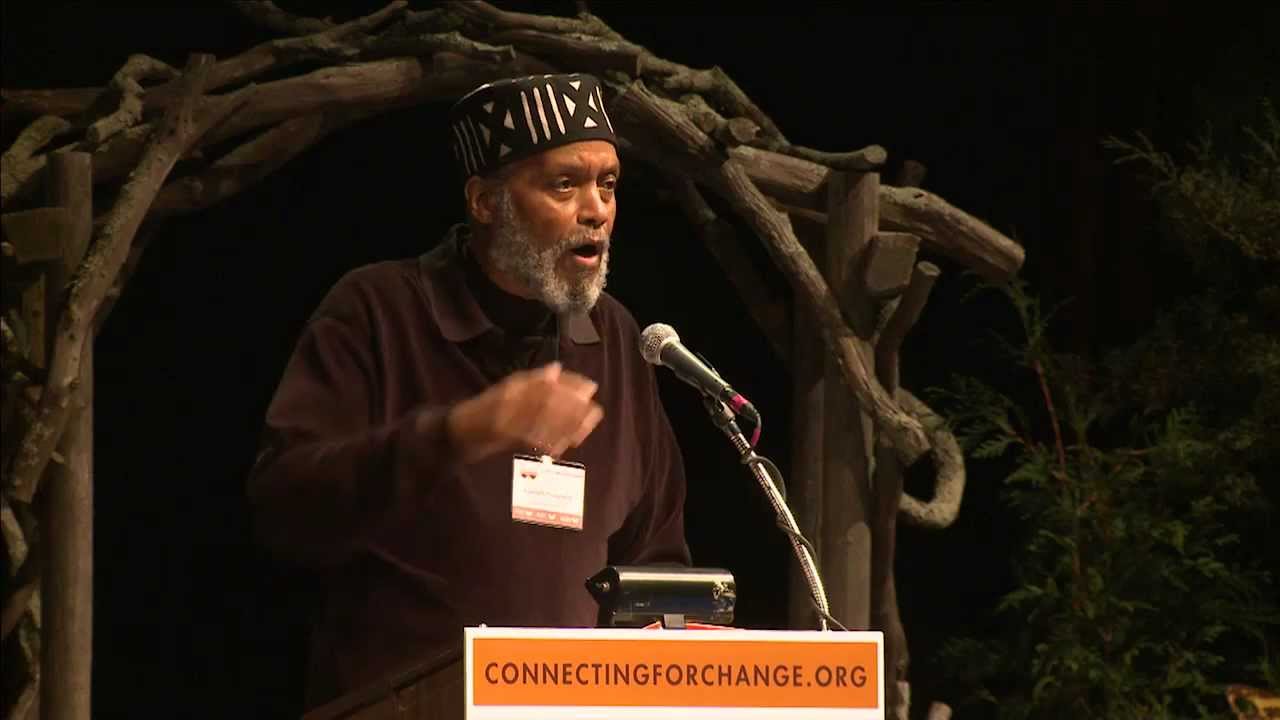
Everett Hoagland, poet/activist in action.


My friend Everett Hoagland is a proud and skilled Black poet who has lived and worked much of his life in mostly white environments.  He was a long time professor of English at the University of Massachusetts at Dartmouth and was for a long time the official the poet laureate of New Bedford, Massachusetts, the historic whaling and fishing port that was his adopted home town.  He has been a member of the  First Unitarian Church in New Bedford and active in wider Unitarian Universalist Association (UUA), both overwhelmingly White despite their liberalism and avowed intent to become multi-cultural and anti-racist.  Within those contexts he has been Black voice and presence.
You may recall that I included a poem by Hoagland from his latest collection The Music and Other Selected Poems last week in National Poetry Month entry on jazz and poetry.  As it often does that posting sparked a renewed connection between us via e-mail.  He wrote to say how pleased he was to be included in that post.   Not only was Langston Hughes a personal hero and role model, but when Hoagland was a senior at Hughes’s alma mater Lincoln University in Pennsylvania when the great man visited the school in 1964 and met with selected students.  Hoagland showed up with two poems in hand.  Hughes took time to make concrete suggestions and one of the poems went on to win a school creative writing award—a powerful reinforcement for a young writer.   Not only that but Jayne Cortez was another early idol to whom he dedicated a poem.

Hoagland accepting the Langston Hughes Society Award.

Experiences like that are an indication of how important Black culture and life have been to his work.  In 2015 that was rewarded when Hoagland received Langston Hughes Society Award joining the ranks of eminent Black poets including Sonia Sanchez, Amiri Baraka, and Gwendolyn Brooks. 
As part of our e-mail exchange, I sent Everett a pdf copy of my recent little chapbook Resistance Verse.  We touched on the state of national affairs and within the UUA which has lately been embroiled in a crisis of identity and purpose that led to the sudden resignation of President Peter Morales and two other top administration figures.  It would take far too long to explain here are of the details—as well as being too inside baseball—of the crisis.  Suffice it to say that a recent hiring decision exposed White privilege—and some have charged deeply ingrained but unacknowledged White supremist assumptions—that overwhelm stated good intentions and liberal pieties
Hoagland recently joined the Northeastern U.S. group of Black Lives Unitarian Universalists (BLUU) and supports its proposal it is bringing to the UUA General Assembly in New Orleans this summer to add a new 8th Principal which would read:
We, the member congregations of the Unitarian Universalist Association, covenant to affirm and promote: journeying toward spiritual wholeness by working to build a diverse multicultural Beloved Community by our actions that accountably dismantle racism and other oppressions in ourselves and our institutions.
Hoagland has read some his antiracism poetry, as well as poetry affirming the Seven Principles, at Unitarian Universalist congregations Plymouth and Bridgewater in Massachusetts and Palo Alto,  California, as well as many times home church in New Bedford.  He will return to New Bedford to deliver the Sunday message on April 30 as part of teach-ins and educational program being undertaken by almost 500 UU congregations.  He will report on the recent Black Lives Matter UU conference in New Orleans.
He sent me two of his latest poems—one literally only a day old grappling with this stuff.  I am happy to introduce them today.  They are wake-up calls for White folk, especially those who consider  themselves as liberal, whether they are UUs or not.
Everett suggested that he would like to come to the Chicago area to do those programs at local congregations or at public venues.  I would be thrilled to have him and also to finally meet him in person.  I can arrange something at Tree of Life UU Congregation in McHenry, Illinois.  Things are just in the earliest discussion stages and there will be plenty of lead time to make arrangements, but if your congregation would like to stage an event and/or include Hoagland in Sunday worship services or if you know of good venues for public events, please contact me at pmurfin@sbcglobal.net .


Echoes
In The President’s talk
about a wall I hear ghetto, barrio.

When he talks about “states' rights”
I am old enough to hear jim crow outright,

no rights which whites need respect.

And when he talks about upping the arms
race I hear apocalypse, see Apocalypse Now
   screened on the inside back
   of my glowing skull.
But here’s the thing.
When I hear white liberals wry

New-Yorker-cartoons-captions-like repartee,
chuckles about how bad, absurd, fascist things are these days,
   even when that goes down, 
   between two glib NPR talk show hosts,
I dig it’s laughing-to-keep-from-crying blues
humor. But it is also the sound of them

knowing, relatively speaking,
they and theirs will still be okay.

Though they may have to endure
roll backs re: recreational marijuana use, infringement

of reproductive rights and such,
even with the state of things in Amerikkka right

now, they know: no uniformed cop, guard, soldier, 
is going to profile, stop-&-frisk, nor shoot and kill

their kids and grandkids—just because
they are white. That is not true for the earth-brown

and night black among We The People 
on whose backs, with whose lives, white privilege was,   

is established, sustained, cultivated like the organic produce
bought by two food shoppers I knew who exchanged, quips, 
   too witty for words, about shit that was, is about as funny
   as police at Standing Rock urging one another to: Hold your ground!

   In the oh, so hip shoppers’ urbane laughter I heard hammering, saw
   a white picket fence being rebuilt around The American Dream.

   I heard a wordless subtext, another kind of us-and-them they themselves were,
   are about but not aware of. 

   And saw Whole Foods markets
   become gated food islands.

—Everett Hoagland
February 2017

“My Fellow Americans”
After listening to an interview on NPR

1. ... What people do you see
when you hear “refugee?”

And whose folk come to mind
when the word “immigrant”

is used for fleeing, refuge-seeking
humankind? What colors your thoughts

when you hear “immigrant”?
Do you see red, white and blue,

“true Americans’ folk? Folk like you?
What do you hear, what colors

your thought when you are told
slaves comes from slavs, from whom

some of you are descended. Europeans
captured, sold, bought with Roman silver, 

Roman gold, millennia before your family’s
“old country” got old.


2. Millions of others’ ancestors, so profitable
they were dubbed Black Gold, many thousands gone

among them forced here to North America chained
in holds of ships powered westward by sails filled

with hot air from recitations of The Declaration 
to this hemisphere’s ... race-based slavery ...

centuries before many, maybe most 
of your immigrant and potato famine refugee ancestors.

And, shamefully, a rice box “Uncle” icon
posing as a Cabinet Secretary 

of a government elected by demonizing difference,
the national us-&-them otherness cult of this

Third post-Reconstruction, a Mr. Secretary descended
from some of those forced here without even clothes,

says to you by news cameras and to him-
self as he contemplates him-

self each morning in his dresser’s mirror, while humming
“Nearer My God To Thee,” they, too, his own folk were opportunity-

seeking “immigrants.” Chants it daily between hummed hymns

in front of the mirror on his dresser. God damn!! Who was it
who said “How quickly the oppressed become the oppressor.”?

—Everett Hoagland