Showing posts with label Anne Sexton. Show all posts

Saturday, April 9, 2022

Maxine Kumin and Two Sides of a Coin—National Poetry Month 2022


Maxine Kumin--a poet in her prime at her desk.

Maxine Kumin was born Maxine Winokur on June 6, 1925 in Philadelphia, the daughter of Jewish parents but attended a Catholic kindergarten and primary school. She received her B.A. in 1946 and her M.A. in 1948 from Radcliffe. In June 1946 she married Victor Kumin, an engineering consultant.  They had three children, two daughters and a son. In 1957, she studied poetry with John Holmes at the Boston Center for Adult Education. There she met Anne Sexton, with whom she started a friendship that continued until Sexton’s suicide in 1974.  Kumin taught English from 1958 to 1961 and 1965 to 1968 at Tufts University and from 1961 to 1963 she was a scholar at the Radcliffe Institute for Independent Study. She also held appointments as a visiting lecturer and poet in residence at many American colleges and universities.

The author of several esteemed collections of poetry, she was honored to be named Poet Laureate Consultant in Poetry to the Library of Congress in 1981–1982.  From 1976 until her death in February 2014, she and her husband lived on a farm in Warner, New Hampshire, where they bred Arabian and quarter horses.

A happy Kumin on her Warner, New Hampshire farm.

Critics have compared Kumin with Elizabeth Bishop because of her meticulous observations and with Robert Frost because she frequently devoted her attention to the rhythms of life in rural New England. She has also been grouped with confessional poets such as Anne Sexton, Sylvia Plath, and Robert Lowell. But unlike the confessionalists, Kumin eschewed high rhetoric and adopted a plain spoken style. Throughout her career, she struck a balance between her sense of life’s transience and her fascination with the dense physical presence of the world around her.

Diane Wakoski wrote in Contemporary Women Poets:

The one thing that is clear throughout [Kumin’s] substantial body of work is that she believes survival is possible, if only through the proper use of the imagination to retrieve those things which are loved well enough.

My first selection of here work may surprise some folks but delight vegans.  After all, I am a notorious omnivore who vegan friends have denounced as social justice and environmental hypocrite and an active saboteur of the planet.  I would be shunned and shamed at a California brown rice and tofu Unitarian potluck.  But my discovery of Accolade of the Animals absolutely charmed and delighted me.

Life-long vegetarian George Bernard Shaw not long before his death from injuries in a fall at age 103.

Accolade of the Animals


All those he never ate

appeared to Bernard Shaw

single file in his funeral

procession as he lay abed

with a cracked infected bone

from falling off his bicycle.


They stretched from Hampton Court

downstream to Piccadilly

against George Bernard's pillow

paying homage to the flesh

of man unfleshed by carnage.


Just shy of a hundred years

of pullets, laying hens

no longer laying, ducks, turkeys,

pigs and piglets, old milk cows,

anemic vealers, grain-fed steer,

the annual Easter lambkin,

the All Hallows’ mutton,

ring-necked pheasant, deer,

bags of hare unsnared,

rosy trout and turgid carp

tail-walking like a sketch by Tenniel.


What a cortege it was:

the smell of hay in his nose,

the pungencies of the barn,

the courtyard cobbles slicked

with wet. How we omnivores

suffer by comparison

in the jail of our desires

salivating at the smell of char

who will not live on fruits

and greens and grains alone

so long a life, so sprightly, so cocksure.


Maxine Kumin


On the other hand, Kumin was no self-righteous scold.  She even admitted to a tinge of bloodlust herself though she wryly recognized her guilt.  This one is matter of fact and rooted in commonplace real life.

                                        A woodchuck and the means of his execution. 

Woodchucks

Gassing the woodchucks didn’t turn out right.

The knockout bomb from the Feed and Grain Exchange

was featured as merciful, quick at the bone

and the case we had against them was airtight,

both exits shoehorned shut with puddingstone,

but they had a sub-sub-basement out of range.


Next morning they turned up again, no worse

for the cyanide than we for our cigarettes

and state-store Scotch, all of us up to scratch.

They brought down the marigolds as a matter of course

and then took over the vegetable patch

nipping the broccoli shoots, beheading the carrots.


The food from our mouths, I said, righteously thrilling

to the feel of the .22, the bullets’ neat noses.

I, a lapsed pacifist fallen from grace

puffed with Darwinian pieties for killing,

now drew a bead on the little woodchuck’s face.

He died down in the everbearing roses.


Ten minutes later I dropped the mother.  She

flipflopped in the air and fell, her needle teeth

still hooked in a leaf of early Swiss chard.

Another baby next. One-two-three

the murderer inside me rose up hard,

the hawkeye killer came on stage forthwith.


There’s one chuck left. Old wily fellow, he keeps

me cocked and ready day after day after day.

All night I hunt his humped-up form.  I dream

I sight along the barrel in my sleep.

If only they’d all consented to die unseen

gassed underground the quiet Nazi way.


Maxine Kumin

Tuesday, April 7, 2015

National Poetry Month—John Holmes, Universalist Poet and Mentor

John Holmes with his pipe and trademark tweed, the beau ideal of a poet/academic.


Some poets are celebrated in their time and seem to disappear like the smoke of an extinguished fire.  Others are local legends, revered here but in need of a proper passport to be recognized there.  There are teachers who dazzle and change lives, mentors.  And there are those who sit at the center of a web of peers creating, perhaps, a movement.
John Holmes was all of these things.  Let me introduce you.
John Albert Holmes, Jr. was born on January 4, 1904 in Somerville, Massachusetts.  His father was a civil engineer who traveled frequently overseeing the construction of dams and bridges.  The family was faithful members of the   West Somerville Universalist Church where he developed a close relationship with the young minister, Rev. Albert S. Cole who would later become his colleague.
Young John early expressed an aptitude and passion which alarmed his mother, who was afraid that his total lack of interest in anything practical would leave him unable to make a living.  She shared her concerns with Rev. Cole who assured her “not to worry about John for he would give a very good account of himself.” 
And indeed he did.  His 1925 graduation class poem so impressed the commencement speaker, John Albert Cousens, President of Tufts College—now University that he recruited Holmes on the spot and arranged the financial assistance that made his attendance possible.

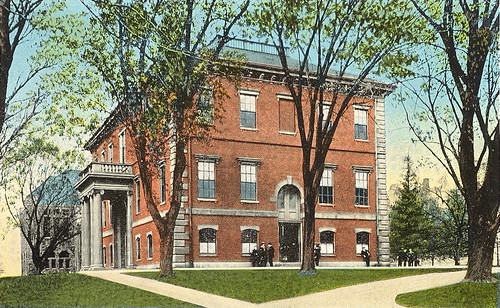
Historic Ballou Hall at Tufts.  Both the building and the pioneering Unilateralist preacher for which it was named were often mentioned in Holme's many poems about the College.
Tufts located in neighboring Medford was a Universalist institution founded in 1854, making it, by the way, the third oldest college in the Boston area and latter benefited from lavish donations from Universalist showman Phineas T. Barnum.  In fact Barnum’s giant elephant was stuffed and mounted for exhibition there and the school’s sports teams were called the Jumbos.
The school was a perfect fit for Holmes, who found encouragement for his poetry.  In fact it became the spiritual home of the rest of his life and as much of his identity as the tweed jackets and pipe that became his trademark.  He and his poetry flourished so well that the college published Along the Row, a collection of verse about his life and experience at the school in his senior year.  After graduating in 1929 he stayed on as an English instructor while doing graduate work at near-by Harvard, the bastion of the Unitarians.
Holmes briefly left Tufts to teach at Lafayette College in Easton, Pennsylvania from 1930-32.  Also on the faculty there was a close friend from his studies at Harvard, poet Theodore Roethke.  He also met his wife, Sarah Frances Ludlow who he wed in 1934.  The couple would go on to have a son, John.
After Holmes’s appointment at Lafayette expired, he was for a time unable to find an academic post due to the Great Depression supporting himself contributing poetry to magazines, including Poetry and popular general interest journals like The New Yorker and The Atlantic.  He was also an in-demand book reviewer.
Much to his relief, Holmes was able to return to Tufts in 1934 and stayed there for the rest of his life.  He became full professor of English and Poetry in 1960.  Holmes was a beloved and popular teacher.  His student Jerome Barron recalled, “When he taught, something magical happened. He made you want to write and understand poetry. He didn’t lecture; he encouraged. Simplicity, and writing that went from the inside out, this is what he was after.”  Several of his students became celebrated poets in their own right including Anne Sexton.
Holmes always sought to encourage great writing through communal encouragement and feedback.  Out of the regular bull sessions he hosted in his home for students and faculty he came to offer a similar experience for working writers.  His circle of Boston area poets in the 1950’s included Sexton, May Sarton, and others.
Beginning with Address to the Living in 1937, Holmes published four more collections of verse in his lifetime, including The Fortune Teller in 1961 which was nominated for the Pulitzer Prize in Poetry.  Many of the poems again reflected his life at Tufts.  They were always exquisitely crafted, often humorous, and always humane.  His good friend Robert Frost praised highly.  After his death, Beacon Press published his Selected Poems with an introduction by John Ciardi, a collection, including work not found in the individual volumes, magazine pieces, and light-hearted verse intended for his wide circle of friends.
In addition Holmes advanced the cause of poetry as a member and later President of the New England Poets Club, taught a night course for poets at the Boston Center for Adult Education, had a poetry program on WGBH-TV (with Philip Booth and Donald Hall), participated in the University of New Hampshire Writers Conference, was Director of the Chautauqua Writers Workshop from 1947to ‘52, and was in charge of the Tufts University Writers Workshop, from 1952 to ‘62.

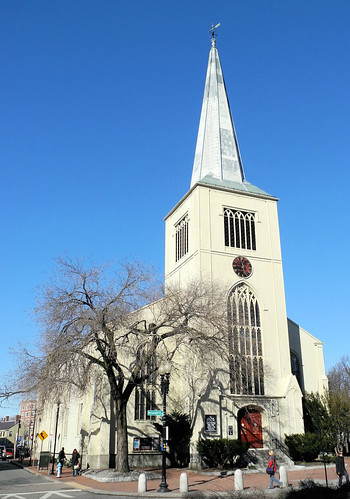
First Parish Cambridge (Unitarian) on Harvard Square was Holmes's last church home.

In 1945 Holmes began attending the Unitarian First Parish in Cambridge and while always retaining his theological Universalism made it his faith home.  He contributed hymns to a Unitarian hymnal and the experimental Universalist Kenneth Patton set other of his poems to music. Some of both of these, along with readings, can still be found in the UUA’s Singing the Living Tradition.
Despite these personal and professional triumphs, Holmes’s personal happiness was shattered in 1947 when his wife Sarah, who had struggled with mental illness, took her own life.  He found eventual solace and happiness with a new young Tufts faculty member, Doris Vivian Kirk.  They were married in 1948 and went on to have two children, Evan and Margaret.  The happy union endured until his death.
Holmes was the recipient of many honors including, being named Phi Beta Kappa Poet at Brown University, the College of William and Mary, Tufts, and Harvard.  He was also awarded the New England Poetry Club Golden Rose Award, The Saturday Review’s William Rose Benet Prize, and in 1962 was elected to the American Academy of Arts and Sciences.
In the early ‘60’s Holmes was stricken with cancer.  Tufts awarded him an honorary Doctorate of Letters in 1962 as he lay gravely ill.  He died weeks later on June 22 and was memorialized at the Tufts chapel before a crowd that overflowed onto the campus.  He was, without exception, the most beloved faculty member in the school’s long history.
Since 2004 Tufts has sponsored and annual John Holmes Memorial Poetry Reading featuring some of the best contemporary versifiers.  Holmes would have approved.

On hearing someone say that every possible subject has been covered in poetry


Granted, my narrow friend, that all
Worth writing about is done,
That repetition begins to pall
And no new lay can be sung;
That everything new under the sun
Is long since written down,
Rythmed and rhymed and made to pun
In Jingle and couplet and ode;
Granted that,(though it isn’t so)
Each time a baby is born
And comes to stay on our old earth
To live and to love and grow,
A reader of poetry who never heard
The songs that the poets sing,
Makes larger by one the audience
Reached by the printed word.
And the time for poets to worry and heed,
And the time for writing to stop,
Is the time when children stop growing up,
And nobody wants to read.
But while the world goes round the sun
These things will happen never,
And poets will sing and someone will hear
For ever and ever and ever.

         —John Holmes

Bewilderment in church
           
Life puzzles me.
I cannot tell how much of it is real
And what is dream.
I am afraid that sore time
I will poke my finger through something.
           
How shall I know
Whether the next breath I draw
Will not, when expelled,
Blow off the mist-dream
Of the crowded street, when I am walking?
Shall I not be afraid
Lest the great arches and walls and windows
Of this church
Dissolve
As a vision?
Whereas, with glorious assurance
I might mount the towers
And silver pinnacles of sound
That roll vast from the organ,
And fill the air.
           
Life puzzles me.
I am afraid that sometime
I will poke my finger through something.

—John Holmes
Fable
Some careless hand, a stranger,
From the wall along my field
Toppled a rock that would not
To my single effort yield.
But the shoulder of my neighbor,
His heart and will, with mine,
Stirred the rook and rolled it
Back from grass and vine.
When the stone was lifted,
The grass began to grow,
The vine reached up to sunlight,
The green began to show.
And a seed of oak was rooted
We had not guessed at all,
That even in our lifetime
Shall be a tree grown tall,
Shall be a shade and greenness,
A commonwealth of bough
To lives that we believe in
Not even seeded now.

—John Holmes