Showing posts with label Robert Frost. Show all posts

Tuesday, April 5, 2022

Poetically Pondering Old Men—National Poetry Month 2022

                            An old man not dead yet.

Maybe it’s the panting after a trip to the grocery store, the pain in my knee and various other body parts, or strapping a breathing gizmo to my face when I go to bed, but I feel more like the Old Man every day.  Without being morose I feel my mortality slipping away day by day.  Not that I plan to check out any time soon.  At least a couple of doctors recently assured me that I will be around and annoying for the foreseeable future with just a few lifestyle adjustments—cutting out sugar and the kind of moderate exercise I can actually do.

But like a lot of geezers past whatever landmarks are meaningful to them, I have been thinking a lot lately about being an old man.  I found some other poets who have been doing the same—white men all and only three out of five of them dead.

C.G. Hanzlicek.

The first poem on the subject that caught my attention was To Be a Danger by C.G. Hanzlicek who was born in Minnesota to a Czech immigrant craftsman and a farmer’s daughter.  He made it into the University of Minnesota where he became interested in poetry.  Hanzlicek is the author of nine books of poetry: Living in It, Stars, winner of the 1977 Devins Award for Poetry; Calling the Dead; A Dozen for Leah; When There Are No Secrets; Mahler: Poems and Etchings; Against Dreaming; The Cave: Selected and New Poems; and, most recently, The Lives of Birds.  In 2001, he retired from California State University, Fresno, where he taught for 35 years and was for most of those years the director of the Creative Writing Program.

To Be a Danger

Just once I’d like to be a danger

To something in this world,

Be hunted by cops

And forced into hiding in the mountains,

Since if they left me on the streets

I’d turn the country around,

Changing everyone’s mind with a word.


But I’ve lived so long a quiet life,

In a world I've made small,

That even my own mind changes slowly.

I’m a danger only to myself,

Like the daydreaming night watchman

Smoking his cigar

Near the dynamite shed.


—C.G. Hanzlicek


Ogden Nash.

Next up is American comic poet Ogden Nash known for his short, pithy verses and limericks.  In this widely re-published verse, a certain melancholy lurks behind the mirth.


Old Men


People expect old men to die,

They do not really mourn old men.

Old men are different. People look

At them with eyes that wonder when…

People watch with unshocked eyes;

But the old men know when an old man dies.


Ogden Nash


                                  Edward Thomas.

When the Great War broke out.  Already in his late 30s he vacillated over whether to enlist.  Thomas enlisted in the Artists Rifles in July 1915, despite being a mature married man who could have avoided enlisting. He was influenced in this decision by his friend the American Robert Frost, who had returned to the U.S. after taking walking trips with Thomas.  Frost sent him an advance copy of The Road Not Taken. The poem was intended by Frost as a gentle mocking of indecision, particularly the indecision that Thomas had shown on their many walks together.  Most took the poem more seriously than Frost intended, and Thomas took it personally, and it Edward Thomas never actually got to be old.  The Welsh-born poet was already an established literary figure provided the last straw in his decision to enlist.  Thomas was promoted to corporal, and in November 1916 was commissioned into the Royal Garrison Artillery as a second lieutenant. He was killed in action soon after he arrived in France at Arras on Easter Monday, April 9, 1917.


Old Man


Old Man, or Lad’s-love,—in the name there’s nothing

To one that knows not Lad’s-love, or Old Man,

The hoar-green feathery herb, almost a tree,

Growing with rosemary and lavender.

Even to one that knows it well, the names

Half decorate, half perplex, the thing it is:

At least, what that is clings not to the names

In spite of time. And yet I like the names.


The herb itself I like not, but for certain

I love it, as some day the child will love it

Who plucks a feather from the door-side bush

Whenever she goes in or out of the house.

Often she waits there, snipping the tips and shrivelling

The shreds at last on to the path, perhaps

Thinking, perhaps of nothing, till she sniffs

Her fingers and runs off. The bush is still

But half as tall as she, though it is as old;

So well she clips it. Not a word she says;

And I can only wonder how much hereafter

She will remember, with that bitter scent,

Of garden rows, and ancient damson-trees

Topping a hedge, a bent path to a door,

A low thick bush beside the door, and me

Forbidding her to pick.


                                            As for myself,

Where first I met the bitter scent is lost.

I, too, often shrivel the grey shreds,

Sniff them and think and sniff again and try

Once more to think what it is I am remembering,

Always in vain. I cannot like the scent,

Yet I would rather give up others more sweet,

With no meaning, than this bitter one.


I have mislaid the key. I sniff the spray

And think of nothing; I see and I hear nothing;

Yet seem, too, to be listening, lying in wait

For what I should, yet never can, remember:

No garden appears, no path, no hoar-green bush

Of Lad’s-love, or Old Man, no child beside,

Neither father nor mother, nor any playmate;

Only an avenue, dark, nameless, without end.


Edward Thomas


Robert Frost.

Speaking of Frost, we naturally assume that New Hampshires beloved poet would have something to meditate on.  Frost was adept at capturing scene and mood while reveling in his craftsmanship with verse.  Here he found pathos in an elderly man’s isolation and loneliness.


An Old Man’s Winter Night


All out of doors looked darkly in at him

Through the thin frost, almost in separate stars,

That gathers on the pane in empty rooms.

What kept his eyes from giving back the gaze

Was the lamp tilted near them in his hand.

What kept him from remembering what it was

That brought him to that creaking room was age.

He stood with barrels round him—at a loss.

And having scared the cellar under him

In clomping there, he scared it once again

In clomping off;—and scared the outer night,

Which has its sounds, familiar, like the roar

Of trees and crack of branches, common things,

But nothing so like beating on a box.

A light he was to no one but himself

Where now he sat, concerned with he knew what,

A quiet light, and then not even that.

He consigned to the moon,—such as she was,

So late-arising,—to the broken moon

As better than the sun in any case

For such a charge, his snow upon the roof,

His icicles along the wall to keep;

And slept. The log that shifted with a jolt

Once in the stove, disturbed him and he shifted,

And eased his heavy breathing, but still slept.

One aged man—one man—can’t fill a house,

A farm, a countryside, or if he can,

It’s thus he does it of a winter night.


Robert Frost

This Old Man.

Of course, the Old Man has chipped in too, relatively unembarrassed to hitch his wagon to his betters.  Take this from last Fall.

Equinox Eve Morn

September 21, 2021

Murfin Estate

Crystal Lake


The first few leaves flutter down

            from the old, slowly dying Boxelder

            in the breaking grey light of dawn,

            most of the thinning leaves not yet turned.


The vigorous five-trunk silver maple

            whose crown enlaces it

            has not even begun to turn

            nor have any of the other trees

            on our small lot.


A wind from the far-off Lake

            breaks yesterday’s heat and humidity,

            on cue the seasons are shifting.


Like that old junk tree

            I can feel myself dropping my own leaves

            tentatively but surely.


My time, too, is slipping away.


—Patrick Murfin 

Tuesday, April 7, 2015

National Poetry Month—John Holmes, Universalist Poet and Mentor

John Holmes with his pipe and trademark tweed, the beau ideal of a poet/academic.


Some poets are celebrated in their time and seem to disappear like the smoke of an extinguished fire.  Others are local legends, revered here but in need of a proper passport to be recognized there.  There are teachers who dazzle and change lives, mentors.  And there are those who sit at the center of a web of peers creating, perhaps, a movement.
John Holmes was all of these things.  Let me introduce you.
John Albert Holmes, Jr. was born on January 4, 1904 in Somerville, Massachusetts.  His father was a civil engineer who traveled frequently overseeing the construction of dams and bridges.  The family was faithful members of the   West Somerville Universalist Church where he developed a close relationship with the young minister, Rev. Albert S. Cole who would later become his colleague.
Young John early expressed an aptitude and passion which alarmed his mother, who was afraid that his total lack of interest in anything practical would leave him unable to make a living.  She shared her concerns with Rev. Cole who assured her “not to worry about John for he would give a very good account of himself.” 
And indeed he did.  His 1925 graduation class poem so impressed the commencement speaker, John Albert Cousens, President of Tufts College—now University that he recruited Holmes on the spot and arranged the financial assistance that made his attendance possible.

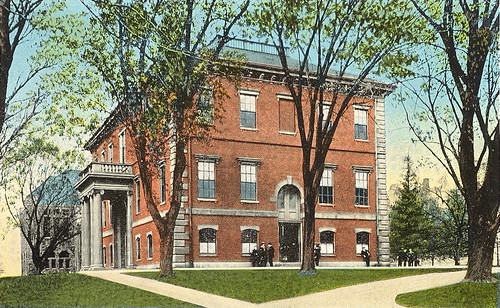
Historic Ballou Hall at Tufts.  Both the building and the pioneering Unilateralist preacher for which it was named were often mentioned in Holme's many poems about the College.
Tufts located in neighboring Medford was a Universalist institution founded in 1854, making it, by the way, the third oldest college in the Boston area and latter benefited from lavish donations from Universalist showman Phineas T. Barnum.  In fact Barnum’s giant elephant was stuffed and mounted for exhibition there and the school’s sports teams were called the Jumbos.
The school was a perfect fit for Holmes, who found encouragement for his poetry.  In fact it became the spiritual home of the rest of his life and as much of his identity as the tweed jackets and pipe that became his trademark.  He and his poetry flourished so well that the college published Along the Row, a collection of verse about his life and experience at the school in his senior year.  After graduating in 1929 he stayed on as an English instructor while doing graduate work at near-by Harvard, the bastion of the Unitarians.
Holmes briefly left Tufts to teach at Lafayette College in Easton, Pennsylvania from 1930-32.  Also on the faculty there was a close friend from his studies at Harvard, poet Theodore Roethke.  He also met his wife, Sarah Frances Ludlow who he wed in 1934.  The couple would go on to have a son, John.
After Holmes’s appointment at Lafayette expired, he was for a time unable to find an academic post due to the Great Depression supporting himself contributing poetry to magazines, including Poetry and popular general interest journals like The New Yorker and The Atlantic.  He was also an in-demand book reviewer.
Much to his relief, Holmes was able to return to Tufts in 1934 and stayed there for the rest of his life.  He became full professor of English and Poetry in 1960.  Holmes was a beloved and popular teacher.  His student Jerome Barron recalled, “When he taught, something magical happened. He made you want to write and understand poetry. He didn’t lecture; he encouraged. Simplicity, and writing that went from the inside out, this is what he was after.”  Several of his students became celebrated poets in their own right including Anne Sexton.
Holmes always sought to encourage great writing through communal encouragement and feedback.  Out of the regular bull sessions he hosted in his home for students and faculty he came to offer a similar experience for working writers.  His circle of Boston area poets in the 1950’s included Sexton, May Sarton, and others.
Beginning with Address to the Living in 1937, Holmes published four more collections of verse in his lifetime, including The Fortune Teller in 1961 which was nominated for the Pulitzer Prize in Poetry.  Many of the poems again reflected his life at Tufts.  They were always exquisitely crafted, often humorous, and always humane.  His good friend Robert Frost praised highly.  After his death, Beacon Press published his Selected Poems with an introduction by John Ciardi, a collection, including work not found in the individual volumes, magazine pieces, and light-hearted verse intended for his wide circle of friends.
In addition Holmes advanced the cause of poetry as a member and later President of the New England Poets Club, taught a night course for poets at the Boston Center for Adult Education, had a poetry program on WGBH-TV (with Philip Booth and Donald Hall), participated in the University of New Hampshire Writers Conference, was Director of the Chautauqua Writers Workshop from 1947to ‘52, and was in charge of the Tufts University Writers Workshop, from 1952 to ‘62.

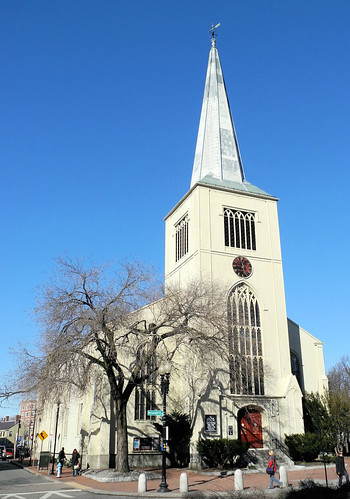
First Parish Cambridge (Unitarian) on Harvard Square was Holmes's last church home.

In 1945 Holmes began attending the Unitarian First Parish in Cambridge and while always retaining his theological Universalism made it his faith home.  He contributed hymns to a Unitarian hymnal and the experimental Universalist Kenneth Patton set other of his poems to music. Some of both of these, along with readings, can still be found in the UUA’s Singing the Living Tradition.
Despite these personal and professional triumphs, Holmes’s personal happiness was shattered in 1947 when his wife Sarah, who had struggled with mental illness, took her own life.  He found eventual solace and happiness with a new young Tufts faculty member, Doris Vivian Kirk.  They were married in 1948 and went on to have two children, Evan and Margaret.  The happy union endured until his death.
Holmes was the recipient of many honors including, being named Phi Beta Kappa Poet at Brown University, the College of William and Mary, Tufts, and Harvard.  He was also awarded the New England Poetry Club Golden Rose Award, The Saturday Review’s William Rose Benet Prize, and in 1962 was elected to the American Academy of Arts and Sciences.
In the early ‘60’s Holmes was stricken with cancer.  Tufts awarded him an honorary Doctorate of Letters in 1962 as he lay gravely ill.  He died weeks later on June 22 and was memorialized at the Tufts chapel before a crowd that overflowed onto the campus.  He was, without exception, the most beloved faculty member in the school’s long history.
Since 2004 Tufts has sponsored and annual John Holmes Memorial Poetry Reading featuring some of the best contemporary versifiers.  Holmes would have approved.

On hearing someone say that every possible subject has been covered in poetry


Granted, my narrow friend, that all
Worth writing about is done,
That repetition begins to pall
And no new lay can be sung;
That everything new under the sun
Is long since written down,
Rythmed and rhymed and made to pun
In Jingle and couplet and ode;
Granted that,(though it isn’t so)
Each time a baby is born
And comes to stay on our old earth
To live and to love and grow,
A reader of poetry who never heard
The songs that the poets sing,
Makes larger by one the audience
Reached by the printed word.
And the time for poets to worry and heed,
And the time for writing to stop,
Is the time when children stop growing up,
And nobody wants to read.
But while the world goes round the sun
These things will happen never,
And poets will sing and someone will hear
For ever and ever and ever.

         —John Holmes

Bewilderment in church
           
Life puzzles me.
I cannot tell how much of it is real
And what is dream.
I am afraid that sore time
I will poke my finger through something.
           
How shall I know
Whether the next breath I draw
Will not, when expelled,
Blow off the mist-dream
Of the crowded street, when I am walking?
Shall I not be afraid
Lest the great arches and walls and windows
Of this church
Dissolve
As a vision?
Whereas, with glorious assurance
I might mount the towers
And silver pinnacles of sound
That roll vast from the organ,
And fill the air.
           
Life puzzles me.
I am afraid that sometime
I will poke my finger through something.

—John Holmes
Fable
Some careless hand, a stranger,
From the wall along my field
Toppled a rock that would not
To my single effort yield.
But the shoulder of my neighbor,
His heart and will, with mine,
Stirred the rook and rolled it
Back from grass and vine.
When the stone was lifted,
The grass began to grow,
The vine reached up to sunlight,
The green began to show.
And a seed of oak was rooted
We had not guessed at all,
That even in our lifetime
Shall be a tree grown tall,
Shall be a shade and greenness,
A commonwealth of bough
To lives that we believe in
Not even seeded now.

—John Holmes