
Emma Lazarus was just 34 years old when she penned the lines that might be the most familiar verse to millions of Americans. Odds were stacked against her ever achieving that kind of recognition. She a woman at a time when most distaff poetry was confined to the pages of women’s magazines and the columns of newspapers desperate to fill inches at next to no expense. Only a handful of women, almost unanimously WASP gentlewomen like Julia Ward Howe were taken seriously by the cultural guardians of the literary elite.
If that was not enough to overcome, she was also a proud and open Jew, which is to say a virtual automatic pariah.
Yet she was no product of the shtetel, one of the impoverished Eastern European refugees from pogroms who were beginning to flood American cities in 1883. Indeed, she had deeper roots in the New World than most Colonial Dames. On her mother’s side she was a Nathan, a Sephardic Jewish family with roots in Portugal via the Netherlands and Brazil who had settled in Manhattan when it was still Dutch Nieuw Amsterdam in the mid-1600s. That side of her family was well established and prosperous and produced a distinguished line that included 18th Century poetess Grace Seixas Nathan and her distant cousin, Benjamin N. Cardozo, later a Justice of the Supreme Court.
The family of Emma father, Moses Lazarus, were German Jews who immigrated in the early 19th Century. They did not come over in steerage. They were middle class, well educated, highly cultured, and well assimilated in Germany. They spoke German, not Yiddish. In New York these Jews quickly established themselves as merchants, shopkeepers, and professionals. These Ashkenazi assumed leadership of the still small Jewish community over the sometimes-resentful long time Sephardic residents.
That Emma, the fourth of seven children, was the product of both of the great lines of European Jewry was somewhat unusual.

She was born on July 22, 1849 in New York City, the year after a wave of European revolutions that sent another surge of Jewish immigrants to the city. The family was upper-middle class, not terribly religious, and deeply interested in high culture. They were comfortable enough to have a summer home at Newport, Rhode Island, home of the famous Sephardic Jewish Synagogue, the oldest in America, which later inspired one of Emma’s best-known poems.
At home they spoke English, which was her mother’s family language for generations, but she also became fluent in her father’s German. He was eager to share with her all of the classics of German literature and of the Romantic movement. Tutored privately, she also learned French and Italian and intently studied British and American literature.
Lazarus was writing poetry in her teens and published translations of German poets including the Romantics Johann Wolfgang von Goethe and Heinrich Heine in the early 1860’s. Her proud father arranged to have her first collection of original poems in 1866 and the next year Poems and Translations had a successful commercial publication. That volume drew the approving attention of no less than Ralph Waldo Emerson for whom the German Romantics were an important early influence.
Over the next decade, Lazarus published a second volume of poetry, Admetus and Other Poems in 1871; the novel Alide: An Episode in Goethe’s Life in 1874, and a play in verse, The Spagnoletto, in 1876. If not a literary celebrity she earned the attention and approval in cultivated circles. But most of her readers were not aware that the youthful female poet was Jewish. In fact, the name Lazarus, familiar from the Jesus miracle story in the New Testament, probably gave many the impression she was Christian.

Like many of the Ashkenazi elite in New York, her father was a political liberal, ardent abolitionist and Union supporter during the Civil War, and open to new and radical ideas. His daughter was an apple that fell close to the tree. When Henry George published his hugely influential Progress and Poverty: An Inquiry into the Cause of Industrial Depressions and of Increase of Want with Increase of Wealth: The Remedy in 1879, Lazarus became an early disciple and soon a close personal friend of the visionary author. She plunged into spreading the word about George’s vision of a communal society supported by a single tax on land which rivaled Marxist socialism as a model for a new society among radicals. In addition to a laudatory poem published in the New York Times she wrote, “Progress and Poverty is not so much a book as an event. The life and thought of no one capable of understanding it can be quite the same after reading it,” and even that reading it would prevent such a person, who also “prized justice or common honesty” from being able to ever again “dine or sleep or work in peace.”
Yet in all of this literary and political activity, Lazarus did not seem much interested in her Jewish identity or advancing Jewish causes. She was occasionally stung by anti-Semitism but like many others believed that assimilation would eventually overcome prejudice.
That changed when she got her hands on George Eliot’s 1876 novel Daniel Deronda which was not well known in America. The social satire contained a moving description of the plight of European Jews and painted an idealistic picture of a young man out to right historic oppression and save his people. Although it was the final work of an important Victorian novelist and therefore a somewhat unlikely source, the book inspired a generation on both sides of the Atlantic to become what is now recognized as proto-Zionists. That term Zionism was not yet invented or became a formal movement until launched by Theodor Herzl in 1897.
This interest was further stirred by the news of Russian pogroms that followed the assassination of Tsar Alexander II in 1881. That set off the first wave of massive Eastern European immigration of largely destitute refugees to the city. While many of the established Ashkenazi elite were horrified by the crude peasants and laborers who they feared would evoke a harsh backlash from latent American nativism, Lazarus plunged into organizing aid and loudly advocating for the truly wretched refuse that were filling the tenements and slums. It became the work of the rest of her life.
She wrote The Dance to Death, a dramatization of a German short story about the burning of Jews in Nordhausen during the Black Death. In addition to articles published wherever she could place them, Lazarus published Songs of a Semite in 1882.
On a practical level Lazarus helped to found the Hebrew Technical Institute in New York to provide vocational training to assist destitute Jewish immigrants to become self-supporting and raised funds for other charities and relief programs.

In that spirit she somewhat casually donated a new poem inspired by the French gift to an auction, conducted by the Art Loan Fund Exhibition in Aid of the Bartholdi Pedestal Fund for the Statue of Liberty in New York Harbor. It was not until 1903 that the first verse of that poem, The New Colossus was installed on a bronze plaque on the pedestal it modestly helped finance. The words subsequently reprinted in school textbooks and recited at patriotic gatherings became some of the most familiar and beloved lines of American poetry.
Lazarus traveled to Europe twice in in 1883 and again from 1885 to 1887 to learn more of conditions there and to contact Jewish intellectuals and leaders as well as leading radicals like William Morris.

She returned from the second trip deathly ill. Two months after she sailed past Lady Liberty which had finally been dedicated while she was abroad, Emma Lazarus died of what is now believed to have been Hodgkin’s lymphoma on November 19, 1887. She was only 38 years old.
At the time of her death, she was still not well known to most of the American public. She was eulogized most often in the Jewish and radical press, although due note was made in the New York Times which had published several of her essays over the years. Many of her earlier admirers distanced themselves from her as she identified more urgently as a Jew.
She is widely recognized today mostly on the strength of The New Colossus. She was honored by the Office of the Manhattan Borough President in March 2008, and her home on West 10th Street was included in a map of Women’s Rights Historic Sites. In 2009, she was inducted into the National Women’s Hall of Fame and The Museum of Jewish Heritage featured an exhibition on her in 2012.

The Postal Service has never seen fit to issue an Emma Lazarus stamp, but it did feature her portrait on the first day cover card of a 1978 16¢ First Class Statue of Liberty stamp that quoted a line from her poem.
Here is that famous poem and two more samples of her work that deserve to be remembered as well.
.jpg)
The New Colossus
Not like the brazen giant of Greek fame,
With conquering limbs astride from land to land;
Here at our sea-washed, sunset gates shall stand
A mighty woman with a torch, whose flame
Is the imprisoned lightning, and her name
Mother of Exiles. From her beacon-hand
Glows world-wide welcome; her mild eyes command
The air-bridged harbor that twin cities frame.
“Keep, ancient lands, your storied pomp!” cries she
With silent lips. “Give me your tired, your poor,
Your huddled masses yearning to breathe free,
The wretched refuse of your teeming shore.
Send these, the homeless, tempest-tost to me,
I lift my lamp beside the golden door!”
—Emma Lazarus

In The Jewish Synagogue at Newport
Here, where the noises of the busy town,
The ocean’s plunge and roar can enter not,
We stand and gaze around with tearful awe,
And muse upon the consecrated spot.
No signs of life are here: the very prayers
Inscribed around are in a language dead;
The light of the “perpetual lamp” is spent
That an undying radiance was to shed.
What prayers were in this temple offered up,
Wrung from sad hearts that knew no joy on earth,
By these lone exiles of a thousand years,
From the fair sunrise land that gave them birth!
How as we gaze, in this new world of light,
Upon this relic of the days of old,
The present vanishes, and tropic bloom
And Eastern towns and temples we behold.
Again we see the patriarch with his flocks,
The purple seas, the hot blue sky o’erhead,
The slaves of Egypt,—omens, mysteries,—
Dark fleeing hosts by flaming angels led.
A wondrous light upon a sky-kissed mount,
A man who reads Jehovah’s written law,
‘Midst blinding glory and effulgence rare,
Unto a people prone with reverent awe.
The pride of luxury’s barbaric pomp,
In the rich court of royal Solomon—
Alas! we wake: one scene alone remains,—
The exiles by the streams of Babylon.
Our softened voices send us back again
But mournful echoes through the empty hall:
Our footsteps have a strange unnatural sound,
And with unwonted gentleness they fall.
The weary ones, the sad, the suffering,
All found their comfort in the holy place,
And children’s gladness and men's gratitude
‘Took voice and mingled in the chant of praise.
The funeral and the marriage, now, alas!
We know not which is sadder to recall;
For youth and happiness have followed age,
And green grass lieth gently over all.
Nathless the sacred shrine is holy yet,
With its lone floors where reverent feet once trod.
Take off your shoes as by the burning bush,
Before the mystery of death and God.
—Emma Lazarus
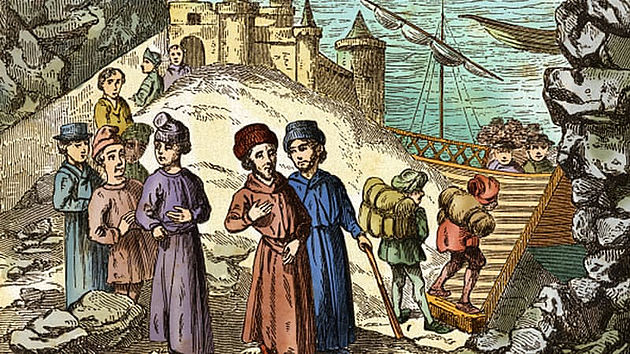
1492
Thou two-faced year, Mother of Change and Fate,
Didst weep when Spain cast forth with flaming sword,
The children of the prophets of the Lord,
Prince, priest, and people, spurned by zealot hate.
Hounded from sea to sea, from state to state,
The West refused them, and the East abhorred.
No anchorage the known world could afford,
Close-locked was every port, barred every gate.
Then smiling, thou unveil’dst, O two-faced year,
A virgin world where doors of sunset part,
Saying, “Ho, all who weary, enter here!
There falls each ancient barrier that the art
Of race or creed or rank devised, to rear
Grim bulwarked hatred between heart and heart!”
—Emma Lazarus


