Showing posts with label Bonus March. Show all posts

Monday, July 28, 2025

The Bonus March—When MacArthur, Eisenhower, and Patton Did Hoover’s Dirty Work


Bonus Marchers in the St. Louis rail yards in late May 1932 ready to hop B & O freights to Washington.  Marchers clogged the freight trains for weeks from all over the country.

Note—On January 6, 2017 the highest echelons of the Trump maladministration did everything they could to prevent National Guardsmen or Army troops from defending the Capitol from a violent insurrection.  It was a different story in 1932 when the full force of the Army was unleashed on veterans who never posed any threat to the Capitol or government.

Today is the anniversary of one of the most important mass protests in American history being crushed by military force.  This is a bit of historical trivia that was never more relevant.

On July 28, 1932 Washington, D.C. became a battle zone when President Herbert Hoover ordered the Army to clear out veterans, their families, and supporters who had been camped since June to press demands for an early payment of a bonus promised to World War I soldiers and sailors

It was nearly four years into the Great Depression with no relief from an almost total economic collapse in sight.  True unemployment was estimated to be nearing 25% with no safety net other than voluntary soup kitchens.  Tens of thousands of small businesses failed dropping once solid citizens into povertyFarm income collapsed.  Across the board, conditions were bleak. 

Veterans of the Great War were still relatively young men, most in their early 30s.  They had been welcomed home as heroes.  Despite the inevitable post-traumatic stresses of any war’s aftermath, most had married and were raising families when disaster struck.  Largely able bodied and well disciplined, they were perhaps the most employable men in America.  But many, very many, were in desperate shape that summer. 

In 1924 under pressure from veterans’ organizations, especially the American Legion, Congress had passed the Adjusted Service Certificate Law over the strenuous objections of President Calvin Coolidge.  Vets were issued 3,662,374 bonus certificates, the face amount determined by a formula of how many days each soldier served with a greater payment for each day overseas.  The maximum amount due was $500 for domestic service up to $650 payable when the certificates matured in twenty years—1945

Although veterans were allowed to borrow against a percentage of that sum—eventually raised to 50%, the money had to be repaid with interest

Congress financed the scheme with annual appropriations of more than $12 million to fund the 1945 payments which were expected to total more than $3.5 billion.  Loans paid out against the certificates had already placed the fund in the red

None-the-less, in face of the dire emergency leading figures like popular retired Marine Corps General Smedley Butler began advocating for an immediate early payment of the bonus certificates.  


Texas Congressman Wright Patman, with hat in hand, is shown receiving a petitions from Veteran representatives in front of the Capital..  Patman sponsored legislation for an early payment of a promised bonus to World War I veterans.

Democratic Congressman Wright Patman of Texas, then in the second term of his long career, introduced a bill to authorize the payments.  It was ardently opposed by the President and Republicans in Congress. 

Hoover, a Quaker, had risen politically largely on his reputation as The Great Humanitarian for his work feeding starving European civilians in the wake of the war.  He was the only engineer until Jimmy Carter to be elected President, a man of meticulous attention to detail, a deep attachment to Republican laissez faire economic philosophy, and a practically physical revulsion to disorder.”  He responded to the Depression with cheerleading, rosy predictions for recovery, expressed sympathy for those affected but a firm belief that they were on their own and that the Federal Government had no Constitutional responsibility to them.  More concerned with the holy writ of a balanced budget, he urged spending be slashed—a policy that not only did not help but actually deepened the Depression.  Naturally Hoover and unified Republicans railed against the proposed Patman Act as a budget buster.

The Bonus Expeditionary Force was organized by Walter W. Waters, a former sergeant in the AEF—American Expeditionary Force—in World War I, to descend en masse on Washington to pressure Congress to pass the Patman Act.  Veterans and their families from all over the country, but mostly from the East, responded to the call arriving in the city on June 17 as the Senate took up the bill, which had already cleared the House.  


Bonus Army camps may have had ramshackle huts and tents, but they were neatly organized with streets and maintained with military discipline, men assigned to clean-up, cooking, and security duties in addition to regular drilling.

Senate Republicans blocked action on the bill and the Bonus Marchers settled into makeshift camps, nicknamed Hoovervilles.  Although the shabby camps were assembled from what tents could be obtained and junk scavenged from scrap yards, the veteran leaders exercised military discipline.  They were laid out in orderly streets, sanitation facilities were dug and maintained, common kitchens established, and camps patrolled by volunteer M.P.s.  Men had to register producing evidence of honorable discharge to be admitted and were each expected to do duty keeping the camps clean, orderly, and secure.  The men responded to daily reveille and held regular paradesAmerican flags were prominent.

The veterans were very concerned that the public see them as loyal patriots.  And by in large, despite being denounced as dangerous Communists in the most conservative press, the public was at least sympathetic to them

Over 17,000 men enrolled. Their wives and children plus some approved volunteer supportersespecially nurses and medical personnelswelled the camps to a total population of over 40,000.  The main camp was laid out on the mud flats and boggy ground by the Anacostia River across from the core of the city.  


Days before he ordered the Bonus Army dispersed and drive from Washington President Herbert Hoover was lampooned in the professional quality camp newspaper,  He was depicted as the Kaiser with a waxed mustache and wearing the Capital Dome asa a German spiked helmet.  Men of every trade and level of education were in the camps, including the experienced journalists, artists, typographers, and printers who produced the paper.

Marchers gathered daily for orderly demonstrations near the Capitol.  By late July it was evident that the Republicans in the Senate would not budge and that the Patman Act was doomed.  Acting on direction of the President, Attorney General William D. Mitchell ordered District Police to “evacuate the city” of bonus marchers on the morning of July 28. 

Veteran leaders were taken by surprise by a police charge and the men resistedIll trained police responded by emptying their revolvers into the crowd killing two men outright and injuring dozensEnraged, the veterans fought back, pelting police with rocks, bricks, and anything else they could lay their hands on.  A few may have had handguns and fired back or fired with weapons taken from disarmed officers.  Police were forced to withdraw with nearly 70 men injured.  The veterans remained on Pennsylvania Avenue. 

Learning of the failure of the police, Hoover ordered the Army to take actionArmy Chief of Staff Douglas MacArthur, in dress uniform and festooned with every decoration he ever received, decided to take personal command.  As commander of the famed Rainbow Division made up of National Guard units, many of the veterans in the streets had served under him


Army Chief of Staff Douglas MacArthur in full dress uniform consults with his cavalry commander Major George S. Patton.  MacArthurs aide-de-camp Major Dwight Eisenhower is the officer at right with his hands on his hips. 

MacArthur deployed two full regiments, the 12th Infantry, and the 3rd Cavalry supported by six battle tanks commanded by Maj. George S. Patton.  The Army arrived on the scene about 4:30 p.m. as Federal employees were leaving their offices.  MacArthur, with his aide Major Dwight Eisenhower at his side, ordered his troops to advance

At first many of the veterans were glad to see their brother soldiers.  Some believed that they had arrived to protect them from the police, others said they thought the advance at first was a parade in their honor.  Then Patton ordered his cavalry to charge, sabers drawn.  As the horrified witnesses from surrounding office buildings screamed “Shame, Shame!” the cavalry crashed into the thick mass of veterans.  As the veterans reeled back toward their camps, the infantry came up with bayonets fixed.  Using adamsite gas, an arsenic based gas inducing violent vomiting, the troops began to clear the camps.  Women, children, and civilian volunteers alike were swept up.  


Patton's Light Tanks attacked Marchers on Pennsylvania Ave. as did his mounted cavalrymen behind them with sabers drawn and used. 

Against the President’s explicit order, MacArthur crossed the Anacostia into the vast main camp.  Tents and huts were put to the torch, destroying all of the personal possessions of the veterans and their families.  Survivors, including many injured, were scattered into the countryside where local law enforcement personnel hectored them for days as they tried to find ways to get home.

In the end at least four veterans, including two of their leaders, William Hushka and Eric Carlson were killed and an estimated 1,017 injured.  Most historians agree that both of those figures are low because many of the injured were either unable to get medical treatment or afraid to seek it.  In addition, one woman suffered a miscarriage and an infant was killed.  Again historians, believe, based on eyewitness accounts, that other children, especially infants were killed or died later as result of the gas.  


The smoldering ruins of the main camp on the Anacostia mud flap.  Marchers and their families lost all of their personal belongings as they fled for their lives and were hectored and harassed for weeks by local authorities and sometimes vigilante mobs as they tried to make their way home.  Here and there local citizens organized aid and comfort.

Within a week newsreel footage of the attack was being played in every movie theater in the country.  Public outrage played a big part in the defeat of Hoover for re-election that November. 

But if veterans thought that Franklin D. Roosevelt would support payment of the Bonus, they were wrong.  Roosevelt wanted to use money for other projects and for direct relief.  But F.D.R. was not about to make the same mistake as Hoover when a smaller Bonus Army appeared in the summer of 1933.  Instead of sending in the Army, he sent Eleanor, who brought tea to the veterans and urged them to instead enlist in the Civilian Conservation Corps (CCC). 

Hundreds took her up on the proposal and were put to work building the causeway road to Key West, Florida.  When the Labor Day hurricane on September 2, 1935 killed 258 veterans working on the Highway, public sentiment again swung behind the veterans’ demand. 

In 1936 Congress over-rode Roosevelt’s veto to finally authorize the early payment of the promised bonus. 

After World War II the G.I. Bill with its promises of immediate money for education or a home purchase was enacted specifically in response to the plight of World War I vets. 
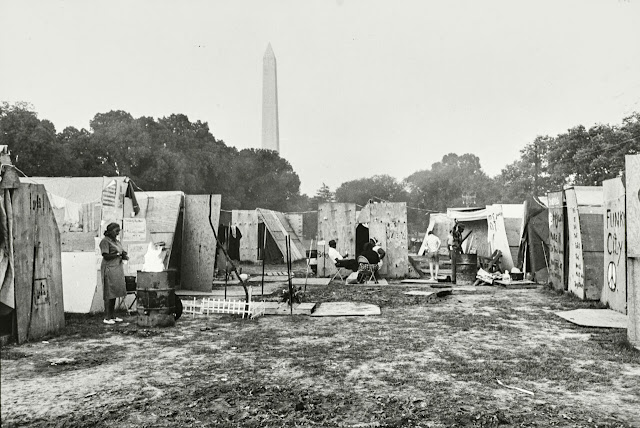
 

In 1968 Resurrection City, the camp of the Poor People's Campaign was unmolested by troops.  President Lyndon Johnson remembered the Bonus March. 

The 1963 March on Washington for Jobs and Freedom called by Martin Luther King, Jr. and his allies was inspired by the Bonus Marchers.  His 1968 plans for the Poor Peoples Campaign, which included a camp of protesters, were even more evocative.  The Campaign, conducted after King’s murder, was not dispersed by troops.


Sunday, June 22, 2025

The GI Bill was the Steroid that Bulked Up the White Middle Class and Left Blacks Behind


  President Franklin Roosevelt passes a pen used in signing the GI Bill in 1944.

Note—If you want an example of how deeply engrained White privilege has benefited millions while largely excluding Blacks and minorities look no further than the GI Bill which lifted individuals and families from poverty or limited prospects into the middle class.  In turn that set up subsequent generations with a head start based on wealth acquisition over time denied to most African-Americans.

On June 22, 1944 President Franklin D. Roosevelt signed the Servicemens Readjustment Act of 1944, better known as the G.I. Bill of Rights.  Barring Social Security, it was the most successful social program in American history.  It set the stage for the long economic boom of the 1950s and ‘60s and the rapid ascendancy of the middle class by forestalling an immediate post-War crisis, fueling an unprecedented housing boom, and by providing American industry and government with a highly educated workforce.  Getting that result was not easy.

In 1944 the end of World War II was in sight even if more than a year of bloody conflict still lay ahead.  That of course was good news.  But it also kept a lot of folks up with night sweats.  What would happen when the largest mobilization in history—millions of armed service members, mostly mencame to an end.  Battle hardened veterans would be dumped into an economy that would be naturally rapidly contracting as the war production boom came wound down.  Men with no skills beyond aiming an M-1 or swabbing a deck would be thrown into competition for scarce jobs with workers who had mastered all sorts of production skills in the defense plants.  Everyone expected a post-war recession; it was just a matter of how severe.  Some fretted it could relapse into the Depression that only really ended when war production began to ramp up in 1939.

Similar conditions had led to the rise of fascism and Communism in Europe after World War I and huge domestic turmoil in the U.S. that included mass strike waves, race riots, and the great Red Scare crackdown that threatened basic Constitutional and Civil Rights.  

Meanwhile the demobilizing troopsdraftees and volunteers alike had been vaguely promised that their years of sacrifice would be honored and rewarded and that they would somehow be “taken care of.”  Conservatives in Congress were already making noises against “undeserved giveaways” and expenditures that would get in the way of deep cuts to high wartime taxes on the wealthy. 

The historic models were not good.  After the Civil War a stingy Congress was parsimonious in handing out pensions and even the politically powerful Grand Army of the Republic (GAR) was frustrated with trying to loosen Congressional purse strings as their membership aged. As a result, many veterans joined the labor movement during the decades of open class war of the late 19th and early 20th Centuries.  They burned down rail yards during the Great Railway Strike of 1877 and were the backbone of Coxeys Army when it marched on Washington in 1894.  


The specter of the Bonus March, which was violently suppressed by the Army under Douglas MacArthur, and possible post war chaos or rebellion haunted the lawmakers who worked on the GI Bill 

After the Great War Congress sought to buy time by promising a Bonus payment to Veterans in 1945.  But when the Great Depression hit sending unemployment soaring thousands joined the Bonus March on Washington that the Hoover administration was terrified signaled a revolution.  The Bonus March was brutally dispersed by the Army under the command of General Douglas MacArthur.   No one wanted a replay of that, either.

In the White House President Roosevelt and his New Deal holdover staff began to put together a relatively modest package of benefits fearing Congressional Republican united opposition.  The bill Roosevelt proposed would have been means tested—only poor veterans would be eligible for most of the benefits and education grants for four years of college would only go to those who got top scores on a written test. 

The leaders of the two most powerful veteran’s organizations, the American Legion and the Veterans of Foreign Wars (VFW) with millions of members, plenty of political clout, and the prospect of enrolling waves of new GIs had other ideas.   Harry W. Colmery, a liberal Democrat and a former National Commander of the American Legion—yes, children, such persons once existed—sketched an early draft proposal for a bill at the Mayflower Hotel in Washington.  The then current Commander Warren Atherton, a Republican lawyer, helped with the final drafts.

With the backing of both Veterans organizations, he quickly gained the support of Sen. Ernest McFarland (D-Ariz.) as the principal sponsor in the Upper Chamber.  He got some bi-partisan support, especially Rep. Edith Nourse Rogers of Massachusetts who was the Republican Chair of the House Veterans Affairs Committee.  The bill was introduced in January 1944 and despite being sweepingly more generous gained the support of the President.  With the Legion and VFW pulling out all stops on pressuring Congress and the hastily organized support of GI families, especially their wives, the Bill rushed through Congress and was adopted by a comfortable margin in the Democratic Senate and the Republican held House.  Only the most curmudgeonly of conservatives groused, and they did so discretely.


An Army Paratrooper poses with a poster promoting the new GI Bill. 

The main provisions of the GI Bill which would reshape American society were:

·         Dedicated payments of tuition and living expenses to attend high school, college or vocational/technical school.

·         Low-cost home mortgages.

·         Low-interest loans to start a business.

·         52 weeks of unemployment compensation.

To be eligible a veteran must have been on active duty during the war years for at least 90 days and had not been dishonorably discharged.  Combat was not a requirement. All veterans including women and minorities—the most controversial component of the legislation—were eligible.

The most glaring omission was those who served in the Merchant Marine, although they had been considered military personnel in times of war under the Merchant Marine Act of 1936.  This even though Merchant Marine suffered higher losses in combat by percentage than any of the recognized Armed Services.  At the signing ceremony Roosevelt urged Congress to act to rectify the omission.  They never did. 

Although Blacks and other minorities were technically eligible for full benefits, custom, political expediency, and Federal timidity conspired to deny many their rights under the program.  Just as many New Deal programs had done before, administration of the benefits were left to local White officials and a tacit policy of deferring to local custom” many Blacks were shut out, especially but not exclusively in the Jim Crow South.  Many of those not directly turned down were discouraged from applying and many were never informed of their rights by the outreach programs of the Veterans Administration and the Veterans organizations.  Most affected was the home loan program because there was no requirement for banks to serve Black borrowers or developers to sell to them.  Of the first 67,000 mortgages insured by the G.I. Bill, fewer than 100 were taken out by non-whites, virtually universal exclusion.


A Black NCO explains GI benefits to his unit of truck drivers.  In reality most Blacks found it difficult or impossible to fully claim their benefits due to custom, Jim Crow laws, and openly bigoted local administrators.  Being locked out would have devastating, multi-generational consequences.  

Vital education benefits were also impacted.  Most colleges and universities still excluded Blacks or admitted them only in small numbers under strict quota systems.  That shunted most potential student off to trade schools, including many fly-by-night operations set up just to harvest GI Bill benefits or to the limited number of historically Black colleges which were quickly overwhelmed.  And, once again, local official found ways to dispute payments to those schools.  Only one fifth of the 100,000 blacks who had applied for educational benefits had registered in college by 1946 and the hard pressed Black schools had been forced to turn away 20,000 eligible vets for lack of space for them.  And in most of the South, it was virtually impossible for Blacks to get their unemployment benefits under the program.

This has had a generational effect as previously poor or working class Whites were lifted into the Middle Class giving their children and grandchildren advantages not available to the offspring and descendants of Black vets.  It is one of the most insidious and invisible elements of White privilege that the beneficiaries never even think about.

Despite these failures, the GI Bill was an enormous success for its favored beneficiaries and for the economy.


 The new American Dream--a house in the suburbs made possible for many by the GI Bill.

By 1956, roughly 8.8 million World War II veterans had used the education benefits including 2.2 million to attend colleges or universities and 5.6 million for some kind of training program.  Millions more took advantage of GI Bill mortgage loans.  One of those was my father, W.M. Murfin who in that very year used it to upgrade us from a slightly run down 1890 frame rental in Cheyenne, Wyoming to a three bedroom brick ranch in a new subdivision out by the airport. 

Many more would continue to use the benefits for decades to come. 

Here are some of the results of the GI Bill.

At the time it was enacted many supporters felt that the most critical component was the guaranteed one year of unemployment benefits which paid $20 weekly.  That was hardly a princely sum and difficult for a person supporting a family to get by on.  But it was a very livable payment for singles providing a modest standard of living.  But it turned out that fewer veterans took advantage of this than anticipated or who took advantage of education benefits.  Less than 20 % of the money set aside for the program was used.


A disillusioned Vet played by Frank Sinatra paid for his carousing with his GI Bill unemployment benefits in Some Came Running with Dean Martin, a film based on an autobiographical novel by James Jones.  

The biggest beneficiaries of the unemployment benefits were those who had the hardest time adjusting to civilian life including those who we now recognize suffered from Post-Traumatic Stress Disorder (PTSD).  Many of them had trouble reconnecting with family and could not establish stable relationships like the millions of vets who rushed into marriage after the war.  They were rootless.   Think of the lead character in James Joness novel Some Came Running who was played by Frank Sinatra in the movie.  It is never explicitly stated but understood that the troubled Vet who returns to his hometown pays for his lodgings and carousing with his unemployment benefits. 

Some Vets purposely took the year to unwind and find themselves gravitating to places like New Yorks Greenwich Village, San Francisco, and Los Angeles.  Among them were several who became leading figures in Beat movement and the post-war art and theater scenes.  Thus, those government checks had profound cultural impact.

But the limited use of unemployment benefits was because the post-war recession was not as deep or long as many had feared.  Pent up demand for automobiles, durable goods, and housing all fueled a rapid recovery and ushered in an unprecedented boom period.  Millions of women left the workforce voluntarily or involuntarily opening jobs and the huge numbers of vets who took advantage of educational benefits which delayed their entry into the job market for years by which time the economy was roaring again. 

Before the War, most Americans who did not live in rural areas and small towns, did not live in single family homes, especially the working class and urban poora population that had been swollen by the depression.  Most lived in apartments, flats, and tenements.  Truly astonishing numbers, including whole families, lived in boarding houses, other rooming houses, and in residential hotels.  The GI Bill, and to some extent FHA Loans, changed that with astonishing speed.  Vets were offered low interest, zero down payment home loans from established banks backed by Federal guarantees and insurance.  Terms of the loans favored new construction over the purchase of existing housing stock, a nod at stimulating the construction industry.


The reality--Levittown, New York in 1947 and the birth of suburban sprawl and '50's car culture.  Even the School was paid for by Federal education construction grants.

GIs and their families poured out of old central cities and into sprawling suburban developments symbolized by Levittown.  Old established neighborhoods were disrupted and broken up.  Blacks, more recent immigrants, and poor Whites took over those areas.  And the coming of Blacks stoked White flight to the suburbs by those who had been left behind. 

The resulting sprawl also contributed to the growing auto centered cultureroads, highways, parking lots, shopping centers, drive-in everything with all the attending pollution and other effects for good and ill.

The new suburban life-style suddenly enshrined the nuclear family—dad, stay-at-home mom, and children as the cultural norm.  Before the war many lived together in extended, multi-generational families.  Despite the relatively recent origin of this norm, contemporary conservatives and reactionaries consider it both time honored tradition and actually anointed by God even as shifting culture and a new harsh economic reality have rendered it nearly obsolete. 

But many argue it was the education benefits that had the farthest reaching consequences.  The many college graduates produced, mostly as admirers of the “Greatest Generation” are eager to point out, motivated, driven, and focused entered the job market in time to provide the engineers, scientists, and other innovators that contributed to one revolution after another in technology, transportation, communication, and production.  On their shoulders America became the undisputed economic master of a shattered world.


Students, many of the Vets on the GI Bill, all of them white, line up for registration at the University of Minnesota. 

They also filled the ranks of what in retrospect might be called the Age of Middle Management in the giant corporations that came to dominate the post war era and government at all levels.  The sons of shoemakers, sharecroppers, and factory hands became junior executives and vice presidents.  Some went even further.  It was a white collar revolution that raised millions into the middle class and firmly set expectations of achievement for the Baby Boomers, Gen Xers, and subsequent generations that followed them.

But in the Digital Age, with globalization, and the aftermath of the 2008 economic collapse and the extended Coronavirus shut down in 2020-21 most of those jobs disappeared as surely as did those of coal miners and rust belt factory workers.  Yet the myth that a college education is an automatic ticket to the middle class and success lingers.  The grandchildren and great grandchildren of those returning Vets are now graduating from college saddled with enormous debt and dim job prospects for many.  We have entered the age of Uber drivers with master’s degrees, retail clerks and low level managers with B.A.s, and thirty-year-old waitresses still hustling tables at Chili’s.  Many can’t launch independent lives and society is getting used to the return of multi-generation homes as under-employed alums linger in or return to their parents’ houses.

Although the versions of the GI Bill have remained in force, veterans of subsequent conflicts did not get the same comprehensive boost as the World War II vets did.ss  Troops returning from Korea found that instead of their institutions receiving payment for tuition and fees, they were given a flat amount regardless of cost of their education to apply to their expanses.  That figure—about $150 a month usually failed to pay all expanses and was reduced in value over the years by education inflation which ran ahead of the general cost of living.


Rep. Gillespie "Sonny" Montgomery, U.S. Army Major General, Retired, and his proudest accomplishment --the Montgomery GI Bill. 

In 1984 the revised Montgomery GI Bill—Active Duty (MGIB) sponsored by Rep. Gillespie V. “Sonny Montgomery, corrected and raised benefits but extended the time of active service required and put in place a 10 year window to use them after leaving the service.  Once again inflation ate up the increased monthly payments despite occasional boosts.  The Montgomery Bill remains the underlying law regarding these veterans’ benefits.

In 2010 Congress after much delay passed President Barak Obamas tweak of benefits, the Post-9/11 GI Bill a/k/a GI Bill 2.0 which among other thing expanded the eligibility of members of the National Guard or Reserves called up for active duty—troops that the Armed Services heavily relied on in the Gulf War, Bosnia, Somalia, Afghanistan, and Iraq as well as other anti-terrorist actions.  Education benefits were redefined with a new cap and there was additional minor tinkering.  


President George W. Bush opposed expansion of GI Bill benefited for fear that it would encourage soldiers to leave the service rather than doing multiple deployments to Iraq and Afghanistan.  His veto was over riden.  Barack Obama secured  improved benefits in the Post-9/11 GI Bill. 

Under heavy pressure in Congress guarantees were written into the law for payment to private, for profit trade schools, and an explosion of iffy on-line diploma mills despite the administration’s desire to rein in the worst offenders who saddled vets with courses most never completed and/or worthless degrees and training certificates not recognized by businesses or legitimate educational institutions.  In 2012, Obama issued an Executive Order to ensure that military service members, veterans, and their families would not be aggressively targeted by sub-prime colleges.  These regulations caused the failure of heavily advertized ITT Tech and Corinthian Colleges which abruptly cease operations after the Obama administration slapped them with federal sanctions.  Many more were in danger of going out of business.

Donald Trump countermanded Obama’s Executive Order with one of his own that unleashed the controversial schools to resume preying on veterans and their families. Trump, of course, famously lent his name to sham school Trump University which bilked vets and others and was under criminal investigation.

Trouble with private schools date back to the beginning of the program.  Although man World War II vets received legitimate technical and trade training but many others were snagged in phony correspondence school scams.  These bad actors have been a constant plague on the program over the years routinely using clout to beat back attempts at reform.

Interestingly, a higher percentage of Vietnam Veterans—72%—used GI Bill compared to 51% of World War II vets and 43% of Korean alumni.  But a large percentage of them used the benefits at questionable trade and technical schools.


ITT was one of many for profit schools that trolled for active duty troops and veterans.  The heavily advertised school with campuses around the country and on-line programs went belly-up when its life blood was cut off for exploiting its students. 

The advent of the Internet allowed on-line college programs to enter the fray alongside the traditional training schools.  Some on-line programs by recognized colleges and universities were legitimate and hailed by many as the wave of the future especially for those already in the workforce or with family responsibilities seeking re-education or career upgrades.  Unfortunately many of the for profit schools that sprang up preying on Veterans were virtually useless.

Today each of the armed services has their own regulations interpreting the terms and eligibility of GI Bill and other veterans’ benefits.  Many of those regulations, like those requiring set minimums of time in continuing deployment abroad have caused many troops and vets not to get the full education benefits that they thought they were entitled to when they enlisted in the “all-volunteer” armed forces.  Many are told that they will have to re-enlist or volunteer for additional deployments in order to get what their initial recruiters promised.


Vets make up a large percentage of the homeless on the streets of San Francisco and other cities with soaring housing costs. 

Along with other cuts to Veterans’ services, a general deterioration of the Veteran’s medical care, and high rates of PSTD, post-9/11 vets suffering extended unemployment and homelessness are on a sharp rise.  Continuing steep rises in housing costs have exacerbated the growing homeless population.

Trump 2.0 and Elon Musk’s DOGE boys slashed Veterans Administration employees, closed or hollowed out Veterans Hospitals and other health services, and took aims at employment carve-outs or preferences for Vets for Federal jobs and the Postal Service (USPS) which employed millions of vets over the years.

Most recent vets don’t even know what a boost their World War II predecessors received under the original GI Bill and how far they have been short changed.