Showing posts with label Washington DC. Show all posts

Tuesday, May 26, 2026

First Singing Superstar--Al Jolson Had a Million of 'em


Al Jolson's signature pose from The Jazz Singer.

Record keeping was hit and miss and life perilous in Jewish village of Srednik near Kaunas in Lithuania, then part of Tsarist Russia around 1886 so Asa Yoelson was never sure about his birthday.  Years later he would pick May 26 out of a hat to serve, and it has been dutifully reported by biographers ever since.

He was the son of a Rabbi and Canter and had three surviving siblings including a brother Hirsh.  His father Moses immigrated to the United States in 1891 and was able to send for his family when he found employment at Washington, D.C.’s Talmud Torah Synagogue in 1894.

Asa and Hirsh became fascinated with American music and show business hanging out on streets outside taverns and music halls.  By 1897 they were performing for spare change on the sidewalks.

In 1902 Asa launched a paying career as a singing usher in a traveling circus.  Soon after he teamed with Hirsh and worked as Al and Harry Jolson were doing specialties on the burlesque circuit.

Over the next five decades Al Jolson would perform and triumph in every possible American show business venue—vaudeville, the Broadway stage, concerts, records, movies, and radio.  He would have conquered television as well, but he died before his planned debut.  In the process he revolutionized stage and popular music by popularizing blues and jazz forms he learned as a young touring vaudevillian in New Orleans.  His charismatic performance style was the first to “make each song an event.”  And one way or another influenced every singer who came after.

Today he is dimly remembered in the popular imagination as the star of the first sound feature film, The Jazz Singer and for his performances in black face.  His style is dismissed as hammy and old fashion.  His black face work makes him suspect as a racist to modern sensibilities.

But one of his closest friends from the streets of Washington as a kid grew up to be tap dancer Bill Bojangles Robinson.  He encouraged Black performers and featured them for the first time on the Broadway stage.  He brought Cab Calloway to Hollywood and not only insisted on equal billing but got adjoining suites in Beverly Hills penthouse hotel rooms during the filming of The Singing Kid.  Eubie Blake, with whom he never worked professionally, was one of his closest personal friends and companion at boxing matches and racetracks.  The home he shared with his then wife dancer Ruby Keeler was the only one among all the stars where Blacks were freely welcome and entertained.  His work was widely admired in the Black community, including his black face because he never performed the usual coon stereotypes, but treated black music with heartfelt earnestness and respect.  He saw the affinity of Jews and Blacks as oppressed outcasts and recognized Exodus as a common metaphorical experience.  At his funeral, the entire of Black Hollywood turned out, he was lauded in the Black press, and eulogized by the President of the Negro Actors Guild.

Jolson first donned blackface in 1904 while working in vaudeville in a trio with brother Harry and veteran performer Joe Palmer.  It not only boosted his career, but it freed Jolson to be more animated and emotional on the stage.

He was on his own as a touring vaudevillian by 1906 based out of San Francisco.  He claimed that he relocated there because the city needed cheering up after the famous earthquake and fire.

In 1909 with his first wife Henrietta, he returned to New York City where he joined the cast of the most popular minstrel show of the day, Dockstaders Minstrels.  He was quickly the main attraction.

                                
                                        Jolson in 1916.

La Belle Paree at the Wintergarden Theater in 1911 was Jolson’s first Broadway show.  Not the headliner, he did Stephen Foster classics in blackface and stole the show.  From then until 1926 Jolson appeared in an unbroken string of hits with shows like Vera Violetta,  The Whirl of Society, Robinson Caruso, Jr., Bombo, Sinbad, and Big Boy.  As his popularity soared so did his weekly paycheck which grew to thousands of dollars a week making him the best paid performer in America.  At the age of 35 he became the youngest actor ever to have a Broadway theater named after him.  Overcoming paralyzing stage fright on opening night for Bombo in 1921, an ecstatic audience called him back for 37 curtain calls.

In 1911 Jolson began his recording career featuring songs from his shows and scores of others.  Had there been a Hit Parade, he would have topped it multiple times almost every year.  His signature songs included Rock-a-Bye My Baby with a Dixie Melodie, My Buddy, Swannee, Avalon, April Showers, Toot-Toot-Tootsie Good-by, Juanita, California Here I Come, I Wonder Whats Become of Sally, Im Sittin on Top of the World, When the Red Red Robin Comes Bob-bob-bobbing Along, My Mammy, Back in Your Own Back Yard, Theres a Rainbow Round My Shoulder, Sonny Boy, and Liza (Let the Clouds Roll Away).  That list is far from definitive.  Over 80 of his hundreds of recordings became hits.  No matter how you slice it, a huge chunk of the classic American song bag.

                                            Jolson's image sold sheet music as fast as his recordings.  This one from 1922 struck a note with Great War vets.

In 1928 Jolson “retired” from the Broadway stage to try his hand in a new medium—movies.

The story of the Cantor’s son who defies his father and tradition to become The Jazz Singer closely paralleled Jolson’s own life.  The Warner Bros. Vitaphone release was the first feature film to include some sound dialogue and songs, although much of the picture was still silent.  The film also highlighted the parallels between the Jewish and Black experiences as expressed by Jolson’s blackface performance.  Legendarily it was a huge hit and doomed silent movies.


What ever was playing next door this crowd is going to The Jazz Singer.

His second film The Singing Fool was his first all talking picture and even a bigger hit because more theaters had been outfitted for Vitaphone sound.  Made and shown in 1928 it held the box office record until Walt Disneys Snow White and the Seven Dwarves ten years later.  The film also introduced the tearjerker, Sonny Boy.

Jolson made four more features for Warner’s, did a short, and made cameo appearances through 1930.  Repetitive and poor quality scripts plus rapidly changing public taste made the last couple of films less successful.  Jolson decided to return to Broadway in a new show, Wonder Bar in 1931.  Although due to the Depression ticket sales to the new show did not match his earlier long string of hits, reviews were positive and helped re-boot his career.

After storied concerts in New Orleans with jazz greats, Jolson returned to Hollywood where Warner’s leant him to United Artists for his most unusual, and many believe finest, film, Hallelujah, Im a Bum.  This Depression Era comedy/drama only takes its title from the Haywire Mac McClintock IWW song.  Songs were by Richard Rogers and Lorenz Hart with the script by Ben Hecht.  Jolson played a happy-go-lucky bum living with a bunch of others in Central Park who saves the Mayors girlfriend from suicide.  She loses her memory.  He falls for her, but also befriends the suffering Mayor, Frank Morgan channeling Jimmy Walker.  Much of the dialogue is in couplets. 


Despite the difference in their ages Jolson and Ruby Keeler, shown shipboard on the return from their 1928 Paris honeymoon, were described as the happiest couple in Hollywood.

His wife Ruby Keeler turned down the female lead fearing that if she made her film debut in her husband’s film she would be dismissed.  Instead, she made Forty Second Street and became an overnight top star.  Jolson’s picture, although now considered a minor classic, was a box office flop and led to a decline in his film career.

Back at Warner Bros. the next year he made a film version of his stage show Wonder Bar.  It incorporated more of the elaborate production numbers fans were now demanding in their musicals and was a moderate success.

The final film for his original studio was The Singing Kid, the film in which he showcased and co-starred Cab Calloway.  Busby Berkley, unaccredited, choreographed and shot the production numbers.

Although he appeared in several films in cameo, Jolson only starred in one more picture, Rose of Washington Square for Paramount in 1939.  He shared top billing with rising stars Tyrone Power and Alice Faye.  The film reprised some of his most famous numbers.

His film career might be winding down and changing public taste for crooners like Bing Crosby and Big Band singers might have cut deeply into his record sales, but Jolson still was a major star on radio.  He had started making broadcast appearances from the time he began making films.  He made a famous appearance on the Dodge Victory Hour early in 1928 live from New Orleans reaching an audience of 35 million over 47 radio stations, a landmark in early broadcasting.  He fronted his own network shows twice in the ’30s.  But he was most in demand as a guest on shows hosted by all band leaders, singers, and comics.  Singers like Crosby, who had eclipsed his popularity, adored him and were glad to share a microphone.  These programs also showed off his considerable comedic talents and ability to ad lib with the best of them.  For those who know Jolson only from his sometimes stiff acting in his hyper sentimental early Warner Bros. films, audio from some of these radio shows is a revelation.

                           
                                     Jolson making a 1938 NBC broadcast.

Still, in the early ‘40s Jolson was restless and depressed.  Occasional radio broadcasts and concerts were not enough to keep him busy.  His fading career and Ruby Keeler’s success mirrored the fictional story in A Star is Born.  By the late ‘30s their marriage, once considered the happiest in Hollywood was over.

World War II gave Jolson something to do.  As soon the fires of Pearl Harbor blew away, he was pressing the War Department for permission to entertain the troops anywhere in the world.  Before the USO was up and running, he became the first star to perform at a GI base in early 1942.  In fact, it was a letter he wrote to Franklin Roosevelts press secretary that is credited with the creation of the USO, into which he was later commissioned.  His first out of country tour took him to Central America and Naval bases in the Caribbean.  Not long after he was in Britain playing to packed and cheering GI audiences.  He would go anywhere—remote Alaskan stations, North Africa, the South Pacific.  He was out of the gate long before his friend Bob Hope and did many more shows.  His tireless work damaged his health.  He contracted malaria and lost most of a lung.

Jolson also found personal happiness.  He met Erle Galbraith, a young x-ray technician in an Arkansas Army camp.  Late in the war he tracked her down and got her work as an actress at Columbia.  They were married in March of 1945.

When the war was over, Jolson found his career was resurrected.  He had gained legions of new young fans among returning GIs and publicity surrounding his shows had endeared him to the public.  Columbia Pictures was eager to produce a bio-pic and in 1946 Larry Parks was tapped to play the singer in The Jolson Story.  Parks carefully studied his performances to match his signature moves and style, but Jolson himself did the singing.  He even managed to play himself in one scene—Suwannee filmed entirely in a long shot showing him dancing and doing his famous runs into the audience on a special runway extending into the theater auditorium.  The Technicolor film was one of the biggest hits of the year.  Parks even earned an Academy Award nomination for the role.

                     
                     Larry Parks won an Oscar nomination playing Jolson, but Al did the singing.

Jolson was back in the big time.  He got a new contract with Decca Records where he not only recreated many of his most famous songs, but also recorded new ones.  He had hits with both.  Among the post war hits were Carolina in the Morning, Waiting for the Robert E. Lee, When Your Were Sweet Sixteen, After Your Gone, Is It True What They Say About Dixie, and Are You Lonesome Tonight.

He was back on radio in a big way too.   From 1947 to ’49 he co-hosted the Kraft Music Hall with Oscar Levant. In 1948 he bested Crosby, Frank Sinatra, Perry Como, and others in a Most Popular Male Vocalist poll by Variety.

Jolson Sings Again, with Parks reprising his role was released in 1949 and was another huge hit.  Jolson toured in support of the film and sang before thousands in special shows in New York and in Chicago.

He distrusted the emerging new medium of television and resisted going on as a guest star.  He wanted to have his own platform.  A proposal to introduce himself with a live two-hour concert broadcast uninterrupted by commercials was naturally greeted coolly by network executives.  But talks were under way for a program of his own.

Those plans were laid aside when President Harry Truman announced he was sending troops to defend South Korea from an attack by the North in the summer of 1950.  Jolson called the White House and simply announced, “I’m going to Korea.”  With the USO officially disbanded Defense Secretary Harold Johnson tried to call him off.  There were no funds for entertainment, he was told. “Funds? Who needs funds? I got funds! I’ll pay myself!” Jolson told reporters.


Jolson in Korea.  The exhausting tour shattered his health.

By September he was on the ground with the troops.  He did 42 shows in 15 days.  He was presented with a medal by General Douglas MacArthur as he returned. 

But he paid a heavy price.  Dust settled into his remaining good lung and he was exhausted.

While playing poker in a San Francisco hotel room just a few weeks later on October 22, 1950 Al Jolson suffered a massive heart attack.  He lived long enough to tell his pals, “Boys, I’m going.”  He was 64. 

Monday, July 28, 2025

The Bonus March—When MacArthur, Eisenhower, and Patton Did Hoover’s Dirty Work


Bonus Marchers in the St. Louis rail yards in late May 1932 ready to hop B & O freights to Washington.  Marchers clogged the freight trains for weeks from all over the country.

Note—On January 6, 2017 the highest echelons of the Trump maladministration did everything they could to prevent National Guardsmen or Army troops from defending the Capitol from a violent insurrection.  It was a different story in 1932 when the full force of the Army was unleashed on veterans who never posed any threat to the Capitol or government.

Today is the anniversary of one of the most important mass protests in American history being crushed by military force.  This is a bit of historical trivia that was never more relevant.

On July 28, 1932 Washington, D.C. became a battle zone when President Herbert Hoover ordered the Army to clear out veterans, their families, and supporters who had been camped since June to press demands for an early payment of a bonus promised to World War I soldiers and sailors

It was nearly four years into the Great Depression with no relief from an almost total economic collapse in sight.  True unemployment was estimated to be nearing 25% with no safety net other than voluntary soup kitchens.  Tens of thousands of small businesses failed dropping once solid citizens into povertyFarm income collapsed.  Across the board, conditions were bleak. 

Veterans of the Great War were still relatively young men, most in their early 30s.  They had been welcomed home as heroes.  Despite the inevitable post-traumatic stresses of any war’s aftermath, most had married and were raising families when disaster struck.  Largely able bodied and well disciplined, they were perhaps the most employable men in America.  But many, very many, were in desperate shape that summer. 

In 1924 under pressure from veterans’ organizations, especially the American Legion, Congress had passed the Adjusted Service Certificate Law over the strenuous objections of President Calvin Coolidge.  Vets were issued 3,662,374 bonus certificates, the face amount determined by a formula of how many days each soldier served with a greater payment for each day overseas.  The maximum amount due was $500 for domestic service up to $650 payable when the certificates matured in twenty years—1945

Although veterans were allowed to borrow against a percentage of that sum—eventually raised to 50%, the money had to be repaid with interest

Congress financed the scheme with annual appropriations of more than $12 million to fund the 1945 payments which were expected to total more than $3.5 billion.  Loans paid out against the certificates had already placed the fund in the red

None-the-less, in face of the dire emergency leading figures like popular retired Marine Corps General Smedley Butler began advocating for an immediate early payment of the bonus certificates.  


Texas Congressman Wright Patman, with hat in hand, is shown receiving a petitions from Veteran representatives in front of the Capital..  Patman sponsored legislation for an early payment of a promised bonus to World War I veterans.

Democratic Congressman Wright Patman of Texas, then in the second term of his long career, introduced a bill to authorize the payments.  It was ardently opposed by the President and Republicans in Congress. 

Hoover, a Quaker, had risen politically largely on his reputation as The Great Humanitarian for his work feeding starving European civilians in the wake of the war.  He was the only engineer until Jimmy Carter to be elected President, a man of meticulous attention to detail, a deep attachment to Republican laissez faire economic philosophy, and a practically physical revulsion to disorder.”  He responded to the Depression with cheerleading, rosy predictions for recovery, expressed sympathy for those affected but a firm belief that they were on their own and that the Federal Government had no Constitutional responsibility to them.  More concerned with the holy writ of a balanced budget, he urged spending be slashed—a policy that not only did not help but actually deepened the Depression.  Naturally Hoover and unified Republicans railed against the proposed Patman Act as a budget buster.

The Bonus Expeditionary Force was organized by Walter W. Waters, a former sergeant in the AEF—American Expeditionary Force—in World War I, to descend en masse on Washington to pressure Congress to pass the Patman Act.  Veterans and their families from all over the country, but mostly from the East, responded to the call arriving in the city on June 17 as the Senate took up the bill, which had already cleared the House.  


Bonus Army camps may have had ramshackle huts and tents, but they were neatly organized with streets and maintained with military discipline, men assigned to clean-up, cooking, and security duties in addition to regular drilling.

Senate Republicans blocked action on the bill and the Bonus Marchers settled into makeshift camps, nicknamed Hoovervilles.  Although the shabby camps were assembled from what tents could be obtained and junk scavenged from scrap yards, the veteran leaders exercised military discipline.  They were laid out in orderly streets, sanitation facilities were dug and maintained, common kitchens established, and camps patrolled by volunteer M.P.s.  Men had to register producing evidence of honorable discharge to be admitted and were each expected to do duty keeping the camps clean, orderly, and secure.  The men responded to daily reveille and held regular paradesAmerican flags were prominent.

The veterans were very concerned that the public see them as loyal patriots.  And by in large, despite being denounced as dangerous Communists in the most conservative press, the public was at least sympathetic to them

Over 17,000 men enrolled. Their wives and children plus some approved volunteer supportersespecially nurses and medical personnelswelled the camps to a total population of over 40,000.  The main camp was laid out on the mud flats and boggy ground by the Anacostia River across from the core of the city.  


Days before he ordered the Bonus Army dispersed and drive from Washington President Herbert Hoover was lampooned in the professional quality camp newspaper,  He was depicted as the Kaiser with a waxed mustache and wearing the Capital Dome asa a German spiked helmet.  Men of every trade and level of education were in the camps, including the experienced journalists, artists, typographers, and printers who produced the paper.

Marchers gathered daily for orderly demonstrations near the Capitol.  By late July it was evident that the Republicans in the Senate would not budge and that the Patman Act was doomed.  Acting on direction of the President, Attorney General William D. Mitchell ordered District Police to “evacuate the city” of bonus marchers on the morning of July 28. 

Veteran leaders were taken by surprise by a police charge and the men resistedIll trained police responded by emptying their revolvers into the crowd killing two men outright and injuring dozensEnraged, the veterans fought back, pelting police with rocks, bricks, and anything else they could lay their hands on.  A few may have had handguns and fired back or fired with weapons taken from disarmed officers.  Police were forced to withdraw with nearly 70 men injured.  The veterans remained on Pennsylvania Avenue. 

Learning of the failure of the police, Hoover ordered the Army to take actionArmy Chief of Staff Douglas MacArthur, in dress uniform and festooned with every decoration he ever received, decided to take personal command.  As commander of the famed Rainbow Division made up of National Guard units, many of the veterans in the streets had served under him


Army Chief of Staff Douglas MacArthur in full dress uniform consults with his cavalry commander Major George S. Patton.  MacArthurs aide-de-camp Major Dwight Eisenhower is the officer at right with his hands on his hips. 

MacArthur deployed two full regiments, the 12th Infantry, and the 3rd Cavalry supported by six battle tanks commanded by Maj. George S. Patton.  The Army arrived on the scene about 4:30 p.m. as Federal employees were leaving their offices.  MacArthur, with his aide Major Dwight Eisenhower at his side, ordered his troops to advance

At first many of the veterans were glad to see their brother soldiers.  Some believed that they had arrived to protect them from the police, others said they thought the advance at first was a parade in their honor.  Then Patton ordered his cavalry to charge, sabers drawn.  As the horrified witnesses from surrounding office buildings screamed “Shame, Shame!” the cavalry crashed into the thick mass of veterans.  As the veterans reeled back toward their camps, the infantry came up with bayonets fixed.  Using adamsite gas, an arsenic based gas inducing violent vomiting, the troops began to clear the camps.  Women, children, and civilian volunteers alike were swept up.  


Patton's Light Tanks attacked Marchers on Pennsylvania Ave. as did his mounted cavalrymen behind them with sabers drawn and used. 

Against the President’s explicit order, MacArthur crossed the Anacostia into the vast main camp.  Tents and huts were put to the torch, destroying all of the personal possessions of the veterans and their families.  Survivors, including many injured, were scattered into the countryside where local law enforcement personnel hectored them for days as they tried to find ways to get home.

In the end at least four veterans, including two of their leaders, William Hushka and Eric Carlson were killed and an estimated 1,017 injured.  Most historians agree that both of those figures are low because many of the injured were either unable to get medical treatment or afraid to seek it.  In addition, one woman suffered a miscarriage and an infant was killed.  Again historians, believe, based on eyewitness accounts, that other children, especially infants were killed or died later as result of the gas.  


The smoldering ruins of the main camp on the Anacostia mud flap.  Marchers and their families lost all of their personal belongings as they fled for their lives and were hectored and harassed for weeks by local authorities and sometimes vigilante mobs as they tried to make their way home.  Here and there local citizens organized aid and comfort.

Within a week newsreel footage of the attack was being played in every movie theater in the country.  Public outrage played a big part in the defeat of Hoover for re-election that November. 

But if veterans thought that Franklin D. Roosevelt would support payment of the Bonus, they were wrong.  Roosevelt wanted to use money for other projects and for direct relief.  But F.D.R. was not about to make the same mistake as Hoover when a smaller Bonus Army appeared in the summer of 1933.  Instead of sending in the Army, he sent Eleanor, who brought tea to the veterans and urged them to instead enlist in the Civilian Conservation Corps (CCC). 

Hundreds took her up on the proposal and were put to work building the causeway road to Key West, Florida.  When the Labor Day hurricane on September 2, 1935 killed 258 veterans working on the Highway, public sentiment again swung behind the veterans’ demand. 

In 1936 Congress over-rode Roosevelt’s veto to finally authorize the early payment of the promised bonus. 

After World War II the G.I. Bill with its promises of immediate money for education or a home purchase was enacted specifically in response to the plight of World War I vets. 


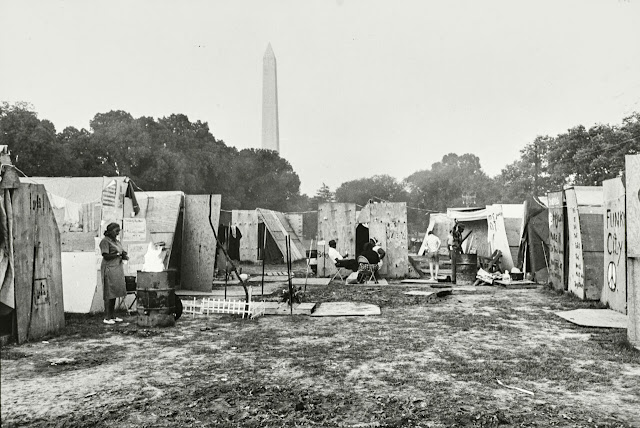
In 1968 Resurrection City, the camp of the Poor People's Campaign was unmolested by troops.  President Lyndon Johnson remembered the Bonus March. 

The 1963 March on Washington for Jobs and Freedom called by Martin Luther King, Jr. and his allies was inspired by the Bonus Marchers.  His 1968 plans for the Poor Peoples Campaign, which included a camp of protesters, were even more evocative.  The Campaign, conducted after King’s murder, was not dispersed by troops.