Showing posts with label British Empire. Show all posts

Thursday, December 19, 2013

How a Ghost Story Saved Christmas

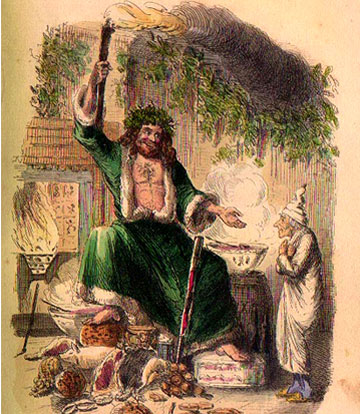
Scrooge meets the Ghost of Christmas Present  in an illustration for the first edition of A Christmas Carol.  This figure is sometimes misidentified with Father Christmas, an English version of St. Nicholas, or, worse, Santa Claus.  He is a thinly disguised pagan figure, one of "nearly 2000 brothers" who were born and died with each Christmas season.


To borrow a phrase from one of the author’s other books, “It was the best of times, it was the worst of times.”  I’m talking about the 1840’s in the early years of what is now recalled, usually through rose colored glasses, as the Victorian Era.  Britain mastered the world unchallenged since the final defeat of Napoleon more than 20 years before.  It presided over a world girdling Empire whose riches and treasures were pouring into the country.  It was ground zero of the industrial revolution, production of every sort of goods was on the upswing, and innovation was making consumer goods cheaper. 
The already very wealthy got wealthier.  So did a limited number of clever commoners.  A middle class, serving the needs of government and corporations, was growing. 
But in the countryside tenant farmers were being evicted to make way for sheep to feed the humming textile mills.  Skilled weavers and other tradesmen found themselves replaced by whirring machines and plunged into poverty.  The displaced made their way with little hope to the teaming cities where they were crammed into unspeakable slums.  There was little chance for work for many of them and they could be—and were—disposed of immediately if they complained about 12 hour days or starvation wages.  Many turned desperately to begging, petty crime, and of course prostitution and vice of every sort.  In London tens of thousands of children lived by their wits on the street.
All of these poor folks were considered dangerous, useless burdens who deserved their fate because of a lack of moral fiber, natural indolence and sloth.  If the Crown had given up on public hangings of 12 year old pickpockets, it was only because there was a whole continent—Australia—to populate with transported prisoners.  Otherwise the jails, workhouses, and cemeteries were filled.
Characteristic of prevailing attitudes was what would happen in Ireland just a handful of years later.  When the potato crop that fed the peasantry failed, British authorities steadfastly refused relief while hundreds of thousands died because charity would “undermine the moral fiber of recipients and sap them of the will to work.”  Sound sort of familiar?
Anyway, this is the England that a successful 31 year old writer named Charles Dickens found himself in.  Once a child of the comfortably middle class when his father failed and was jailed for debt young Charles had been forced to leave his beloved studies and go to work in a shoe blacking factory at age 14.  The experience scarred him deeply and affected his whole world view. 
After achieving fame and some level of modest comfort for his serialized novels, The Pickwick Papers and Oliver Twist, Dickens decided to employ his fame to decry the condition and treatment of the poor, with which he was all too familiar.  After a tour of the Cornish mines which employed child laborers in dangerous conditions, and visiting a London Ragged School for street urchins, He planned to pen a pamphlet to be called An Appeal to the People of England, on behalf of the Poor Man’s Child.  But finding an audience at a speech in Manchester covering the gist of his planned opus was bored and unresponsive, Dickens abruptly changed his plans.  He would recast the appeal as a fictional story.
Thus A Christmas Carol was born.  The author hastily scribbled the manuscript in just six weeks, barely finishing in early December 1843 in time to rush the manuscript to publication.
In setting his fictional appeal at Christmas, Dickens was being doubly counter-cultural.  It seems that the holiday, once the happiest of seasons, had fallen into disrepute and was in actual danger of being officially abolished from the calendar—for the second time. 
Christmastide had once been a popular event, the official occasion of Christ’s supposed birthday folded into ancient traditions from both Druidic and Roman times marked with singing, dancing, general merry making, drinking and a sort of social-turn-the-tables in which masters and servants switched places for at least a day.  Oliver Cromwell and the scandalized Puritans put an end to that.  They outlawed the holiday and imposed draconian punishment on those discovered trying to celebrate, even in the privacy of their own homes.
Although the Restoration had put the religious celebration back on the calendar, its association with Popery—it was after all Christ’s Mass—discouraged celebration by “loyal” Anglicans and most Protestant Dissenters.  Over the years many customs vanished or were marginalized—the hanging of greens, country dancing, and caroling.  In fact the words for many traditional carols were lost until a fad for folklore began resurrecting them in the early 19th Century.  Christmas Day was generally considered a work day.  Factories and shops were mostly open, as were government offices and courts. 
After seeing some backsliding on Christmas celebrations—Queen Victoria’s new husband Albert, a Christmas loving German princeling, had erected a Christmas Tree at the Palace and the fashionable were taking up the custom—conservative Protestant  leaders energized by new round popular evangelism  and hostility to Catholics—were once again agitating for the holiday to be officially abolished.
Dickens himself was an apostate Anglican with no interest in the religious observation of the Nativity, which had caused the final alienation of his tenuous ties to his family.  He was at this point in his life associating and worshiping with Unitarians, the most radical of all of the Dissenting sects who rejected both the divinity of Christ and miracles like those in the Christmas story as distractions from “pure” Christianity.
He was however, influenced by the stirring of nostalgia for old time Christmas celebrations which seemed to him to be both more egalitarian and warmer in human sympathy.  Christmas had played a key part in his first success, The Pickwick Papers in which Mr. Wardle relates the tale of Gabriel Grub, a lonely and mean-spirited sexton, who undergoes a Christmas conversion after being visited by goblins who show him the past and future—obviously a seed for his new story.
Without the trapping of religious conversion on which to hang is tale of personal and social redemption, Dickens fell back on elements of spiritualism, which was widely popular, especially in the middle classes at the time and even imbued with some pseudo scientific justification.  Not that Dickens personally believed in communication with the dead, but in the spirit of old time fairy tales, the kind with pointed morals, he was quite willing to employ them as literary devises.
Thus was born a Christmas ghost story, as frightening in some parts as any fashionable gothic novel.  But the terror came less from the spirits—despite Jacob Marley’s groans and chains and the fearsome, black, and silent Ghost of Christmas Yet to Come—the familiar specter of Death as depicted since the time of the great Plague—than from the poverty of the Cratchits and their bleak prospects, the alienation of family and love, and the hardening of a miserly heart.
Redemption is accomplished when Scrooge is re-united with his own humanity.
With, you should pardon the expression, great expectations, Dickens arranged to have an edition printed at his own expense taking as payment from the publisher, Chapman & Hall a percentage of sales rather than the customary lump sum.  He commissioned original engravings for a fine edition, including some tinted in color, to be bound in leather and gilt edged.  He quarreled with the publisher and the book had to be re-made with new end-papers and cover to meet Dickens’s exacting specifications, delaying publication to within days of the holiday.  All of this cut deeply into the profits the author hoped to earn to support his young wife.
But the book was finally published on December 19, 1843 and was an immediate popular and critical success.  The first edition sold out almost immediately and seven more were printed the same year.  Pirates soon had cheap paper editions out, which the ever vigilant Dickens fought with law suit after law suit.  He authorized a stage version which premiered in February 1844.  Six other unauthorized productions were soon playing simultaneously in London.
America, except for a handful of fans, was at first cool to the book, largely because the young nation felt insulted by Dickens’s account of his first tour there a year before.  Christmas, especially in New England, was still suspect in much of the country.  But over the next decades that would change.  One after another Christmas traditions were introduced and spread.  By the time Dickens returned for a post Civil War tour, both he and the book were beloved.
The little book was always Dickens personal favorite.  He staged his first public reading with it in 1858.  Such readings were a principle income for him for the next decades.  His last reading, in ill health on March 15.1870 in London, was a final sharing of A Christmas Carol.  He died in the manor home in Kent which his literary work had earned him, on June 8, 1870 at the age of only 58.
A Christmas Carol has never gone out of print.  It is perennially popular on both sides of the Atlantic and was perhaps the main engine of Christmas becoming a popular, sentimental, and family holiday all over the English speaking world.
In addition to countless stage productions there have been at least 28 film versions for either theatrical or television release, the first in 1901.  Alistair Sym in the title role of Scrooge in 1951 is thought by many to be the definitive version.  Other notable versions include those with Reginald Owen in 1938, Albert Finney in a 1970 musical, George C. Scott and Patrick Stewart in two notable TV versions, and the horrible Disney disaster with Jim Carey in 2003.
There have been multiple musical versions, three operas, notable radio broadcasts—especially one with Lionel Barrymore—and several animated versions.  In addition there have been parodies, and just about every TV sitcom that lasts a few seasons eventually does an episode in which a principle character is visited by Christmas ghost.
Yes, A Christmas Carol, that odd seasonal tale devoid of both traditional religion on one hand and Santa Claus, magical animals, or elves on the other, maintains a grip on our imagination after all these years.  Maybe because it speaks to the real spirit of the holiday better than any other tale.

Tuesday, August 27, 2013

The Shortest War in History Still Sucked


It may have been the shortest war in recorded history but the Anglo-Zanzibar War which began and ended in the space of three quarters of an hour on August 17, 1896 was still plenty brutal and a testament of the power and arrogance of the British Empire at its height.  Not that the defeated Sultan of Zanzibar, Khalid bin Bargash was any prize either.
The island of Zanzibar, the largest of the Spice Islands off of the east coast of southern Africa was, as the European name for the archipelago suggests a rich trading plumb specializing in the production of spices including cloves, nutmeg, cinnamon, and black pepper.  It was ruled by the Swahili kingdoms of East Africa which grew wealthy trading with Persians, Arabs, and traders from the Indian Sub-Continent.
The Portuguese, the dominant European power in the Indian Ocean, achieved control of Zanzibar and neighboring islands in 1504 ruling through puppet Sultans of African—Swahili--origins.  After the local Sultan massacred Portuguese traders on the islands in 1631, they finally garrisoned the island and ruled more directly through a Governor General.  Contemptuous of the polyglot local population of long established Arabs, Blacks, and mixed race decedents of Persian traders, the Portuguese ruled with typical brutality.
Around 1690 the local Arabs, who had no political connection to the Arabian empires for centuries, appealed to the Sultan of Oman for aid.  The Sultan and his naval forces drove out the Portuguese, already a fading power, and added Zanzibar to the Sultanate formally in 1698.  They ruled prosperously for more than 100 years.  Indians came into control of much of the spice growing and large numbers of laborers were imported to tend the valuable crops.
But even more valuable was the slave trade, of which Zanzibar became a center.  Arab traders and Swahili mercenaries raided tribes in the interior of the African continent and shipped them from the island to meet demand throughout the Muslim world, and increasingly to the insatiable demands of Europeans in South America, especially Brazil, and the sugar islands of the Caribbean. English merchant seamen were among the most active in transporting the valuable human cargo to the New World.
The wealth of Zanzibar became so great that around 1840 Said bin Sultan moved his capital from Muscat, Oman to Stone Town in Zanzibar City.  After the Sultan’s death in 1856 his two sons quarreled over succession.  To avoid civil war they appealed to Lord Charles Canning, Viceroy and Governor-General of India, by then the islands main trading partner, to settle the dispute.  He divided the Sultanate making one brother Sultan of Oman and creating Majid bin Said first Sultan of Zanzibar.  Just in case the arrangement was not to the liking of both, the British Navy was on hand to dissuade any armed dissent.
Thus, although still independent Zanzibar fell within the realm of British influence and interest.  A formal treaty even gave the British final approval of any successors to the Sultan.
The Sultanate also controlled vast areas of East Africa around Dar es Salaam and the slave trade routes stretching as deep into the continent as the Congo.  Over the next 40 years they lost most of their continental possessions, particularly to the aggressive Germans who were trying to catch up as a colonial power.  The British, meanwhile, abolished the slave trade and had a sudden Victorian moral scruple about allowing its client state to continue in the trade.  The wealth from the spice trade and the increasing presence of a large, prosperous Indian community also piqued their interests.
In 1896 the Sultan Hamad bin Thuwaini died and Sultan Khalid bin Barghash succeeded him.  The new Sultan had grown wealthy in the slave trade and in the trade for ivory from the continent, both of which were threatened by the new colony of German East Africa.  The British suspected Khalid would strike a deal with the Germans.  They exercised their veto of the succession instead the British Consul named Hamud bin Muhammad as Sultan.
Khalid refused to give up the throne.  The British declared that failure to do so would be a casus belli and sent the Sultan an ultimatum to vacate the palace by 9 a.m. August 27.
Khalid called up his palace guard, about 700 British trained Zanzibar Askari, rallied more forces from the local population, and armed his household, including his slaves. Most were lightly armed with obsolete muskets. He fortified the place grounds and set up Maxim machine guns, a Gatling gun, a 17th century bronze cannon and two 12 pounder field guns trained on a British flotilla in the Zanzibar Town harbor. The sultan’s troops also took possession of the Zanzibar Navy which consisted of one wooden sloop, the HHS Glasgow, built as a royal yacht in 1878 based on the British frigate Glasgow and two small boats.
The British had 900 loyal Askari troops, plus sailors and Marines under the command of Lieutenant Arthur Edward Harington Raikes of the Wiltshire Regiment who was in command of the Zanzibar Army with the rank of Brigadier General.  Another contingent of sailors and Marines was landed to guard the British Consulate, where Imperial citizens were gathered for protection.
Promptly at the expiration of the ultimatum deadline the fleet of two modern heavily armored cruisers and two gun boats opened deadly fire.  The Royal Yacht was quickly sunk.  The Sultan’s artillery attempted to return fire, but the batteries were quickly blasted into oblivion.  The naval guns then turned their relentless fire on to the Palace itself.  The largely wooden palace was quickly destroyed and set on fire.  The masonry Harem was reduced to rubble, most of its inhabitants and defenders killed.
As the bombardment continued British Askari troops under Raikes briefly came under fire as they advanced on the palace then returned withering rifle vollies.
At 9:40 the flag over the Palace was either shot away or struck.  Firing from the compound ceased.  Admiral Sir Harry Holdsworth Rawson in command of British forces ordered his guns to go silent.  The war was officially over.
Khalid and most of his top Arab supporters managed to escape the palace sometime during the bombardment and found refuge in the German Consulate.  His loyal troops and members of his household, however, took heavy losses.  British ships and troops had fired around 500 shells, 4,100 machine gun rounds and 1,000 rifle rounds during the engagement killing or wounding over 500,  more than a quarter of all Khalid’s troops.
By contrast the British incurred one wounded petty officer aboard the gunboat HMS Thrush.
By mid-afternoon Hamud bin Muhammad was installed as Sultan with much reduced powers.  He was a virtual puppet figure head.
Meanwhile the fire at palace spread into the city, engulfing nearly a quarter in flame.  British sailors were landed to help fight the fires.  Rioting also broke out aimed at the Indian community.  Eventually 150 British Sikh troops were transferred from Mombasa to patrol the streets to restore order.
The Germans refused British demands that Khalid be handed over to them.  Despite an extradition treaty between the two powers the Germans maintained that political prisoners were excluded from its terms.  After menacing the Consulate, the Germans promised the British that Khalid would not depart for East Africa via British controlled Zanzibar soil.
They waited for a high tide a night which enabled a boat to dock at the Consulate.  Khalid was picked up and taken safely to East Africa.    He would be captured during colonial fighting during World War I and sent to exile on the Seychelles and Saint Helena before being allowed to return to East Africa, where he died at Mombasa in 1927. Khalid’s supporters were forced to pay reparations to cover the cost of shells fired and for damages caused by the looting which amounted to 300,000 Rupees, a sum that impoverished most of the once loyal leadership.
For his part the new Sultan promptly satisfied British demands by abolishing slavery.  But he made the process of obtaining manumission documents so cumbersome that after a decade only about 16,000 of an estimated 90,000 slaves on the island were at liberty.  The British turned a blind eye to this circumvention of their supposed ideals.
Today we may look back and scorn the arrogance and brutality of the British Empire.  But the unofficial American Empire which has succeeded it continues on in the same tradition.  Of course we prefer to do our dirty work behind a curtain, using the CIA and covert means to overthrow governments of which we disapprove, witness Iran in 1953, Vietnam in the ‘60’s, Chile in 1973, and the long brutal war of the Contras against the Nicaraguan Sandinistas in the ‘80’s.
But some time a country is weak enough and the temptation is too great so we just land troops and say to hell with it, witness Grenada and Panama.  Just like Perfidious Albion.

Wednesday, December 26, 2012

It’s Boxing Day and/or the Feast of St. Stephen


Ask an American of a certain age about Boxing Day and he will tell you about the gym class when they made you lace up the gloves back in the day when it was considered both good healthy exercise and a character builder—“don’t be a pansy, it’s only a split lip!”—to let children wail the daylights out of each other.  Since those days have long past, younger Yanks probably thinks it’s just the day before the moving van arrives.
But in Britain and the scattered remnants of her former Empire Boxing Day is a treasured tradition and a legal holiday.  It traditionally falls on the day after Christmas, December 26.  Since becoming an official holiday if it falls on the weekend, the official observance is pushed over into the next week.
The celebration had its roots with the aristocracy, gentry, and wealthy townsmen and their households.  The master would give presents to his servants and staff, who would also have the day off work.  Sometimes the master’s family would even serve meals to their inferiors!  Needless to say, this custom was very popular among the servants, and sometimes observed resentfully by those unaccustomed to either manual labor or generosity.
The day is a remnant of an ancient tradition that may—or may not—go back to the Roman celebration of Saturnalia, when there was a carnival like “turn around” with slaves lording over masters for a day.  The tradition continued into the Middle Ages on into Elizabethan times, where it took on the wild excesses of street revelry.
That revelry doomed the whole season when Oliver Cromwell and his Puritans took over.  Eventually, Boxing Day restored a controlled dollop of the old festival.  The Church of England gave a religious cover to the day as St. Stephen’s Day.  Stephen was the Deacon of Jerusalem the earliest days of Christianity known for his charities to the poor.  He was also the first Christian martyr, stoned to death for allegedly preaching the Trinity in the Temple.
The familiar carol Good King Wenceslas is a St. Stephen’s Day song meant for street begging.  In Ireland, the day is still officially called St. Stephen’s Day.
In the Bank Holidays Act of 1871, Parliament recognized Boxing Day as a Bank Holiday—an officially recognized public holiday.  While time off from work was not originally mandatory, but has become nearly universal.
The holiday spread across the Empire and is still official in Canada, Australia, New Zealand, and other Commonwealth countries.  In South Africa it was re-named The Day of Goodwill in 1994.
Today small gifts are still given trades people and service workers, but in Britain the day has become all about shopping.  It is the biggest shopping day of the year and has been compared to American Black Friday, the day after Thanksgiving.  Stores mark the day with huge sales.
It is also a day of sport.  Football—that’s soccer Americansand Rugby leagues hold full schedules of on that day, teams usually playing their most serious rivals.  There are also prestige horse races and the country gentry mount Fox Hunts.  The toffs are no longer allowed to chase real fox, but still get to ride to the hounds chasing a scented bait.
So for my friends across the pond and around the world who celebrate, happy Boxing Day!  This year, by accident of the calendar even we American’s have a holiday today, observing Christmas which fell on Sunday.