
When I was a kid, Theodore Roosevelt was my hero. I know, incredibly dorky. But Teddy was a fat, bookish kid with glasses, sort of like me, who grew up to have an exciting life. For a couple of years or so in my pre-teens I took to pinning the brim of my cowboy hat to the crown on one side with a U.S. Army insignia swiped from my Dad’s World War II uniform. I led an entirely imaginary “Junior Rough Riders” outfit in elaborate games of defending Cheyenne from foreign menace. I assure you that I could not get any of the other kids in the neighborhood to join me in this oddball fantasy.
In school, much to the confusion and irritation of my teachers, I insisted on dating all of my papers 1905, the first year of Roosevelt’s second term as President. Much of Roosevelt’s appeal to me was his famous Charge on San Juan Hill. In later years I discovered that while T.R. did, indeed, perform ably and bravely that day and that his Rough Riders fought well, it was not the whole story.
On July 1, 1898 the heaviest land combat of the Spanish American War took place in the Battle for San Juan Heights during the American drive to take the city of Santiago, Cuba.
With the outbreak of the War Roosevelt, a hyperkinetic New York politician who was serving ably as Assistant Secretary of the Navy—a post in which he had played a key role in building the Great White Fleet which made the U.S. Navy among the most modern in the world—yearned for military action on the ground.
.jpg)
Col. Theodore Roosevelt 1st Volunteer Cavalry after his brevet from Lt. Col.
He was not encouraged by President William McKinley in his first attempt to volunteer to raise a cavalry regiment for the conflict. He convinced his close friend Col. Leonard Wood, one of the most respected officers in the Regular Army and a medical doctor serving as an advisor to the President, to offer to lead a volunteer unit with Roosevelt as his second in command and in charge of recruitment. McKinley, needing to raise a large army quickly, reluctantly agreed.
Roosevelt famously recruited a unit that mixed cowboys who he was familiar with from his days as a South Dakota rancher, Harvard pals, and polo playing New York socialites.

Among the Volunteers were a legendary western lawman, Bucky O’Niell, Captain of a troop raised in Arizona and at least one of the criminals he had once locked up serving under an assumed name. Like O’Niell, a former militia officer, many men were veterans of the Indian wars and provided leadership as junior officers and non-commissioned officers that was rare in Volunteer units. There were also swells like Hamilton Fish, grandson of the New York Governor and Senator of the same name.
Roosevelt used his considerable influence, and some of his own wealth, to make sure that the men were armed with the same modern Krag-Jorgensen carbines used by the regular cavalry and generally had the most up-to-date equipment and the finest horse stock available. The unit was trained to the highest standards and the men, mostly expert horsemen, were soon considered the equal of regular troops.

Designated the First Volunteer Cavalry (1st U.S.V.C), the unit arrived by train with their horses, mules, and baggage at Tampa, Florida for disembarkation on May 29. They found a tangle of confusion and a shortage of ships. After days of dithering while troops fell ill with heat stroke and tropical infections, Major General William Shafter, a 300 lb. veteran regular army officer who turned out to be an indifferent bordering on incompetent commander of the V Corps for the campaign against Santiago, under pressure from Washington to move quickly ordered the Volunteers to board available ships without their horses, mules, and most of their equipment.
There was only room for eight of twelve companies. With yellow fever and malaria already rampant a fourth of the men mustered and trained were unavailable by the time the ships landed in east of Santiago on June 21 and 22 the men were also demoralized by the loss of their horses and equipment.
Once on shore they became part of the cavalry division commanded by Major General of Volunteers Joseph Wheeler, a storied Confederate cavalry commander and longtime Democratic Representative from Alabama. McKinley had accepted Wheeler’s offer to serve and placed him in high command in the hopes that common wartime service would heal lingering sectional divisions. And in fact, that was one of the results. Blue uniformed Federal troops were cheered as they moved through the South to disembarkation points instead of stoned as some Yankees had feared.
Wheeler’s division also included the 9th and 10th Cavalry Regiments, Buffalo Soldier Black troops and tough as nails veteran Indian fighters from Ft. Leavenworth. Along with the Rough Riders and other regular army cavalry units, they had arrived without horses and baggage.

An Unreconstructed former Confederate, Major General of Volunteers Joseph Wheeler (left) was in command of the cavalry in the Santiago campaign. Seen here with Lenard Wood who was brevetted to Brigadier General of the 2nd Brigade, and Col. Roosevelt of the Rough Riders.
Wheeler was only a barely reconstructed Rebel. He hated Yankees and disdained the Colored troops under his command. But he was an aggressive officer. Two after days of landing Shafer dispatched Wheeler on a dismounted cavalry reconnaissance of enemy lines in support of Cuban irregulars to find where the enemy might be dug in. He was under orders to hold the bulk of his troops to cover continuing landing operations. Instead, Wheeler, acting on his own authority moved his men aggressively forward with the Rough Riders and 10th cavalry in the lead and provoked a pitched battle with the Spanish rearguard at Las Guasimas.
The troops were weakened by heat and disease and issued four days of rations and what ammunition they could carry. They had no baggage, logistical support, and had only two small field guns. Only officers were mounted. None of the men were trained as infantry or accustomed to long marches, especially in the stifling heat. For two hours the Spanish infantry, which enjoyed artillery support, mauled and stymied the American advance until the Spanish commander Major General Antero Rubín called for an orderly retreat to more defensible lines.
During the battle a confused and excited Wheeler was heard rallying his troops with exhortations to “Get those damned Yankees!” War correspondents covering the battle reported a glorious victory. On the ground it was recognized as the near disaster it was.
The Spanish fell back on a well defended line of trenches and block houses including commanding positions on two hills of the San Juan Heights. After waiting for the rest of V Corps to land, Shafter ordered a general offensive against the Santiago defensive line on July 1. Wheeler fell ill with malaria and was replaced by his subordinate Brigadier General Samuel S. Sumner and Wood was brevetted to Brigadier to take command of Sumner’s 2nd Brigade. Roosevelt in turn was brevetted full Colonel in command of the Rough Riders.
Shafter had three divisions. He ordered the infantry of the 1st and 2nd Divisions, which included two other Black regiments, the 23rd and 24th Infantry (Colored), to the north to take the fortified stronghold at El Caney. This was to take no more than two hours then the divisions were expected to move up to support an attack by the dismounted cavalry on the heights.
But the 2nd Division under General Henry W. Lawton was held off by stiff Spanish resistance at El Caney for more than twelve hours. Brigades of the 1st Division came under withering fire when they emerged from a tree line at the base of the heights. The commander of the 3rd Brigade was mortally wounded the second he stepped from the tree line and two more officers assuming command were quickly wounded and had to be evacuated. The whole division was pinned down under intense fire in what became known as Hell’s Pocket while they waited for Lawton to come up.
The cavalry on the right of the line came up and also took heavy fire. With his men pinned in shallow trenches Capt. O’Niell of the Rough Riders exposed himself to enemy fire to calm his troops and was shot through the throat shortly after assuring a worried subordinate that “a Spanish bullet hasn’t been made that can kill me.”
Distressed, Roosevelt determined that their position was untenable and he must either withdraw or attack. He took a vague order to support the pinned down infantry on his left as an excuse to attack. Ahead of him was the smaller of two hills commanding the heights, dubbed Kettle Hill because a cauldron for boiling sugar cane was found near the base. Roosevelt formed his regiment under fire and moved out. He was the only officer mounted because he feared he might succumb to an asthma attack in the heat trying to climb the hill.

Tough veteran Buffalo Soldier cavalrymen in Cuba.
Seeing the Rough Riders moving unilaterally, other units of Woods’ 2nd Brigade, including elements of the 10th and the white Volunteers of the 3rd Cavalry joined in the assault at the urging of 1st Lt. Jules G. Ord of the 10th. Further left the Black troops of the 23rd and 24th Infantry from the 2nd Division began moving without orders when they observed the advance...
Men started dropping of heat prostration on the climb. Others were riddled by heavy fire. Roosevelt lost his horse and sustained a light wound on the wrist but pressed forward. The dismounted cavalry, units now thoroughly mixed, pressed the frontal attack with some of the 10th joining the Black infantry regiments on the left slope.
After sustaining heavy casualties, the troops, Roosevelt near the van, took the summit sending the defenders to the protection of the fortifications and block house atop San Juan Hill itself. The first colors on the summit were the 3rd and the 10th Cavalry with the Rough Rider banner soon following. In fact, troops of all units plus elements of the Black infantry took Kettle Hill, although Roosevelt and the Rough Riders would receive almost all of the credit in press accounts.

Meanwhile, the men on top of Kettle hill were taking heavy fire from San Juan. General Wheeler, rising from his sick bed at the sound of battle, arrived on the scene to take operational command since Shafter was ill at his headquarters well behind the lines. He ordered the whole 1st Division under the command of Brigadier General Jacob Ford Kent forward and then re-took personal command of the cavalry.
Kent’s Colored Infantry and elements of the 10th Cavalry were already advancing up the slope. Other units closed in support. Meanwhile the Cavalry at the top of Kettle Hill began an advance down the “saddle” between it and San Juan Hill and up the second. Young Ord was killed breasting the summit of the Hill his Black troops on his heels. The troops pressed on, taking the shell pocked block house in furious hand to hand combat.
Roosevelt led a last charge of the cavalry up to the top of the hill, sweeping it of Spanish and uniting with the exhausted black troops.
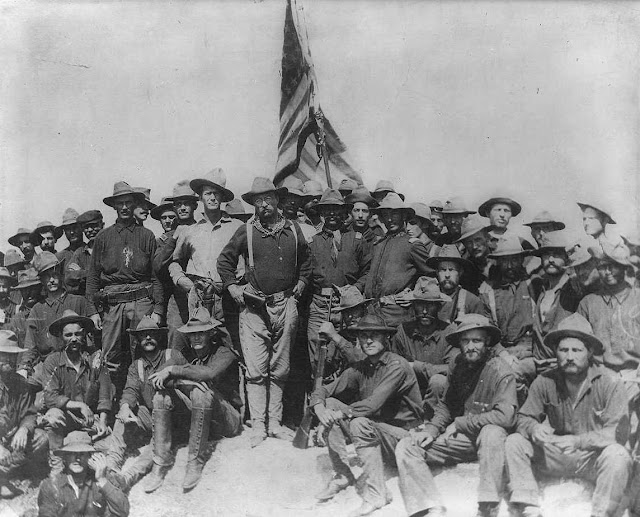
Shortly after the battle, Roosevelt posed with his Rough Riders atop San Juan Hill. The Buffalo Soldiers who had fought with them were notably not included.
Meanwhile other units of the cavalry’s 1st Brigade secured a smaller knoll on the Spanish right flank. The heights had been cleared, but fearing a counterattack, Wheeler ordered the exhausted men to throw up breastworks facing the city of Santiago, a mile or so in the distance.
Roosevelt’s men did repulse one weak counterattack. But back at his headquarters in the rear Shafter feared a general counterattack and ordered a retreat to the original positions in the trenches as the bottoms of the hills. Unable to convince his superior to countermand the order, Wheeler on the scene simply ignored it and continued fortifying his position over night.
Lawton’s Division, badly roughed up at El Caney, finally arrived around noon on July 2. The position was now secure, and artillery was brought up to the heights to threaten the city and a squadron of Spanish cruisers in the harbor. The cruisers were forced to flee the guns and ran into a waiting superior American Navy taskforce which destroyed them.
After a siege by combined American and Cuban nationalist forces, the Spanish surrendered Santiago on July 17. That completed major land operations in Cuba.
Troops who survived the shot, shell, and heat stroke of the Battle for San Juan Heights were ravaged by yellow fever and malaria. General Shafter petitioned Washington for a rapid withdrawal of V Corps calling it an “army of convalescents.” Concerned that the President would ignore the bumbling Shafter, a group of senior officers prevailed upon the politically well-connected Roosevelt to send a similar appeal on their behalf.
American evacuation began on August 7. Troops of the 9th Infantry (Colored) were left behind as an occupation force under the theory that their race and Southern origin would protect them from illness. It didn’t. By the time they, too, finally went home almost a tenth of their number came down with yellow fever.
Roosevelt returned aa a national hero, the Rough Riders were celebrated as folk heroes. On the strength of his celebrity Roosevelt won the spot as McKinley’s running mate in 1900 and ascended to the Presidency upon his assassination.
The Buffalo Soldiers, cavalry and infantry alike, who had fought so well received virtually no notice. Even their White officers, including the heroic Lt. Ord, the son of an active duty General, were denied decorations. Roosevelt got his Medal of Honor, arguably well deserved. But so did Schafer who was ineffective as a commander and never came under hostile fire.
And, oh yes, the U.S. won the war, obtained an empire, and was recognized as a first-rate world power for the first time.


