Showing posts with label Theodore Roosevelt. Show all posts

Wednesday, July 1, 2026

Buffalo Soldiers Did the Heavy Lifting But Teddy Roosevelt Got the Glory


This Landmark book for young adults and a Classic Comic Book both fired my boyhood hero worship of Theodore Roosevelt.  The cover illustration turned out to be inaccurate.  Roosevelt was wearing his blue field shirt not his khaki officer's tunic and completed the charge on foot after he lost his horse.  But it did show one Black trooper in the lower right of the picture--more credit than Buffalo Soldiers usually got.

When I was a kid, Theodore Roosevelt was my hero.  I know, incredibly dorky.  But Teddy was a fat, bookish kid with glasses, sort of like me, who grew up to have an exciting life.  For a couple of years or so in my pre-teens I took to pinning the brim of my cowboy hat to the crown on one side with a U.S. Army insignia swiped from my Dad’s World War II uniform. I led an entirely imaginary “Junior Rough Riders” outfit in elaborate games of defending Cheyenne from foreign menace. I assure you that I could not get any of the other kids in the neighborhood to join me in this oddball fantasy.

In school, much to the confusion and irritation of my teachers, I insisted on dating all of my papers 1905, the first year of Roosevelt’s second term as President.  Much of Roosevelt’s appeal to me was his famous Charge on San Juan Hill.  In later years I discovered that while T.R. did, indeed, perform ably and bravely that day and that his Rough Riders fought well, it was not the whole story. 

On July 1, 1898 the heaviest land combat of the Spanish American War took place in the Battle for San Juan Heights during the American drive to take the city of Santiago, Cuba.

With the outbreak of the War Roosevelt, a hyperkinetic New York politician who was serving ably as Assistant Secretary of the Navy—a post in which he had played a key role in building the Great White Fleet which made the U.S. Navy among the most modern in the world—yearned for military action on the ground. 


                             Col. Theodore Roosevelt 1st Volunteer Cavalry after his brevet from Lt. Col.

He was not encouraged by President William McKinley in his first attempt to volunteer to raise a cavalry regiment for the conflict.  He convinced his close friend Col. Leonard Wood, one of the most respected officers in the Regular Army and a medical doctor serving as an advisor to the President, to offer to lead a volunteer unit with Roosevelt as his second in command and in charge of recruitment.  McKinley, needing to raise a large army quickly, reluctantly agreed. 

Roosevelt famously recruited a unit that mixed cowboys who he was familiar with from his days as a South Dakota rancher, Harvard pals, and polo playing New York socialites.  


Legendary Arizona lawman Bucky O'Neill was captain of a troop of Rough Riders raised in the West and including cowboys and veteran Indian fighters.

Among the Volunteers were a legendary western lawman, Bucky ONiell, Captain of a troop raised in Arizona and at least one of the criminals he had once locked up serving under an assumed name.  Like O’Niell, a former militia officer, many men were veterans of the Indian wars and provided leadership as junior officers and non-commissioned officers that was rare in Volunteer units.  There were also swells like Hamilton Fish, grandson of the New York Governor and Senator of the same name. 

Roosevelt used his considerable influence, and some of his own wealth, to make sure that the men were armed with the same modern Krag-Jorgensen carbines used by the regular cavalry and generally had the most up-to-date equipment and the finest horse stock available.  The unit was trained to the highest standards and the men, mostly expert horsemen, were soon considered the equal of regular troops. 


300-pound Regular Army Major General William Shafter was the commander of V Corps in the drive to capture Santiago.  He was an indifferent to incompetent senior officer.

Designated the First Volunteer Cavalry (1st U.S.V.C), the unit arrived by train with their horses, mules, and baggage at Tampa, Florida for disembarkation on May 29.  They found a tangle of confusion and a shortage of ships.  After days of dithering while troops fell ill with heat stroke and tropical infections, Major General William Shafter, a 300 lb. veteran regular army officer who turned out to be an indifferent bordering on incompetent commander of the V Corps for the campaign against Santiago, under pressure from Washington to move quickly ordered the Volunteers to board available ships without their horses, mules, and most of their equipment. 

There was only room for eight of twelve companies.  With yellow fever and malaria already rampant a fourth of the men mustered and trained were unavailable by the time the ships landed in east of Santiago on June 21 and 22 the men were also demoralized by the loss of their horses and equipment. 

Once on shore they became part of the cavalry division commanded by Major General of Volunteers Joseph Wheeler, a storied Confederate cavalry commander and longtime Democratic Representative from Alabama.  McKinley had accepted Wheeler’s offer to serve and placed him in high command in the hopes that common wartime service would heal lingering sectional divisions.  And in fact, that was one of the results.  Blue uniformed Federal troops were cheered as they moved through the South to disembarkation points instead of stoned as some Yankees had feared. 

Wheeler’s division also included the 9th and 10th Cavalry Regiments, Buffalo Soldier Black troops and tough as nails veteran Indian fighters from Ft. Leavenworth.   Along with the Rough Riders and other regular army cavalry units, they had arrived without horses and baggage. 


An Unreconstructed former Confederate, Major General of Volunteers Joseph Wheeler (left) was in command of the cavalry in the Santiago campaign.  Seen here with Lenard Wood who was brevetted to Brigadier General of the 2nd Brigade, and Col. Roosevelt of the Rough Riders.

Wheeler was only a barely reconstructed Rebel.  He hated Yankees and disdained the Colored troops under his command.  But he was an aggressive officer.  Two after days of landing Shafer dispatched Wheeler on a dismounted cavalry reconnaissance of enemy lines in support of Cuban irregulars to find where the enemy might be dug in.  He was under orders to hold the bulk of his troops to cover continuing landing operations.  Instead, Wheeler, acting on his own authority moved his men aggressively forward with the Rough Riders and 10th cavalry in the lead and provoked a pitched battle with the Spanish rearguard at Las Guasimas. 

The troops were weakened by heat and disease and issued four days of rations and what ammunition they could carry.  They had no baggage, logistical support, and had only two small field guns.  Only officers were mounted.  None of the men were trained as infantry or accustomed to long marches, especially in the stifling heat.  For two hours the Spanish infantry, which enjoyed artillery support, mauled and stymied the American advance until the Spanish commander Major General Antero RubĂ­n called for an orderly retreat to more defensible lines. 

During the battle a confused and excited Wheeler was heard rallying his troops with exhortations to “Get those damned Yankees!”  War correspondents covering the battle reported a glorious victory.  On the ground it was recognized as the near disaster it was. 

The Spanish fell back on a well defended line of trenches and block houses including commanding positions on two hills of the San Juan Heights.  After waiting for the rest of V Corps to land, Shafter ordered a general offensive against the Santiago defensive line on July 1.  Wheeler fell ill with malaria and was replaced by his subordinate Brigadier General Samuel S. Sumner and Wood was brevetted to Brigadier to take command of Sumner’s 2nd Brigade.  Roosevelt in turn was brevetted full Colonel in command of the Rough Riders. 

Shafter had three divisions.  He ordered the infantry of the 1st and 2nd Divisions, which included two other Black regiments, the 23rd and 24th Infantry (Colored), to the north to take the fortified stronghold at El Caney.  This was to take no more than two hours then the divisions were expected to move up to support an attack by the dismounted cavalry on the heights. 

But the 2nd Division under General Henry W. Lawton was held off by stiff Spanish resistance at El Caney for more than twelve hours.  Brigades of the 1st Division came under withering fire when they emerged from a tree line at the base of the heights.  The commander of the 3rd Brigade was mortally wounded the second he stepped from the tree line and two more officers assuming command were quickly wounded and had to be evacuated.  The whole division was pinned down under intense fire in what became known as Hells Pocket while they waited for Lawton to come up. 

The cavalry on the right of the line came up and also took heavy fire.  With his men pinned in shallow trenches Capt. O’Niell of the Rough Riders exposed himself to enemy fire to calm his troops and was shot through the throat shortly after assuring a worried subordinate that “a Spanish bullet hasn’t been made that can kill me.” 

Distressed, Roosevelt determined that their position was untenable and he must either withdraw or attack.  He took a vague order to support the pinned down infantry on his left as an excuse to attack.  Ahead of him was the smaller of two hills commanding the heights, dubbed Kettle Hill because a cauldron for boiling sugar cane was found near the base.  Roosevelt formed his regiment under fire and moved out.  He was the only officer mounted because he feared he might succumb to an asthma attack in the heat trying to climb the hill. 


 Tough veteran Buffalo Soldier cavalrymen in Cuba.

Seeing the Rough Riders moving unilaterally, other units of Woods’ 2nd Brigade, including elements of the 10th and the white Volunteers of the 3rd Cavalry joined in the assault at the urging of 1st Lt. Jules G. Ord of the 10th.  Further left the Black troops of the 23rd and 24th Infantry from the 2nd Division began moving without orders when they observed the advance... 

Men started dropping of heat prostration on the climb.  Others were riddled by heavy fire.  Roosevelt lost his horse and sustained a light wound on the wrist but pressed forward.  The dismounted cavalry, units now thoroughly mixed, pressed the frontal attack with some of the 10th joining the Black infantry regiments on the left slope. 

After sustaining heavy casualties, the troops, Roosevelt near the van, took the summit sending the defenders to the protection of the fortifications and block house atop San Juan Hill itself.  The first colors on the summit were the 3rd and the 10th Cavalry with the Rough Rider banner soon following.  In fact, troops of all units plus elements of the Black infantry took Kettle Hill, although Roosevelt and the Rough Riders would receive almost all of the credit in press accounts.  


Charge of the 24th and 25th Colored Infantry, in the Battle of San Juan Hill. 1899 lithograph by Chicago printers Kurz and Allison

Meanwhile, the men on top of Kettle hill were taking heavy fire from San Juan.  General Wheeler, rising from his sick bed at the sound of battle, arrived on the scene to take operational command since Shafter was ill at his headquarters well behind the lines. He ordered the whole 1st Division under the command of Brigadier General Jacob Ford Kent forward and then re-took personal command of the cavalry. 

Kent’s Colored Infantry and elements of the 10th Cavalry were already advancing up the slope.  Other units closed in support.  Meanwhile the Cavalry at the top of Kettle Hill began an advance down the “saddle” between it and San Juan Hill and up the second.  Young Ord was killed breasting the summit of the Hill his Black troops on his heels.  The troops pressed on, taking the shell pocked block house in furious hand to hand combat. 

Roosevelt led a last charge of the cavalry up to the top of the hill, sweeping it of Spanish and uniting with the exhausted black troops.  
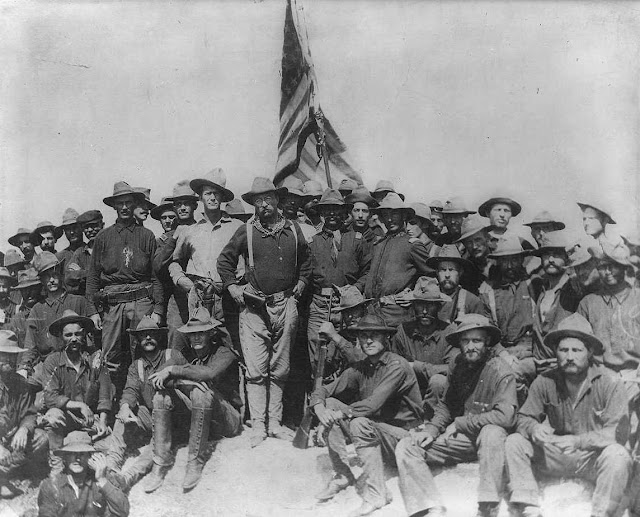

Shortly after the battle, Roosevelt posed with his Rough Riders atop San Juan Hill.  The Buffalo Soldiers who had fought with them were notably not included.

Meanwhile other units of the cavalry’s 1st Brigade secured a smaller knoll on the Spanish right flank.  The heights had been cleared, but fearing a counterattack, Wheeler ordered the exhausted men to throw up breastworks facing the city of Santiago, a mile or so in the distance. 

Roosevelt’s men did repulse one weak counterattack.  But back at his headquarters in the rear Shafter feared a general counterattack and ordered a retreat to the original positions in the trenches as the bottoms of the hills.  Unable to convince his superior to countermand the order, Wheeler on the scene simply ignored it and continued fortifying his position over night. 

Lawton’s Division, badly roughed up at El Caney, finally arrived around noon on July 2.  The position was now secure, and artillery was brought up to the heights to threaten the city and a squadron of Spanish cruisers in the harbor.  The cruisers were forced to flee the guns and ran into a waiting superior American Navy taskforce which destroyed them. 

After a siege by combined American and Cuban nationalist forces, the Spanish surrendered Santiago on July 17.  That completed major land operations in Cuba. 

Troops who survived the shot, shell, and heat stroke of the Battle for San Juan Heights were ravaged by yellow fever and malaria.  General Shafter petitioned Washington for a rapid withdrawal of V Corps calling it an “army of convalescents.”  Concerned that the President would ignore the bumbling Shafter, a group of senior officers prevailed upon the politically well-connected Roosevelt to send a similar appeal on their behalf. 

American evacuation began on August 7.  Troops of the 9th Infantry (Colored) were left behind as an occupation force under the theory that their race and Southern origin would protect them from illness.  It didn’t.  By the time they, too, finally went home almost a tenth of their number came down with yellow fever. 

Roosevelt returned aa a national hero, the Rough Riders were celebrated as folk heroes.  On the strength of his celebrity Roosevelt won the spot as McKinley’s running mate in 1900 and ascended to the Presidency upon his assassination. 

The Buffalo Soldiers, cavalry and infantry alike, who had fought so well received virtually no notice.  Even their White officers, including the heroic Lt. Ord, the son of an active duty General, were denied decorations.  Roosevelt got his Medal of Honor, arguably well deserved.  But so did Schafer who was ineffective as a commander and never came under hostile fire. 

And, oh yes, the U.S. won the war, obtained an empire, and was recognized as a first-rate world power for the first time.


Monday, October 27, 2025

A Dorky Cheyenne Boy Had aNutty Obsession With the Rough Rider


Theodore Roosevelt--boyhood idol turned obsession.

Brilliant. Bombastic. Explosively energetic.  Arrogant.  Innovative.  Ego maniacal.  Heroic.  Perpetually manic.  Self-inventing.  Those are some of the words and phrases the immediately spring to mind when contemplating the life of Theodore Roosevelt, the man who, among other things, reinvented the Presidency for the 20th Century.  The man who was born into a wealthy and influential old Knickerbocker Dutch family on October 27, 1858 continues to fascinate 106 years after his death in 1919 at the age of 60. 

In recent years he was the subject of widely hailed three volume biography by Edmund Morris and several other books examining various parts of his multi-faceted life, studied in Doris Kearns Goodwin’s close examination of the Progressive era in The Bully Pulpit, portrayed by Tom Berenger in the TV miniseries Rough Riders, and was one of the three main characters profiled in Ken Burns epic 5 night PBS documentary series The Roosevelts. And one of my favorite novelists and Facebook connections Jerome Charyn got inside T.R.’s head in The Perilous Adventures of the Cowboy King.


Jerome Charyn's The Cowboy King was a rip-roaring romp and a reminder of why idolized Theodore Roosevelt.  It even echoed the vibe of my Classic Illustrated comic book.

But 40 years after Roosevelt’s death, he also grabbed the idolizing attention of a 10 year old nerd from Cheyenne, Wyoming.  I was already in the grips of fascination with history as a bespectacled, bookish kid with no friends when I first encountered passing notice of him in my entirely inadequate elementary school social studies text.  From there I checked him out in the illustrated Presidential biography books that I had already collected.  And my folks rook me to the Black Hills where I saq Roosevelt’s visage squeezed in between Jefferson and Lincoln on Mount Rushmore.  So I knew he was a big deal.

But what turned Roosevelt from a passing interest into an obsession was a Classics Illustrated   comic book, The Roughrider.  It told the story of how young Theodore, the weakling asthmatic who was bullied and mocked for his myopia and thick glasses but who by dint of sheer grit and determination transformed himself into a Harvard boxer, South Dakota rancher, New York City Police Commissioner, war hero, and eventually President.  A particularly satisfying panel in the book depicted Roosevelt knocking out with one mighty blow a cowboy who mocked him as four eyes.  The boy Teddy seemed a lot like me, likewise the brunt of ridicule and abuse.  The adult hero held out promise that it did not always have to be that way.

It was a short step from hero worship to nutty obsession.  How so?  Let me count the ways.

Not Batman, Superman, or The Flash could compete with my comic book super hero..

The first thing was appearance.  The mustache stubbornly refused to rise from the fine blonde down on my upper  lip Halloween costume fakes were all jet black, lacked the distinctive inward curl around the sides of the mouth, and, well, looked like crap.  And I discovered that pince-nez glasses were not available at my local optician.  I was stuck with the clunky plastic faux tortoise shell frames fit for a middle aged accountant.  But I could get the hat right.

I started with a cheap gray felt hat I bought at a souvenir stand at Cheyenne Frontier Days.  It was supposed to be a Confederate hat and had a paper Stars and Bars Flag sticker on the front.  I was a loyal Union man and spent hours trying to get all vestiges of that peeled off.  The hat did have a satisfyingly military looking gold braid band with end tassels.  I pinned up one side with a brass US collar insignia from my Dad’s World War II uniform.  It made a satisfying reproduction of Col. Roosevelt’s famous Rough Rider campaign hat.

At first I decorated it with a long pheasant tail feather, but discarded that when I realized that no photo showed my beloved Teddy sporting such a plume.  I wore that increasingly battered hat every single day from the moment I got out of bed to the time I turned in at night—except when required to remove it at schooor church—for almost three years until it practically disintegrated, and my head got too big.  Needless to say, I attracted a lot of gaping stares.  And the bullies were unimpressed by its martial appearance.

The hat was useful in the back yard fantasy games I played largely by myself.  None of the other neighborhood kids, least of all twin brother Tim who was running with a faster older crowd and already smoking cigarettes in their fort/club house, were interested in daily charges up San Juan Hill or whatever other adventures I could conjure.  My red and white Firestone coaster brake bicycle with the plastic streamers on the hand grips had to be my noble steed.

Alas, there are no extant photos of me in my Rough Rider hat, although I know that several were snapped on our old Kodak Brownie Box Camera.  My mom, likely out of shame and humiliation, left them out of her meticulously maintained photo albums and they can’t even be located in the unsorted shoe boxes of old photos. 

School was a place where my obsession played out with a bit of drama.  I started handing in my homework, busy work Ditto activity sheets, quizzes, and tests with the correct day of the month underneath my name but instead of 1959 listing the year as 1905, the year after Roosevelt’s election to a full term on his own. I picked the year because the old movies I watched on TV when I got home from school painted that era as sunny, pleasant, and free from looming nuclear annihilation—something that was constantly on our minds in Cheyenne where the Air Force was beginning to build the nation’s first ICBM missile base and which, the civic boast proclaimed, would be a top target for Commie obliteration.  The movies, mostly musicals and comedies like Meet Me in St. Louis or Life With Father were all made in the ‘30’s and ‘40s when many ticket buyers were of an age to recall those days with wistful nostalgia.  Most depicted the comfortable middle class in large homes with live-in servants.  It seemed to me that Teddy Roosevelt ruled over an ideal time to be alive.

The comfortable family life depicted in movies like Meet Me in St. Louis made me long to live in the days of Teddy Roosevelt's Presidency. After all, no Ruskie was apt to drop a nuke on this house..

So I decided that, come hell or high water, I would live then.  Neither my teachers, nor the Principal at Eastridge Elementary where I was routinely sent for an attitude adjustment, were amused by this quirk.  They demanded that I use the correct date and used every punishment in their arsenal to compel my acquiescence.  For a while I was given an (actually a 5 because Cheyenne Public Schools were then using an odd numerical grading system) on every paper I turned in with the wrong year.  But I was a student reading at the level of a senior in high School and in subjects like social studies and science showed every evidence of complete mastery of the lessons.  Of course my spelling was atrocious, my hand writing cramped and nearly illegible, and I was too bored by arithmetic to bother with accurate computations and, it would be discovered much later, was mildly dyslexic compounding that problem.  Despite my wildly uneven academic performance, eventually it was decided that it was hopeless the hold the date thing against my grades.  Besides, if the teachers kept it up, I would be held back for another year and they would be stuck with me again.

So, they tried keeping me in for recess.  Hardly a punishment as it kept me from getting beat up on the playground.  While the others were outside running around and screaming, I was happily alone in the classroom partaking of my favorite activity—reading.  Keeping me after school was no skin off my nose either.  Things were not all that rosy at home where my Mom was battling mental health and rage issues and I was the #1 object of her wrath and dissatisfaction with the hand life had dealt her.  Of course, that also meant that when the school sent home notes complaining about my stubborn misdating, she took it as a purposeful disgrace to the familythe gravest of all possible offenses.  Then out would come the wire handle of the fly swatter, down would drop my jeans and underwear and my ass got whipped to hamburger.

None of it mattered I just kept entering that date, and dreaming of the time and place where nothing like that happened. 


Roosevelt made several visits to Wyoming including this 1902 Presidential visit to Yellowstone National Park.  A special full scale rodeo was once put on for him in Cheyenne at the Frontier Days grounds.  Several Wyoming cowboys had joined his Rough Riders and other were ready to sign up for the new volunteer cavalry unit that Woodrow Wilson would not let him raise for World War I.

The whole thing lasted almost three years until I entered Junior High School and just let it all slide for new dreams and obsessions, every bit as weird perhaps, but not as apt to draw notice. 

Then in a few more years I would discover the underside of 1905 and the Roosevelt utopia—the world of vicious capitalist exploitation of working peopletheir resistance and rebellion, of open class war, Jim Crowlynchings, and of nasty little imperialist wars.

Wednesday, September 24, 2025

Native Holy Site Devils Tower Became the First U.S. National Monument


                                            A 1950's era National Park Service poster promoted visits to Devils Tower National Monument in Wyoming. 

My old home state of Wyoming has a lot of memorable, iconic sights—the Yellowstone geyser Old Faithful, the front range of the Grand Tetons, Independence Rock on the old Oregon Trail But nothing is more unusual or more recognized than the formation that looks like a giant tree stump rising high above the winding Belle Fouche River in a remote corner of the state—Devils Tower

After 10 years of futile efforts by the Wyoming Congressional delegation to have a much larger area including the formation declared a National Park on September 24, 1906 President Theodore Roosevelt, proclaimed Devils Tower a National Monument. It was the first ever use of that designation.  Only 1,152.91 acres of the originally proposed park were protected.  

Two years later the rest of the abortive park in the drainage, including the nearby Little Missouri Buttes, were opened for public use—a victory for both timber interests and cattlemen seeking yet more open range grazing.

No one is exactly sure when the imposing feature was first seen by Whites.  Likely early trappers caught a glimpse, but accounts have not been found.  In 1857 Lt. G. K. Warrens expedition to reach the Black Hills from Ft. Laramie was turned away from the area by a large party of hostile Lakota Warren’s log mentions seeing the Bear Lodge—one of several indigenous names for the rock—and the Little Missouri Buttes in the distance through a powerful telescope.  But some scholars believe, because he did not remark on its unusual configuration, that he was probably referring to the Bear Lodge Mountains also nearby.

On July 20, 1859 topographer J. T. Hutton and Sioux scout Zephyr Recontre reached the formation.  They were a small party from the larger Capt. W. F. Raynolds Yellowstone Expedition But once again neither Hutton nor Raynolds left a detailed account.  


 A 1900 photograph of Devil's Tower.  Few visitors came to the remote location far from rail lines and improved roads of any kind.  Most visitors packed in by horse and mule for days to see the marvel.

It wasn’t until 1875 that a U.S. Geological Survey expedition and its military escort under Col. Richard I. Dodge studied the formation and described in detail.  Expedition member Henry Newt wrote: 

Its remarkable structure, its symmetry, and its prominence made it an unfailing object of wonder. . . It is a great remarkable obelisk of trachyte, with a columnar structure, giving it a vertically striated appearance, and it rises 625 feet almost perpendicular, from its base. Its summit is so entirely inaccessible that the energetic explorer, to whom the ascent of an ordinarily difficult crag is but a pleasant pastime, standing at its base could only look upward in despair of ever planting his feet on the top.

Dodge was credited with giving the formation its now familiar English name.  As was so often the case, it came from a misunderstanding about a native name.  An interpreter mistranslated one of the native names—most of which were some variation of Bear’s Lodge in several different Plains tribe tongues—to Bad Gods Tower.  Expedition members converted this to “Devil’s Tower.”  Following standard topographical practice, the apostrophe was dropped from the official name given the formation.  We can be fairly certain that the translation somehow went awry because none of the many native legends associated with the rock have anything remotely to do with a “bad god.” 

Of course, Native tribes had been aware of the Tower.  It was considered magical or sacred by many tribes—in addition to the Lakota and other Sioux the Arapaho, Cheyenne, Crow, and Kiowa The Lakota, the dominant tribe in the since their arrival from the area around the headwaters of the Mississippi in the late 18th Century and their spectacularly successful adoption of the horse centered Plains Indian culture, regarded the Bear Lodge—Matho ThĂ­pila—as a sacred location second only to the Black Hills

The various tribes have different origin stories for the great rock and many associations with mythic figures or great heroes.  Many used the Tower as the site of individual cleansing rituals, group spiritual practice such as the Sun Dance and Sweat Lodge purifications, and as a sacred burial ground for heroes and great shamans.  The Lakota associated it with one of their most sacred objects, the White Buffalo Pipe, a gift of White Buffalo Woman, a great spiritual mythic or semi-mythic presence. 


Of several origin stories from various tribes, the Park Service has heavily promoted the somewhat dubious Bear Legend connecting the tower to the Pleiades star formation--a Lakota tale grafted to stories of European origin.  This painting is on display at the visitor's center and is regularly used in Park Service literature. 

Among the many legends associated with the tower, the National Park Service, custodians of the Monument, heavily promoted one story in their literature.  In this tale, shared in slightly different forms by the Kiowa and Lakota, seven Indian girls were playing or gathering food near the river when a giant bear attacked them.  The girls fled and ran to a large stump.  They jumped on it and began to pray to the Great Spirit (this language is a tip-off that the story has been laundered through Whites and not collected directly from the people) for help.  Hearing their prayers, he began to raise the stump to the heavens.  As it grew and grew, the enormous Bear tried to climb the stump leaving his claw marks on the side and littering the base with the shredded bark.  The Bear could not reach the girls and went away.  But by then the stump had grown so high that the girls could not climb down.  Taking pity on their plight, the Great Spirit transformed the girls into seven stars directly above the tower, stars known to Europeans as the Pleiades.  It is difficult to tell know exactly how much of this popular story—I was entranced with it as boy—came from authentic tradition, and how much grafted from similar tales in Western mythology.


Standing in a spring snow, this Park Service Sign warns visitors to leave Native sacred objects alone.  Despite the admonition tourists steal or attempt to steal objects as souvenirs. 

Today members of several tribes continue to hold ritual observances at the Tower, although burials are now forbidden by the Park Service. 

It is also a popular tourist attraction, although it takes a fairly determined tourist to get there.  Located hours away from the nearest attractions in the Black Hills, far from any town of even modest size, well away from major highways, most visitors have to dedicate an entire day to seeing just this one sight.  There is only one cafĂ© at road junction miles away and a Park Service concession stand on site for food.  There are a couple of 1950’s style motels nearby, dude ranches in the area, and camping at Monument.


Devils Tower became an alien landing place in Stephen Spielberg's Close Encounters of a Third Kind sparking new waves of visitors to the remote location. 

Yet people come.  Visits took a dramatic jump when Steven Spielberg featured the Tower as the alien landing spot in Close Encounters of the Third Kind.  And it has become a Mecca for the growing sport of rock climbing.  Hundreds make the climb every season, as many as a dozen a day, using several well established routes to the top on every side. 

Native tribes, for home the site is sacred, objected to any climbing.  White climbers and the tribes were at odds for years until the Park Service brokered a “voluntary” compromise.  Since most tribes hold their holiest ceremonies at the Tower in June, the Park Service asked climbers to voluntarily refrain from ascending the rock in that month.  They estimate that 85% of climbers honor that agreement.  But authorities are powerless to stop those who do not.  A climbing group and local tourist interests have sued the Park Service for even suggesting self-restraint.


On a nice summer day dozens of parties can be seen ascending the tower.  Here two groups are rappelling down from the top. 

I visited Devils Tower several times as a boy.  Years ago, when my two oldest daughters were still children my wife and I made the long trip from the Black Hills to show it to them.  It was one of the few natural wonders that they saw on that Western trip that actually impressed them.  They even managed to hike the trail that encircles the rock, quite an achievement for kids allergic to walking.