Showing posts with label Civil Rights Movement. Show all posts

Thursday, August 6, 2026

Two Fulcrum Anniversaries —The Bomb and a Boon


The mushroom cloud over Hiroshima August 6, 1945.

Two incredibly significant anniversaries are being observed today.  They couldn’t be more different, but each event shaped and changed forever the world in which we live.  Eighty-one years ago on August 6, 1945 the Atomic Bomb was first used as a weapon of war, exploding with unprecedented devastation over Hiroshima, Japan and ushering in decades of fear known as the Nuclear Age.  Twenty years later President Lyndon B. Johnson signed the Voting Rights Act of 1965 ushering in an era of increased Black political participation and power particularly in the states of the old Confederacy.

Despite the anniversary, the defining world historical event of the 20th Century attention to Hiroshima seems, at least to me, to be more muted than during previous years.  Perhaps it has to do with the rapid fading of the World War II generation itself.  Perhaps because a generation or more has come of age since the demise of the old Soviet Union and with it the Sword of Damocles threat of global incineration that Baby Boomers like me grew up with.  Despite rising tensions with Russia under Vladimir Putin and the invasion of Ukraine few expect that not-so-veiled threats to seriously threaten the United States or its European allies with nukes.  China, the emerging polar power vs. the U.S. has not been unclearly aggressive. 

There have been periodic scares from the Third World—largely fantastic attempts to whip up hysteria over supposed suite case bombs in the hands of terrorists, the so called Islamic bomb in Pakistan which was preemptively squashed by India, periodic bluster and chest beating threats from North Korea, and Israeli Prime Minister Netanyahus persistent attempts to drum up a war between the U.S. and Iran over as yet undeveloped possible nuclear arms.  With Donald Trump as his imbecilic dupe, he finally stirred up a war with the Islamic Republic.  You may have heard that is not going well.

Despite all this most Americans no longer live with the dread of the world coming to an end tomorrow.  


The Doomsday clock is set closer than ever to Midnight

We may be too nonchalant.   In 2023 the Bulletin of Atomic Scientists which keeps close track on such things re-set their famous Doomsday Clock to 90 seconds to Midnight, the most alarming re-set ever which reflected North Korean efforts, the collapse of agreements by Iran to suspend weapon development, and the general instability of the world largely due to Donald Trump’s feckless policies, and population pressures from accelerating climate change.  The Clock has been re-set again to 85 seconds to Midnight.


The devastation in Hiroshima.

The U.S. Army Air Corps B-29 bomber Enola Gay piloted by Colonel Paul Tibbets dropped a bomb on Hiroshima at 8:15 local time as residents were beginning their work and school days.  To do justice to the occasion today, I would have to dwell in detail on what it was like in the city that morning when “the face of the sun seemed to kiss the earth.”  And frankly I am not up to that ever-wrenching experience.  Call me a coward.  Instead, for just a taste of the horror and destruction I invite you to view Hiroshima: The Lost Photographs.


Voting rights demonstrations across the South, often brutally suppressed, like the first attempt of a march from Selma Alabama where young John Lewis had his skull fractured and the deaths of White civil rights workers pressured Lyndon Johnson to act and ultimately gave him the leverage to get an act through Congress.

The anniversary of the Voting Rights Act continues to generate more interest than usual because voting rights are under such relentless attack and because of the deaths of voting rights champions Congressman John Lewis and Rev. C.T. Vivian.  Progressive forces are now rallying to preserve them and to recoup what has been lost since 2013 when the Supreme Court overturned a key provision to combat racial discrimination in voting.

Under Section 5 of the landmark civil rights law, jurisdictions with a history of discrimination needed to seek pre-approval of changes in voting rules that could affect minorities.  It blocked discrimination before it occurred. In Shelby County V. Holder the Court invalidated Section 4—which laid out criteria for identifying states and localities covered by Section 5—claiming that current conditions require a new coverage formula.  That left Section 5 intact but unenforceable.  The conservative majority on the Court claimed that Congress could easily adopt a new formula and restore enforcement, knowing full well that with the House of Representatives in the iron grip of reactionary Republican majorities that no remedy would be enacted.

Since then, attacks on voting rights have intensified across the country—and not just in the old Deep South.  Republican Legislatures and Governors have enacted waves of legislation aimed at curbing or discouraging voting by minorities and any groups of voters suspected of possible Democratic tendencies.  In the name of fighting a virtually nonexistent form of voter fraud—registration and voting by non-citizens misrepresenting their status—burdensome proof of identity legislation, including very limited numbers of approved identification documents and fees and charges for attaining those documents.  Places where applicants can obtain documents have been reduced requiring burdensome travel and their hours of operation restricted.  Students have been barred from registering where they attend college, even if they live there year around.  Early voting periods have been reduced and restricted.  Polling places have been eliminated and consolidated in minority areas to guarantee long and discouraging lines.  It seems like new and creative ways to curb registration or discourage voting are introduced every year, churned out as model legislation by some right wing think tank and spreading from red state to red state like a virus.


The Rev. William Barber in the red stole became a leading voice for the "Civil Rights Movement for our times" and demands to end the GOP rampage of voter suppression laws.  Seen here before his arrest with other faith leaders in Washington.

Many, maybe even most, of these restrictions eventually get struck down in the courts, but not before having their desired effect for an election cycle or two.  With Section 4 in place, many of these changes would have been stopped by Federal review before they were even put in place. 

Meanwhile there was a growing rank-and-file movement to reclaim voting rights in the same way as they were first won at bitter cost to begin with—with street protests and civil disobedience.  The NAACPs Moral Monday movement in South Carolina was a model for a new activism and a movement that has been called the Selma of the 21st Century.


Lyndon Johnson signing the Voting Rights Act of 1965.  Among the witnesses are Senate Co-Sponsor and Republican Minority Leader Everett Dirksen of Illinois, Rev. Ralph Abernathy, Rev. Martin Luther King, Jr. , Benjamin Hooks and Rosa Parks.

On August 6, 1965, President Lyndon Johnson signed the landmark National Voting Rights Act of 1965 in a ceremony at the White House attended by leaders of both parties in Congress and Civil Rights leaders including the Rev. Martin Luther King, Jr. and Benjamin Hooks

My generation, which grew up protesting the War in Vietnam, grew to regard Johnson as “the enemy.”  Yet his record on domestic issues was unmatched by any President except Franklin Delano Roosevelt.  His Great Society programs, though far from perfect, were the last great systematic assault on poverty in our history.  And this Texas wheeler-dealer accomplished what Northern liberals like John F. Kennedy never could—a comprehensive legislative attack on discrimination and the subjugation of Black citizens. 

Perhaps we expected that subsequent Democratic Presidents would take up where Johnson left off without the stain of a fruitless war.  The fact is that whatever their intentions, none of them did.  The previous year the Civil Rights Act of 1964 opened doors of public accommodations in response to ongoing campaigns by the Southern Christian Leadership Conference (SCLC), the Congress of Racial Equality (CORE), branches of the National Association of Colored People (NAACP), and others. 

But the historic pattern of restricting voting by Blacks through the use of poll taxes, literacy tests, and outright intimidation that was the hallmark of the Jim Crow era after Southern Whites dismantled the reforms of post-Civil War Reconstruction, remained untouched.  With new militancy the SCLC and the Student Nonviolent Coordinating Committee (SNCC) turned to campaigns to register voters. 

That campaign took a bloody, violent turn in Selma, Alabama earlier that year. Marchers attempting to reach the local Court House to register were attacked and many severely beaten. Black demonstrator, Jimmy Lee Johnson, was killed during a march in near-by Marion City.  Then James Reeb, a White Unitarian Universalist Minister who had responded to a call by Dr. King for support, was beaten to death shortly after arriving in the city. 

Johnson instinctively knew that the death of the White minister would galvanize public sentiment and support in the way no number of Black deaths could. A few days later a massive Selma to Montgomery March was turned back with violence at the Edmund Pettis Bridge—Bloody Sunday.   

On March 15, Johnson addressed a joint session of Congress to call for the Voting Rights Act. It was introduced in the Senate on March 18 by Senate Majority Leader Mike Mansfield of Montana and Republican Minority Leader Everett Dirksen of Illinois 

A second March to Montgomery, this time under the protection of Federal Authorities, got underway on March 21 and arrived at the Alabama capital for a massive rally on March 25 with the renewed purpose of supporting the Voting Rights Act.  After the rally a White Unitarian Universalist volunteer from Michigan, Viola Liuzzo, was shot and killed while driving a Black demonstrator back to Selma.  


The deaths of a white minister and a white woman volunteer during the Selma Campaign spurred Congress to action on the Voting Rights act in a way the vastly more numerous murders of Black activists like Jimmy Lee Jackson had ever done.  White privilege thus leveraged the landmark act.  At least the Unitarian Universalist Association (UUA) recognized the sacrifice of Jackson alongside UUs Rev. James Reeb and Viola Liuzzo in the memorial plaque that hangs in the Boston headquarters.

That only stepped up pressure on Congress, where despite a fierce last line of resistance by Southern Democrats, a filibuster was broken and the measure passed the upper chamber on May 26.   The vote was 77-19 with 47 Democrats in favor, 17 opposed and 30 Republicans—who still were proud to be the party of Lincoln—in favor and 2 opposed. 

Delaying tactics and attempts at gutting the measure by amendment slowed action in the House of Representatives but it passed with minor amendments on a vote of 333-85 when Congress reconvened from the Independence Day recess on July 9.  A Conference Committee reconciliation of the two versions cleared the House on August 3 and the Senate the next day. 

Johnson wasted no time including King and Rosa Parks to attend. 


Tuesday, June 23, 2026

It Was an Equal Opportunity Mississippi Lynching—Chaney, Goodman, and Schwerner


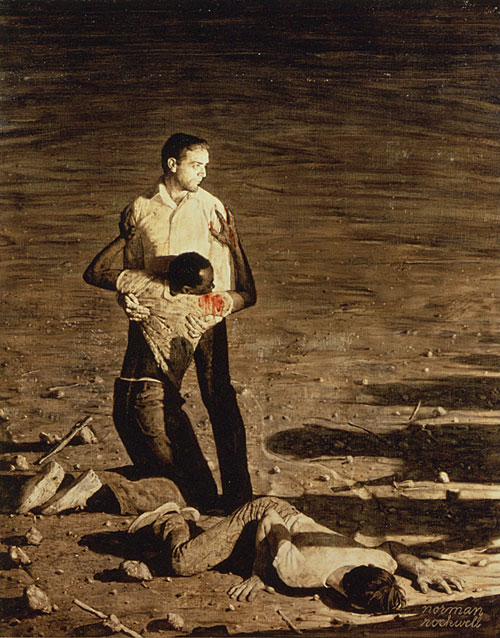
 Norman Rockwell, the beloved painter and illustrator of a pleasant America, was deeply moved by the Civil Rights movement and shocked the nation with his depiction of the murder of Chaney, Goodman, and Schwerner.  

June 21 was the anniversary of an important and tragic event in the struggle for social justice in America—the murder of three young civil rights workers in Mississippi in the summer of 1964.  Their story reminds us that before young white people took to the streets in unprecedented numbers in support of the Black Lives Matter movement and in protest to the police killings of George Floyd and other African-Americans and People of Color, an earlier generation put their lives on the line in the segregationist South where the Ku Klux Klan still terrorized with near impunity. 

They were fewer in number than the young BLM activists who took to the streets in every corner of the country including small towns and white suburbs where they were totally unexpected.  The Freedom Riders and voting rights activists of the ‘60s came mostly from Northern university enclaves and were often red blanket babies and frequently Jewish.   My own best friend from high school, Jon Gordon, went down in the summer of 1967 and thankfully returned safely.  I wished then that I had gone with him instead of spending the summer washing dishes at a Skokie Howard Johnsons.

Many of us of a certain age still have vivid snowy black and white TV images stuck in our heads keeping alive the memory of the murders of those three young civil rights activists in the Freedom Summer of 1964.  


Andrew Goodman, James Chaney, and Michael Schwerner. 

It still made news 52 years later in 2016 when Mississippi Attorney General Jim Hood announced an end to the active Federal and State investigations into the 1964 killings of James Chaney, Andrew Goodman, and Michael Schwerner in Mississippi.  The announcement came just days after the death of Judge Marcus D. Gordon, who oversaw the 2005 murder trial at which Edgar Ray Killen, a Ku Klux Klansman and Baptist preacher who was believed to be the prime mastermind of the crime was finally convicted.  Hood told reporters: 

The FBI, my office and other law enforcement agencies have spent decades chasing leads, searching for evidence and fighting for justice for the three young men who were senselessly murdered...It has been a thorough and complete investigation. I am convinced that during the last 52 years, investigators have done everything possible under the law to find those responsible and hold them accountable; however, We have determined that there is no likelihood of any additional convictions. Absent any new information presented to the FBI or my office, this case will be closed.

The news came as no surprise to any of the victims’ families.  After so many years most, if not all of the others involved in the crime are likely dead—Killen turned 91 in prison—as are almost any witnesses.  The likelihood that new physical evidence may show up has diminished to the vanishing point.

The case was kept alive in the press and public awareness due to the diligent work of the Andrew Goodman Foundation which encourages young people of all religious backgrounds to be engaged in social justice work and continues to campaign for the preservation and extension of voting rights which are under pressure from a wave of suppression laws enacted across the Old South and states with Republican governors and Legislatures Andrew Goodman’s brother, David is the effective public face of the foundation.

Then there was the troubling role of FBI informants within the Klan.  Although J. Edgar Hoover planted spies in both the civil rights camp and in various Klan groups and White Citizens Councils, he was clearly more fixated on discrediting the Civil Rights Movement, particularly its charismatic leaders like the Rev. Martin Luther King, Jr., than he was with White terrorists.  He was also loath to disclose how deeply his informants were involved in several high-profile cases, including the murders of the Rev. James Reeb and Viola Liuzzo during the Selma Campaign—so deeply they may have been directly complicit in brutal crimes.


The film Mississippi Burning starring Gene Hackman and Willem DaFoe as the lead FBI investigators on the case started a trend in films about the Civil Rights movement that put white heroes at the center of Black stories. 

1988’s award winning Mississippi Burning told the brutal tale of entrenched Southern racism.  It starred Gene Hackman and Willem Dafoe as a pair of FBI agents who diligently and doggedly investigated the crime.  Widely praised at the time of its release, the film set a pattern for other movies about the Civil Rights era which always centered on white heroes relegating Black victims and civil rights workers alike to secondary roles in their own stories.  And the irony of the FBI as heroes was not lost on many who lived through those times.

By the summer of 1964 the Civil Rights movement had matured.  The non-violent civil disobedience campaigns of the Southern Christian Leadership Council (SCLC), Congress of Racial Equality (CORE), Student Nonviolent Coordinating Committee (SNCC), and other groups had won some local victories and the near passage of the Civil Rights Act of 1964, which had cleared a 57 day long Senate Filibuster just two days before the murders.  But progress was painfully slow and everywhere bitterly resisted, often with violence.  The Movement was experiencing internal stresses due to tactical differences, jealousies, and rivalries between groups and leaders, and the early stages of restiveness among younger militants over the limitations of non-violence in the face of increasingly brutal attacks.

CORE was gaining a reputation for both a more confrontational approach than Dr. King’s SCLC and for going into the heart of the Black Belt to work in small towns and rural communities with long-term organizing projects.  It declared that summer to be Freedom Summer and publicly vowed to bring up to 30,000 volunteers into Mississippi to set up Freedom Schools and conduct voter registration drives.  Although that number was wildly exaggerated, it got the attention of Whites, many of whom flocked to join the White Knights of the Ku Klux Klan, a splinter group founded and led by Samuel Bowers which had a reputation of being much more aggressive than older Klan organizations.  It was also very active in recruiting among local law enforcement officers.

Andrew Goodman was a 20 year old New York student and activist from a Red Blanket secular Jewish background.  Michael Schwerner was a 24-year-old from a comfortable suburban background who graduated from Cornel University and was in graduate school at Columbia University.  Like Goodman he came from a Jewish family.  His classmate and friend at Columbia, the diminutive Robert Reich, later a Secretary of Labor and now a progressive social media star, remembered him as a “Gentle giant” who protected him from campus bullies.  Both Goodman and Schwerner became involved with CORE while in school and eagerly signed up to join the volunteers heading to Mississippi for the Freedom Summer.


 Student volunteers for COREs Freedom Summer voter registration project in Mississippi join hands and sing as the prepare to head south.

Once in state they were teamed with James Chaney, a 21 year old working class Black man from Meridian, Mississippi who was already a Civil Rights veteran.  Two years earlier in 1962 he had and endured the attacks on the Freedom Riders on interstate busses.  He had joined CORE and was already experienced in organizing voter registration drives in his hometown.  Of the three young men Chaney was the only one remotely aware of how dangerous their work would be.

Chaney and Schwerner were assigned to organize Freedom School in Neshoba County to prepare local Blacks to pass the tough comprehension and literacy tests required by the state.  These tests were a huge hurdle to voting and even answering every question correctly did not guarantee that it would be correctly marked.   Many would-be voters had to take the test repeatedly.  Part of the training at the school was in how to behave when turned down to prevent immediate arrest for causing a disturbance.  


The ruins of the Mt. Zion Methodist Church in Longdale, Mississippi where  James Chaney and Mickey Schwerner spoke on Memorial Day.  

The pair kicked off their organizing attempt with speeches at Mount Zion Methodist Church in Longdale, Mississippi Local members of the White Knights of the Klan immediately got word of the effort and began monitoring the pair’s travels and activities.  They also wanted to attract more CORE volunteers to the area with the intent of targeting them.   They burned the Mount Zion Church knowing that CORE would respond.  It did and Goodman soon joined the other two.

Early on June 21the trio met in the Meridian offices of CORE’s ally in the Freedom Summer project, the Council of Federated Organizations (COFO) to investigate the Mount Zion arson.  Schwerner told the staff to start searching for them if they were not back by 4 p.m.   After visiting Longdale they began the return to Meridian on State Rt. 16 to the county seat at Philadelphia where they planned to pick up Rt. 19 back to their base. 

Just inside the Philadelphia city limits they experienced a flat tire, probably the result of sabotage to the vehicle or sharp objects strewn it its path.  As the car limped down the road they were almost immediately pulled over by Deputy Sheriff Cecil Ray Price who apparently had been following them.   Price radioed Harry Wiggs and E. R. Poe of the Mississippi Highway Patrol for assistance.  Chaney, the driver was arrested on the impossible charge of speeding over 65 MPH.  The other two were held for investigation.  All were taken to the Neshoba County Jail on Myrtle Street and held incommunicado. 

By 4:45 alarmed staffers began calling authorities, including the Highway Patrol, in search of information on their whereabouts.  They were given no information.

Still prevented from making a phone call, all three were released at 10 that night.   They were followed by Deputy Price as they headed south on Rt. 19.  A Highway Patrol car sitting conspicuously outside Pilgrims Store dissuaded them from trying to stop and use the phone.  Meanwhile a mob of White Knights gathered in two cars drinking and arguing who would have the privilege of killing the men who were now literally fleeing for their lives. Philadelphia Police Officer Burkes told the men in the cars where to find the trio with instruction to “go get them.”

One of the two cars broke down and six of the men jammed into Horace D. Barnettes ’57 Ford Fairlane for the pursuit.  Meanwhile Deputy Price stopped the CORE station wagon which had turned west on State Rt. 492 in an attempt to elude any pursuers.  He turned the men around and moved them back on Rt. 19 to Philadelphia, strait into path of the oncoming lynchers.  The police cruiser and Fairlane boxed in the station wagon and steered it onto nearly deserted Rock Cut Road where they stopped at a secluded intersection with another County Highway.  The three Civil Rights workers were dragged from their car.

Alton W. Roberts, 26, a dishonorably discharged U.S. Marine who worked as a salesman in Meridian shot both Goodman and Schwerner at point blank range after asking Schwerner, “Are you that Nigger lover.”  Chaney was singled out for a beating and then shot in the stomach by James Jordan and then finished off with another shot to the head by Roberts.

After the murders the bodies were loaded into their station wagon which was driven by prior arrangement to Old Jolly Farm owned by Olen L. Burrage southwest of Philadelphia and placed on a red clay dam on the property.  Herman Tucker, a heavy machinery operator, was at the dam waiting for the lynch mob’s arrival with his bulldozer, which he used to cover the bodies. 

Goodman was apparently not yet dead when he was covered.  When his body was finally recovered red clay was found in his lungs and clenched hands.

After the job was done Deputy Price told the men:

Well, boys, you’ve done a good job. You’ve struck a blow for the white man. Mississippi can be proud of you. You’ve let those agitating outsiders know where this state stands. Go home now and forget it. But before you go, I’m looking each one of you in the eye and telling you this: “The first man who talks is dead! If anybody who knows anything about this ever opens his mouth to any outsider about it, then the rest of us are going to kill him just as dead as we killed those three sonofbitches tonight. Does everybody understand what I’m saying. The man who talks is dead, dead, dead!
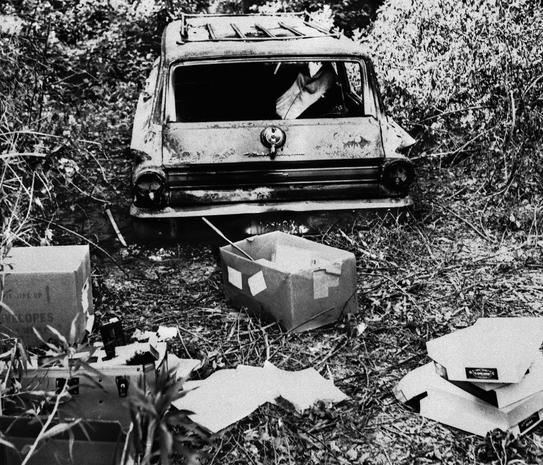
 

 The burnt out station wagon used by the Civil Rights Workers was quickly discovered confirming the worst fears for their fate.

Tucker was assigned to dispose of the CORE station wagon by driving it to Alabama.  Instead. he ditched it near a river along Highway 21 in northeast Neshoba County and set it ablaze.  That proved to be a fatal mistake.  After the Meridian COFO office, the initial target of an FBI surveillance team already stationed in town, reported its three volunteers missing, J. Edgar Hoover reluctantly moved to begin a search.  He was acting under pressure from Attorney General Robert Kennedy who also ordered 150 additional agents from New Orleans to the scene.  The burnt-out station wagon was accidently discovered the next day by two Native Americans who reported it to the Meridian Agent in charge, John Proctor Kennedy then ordered hundreds of sailors from the Naval Air Station Meridian to search the swamps of Bogue Chitto for the bodies.  Top Special Agent Joseph Sullivan was brought in from Memphis to lead the investigation.  Proctor and Sullivan were the models for the fictional FBI agents in Mississippi Burning.

That search turned up unexpected results.  The bodies of college student Charles Eddie Moore and a sawmill worker from Franklin County, Mississippi were found badly decomposed in a river chained to a Jeep motor.  Although neither 19-year-old Black men was known to be involved in Civil Rights work, they were picked up while hitch hiking in May on suspicion, beaten, tortured, and interrogated before being dropped into the river alive.  The bodies of five other recently murdered young black men from rural towns in the area who were never reported missing were also turned up.  It was grizzly evidence of a well-oiled and active night riding operation.

Acting on a tip from a mysterious Mr. X the FBI dispatched searchers to Burrage’s farm where the bodies were discovered 44 days after their abduction and murder.  The case unraveled from there.


Outrage over the murders help secure passage of the Civil Rights Act of 1964.  Lyndon Johnson presents Rev. Martin Luther King, Jr with a ceremonial pen following a signing ceremony at the White House. 

National outrage about the murder of the idealistic young Northern volunteers was used by President Lyndon Johnson to leverage final passage of the 1964 Civil Rights Act on July 2.  As many noted even at the time, the death of their Black comrade Chaney alone would hardly have caused a ripple in Congress.  The case along with the deaths of White volunteers Rev. James Reeb and Viola Liuzzo during the Selma Campaign the next year was also credited with the passage of the Voting Rights Act of 1965.

You may have noted the great and specific detail known about exactly how the murders were committed and by whom.  Exactly how do we know so much?  Good question.  Although the FBI may not have had informants within the inner circle of those who plotted and planned the murder as well as the lynch mob that carried it out—although some historians believe that at least one of the men may have been a deep cover informant never revealed by the Feds because he was actively involved in the killings—there were informants in the wider White Knights of the Klan organization.  Take Mr. X.  Forty years after the fact he was identified as Mississippi State Trooper and Klan member Maynard King who was enlisted as an informant by Agent Sullivan.

Other informants were on hand on for instance on June 7 when White Knights Imperial Wizard Bowers told a secret rally:

This summer the enemy [CORE] will launch his final push for victory in Mississippi…there must be a secondary group of our members, standing back from the main area of conflict, armed and ready to move. It must be an extremely swift, extremely violent, hit-and-run group.

So, the FBI was aware that a serious and violent plot against Freedom Summer volunteers was afoot weeks before the murders.  After the fact other informants associated with the Klan but never identified by Federal agents passed bits and pieces of information they picked up from the loose lips of participants or second hand from others.

In late November 1964 the FBI accused 21 men of conspiracy to injure, oppress, threaten, and intimidate Chaney, Goodman, and Schwerner.  Most of the suspects were arrested by the FBI on December 4, 1964.  Mississippi officials declined to prosecute any of the men for murder so Assistant Attorney General John Doar led a star-crossed Federal prosecution for conspiring to deprive the three activists of their civil rights.  18 men including Sherriff Rainey and Deputy Price were originally indicted.  Travis M. Barnette, owner of a Meridian garage where much of the planning was done, and James Jordan who was the first to shoot Chaney both confessed and testified at upcoming trials.  Jordan’s testimony was particularly damming.


The faces of evil--members of the lynch mob who carried out the murders: Top Row, L-R: Deputy Cecil R. Price, Travis M. Barnette, Alton W. Roberts, Jimmy K. Arledge, Jimmy Snowden. Bottom Row, L-R: Jerry M. Sharpe, Billy W. Posey, Jimmy L. Townsend, Horace D. Barnette, and James Jordan who confessed and testified against the others. 

Despite strong evidence, the case hit snag after snag.  After several false starts and bringing the case back to a Grand Jury once, the U.S. v. Cecil Price et. al. came to trial on October 7, 1967 in the Meridian with Federal Judge William Cox, an ardent segregationist, presiding.  An all-White jury included one admitted former Ku Klux Klan member.  When the jury deadlocked despite overwhelming evidence, Cox admonished them with an Allen charge for the minority to reconsider its judgement. 

On October 20 Cecil Price, Imperial Wizard Bowers, Alton Wayne Roberts, Jimmy Snowden, Billey Wayne Posey, Horace Barnett, and Jimmy Arledge were convicted and sentenced to between 3 to 10 years.  After losing their appeal they all went to prison, but no one served more than six years.  They were the first White men convicted of a fatal crime against civil rights workers.  The cases of E. G. Barnett, a candidate for Sheriff, and preacher Edgar Ray Killen, believed to be the principal mastermind of the plot ended in a hung jury.  Prosecutors declined to re-try them.  No charges were brought against several other men known to be involved in the wide-spread plot.


Edgar Ray Killen, mastermind of the plot was finally convicted of the three murder in a Mississippi court in 2005. 

After years of investigation by intrepid journalist Jerry Mitchell of the Jackson Clarian-Ledger and the work of high school teacher Barry Bradford at Stevenson High School in Lincolnshire, Illinois and three of his students, Allison Nichols, Sarah Siegel, and Brittany Saltiel who produced a documentary film on the case and helped uncover new evidence, Mississippi prosecutors were finally pressed into bring murder charges against Killen.  At age 80 he was convicted and sentenced to three consecutive 20-year terms in 2005.  He died in prison on January 11, 2018, six days before his 93rd birthday.


Saturday, April 4, 2026

Two for Dr. King on April 4——National Poetry Month 2026


Martin Luther King lays on the balcony of Memphis's Lorraine Motel moments after he was shot as aids point to where they believe the shot that killed him was fired.

Except for the month of April, this blog is generally in the business of history. But in this month dedicated to poetry, things that matter can get short shrift. Take today. It is the 58th anniversary of a gut-wrenching occasion that left a scar on the nation and on many of our hearts. It was on April 4, 1968 that the RevMartin Luther KingJr. was gunned down as he stood on the balcony of a Memphis motel. He was in the city to complete some unfinished business—a march in support of striking garbage collectors, a follow up to an earlier march where violence had broken out as younger marchers began smashing shop windows.  He returned against the unanimous advice of his closest associates. But he felt he had a duty to complete the march in peace. 


On the eve of his assassination Dr. King delivered his eerily prescient final speech to a packed church.

The rainy night before, Dr. King went to a local church that was packed to the rafters to hear him. It was there that to a strangely hushed crowd he delivered his own elegy: 

… I don’t know what will happen now. We’ve got some difficult days ahead. But it doesn’t matter with me now. Because I’ve been to the mountaintop. And I don’t mind. Like anybody, I would like to live a long life. Longevity has its place. But I’m not concerned about that now. I just want to do God’s will. And He’s allowed me to go up to the mountain. And I’ve looked over. And I’ve seen the promised land. I may not get there with you. But I want you to know tonight, that we, as a people, will get to the promised land. And I’m happy, tonight. I’m not worried about anything. I’m not fearing any man. Mine eyes have seen the glory of the coming of the Lord. 

The night of the killing riots erupted around the nation. Black rage boiled on to the streets. In Chicago the West Side burned. White America cowered in front of their television sets in fear and horror. At tiny Shimer College, I locked myself in a closet and cried for what seemed like hours. 

We’ll leave it to the pathetic conspiracy theorists to argue about who to pin the rap on. It really doesn’t matter if we know the name attached to the finger on the trigger, or the names of who may have paid or abetted, or even of those who just winked. A festering boil of racism killed Dr. King in the forlorn hope that they could kill his dream and the march to justice. Traumatic events like this are often processed through poetry. Think of Walt Whitmans elegies to fallen LincolnO Captain, My Captain and When Lilacs Last in the Door Yard Bloomed

Today, let’s remember through the eyes of two Black women. Nordette Adams grew up in New Orleans. After a varied career as a journalist, government public relations person, ghost writer, technical writer, and writer and producer of documentaries, she is concentrating on her creative writing and poetry. 


Nordette Adams.

 Remembering A Life 

I remember him in the misted vision of toddler years 

and again in girlhood, the booming voice on TV, 

someone grown-ups talked about, eyelids flapped wide. 

Elders huddled ’round the screen enraptured, 

in fear for him, in awe. 


I remember him. His words swept the land, singing our passion. 

Dogs growled in streets. Men in sheets. 

Police battering my people. (Water, a weapon.) 

Yet my people would rejoice ... And mourn. 


I remember him, a fearsome warrior crying peace, 

a man—blemished by clay, the stain of sin as 

any other, calling on the Rock— 

Death's sickle on his coat tails, 

yet he spied glory. 


Shall we walk again and remember him, 

not as the Madison Aveners do, 

but in solitude and hope 

with acts of courage and compassion, 

with lives of greater scope 

carving fresh paths of righteousness? 


I remember. 

Nordette Adams © Copyright January 2004, Nordette Adams 


June Jordan.

June Jordan was born in Harlem in 1936 and grew up in Brooklyn’s Bedford-Stuyvesant, Poet, activist, teacher, and essayist, she was a prolific, passionate, and influential voice for liberation. Jordan died in 2002 but lived and wrote on the front lines of American poetry with political vision and moral clarity. 

In Memorium: Martin Luther King Jr. 

honey people murder mercy U.S.A. 

the milkland turn to monsters teach 

to kill to violate pull down destroy 

the weakly freedom growing fruit from

being born 


America 

tomorrow yesterday rip rape 

exacerbate despoil disfigure 

crazy running threat the 

deadly thrall 

appall belief dispel 

the wildlife burn the breast 

the onward tongue 

the outward hand 

deform the normal rainy 

riot sunshine shelter wreck 

of darkness derogate 

delimit blank 

explode deprive 

assassinate and batten up 

like bullets fatten up 

the raving greed 

reactivate a springtime terrorizing 

death by men by more 

than you or I can 


STOP 

II 

They sleep who know a regulated place

or pulse or tide or changing sky 

according to some universal 

stage direction obvious 

like shorewashed shells 


we share an afternoon of mourning 

in between no next predictable

except for wild reversal hearse rehearsal 

bleach the blacklong lunging 

ritual of fright insanity and more 

deplorable abortion

 more and 

more 

June Jordon From Directed By Desire: The Collected Poems of June Jordan (Port Townsend, WA: Copper Canyon Press, 2005) © 2005 by The June M. Jordan Literary Trust.

Tuesday, February 3, 2026

Black History Month Resists Erasure


Note—Adapted from previous posts. 

The 1619 Project, a long-form journalism project developed by Nikole Hannah-Jones, writers from The New York Times, and The New York Times Magazine, first came under attack five years ago.  The highly praised series and book re-examined the Black experience in the New World from the importation of African “indentured servants” to the Jamestown Colony in 1619.  It clearly showed that the generational experience of slavery continues to put African-Americans at a social and economic disadvantage and laid the blame for that on the development of an explicitly racist ideology that still lurks not far below the surface of polite White society. It was adapted as a six-part documentary on Hulu.   

Naturally, the right-wing propaganda machine went on a full-press attack on the series and on it’s authors.  Hannah-Jones was denied a tenured position at the University of North Carolina after the university’s board of trustees took the highly unusual step of failing to approve the Journalism Departments recommendation under intense pressure and threats to withhold state funding for the school and a boycott by wealthy White donors. 


The 1619 Project was the most talked about book of 2022 and widely celebrated in Black and progressive circles.  It also quickly aroused a tsunami of hysteria and and backlash

That was just the beginning of an escalating campaign. 

Republican governors like Glenn Youngkin of Virginia and GOP controlled state legislators rushed to ban the teaching of critical race theory after a campaign to stir up a social panic was whipped by Tucker Carlson and other Fox News propagandists and the right-wing echo chamber on social media.  Local school board meetings were stormed and disrupted; teacher, administrators, and parents were threatened and/or assaulted; captive library boards are banned books.  

As one eight-year old observed in the related banning of the graphic novel Maus about the Holocaust, “The people who want to ban this are the ones who want to do it again.” 


This editorial cartoon makes clear what Florida Governor Ron DeSantis intended.

Republican Florida Governor and failed presidential wannabe Ron DeSantis cashed in on the hysteria by announced plans to block state colleges from having programs on diversity, equity, and inclusion, as well as critical race theory (CRT).  He also blocked a new national high school Advanced Placement course from public schools and threatened sanctions of private schools that adopted it. 

Television stations were inundated with protests and threats for airing Black History Minutes and other programing that have been routine for years.  

It came to a head with the re-election of Donald Trump.  The new buzz word of the moment was DEI—Federal and private diversity, equity, inclusion programs which the Orange Menace blamed for failures in everything from criminal justice, the military, education, food and energy prices, trans kids in bathrooms, to FEMA disaster relief and aviation safety.  He said they promoted incompetence denying advancement to highly qualified—White male—candidates and set races, immigrants, and minorities against real Americans.  He trotted out the racist trope the Martin Luther Kings dream was a color-blind society.  He vowed to root out DEI policies from every corner of the Federal Government and coerce states, municipalities, public institutions, and private non-governmental organizations to do the same. 

He meant what he said and then some. 

Trumpist media celebrated.

The White House purge of (DEI) programs and workers, begun last January, and accelerated at lightning speed.  A policy directive to all Federal Departments and agencies ordered: 

Each agency, department, or commission head shall take action to terminate, to the maximum extent allowed by law, all DEI, DEIA, and ‘environmental justice’ offices and positions within sixty days.  

The memo updated a directive sent earlier that told agencies to submit written plans for executing a reduction-in-force—layoffs—no later than January 31.  The new memo demanded those notices go out immediately.  It wass not clear how many DEI staffers there are in the Federal government, which employs millions of workers. 

It also followed a directive issued earlier this that ordered department and agency heads to close DEI offices.  Agencies were ordered to put staff on paid leave, as well as take down all DEI websites, social accounts, and “outward facing media” and to withdraw any plans in the equity and inclusion space and cancel all trainings and contracts.  The directive included an email template that called on government employees to snitch on each other.. 

The administration also tried to immediately shut down all Federal grants pending investigations into any recipients enforcing their own DEI rules or to other hot button issues like service to migrants and refugees; sanctuary city laws; abortion, contraception, and family planning; transgender health care and self-identification in law and on documents; and definitions covered by the Americans with Disabilities Act (ADA).  The orders sewed wide-spread panic and uncertainty.  Contractors due payment for work already completed were immediately affected and small providers like day care, home health care, and homeless services feared that they could be put out of business.  State and local governments feared grants for already started or planned for things like road construction and other infrastructure projects.  Social Securityveterans benefits, and other programs seemed in danger. 

After a huge public backlash, the Occupant was forced to promise that those lifelines would not be frozen.  Federal courts put the whole suspension on pause pending review.  

Meanwhile, some local governments, agencies, and private businesses, led by the MAGA tech bros. and companies like MetaWal-MartMcDonaldsTarget, and defense contractors scrapped their own DEI policies.  Others remained defiant. 

The breadth of these sweeping attacks transcends racial, ethnic, language, gender identity, or disability groups alone.  The masterminds of these attacks hope that under pressure identity groups will turn on each other—Blacks against immigrants, certain feminists against “fake women.”  The need for a united front of all these oppressed if essential for the survival of all. 


Black History month was scrubbed from Federal web sites including the expurgated page on WhiteHouse.gov.  

Still, it is not hard to feel that African-Americans are a particular target for erasure.  The official website on the Constitution ominously took down its page on the 14th Amendment.  A long list of recognitions of honoring minority groups was scrubbed.  The censors could not completely eradicate Martin Luther King Day or Juneteenth, both Federal holidays because the are statutory.  For now Federal employees will keep their days off, but no other notice or celebration is permitted.   

The roots of the annual Black History Month observance stretch back to 1926 when Carter GWoodson and the Association for the Study of Negro Life and History announced the second week of February to be Negro History Week.  Woodson, who died in 1950, spent the rest of his life promoting historical awareness in both academia and the community.  There was plenty of resistance in the first case and the revelation of an untapped hunger in the second. 

In the wake of the Civil Rights Movement and especially the Black Power movement of the 1970’s Black history finally began to take hold as a recognized academic discipline and as part of the curriculum in public and private schools.  The first Black History Month was celebrated at Kent State University in Ohio.  By 1976 President Gerald Ford recognized Black History Month, during the celebration of the United States Bicentennial. 

Since then, Black History month has spread and now usually adopts a theme each year. This year the theme celebrates A Century of Black History Month and honors Carter Woodson and other pioneers. 


Some African-Americans think the Black History Month ghettoizes the Black experience. 

By the early 21st Century the media and many corporations seemed to co-opt the month to pander to the Black community and inoculate themselves against charges of institutional racism.  Ubiquitous Black History Moments on television promoted hero worship of individual “pioneers” often without any context to a broader struggle or the experience of ordinary Black people.  It has also drew criticism for “ghettoizing” Black history and confining it to a silo without connection to American history as a whole.  Actor and director Morgan Freeman declared “I don’t want a Black history month. Black history is American history. 


Black History Month must always keep in mind the sacrifices of participation of the many in the Civil Rights movement like these women in the 1963 March for Jobs and Justice in Washington.  They made Dr. Martin Luther King's soaring rhetoric a reality. 

I’m well aware of these pitfalls as a White writer, amateur historian, and hope-to-be ally.  Yet I think there is still much to be learned if Black History can be placed in its broadest context and include the struggles and sacrifices of the many as well as iconic figures.