Showing posts with label Cook County Jail. Show all posts

Friday, August 22, 2014

Becoming an All-Expense Paid Guest of Uncle Sam—Sandstone Settling In

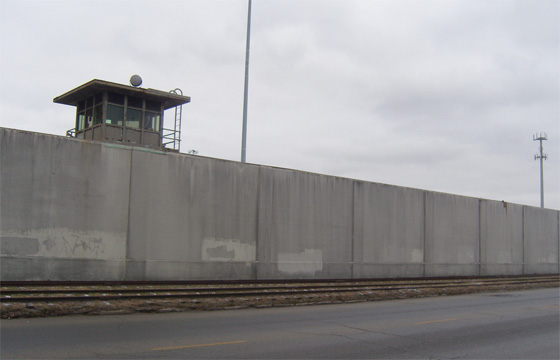
Sandstone as it looks today--much as it did nearly 40 years ago.  It is now a low security facility.


Note—This is the seventh installment in my memoir series about my experiences with the Draft and Justice System during the Vietnam War era. The first six previously appeared in The Third City blog and were re-posted here.  This is an entirely new post continuing the saga.
Early one morning the guard in the isolation booth that jutted into our unit at Cook County Jail called six names over the speaker with instructions to gather our belongings and bedding and report to the portal.  I was one of the names.  The others were also Federal prisoners, all of whom had come over from the Dirksen Federal Building in the same van weeks earlier.  Evidently Federal Marshalls were done shooting at Indians at Wounded Knee and once again available to transport prisoners.
I rolled my thin pillow, second jail jump suit, spare socks and underwear in my blanket.  A small paper bag accommodated my personal hygiene stuff, Bugler tobacco and rolling papers I bought at the Commissary,  a yellow legal tablet, Bic pen, envelopes, and stamps—all of my worldly goods at that point. 
One by one were we allowed to exit through the portal by the guard station where we were relieved of our bedding and jail clothing, patted down, and handcuffed.  We were once again led through the bewildering maze of hallways and locked gates, the din of the whole damn jail ringing in our ears, to a room off of the service garage.  There we deposited the clothing we were wearing and subjected to the thorough strip search known as the dance.  We were given back the civilian clothing we wore at the time we arrived at the jail.  Large manila envelopes containing the personal items taken from us at the time were handed to one of the two Marshalls in attendance.  Some paperwork was signed and we were the official property of the Feds.
We were again handcuffed with our wrists in front of us, hobbled by shackles around our ankles, and chained together around our waists.  We walked the short distance to an unmarked white van.  Each of us was seated and our waist chains were attached to clips on the floor.  Our leg shackles were removed.  We were told that the Marshalls would kindly allow us to remain handcuffed in front, but that it was a privilege which could be revoked if there was the slightest breech of decorum.  A long trip with our hands behind us would be excruciatingly uncomfortable. 
After we were all secure we rolled out of the dim cave of a garage into the first blinding sunlight I had seen in over a month. 
It would be almost 800 mile trip from Chicago to the Federal Correctional Facility at Sandstone, Minnesota, which was about 65 miles from Duluth.  It was about eight hours of driving time plus a couple of short meal breaks, and a potty stop or two.
I remember three of my traveling companions clearly, but not one of their names.  One was a Black man in his early fifties, snazzily dressed in a sharp burgundy three piece suit and topped with an impeccably barbered salt-and-pepper Afro.  He was friendly and a glib talker.  He was going up on some sort of securities fraud rap. 
The second guy was a small, meek looking guy named Ted with Greek last name and a balding head who had suddenly taken up sticking up banks in his middle age.  He had hit three or four before he was nabbed.  Luckily for him, he had only used notes and never showed a weapon.  Otherwise he would be headed to hard time at Leavenworth, Atlanta, or some other unpleasant destination.
The third one was the most pathetic of us all.  He was also middle aged, the pharmacist/proprietor of a small Chicago drug store.  He was accused by the IRS of co-mingling his personal and business income in the process committing some sort of tax evasion.  Since he essentially was the company, he didn’t understand what he did wrong.  It was a technical violation which ordinarily would have been settled by payment of back taxes plus interest and fines.  But the Feds had selected him, pretty much at random, to be an example with which to scare the hell out of other would-be offenders.  The poor, plump little man was bewildered and distraught, his entire life in ruins, his store lost, his family shamed, and his respectable ass on its way to prison.
We exchanged these tales of woe on the way up, interspersed with long periods of silence and boredom as the miles went by.   We ate when the van needed gas.  The Marshalls brought us food in a bag from whatever roadside diner or hamburger stand was near-by.  We were allowed to stretch our legs a little—as far as our fetters allowed.  We were allowed to go to the restroom one at a time with a Marshall standing guard at the door.  We were even un-handcuffed so we could un-zip ourselves hold our peckers to pee.  Another privilege, we were told.
In the gloaming we finally pulled up to the prison, which looked to us like a low, broad building, more like a high school from the outside than what I imagined the slammer would look like.
We were disgorged into a large brightly lit room.  The Assistant Warden and two or three guards were waiting for us.  They signed paper work for us from the Marshalls and took the envelopes of our personal possessions.  Then were put through the Dance again and told to put our clothes back on. Back in our clothes, the Warden “welcomed us” with the standard lecture which boiled down to “don’t give us any shit or we we’ll send you to Leavenworth.”  We were handed a pamphlet with prison rules, visitation info, and the like.
Then we were taken for our uniforms.  Cons behind a counter gave us each the once over and handed us two sets which might or might not fit.  Either way, they could give a rat’s ass.  If they didn’t fit you would trade later with other prisoners.  We were told to strip once again and put on one set.  Our clothes, were told would be sent home.  We never saw them again.  The uniform was just khakislong sleeved shirts and pants, an olive drab web belt with a plain brass buckle, white t-shirt and shorts, olive socks, and high top black boots.  Minus the insignia, we looked like 1950’s GIs.  We were also issued bedding—this time including sheets, pillow cases, and a more substantial blanket.
We were told to fall in for a march to our quarters.  We emerged from the intake facilities into a large open quad criss-crossed by several sidewalks surrounded by buildings—a row of two story tiers on my left, more housing units and other structures I couldn’t identify on my right, and larger buildings across the way including, I learned the mess hall, an auditorium, and various prison shops and facilities.  We were herded to the right, arriving at a unit nearest the administrative wing.
We entered into a large day room with card tables toward the rear and Naugahyde covered chairs and sofas mixed with fiberglass bucket chairs arrayed in front of a TV set on a cart.  This, we were told was the processing unit where we would be held a few day until receiving our regular billets and work assignments. 
Off to the left was our accommodations—an open barracks with steel-framed cots lining both wall with a footlocker along side.  We were told to pick an unmade bunk.  I got one along the inner wall where windows opened onto the Quad.  We quickly made our beds—I struggled with getting the flat sheet to fit the thin mattress.  We would have to learn quickly, we were told.  There would be daily inspections.
At the head of the room was a rack containing paper packages of Tops tobacco, little cotton sacks or Bull Durham, rolling papers, and books of matches.  These were free.  In those distant days the Feds figured smokes were a necessity and knew that we would not yet have our commissary accounts set up, or would never have any money in them.  Like I said a long time ago.
We had arrived too late for dinner.  I was hungry, but had to put up with it.  It would be the last time I was ever hungry in that joint.
I rolled and smoked a few in the day room, and puttered around my bunk.  Lights out was at ten o’clock.  We were first lined up by our beds for a roll call—of our numbers.  I almost failed to respond to mine as I barely recognized it.  We would be counted by our beds four times a day—before being marched to the mess hall for meals and at lights out.
I lay in the bunk eyes wide open unable to sleep.  Soon I was serenaded by snoring, quiet whispering, and the gentle moans of guys beating their meat.  I thought I heard the horn of a distant diesel locomotive.  Without expecting it, sleep overcame me.
Wake up was at six in the morning.  Prison was turning out to be a lot like the Army I was serving time for avoiding.  We showered, shaved, and shit quickly in the latrine which was off of the day room, got dressed, made our bunks, and waited for roll call and inspection. 
Units were marched off in some kind of shambling formation in rotation to the mess hall for breakfast.  As the rookies, our unit went last.  No matter.  They did not run out of food.  The mess hall was large and set up like a cafeteria.  Grabbing a tray I was astounded to be offered a selection—eggs fried, boiled, or scrambled; bacon and link sausage; biscuits and gravy; flap jacks with real butter and syrup; oatmeal and cold cereal; white and whole wheat toast.  There was fresh, good coffee with plenty of cream and sugar, little glasses of orange or apple juice, white or chocolate milk in cartons.
It turns out that in those days the Feds figured that well fed prisoners caused less trouble.  No food riots like regularly erupted in state joints where they tried to penny pinch on the grub and considered lousy food part of the sentence.  In fact, way back then the Federal prison system was considered far more humane in every detail that state penitentiaries of whatever level of security.  That is no longer the case.  During the tough-on-crime years of the Regan Administration, the whole philosophy of rehabilitating prisoners was tossed out in favor of rigorous punishment, super high security, and the longest sentences in the world.  Now days all but a handful of country club facilities for white collar criminals and former Congressmen are dreaded by all.
At any rate, the same largess was available for lunch and dinners.  Entrée selection at dinner might have been limited to just a couple, but they were well prepared with ample portions and a selection of deserts.  No wonder meal times were the highlights of our days.  While I was there I actually porked up.
Sandstone in those days was considered a medium security facility, but on the low end of that scale.  Tougher than the low security prison farms, but lacking the cell-blocks of harder joints.  Experienced cons assured me you could do time there “standing on your head.”
The first day I received a work assignment as the unit orderly.  The duties were not onerous—a couple of hours a day of collecting trash, sweeping and mopping, dusting, and cleaning the latrine.  The most onerous duty was once a week scouring the shower tile grout with a tooth brush to get out the mildew stain. 
During the first few days, as we were being processed, I was the only guy with a work assignment, meaning that I had to do my chores in between my physical exam; batteries of intelligence, personality, and aptitude tests, and a lengthy intake interview with the assistant warden.  I also filled out forms listing my preferences for assignment, although I was told that those were not a major consideration.
Inmates could be assigned to work around the prison from coveted light duty like administrative clerks, library, and dispensary workers, to the kitchen and mess hall, maintenance, and the dreaded laundry.  Trustees could be assigned grounds care and the large garden which took them outside the barbed-wire perimeter.  You could also be assigned to education and job training.  Finally, you could be assigned to Prison Industries working for a few cents an hour for either your commissary or going home money.  In those days Federal inmates were forbidden from producing anything for the market that might compete with free labor.  Items were produced for use by the Bureau of Prison, other Federal agencies, and the Armed Forces.  I can’t remember what the Sandstone shops produced back then.
Most guys got their assignments and were on their way out of the intake unit within about five days.   Not me.  Either I was the best damn orderly they ever had or they couldn’t figure out what to do with me. I stayed there for a month as cons came and went around me. 
That made it hard to make friends.  But there was one young guy from Kansas City who was up on some sort of charge concerning a radical bombing plot.  Given our ages and background we got close for a few days.  He told his story, I told mine.  We philosophized.  One night the conversation drifted toward snitches.  I told him self-righteously that I could never turn evidence against my friends and fellow workers.  He fell silent and withdrew.  I later realized that he was at Sandstone instead of drawing hard time in a high security joint, because he must have made a deal with the prosecutors. 
After my intake tests were completed, my duties as orderly gave me more free time than most.  I checked books out of the library—a thick biography of Napoleon and some science fiction novels come to mind.  I wrote letters, of course.  I was listed as a Prisoner of Conscience by Amnesty International and a lovely middle-aged woman from England adopted me and began correspondence.
Work assignments were generally over by 3 pm unless you were in food service.  We were free for two hours to use the exercise yard, a large area outside the walls surrounded by wire.  There was a soft ball diamond, a football field, cinder track, a weight lifting area, tennis and volleyball courts, basketball hoops, and even a little six-hole prisoner build mini-golf course.  I tried the putt-putt course a couple of times, but beings earnestly un-athletic by inclination spent my exercise time simply ambling around the cinder track and soaking up the Minnesota sunshine.   If it was raining, there was a well stocked gym, too.
So my days and weeks went until they finally figured out what to do with me.
Next—Sandstone Marking Time.


Thursday, August 21, 2014

Becoming an All-Expense Paid Guest of Uncle Sam—Cook County Jail


Note—The fifth installment in my on-going series of stories about my Draft Resistance during the Vietnam War, trial, and imprisonment.
Moments after I entered the Federal Building to report for incarceration on my Draft resistance conviction I was made rudely aware of the difference between being held for arraignment and being an official convict.  Gone was any semblance of politeness or acknowledgement of me as an individual.  The processing was brisk.  There was no reluctance to lay hands on me although I was totally compliant.  I was finger printed and mug shot once again.  But this time my new Bureau of Prisons identification number was attached.  I was told to memorize that number.  From that point forward that was how I would be known.  I would not be referred to or called in any official capacity by my name.  I must instantly answer to my number.
Some folks never forget that number.  I have trouble remembering my phone number and it took the better part of my first 50 years just to master my Social Security number by heart.  So I have long since forgotten the long string of digits.  But, believe me, I was keenly aware of them then.
I was also subjected to The Dance for the first time.  That’s the strip search procedure used every time a prisoner is moved from one secure area to another, between or inside institutions.  Anyone who has been inside the joint knows the drill.  Strip naked.  Raise your right arm over your head.  Raise your left arm over your head.  Run your fingers through your hair.  With feet apart raise you scrotum.  Turn around.  Place your hands on the wall. Raise you right foot and show the bottom of your foot. Raise your left foot and show the bottom of your foot.  Lean over, grab your butt cheeks and spread them.  Be prepared, at the discretion of the guard, to have your anus probed by a gloved hand.
After initial processing I was placed in a cell with three or four other men to await transfer to Cook County Jail where we were to be held until Federal Marshalls could transport us to our prison assignments.  It was a two or three hour wait.
When a vehicle and Marshalls were ready we were removed from the cell and shackled—hands together in front of us, at the ankles so no more than a shuffling movement could be made, chained around our waists and linked together.  Down in a cramped elevator to the basement garage a panel van awaited.  Unchained from each other, we took hard seats and chains from our waists were bolted to the floor.  We were instructed not to talk.  We didn’t.
The van disgorged us in the bowels of Cook County Jail, where uniformed County guards signed for us.  Frankly the next couple of hours were a blur.  I remember being lead through a maze of hallways, frequently stopping to pass locked gates.  The place had a loud, continuous din of noise—the banging of doors, buzzers, shouted orders, the hum and roar of fans and ventilation equipment, assorted yells and cries as we passed tiers of cells.
We were processed once again.  Again finger printed and photographed.  Stripped and searched.  We were issued Cook County uniforms, in those days two olive green jump suits, two sets of well used underwear, two pair of black socks, and thick soled black boots.
My little gaggle of Federal prisoners and I were still in a group, destined for the same tier.  I can no longer remember the tier designation.  It was on the 2nd or 3rd floor.  Cell blocks radiated out from a common core.  Inmate tiers were designated by direction and floor, 2W, 3N, etc.  Our particular destination was reserved for those on or awaiting serious felony charges, prisoners brought up from downstate institutions for appeals or to testify in court proceedings, and Federals like ourselves.  This, I was later told, was elite company far from the puking drunks, detoxing junkies, gang bangers and petty criminals being held for lack of bond or the poor saps who were serving out their sentences in jail.
We were injected, one by one, into the day room of the tier through a secure portal.  We each carried a rough wool blanket and a single sad pillow.  The portal was to one side of the glassed-in guard station which protruded into the day room.  Ordinarily guards did not enter the tier unless there was trouble or inmates were locked down. 
The day room itself was large and crowded.  Behind an open area were three or four rows of tables with attached benches.  Men sat at the tables playing cards or dominos, reading and talking.  Many sat or sprawled on the bare concrete staring at small black and white TV mounted high in one corner.  The rear of the day room opened up on a corridor lined on both sides with two-bunk cells.  The perimeter of the entire tier was surrounded by bars and a walk way.  One side of each cell was visible through the bars from that hall, which was lit 24 hours a day.  At the end of the hall was a large open latrine with rows of toilets, sinks and open showers.
Our arrival caused something of a stir.  We were greeted and peppered with questions.  I was easily the youngest man that I could see.  When they found out that I was up on a Draft rap there was a ripple of guffaws.  Turns out it was not a prestige crime.  I could hear some muffled jokes about fresh meat.  Not reassuring.
When the crowd thinned a bit, a Black guy in his mid-thirties approached me.  He was wearing the standard jump suit, but the collars were long, pendulous ending in a blunt arch more than half way down the chest.  He was, he informed me with no sense of braggadocio, the Boss of the tier.  It turned out ranking gang members could obtain special uniforms and various other goodies and favors.  He had a relationship with several of the guards—he kept order on the tier and he got certain, ahem, luxuries in return and for a modest price.  He told me he would look out after me and to let him know if I had problems with any of the cons.  I appreciated the help, but had the suspicion that he would want something from me, sooner or later.
I was informed that because of overcrowding that there were no available bunks in the cells.  I would have to sleep on the floor of the day room.  Since I thought I would only be there a day or two, I thought nothing of it and stashed my bed roll off to one side.  I found an empty spot on a table bench and settled it to staring blankly at whatever was on the TV.
I had missed lunch and had no stomach for breakfast.  Despite my stomach continuing to do nervous flips, I was getting hungry.   
Around 5 o’clock dinner arrived.  Metal pans and cups were handed out.  The pan was filled with a large ladle-full of some kind of bean slop.  There were a couple of slices of dry white bread evidently baked from sawdust.  A foul black concoction alleged to be coffee or a small carton of milk were our choice of beverages.
I stared into the bowl.  It appeared that some sort of red worms were swimming among the beans.  “Them’s pig tails!” I was informed.  Turned out that pig tails and beans were the most common dinner, alternating with Ox tails and beans and on rare occasions a slab of gristly meat deep fried and advertised as chicken fried steak.  There was no salt.  The beans smelled and tasted like crap.  I passed that first night.
But hunger eventually gets to you and after a few days I was wolfing the stuff down, spitting out the bones with the best of them. 
Breakfast was a glop of powdered eggs or an oatmeal gruel with the saw dust bread pre-toasted but cold.  Lunch, unvaryingly was the same plain bologna on dry white bread famously handed out in police station lock-ups.  Those who had money in the commissary could supplement their diet with chips, candy bars, and brownies.
The diet and the tension ganged up on me.  Usually as regular as a twice a day milk train, I couldn’t produce a crap for a week, which I assure you made me very uncomfortable.
A week you say, wasn’t I supposed to be on my way to the big house before that?  I began to wonder the same thing until one of the other Federal prisoners got word from his lawyer that we were stuck in Cook County Jail because all of the Federal Marshalls needed to move us had been sent to Wounded Knee to shoot Indians.  American Indian Movement leaders including Dennis Banks and Russell Means were holed up in a standoff with authorities in the village of Wounded Knee on the Pine Ridge Reservation in South Dakota.  As long as both sides continued taking pot shots at each other, I was stuck in Cook County.
The days stretched into weeks.  I continued to sleep, fitfully on the floor usually under a table to provide some shield from the 24 hour a day light in the day room.
Because I was assumed to be headed rapidly to the prison in Sandstone, Minnesota, my friends lost track of me and my commissary money provided to me as a class war prisoner by the IWW General Defense Committee was sent up there.  Without any money on deposit at Cook County, I could not access the commissary for smokes, or any of the little luxuries including writing implements, paper, envelopes, stamps, toiletries, smokes, or snacks.  The lack of cigarettes made me a double beggar because cigarettes packs were the currency between cons.
After a few days I got word to the fellow workers and received my first visit.  We spoke through a thick window.  It was good to see them.  And good to have them put some money in my commissary, which I rapidly spent on Pall Malls, writing equipment, and magazines to pass the time.  About a week later my girlfriend Cecelia took an afternoon off work to come. Our meeting was awkward.  Neither of us knew what to say.  I never saw anyone else in my time there, although my commissary account got refreshed.
Every morning we were all wakened.  We had half an hour to piss, shower and shave.  I had been warned about the showers and tried to avoid them by washing in the basin, but was told by guards that I must shower at least twice a week.  I tried to keep my butt to the wall and never, ever, bend over.
To shave we were allowed the use of the then new disposable razor.  Used to the metal heft of a Gillette Safety Razor, it felt weightless in my hand.  The blades were bad and maneuvering it over the unfamiliar territory of my chin, which had been adorned for years with a goatee, meant that I was bleeding for breakfast most mornings.
I passed the time in the day room mostly watching daytime television.  A punishment then as now.  Since I didn’t gamble, the card and domino games were out.  After I finally got some commissary money, I had something to read and I began writing the epic letters that prisoners with a lot of time on their hands are known for.  And not just to friends.
One day I caught Helen Reddy on some morning show.  She sang a couple of songs.  I was impressed and wrote her a heartfelt four page handwritten fan letter, something I had never done in my life.  I forgot that my hen scratch printing was virtually illegible and that my unassisted spelling made me seem to be at best semi-literate.  I never heard back from Helen.  But later I realized that fan mail from jail tends to give stars the creeps.
One day the tier was surprised by the delivery of several cartons of brand new Penthouse magazines—enough for everyone.  Let me tell you the guys were excited.  You could buy girlie mags in the commissary, but most didn’t have enough in their accounts to buy them.  The magazines came courtesy of the tier’s most famous resident.
Silas Jayne was always described in the press as a horseman.  He ran an upscale riding stable and a business peddling broken down nags as expensive show horses to the teen age daughters of wealthy men.  He also had a habit of seducing and/or assaulting those same girls and blackmailing their fathers.  Some of the girls had turned up missing.  He also had a long running feud with his brother George who was in the same business.  There had been fatalities on both sides.  But Silas, who made pals of cops, escaped arrest, even after he was suspected of the sniper killing of an Indiana cop investigating the disappearance of three girls.  What finally got him arrested was the similar shooting of his brother George.  He was in Cook County awaiting trial.
For all of his tough guy swagger, Silas was deathly afraid of the other inmates, especially the Black ones.  He paid our tier Boss plenty for protection.  But he never left the safety of his cell.  A little rat faced toady who was his cell mate would bring him his food.  This was in violation of the jail rules, but the guards were also well paid to ignore it.  I only glimpsed Jayne through the bars of his cell on my way to the latrine and showers. 
Jayne’s hot shot lawyer was somehow also involved with Penthouse’s Bob Guccione.  Thus the gifts.
Jayne was later acquitted of the murder.  He was arrested again for the barn arson of a rival that killed dozens of horses but died before that case came to trial.  Years later he was tied to the disappearance of candy heiress Helen Brock who apparently was going to the authorities with evidence of some of his horse frauds
We had a couple of other murderers who had made headlines, but no one matched Jayne for star power. 
About three weeks in, the tier Boss invited me to visit his cell.  Not for the first time.  But this time he had something to offer I could hardly refuse—hooch.  That’s a sort of home brew alcohol.  This batch was made up by his friends in the kitchen, made from fermented fruit pulp, honey and a little yeast.  Closer to mead than wine or beer.  It stunk and tasted, well, like you would expect.  The Boss had a couple of quarts of the stuff in milk jugs smuggled to him by obliging guards. 
It was mid-afternoon and the cells were mostly empty.  We shared a few swigs of hooch.  He offered me some downers, but I never did like pills.  He said if I wanted, he could even get some grass.  I couldn’t imagine how that would work with the smell wafting everywhere.  But the Boss had everyone in his hip pocket, so I supposed nothing was impossible.  As we grew mellower, he began to come on to me.  I was expecting that.  I kept a close eye on the open cell door.  He explained how he could protect me, even in the Federal joint.  He had friends everywhere.  He extolled the virtues of becoming his bitch.
I thanked him but declined.  “I just can’t do it,” I told him.  “No, I didn’t think you would, but it was worth the pitch.”  We shared another swig or two and he let me go without laying a hand on me.  He never invited me back, but he did make clear later in the day room where tongues were wagging that I was a “stand up dude, so lay the fuck off.”  And they did.
The Wounded Knee siege was finally broken on May 5, 1973.  The Federal inmates got word that Marshalls would again be available to transport us in a couple of more days.  I was still sleeping on the floor under a table.  I had been in Cook County for just over a month.
Next:  Sandstone.