I quickly recovered from my
usual depression at being passed over yet again for selection as the new Poet Laureate of the United States. But first I had to find out just who this
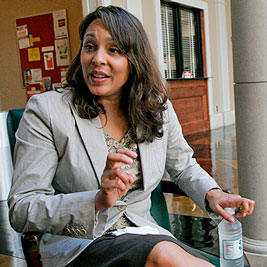
Natasha Trethewey is and why her
poetry matters.
First off, I was embarrassed
to realize that she had won the Pulitzer
Prize for Poetry in 2007 without
me noticing. And that at the young age
of 46 this Gulfport, Louisiana born
poet has publish three widely hailed volumes of poetry described as “exploring
the intersections of memory and history” using both traditional and free verse forms.
Trethewey is the first Southerner to receive the honor since Robert Penn Warren was named the first
Poet Laureate by the Library of Congress
back in 1987. She is the first African-American since Rita Dove in 1993 and only the fifth
woman out of 27 honorees.
I have to hand it to
the Library of Congress selection committee; they have tried hard in recent
years to break out of the strict academic ghetto and the stuffy confines of the
Eastern literary elite. Over the last
ten years Laureates have included Billy
Collins whose work is often funny, accessible, and worst of all from the
perspective of certain poetry snobs, popular; Ted Kooser the insurance executive and Unitarian
Universalist from Nebraska whose work reflected life on the Great
Plains; and Philip Levine, the former factory worker who chronicled
the lives of autoworkers, the inheritors of the Jewish immigrant identity, and
latter California farm laborers.
Like these poets Trethewey’s life experience informs her work. She was born the daughter of a Black mother
and a White father when such marriages were illegal in Mississippi. She notes that on her birth certificate her
father’s race was listed as Canadian, perhaps as a way to skirt the law.
Coming to grips with her mother’s murder by an estranged second husband
when she was a 19 year old college student, has motivated and informed her
work.
So has coming to grips with the complicated racial history of the South
in innovative ways.
Her first volume of poetry, Domestic Work
published in 2000 dealt with the forgotten and neglected of history--black
maids, washerwomen, factory workers. Her
second book Bellocq’s Ophelia has been described as a sort of epistolary
novella in verse based on a character imagined by a photograph of mixed-race
prostitutes in New Orleans at the
turn of the 20th Century.
Her third book excited
the attention of the Pulitzer committee and led ultimately to her selection as Poet Laureate of Mississippi. Native Guard dealt with a regiment of
freed slaves, the Louisiana Native
Guards who were assigned to guard Confederate
prisoners of war.
Beyond Katrina: A
Meditation on the Mississippi Gulf Coast is a non-fiction
work in which she delves deep into her own experience as well as the disaster
and includes passages of poetry.
Trethewey is currently Professor of Creative Writing at Emory
University in Atlanta. Her
new collection of poetry, Thrall,
will be published this fall just about coinciding with her assuming her duties
at the Library of Congress.
Letter Home
—New Orleans, November 1910
Four weeks have passed since I left, and still
I must write to you of no work. I've worn down
the soles and walked through the tightness
of my new shoes calling upon the merchants,
their offices bustling. All the while I kept thinking
my plain English and good writing would secure
for me some modest position Though I dress each day
in my best, hands covered with the lace gloves
you crocheted--no one needs a girl. How flat
the word sounds, and heavy. My purse thins.
I spend foolishly to make an appearance of quiet
industry, to mask the desperation that tightens
my throat. I sit watching--
though I pretend not to notice--the dark maids
ambling by with their white charges. Do I deceive
anyone? Were they to see my hands, brown
as your dear face, they'd know I'm not quite
what I pretend to be. I walk these streets
a white woman, or so I think, until I catch the eyes
of some stranger upon me, and I must lower mine,
Letter Home
a negress again. There are enough things here
to remind me who I am. Mules lumbering through
the crowded streets send me into reverie, their footfall
the sound of a pointer and chalk hitting the blackboard
at school, only louder. Then there are women, clicking
their tongues in conversation, carrying their loads
on their heads. Their husky voices, the wash pots
and irons of the laundresses call to me.
I thought not to do the work I once did, back bending
and domestic; my schooling a gift--even those half days
at picking time, listening to Miss J--. How
I'd come to know words, the recitations I practiced
to sound like her, lilting, my sentences curling up
or trailing off at the ends. I read my books until
I nearly broke their spines, and in the cotton field,
I repeated whole sections I'd learned by heart,
spelling each word in my head to make a picture
I could see, as well as a weight I could feel
in my mouth. So now, even as I write this
and think of you at home, Goodbye
is the waving map of your palm, is
a stone on my tongue.
—Natasha Trethewey
From Bellocq’s Ophelia, Graywolf Press, Saint Paul, Minnesota.