Showing posts with label Gulf Coast. Show all posts

Sunday, August 29, 2021

New Orleans Déjà vu—An Anniversary Replay


Hurricane Ida is gathering strength as it barrels north in the Gulf of Mexico and will slam into the Louisiana coast as a strong category 4 storm about 1 pm this afternoon.  Passing west of New Orleans the worst of winds of more than 150 mile per hour and an expected storm surge of up to 17 feet at the mouth of the Mississippi and 8 feet upriver at Lake Pontchartrain are expected to be catastrophic.  It is exactly 16 years since Hurricane Katrina wrecked its devastation.

Hopefully the Big Easy and other vulnerable Gulf communities will be better prepared this time around.  Lessons of that big storm, reinforced by three storms that slammed the same area last year.  Sea walls and levees have been reinforced and raised.  Residents are more apt to positively respond to calls for early evacuations and plans for those evacuations are said to be better.  New Orleans and other areas have lost as much as a quarter of their pre-Katrina populations somewhat easing the pressure.  City and State resources have been pumped up.  And perhaps most critically the Federal response by the Federal Emergency Management Agency (FEMA) will be in the hands of competent and experience professionals fully backed by President Joe Biden who unlike George W. Bush actually believes that government can function.

Even before Hurricane Ida makes landfall in Louisiana power crews are at work trying to restore service in some areas.

On the other hand, Louisiana is already in the grips of one of the worst Coronavirus Delta variant outbreaks in the country.  Its hospitals are already overwhelmed.  Masking, social distancing, and sanitation protocols, only tepidly supported by the Republican governor and legislature will be impossible to maintain especially in crowded shelters and on evacuation busses.   Vaccination rates are low.  A sharp spike in new infections is likely just as hospitals are least able to deal with critical cases.

There is still political and social tension between the Democratic city government and the Republican controlled state that can easily scuttle cooperation and lead to new rounds of blame shifting and finger pointing when things go wrong.

Systematic racism is the political and cultural order of the day along the Gulf Coast.  Poor Black residents may still be denied equal access to emergency aid and be blocked from evacuation through or to wealthy white enclaves.

We can hope for the best but must be ready for the worst.

A look back at Katrina reminds us of an enduring rage and sorrow.

A Black mother and her children desperately sought refuge from flooding after Hurricane Katrina in 2005.

On August 29, 2005 Hurricane Katrina slammed into the Gulf Coast with the eye just east of New Orleans.  Winds had diminished and the storm had been downgraded from a Category 4 to a Category 3 and there was some hope that the city and surrounding Parishes might be spared the destruction predicted earlier in the week.  Although wind damage was severe, a lot of folks breathed deeply after the brunt of the storm moved past.

But the storm surge sent as much as 15 feet of water inland flooding the low lying coast from the Texas border to nearly Pensacola.  It pushed up the Mississippi and into Lake Pontchartrain.  Within a few hours the levy system protecting the city broke in several places and water inundated most of the city.  Especially hard hit were the low lying neighborhoods along the canals and directly under the levies, including the largely Black and impoverished 8th and 9th Wards.  By 11 p.m. Mayor Ray Nagin described the loss of life as significant with reports of bodies floating on the water throughout the city.

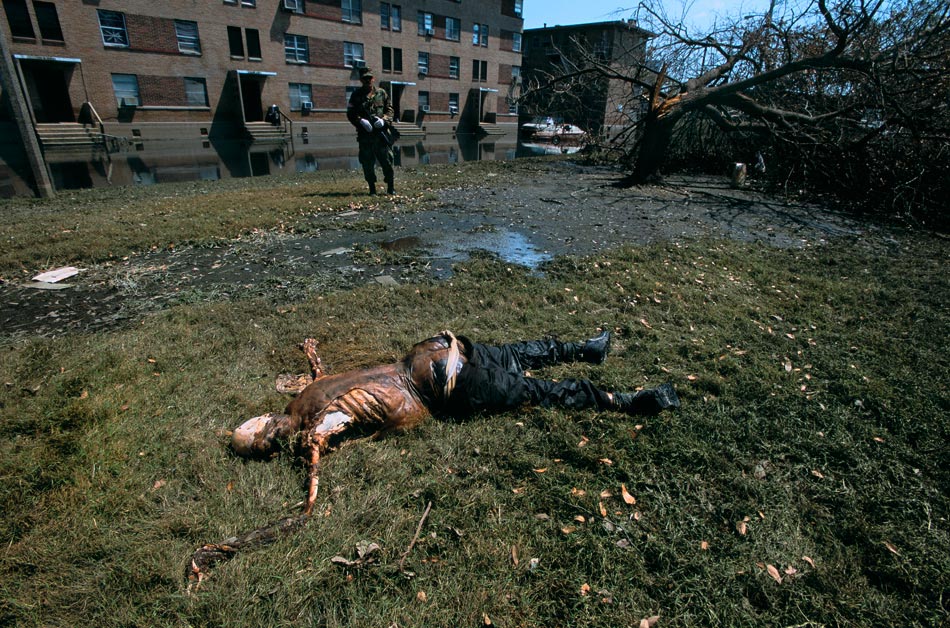
An enduring symbol of the criminal negligence in rescuing poor Black residents after Katrina--the body of a drowning victim rotting in the sun days later.

As horrible as the situation was, it was only the beginning.  Evacuation orders had encouraged many of those with vehicles to flee north.  But the highways were soon clogged and those late to leave were trapped.  No plans had been made for the hundreds of thousands of city residents without transportation, or the aged and ill.  The poor were essentially trapped in the city.  And as they drowned talking heads on television scolded them for not heeding the evacuation orders.

The story of the immediate misery of the next few days has been told and retold and is far too vast to be recounted here.  Suffice it to say the disaster unmasked incompetence at every level of government compounded by a blasé racism eager to blame the victims.  The response by the Federal Emergency Management Agency (FEMA), headed by political toadies and lickspittles, became a national scandal.  But it was the inevitable result of George W. Bush’s administration which had as its highest goal to prove that government is inherently incapable of managing things efficiently.

The disaster created a diaspora.  Eighty percent of the New Orleans population fled.  Five years later less than half had returned.  And much of the city, particularly the Black Wards away from the restored tourist areas, remained a waste land.

The Black and poor Lower 9th Ward of New Orleans months after the storm.  Amazingly little has been restored to this day.

The youth group of my church, then known as the Unitarian Universalist Congregation of Woodstock, spent a week there in July 2010, nearly five years after the storm, doing service projects.  They brought back video and photographic evidence of the distressing situation.  There will be work rebuilding and restoring homes in those districts for hundreds of youth groups for years to come.

When historians look back on the disaster and its long aftermath years from now, they may well conclude that this was the moment when the traditional cocky confidence of American exceptionalism bit the dust and the Empire began it precipitous decline.


Monday, August 28, 2017

Making Disasters Worse—Gulf Hurricane Redux

Hurricane Harvey damage on Saturday in Galveston, Texas, a city that knows about Big Blows.


Two days short of the 12th anniversary of Hurricane Katrina slamming into New Orleans and other Gulf Coast Communities another catastrophic storm has his the Texas coast.  Hurricane Harvey came ashore near Corpus Christy as category 4 storm with 130 mile per hour winds and a dangerous storm surge.  Two days later it has been downgraded to a Tropical Storm but is stalled over the region and continues to dump torrential rains over a wide area.  Up to three feet of rain is expected before it finally dissipates toward the end of the week.
No one really knows the extent of the damage but tens of thousands have been displaced and many are still stranded and in imminent danger.  Few cities effectively evacuated despite pleas by officials for residents to relocate.  Few options were available for those without cars, roads were jammed, and many are now flooded or cut off.

Flooding in Houston this morning.
This hammers one of the most populous regions in the South including the city of Houston the fifth largest city in the U.S. which is now mostly flooded with water continuing to rise. 
A lot of this seems like a replay of the chaos following Katrina and other recent Texas hurricane disasters despite days of notice that the storm was coming.
Hopefully the outcome will be better than after Katrina, but don’t bet on it.  Texas has somethings going for itmore and richer Whites who vote reliably Republican.  The large and poor Black population New Orleans made the depopulation of the city a political bonanza for the Republican Party.  The city and poorer suburbs lost so many residents that Louisiana went from being the last Deep South state that trended Democratic to another bright red blotch on the map.
Ironically, Houston is the home of the largest concentration of the New Orleans Diaspora in the nation.  Many are still struggling financially and have never recovered from the losses of homes they owned, vehicles, possessions, tools, and livelihoods.  Although reports today from Houston say that residents of every income level are still trapped in flooded homes and apartments, the poor, as always, will endure more lasting personal devastation.
It is worth noting that both United States Senators from Texas, Assistant Republican Leader John Cornyn, and borderline psychotic Tea Party and Religious Right darling Ted Cruz, were proud to vote against disaster relief for victims of Hurricane Sandy in New York and New Jersey apparently because too many of them were Black, Latino, emigrants, Jews, and, of course, Democrats.  It was the fiscally responsible thing to do they told anyone who would listen.  They now have both announced support for major funding for post-Harvey reconstruction.  Fortunately for the people of Texas, Senate Democrats are unlikely to play tit-for-tat.
Speaking of reconstruction—that promises to be severely hampered by a construction labor shortage created by Trumps anti-immigrant crusade.  Mexican and other Latin American immigrants have made up a huge percentage of both skilled workers, especially carpenters and masons, and laborers in recent years.  Many have already fled the region for fear of immigration raids on job sites.  Wide-spread labor shortages were reported before the disaster and there is likely no way there will be enough workers for all of the clean-up, repair, and reconstruction ahead.  Just in case there is any doubt, Immigration authorities have assured the public that they will “continue to vigorously enforce the law” even through the present emergency.  Even evacuees will be subject to arrest, detention, and deportation.
Good luck Texas.
Days later this abandoned Hurricane Katrina victim was found.  Not only was he dead, but the media blamed him for it.
In the meantime here is a look back at Katrina and its aftermath from a 10th anniversary post two years ago.
Some anniversaries are just too painful.  This is one of them.  On August 29, 2005 Hurricane Katrina slammed into the Gulf Coast with the eye just east of New Orleans.  Winds had diminished and the storm had been downgraded from a Category 4 to a Category 3 and there was some hope that the city and surrounding Parishes might be spared the destruction predicted earlier in the week.  Although wind damage was severe, a lot of folks breathed deeply after the brunt of the storm moved passed.
But the storm surge sent as much as 15 feet of water inland flooding the low lying coast from the Texas border to nearly Pensacola.  It pushed up the Mississippi and into Lake Pontchartrain.  Within a few hours the levy system protecting the city broke in several places and water inundated most of the city.  Especially hard hit were the low lying neighborhoods along the canals and directly under the levies, including the largely Black and impoverished 8th and 9th Wards.  By 11 p.m. Mayor Ray Nagin described the loss of life as significant with reports of bodies floating on the water throughout the city.
As horrible as the situation was, it was only the beginning.  Evacuation orders had encouraged many of those with vehicles to flee north.  But the highways were soon clogged and those late to leave were trapped.  No plans had been made for the hundreds of thousands of city residents without transportation, or the aged and ill.  The poor were essentially trapped in the city.  And as they drowned talking heads on television scolded them for not heeding the evacuation orders. 
The story of the immediate misery of the next few days has been told and retold, and is far too vast to be recounted here.  Suffice it to say the disaster unmasked incompetence at every level of government compounded by a blasé racism eager to blame the victims.  The response by the Federal Emergency Management Agency (FEMA), headed by political toadies and lickspittles, became a national scandal.  But it was the inevitable result of George W. Bush’s administration which had as its highest goal to prove that government is inherently incapable of managing things efficiently. 
The disaster created a diaspora.  Eighty percent of the New Orleans population fled.  Five years later less than half had returned.  And much of the city, particularly the Black Wards away from the restored tourist areas, remains a waste land.
The Black and poor Lower 9th Ward of New Orleans months after the storm.  Amazingly little has been restored to this day.
The youth group of my church, then known as the Unitarian Universalist Congregation of Woodstock spent a week there in July 2010, nearly five years after the storm, doing service projects.  They brought back video and photographic evidence of the distressing situation.  There will be work rebuilding and restoring homes in those districts for hundreds of youth groups for years to come.
When historians look back on the disaster and its long aftermath years from now, they may well conclude that this was the moment when the traditional cocky confidence of American exceptionalism bit the dust and the Empire began it precipitous decline.

Thursday, August 29, 2013

Sadly, Angrily Remembering Hurricane Katrina

Just another "recalcitrant defier of evacuation orders" according to Fox News.


Some anniversaries are just too painful.  This is one of them.  On August 29, 2005 Hurricane Katrina slammed into the Gulf Coast with the eye just east of New Orleans.  Winds had diminished and the storm had been downgraded from a Category 4 to a Category 3 and there was some hope that the city and surrounding Parishes might be spared the destruction predicted earlier in the week.  Although wind damage was severe, a lot of folks breathed deeply after the brunt of the storm moved passed.
But the storm surge sent as much as 15 feet of water inland flooding the low lying coast from the Texas border to nearly Pensacola.  It pushed up the Mississippi and into Lake Pontchartrain.  Within a few hours the levy system protecting the city broke in several places and water inundated most of the city.  Especially hard hit were the low lying neighborhoods along the canals and directly under the levies, including the largely Black and impoverished 8th and 9th Wards.  By 11 p.m. Mayor Ray Nagin described the loss of life as significant with reports of bodies floating on the water throughout the city.
As horrible as the situation was, it was only the beginning.  Evacuation orders had encouraged many of those with vehicles to flee north.  But the highways were soon clogged and those late to leave were trapped.  No plans had been made for the hundreds of thousands of city residents without transportation, or the aged and ill.  The poor were essentially trapped in the city.  And as they drowned talking heads on television scolded them for not heeding the evacuation orders. 
The story of the immediate misery of the next few days has been told and retold, and is far too vast to be recounted here.  Suffice it to say the disaster unmasked incompetence at every level of government compounded by a blasé racism eager to blame the victims.  The response by the Federal Emergency Management Agency (FEMA), headed by political toadies and lickspittles, became a national scandal.  But it was the inevitable result of George W. Bush’s administration which had as its highest goal to prove that government is inherently incapable of managing things efficiently. 
The disaster created a diaspora.  Eighty percent of the New Orleans population fled.  Five years later less than half returned.  And much of the city, particularly the Black Wards away from the restored tourist areas, remains a waste land.
The youth group of my church, then known as the Unitarian Universalist Congregation of Woodstock spent a week there in July 2010, nearly five years after the storm, doing service projects.  They brought back video and photographic evidence of the distressing situation.  There will be work rebuilding and restoring homes in those districts for hundreds of youth groups for years to come.
When historians look back on the disaster and its long aftermath years from now, they may well conclude that this was the moment when the traditional cocky confidence of American exceptionalism bit the dust and the Empire began it precipitous decline.

Friday, June 8, 2012

The New Poet Laureate—Since it Ain’t Me, I’m Glad it’s Her


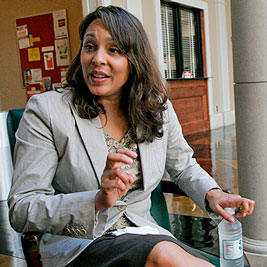
I quickly recovered from my usual depression at being passed over yet again for selection as the new Poet Laureate of the United States.  But first I had to find out just who this Natasha Trethewey is and why her poetry matters. 

First off, I was embarrassed to realize that she had won the Pulitzer Prize for Poetry in 2007 without me noticing.  And that at the young age of 46 this Gulfport, Louisiana born poet has publish three widely hailed volumes of poetry described as “exploring the intersections of memory and history” using both traditional and free verse forms.

Trethewey is the first Southerner to receive the honor since Robert Penn Warren was named the first Poet Laureate by the Library of Congress back in 1987.  She is the first African-American since Rita Dove in 1993 and only the fifth woman out of 27 honorees.

I have to hand it to the Library of Congress selection committee; they have tried hard in recent years to break out of the strict academic ghetto and the stuffy confines of the Eastern literary elite.  Over the last ten years Laureates have included Billy Collins whose work is often funny, accessible, and worst of all from the perspective of certain poetry snobs, popular; Ted Kooser the insurance executive and Unitarian Universalist from Nebraska whose work reflected life on the Great Plains; and Philip Levine, the former factory worker who chronicled the lives of autoworkers, the inheritors of the Jewish immigrant identity, and latter California farm laborers.

Like these poets Trethewey’s life experience informs her work.  She was born the daughter of a Black mother and a White father when such marriages were illegal in Mississippi.  She notes that on her birth certificate her father’s race was listed as Canadian, perhaps as a way to skirt the law.

Coming to grips with her mother’s murder by an estranged second husband when she was a 19 year old college student, has motivated and informed her work.

So has coming to grips with the complicated racial history of the South in innovative ways.

Her first volume of poetry, Domestic Work published in 2000 dealt with the forgotten and neglected of history--black maids, washerwomen, factory workers.  Her second book Bellocq’s Ophelia has been described as a sort of epistolary novella in verse based on a character imagined by a photograph of mixed-race prostitutes in New Orleans at the turn of the 20th Century.

Her third book excited the attention of the Pulitzer committee and led ultimately to her selection as Poet Laureate of MississippiNative Guard dealt with a regiment of freed slaves, the Louisiana Native Guards who were assigned to guard Confederate prisoners of war.

Beyond Katrina: A Meditation on the Mississippi Gulf Coast is a non-fiction work in which she delves deep into her own experience as well as the disaster and includes passages of poetry.

Trethewey is currently Professor of Creative Writing at Emory University in Atlanta.  Her new collection of poetry, Thrall, will be published this fall just about coinciding with her assuming her duties at the Library of Congress.

Letter Home

—New Orleans, November 1910

Four weeks have passed since I left, and still
I must write to you of no work. I've worn down
the soles and walked through the tightness
of my new shoes calling upon the merchants,
their offices bustling. All the while I kept thinking
my plain English and good writing would secure
for me some modest position Though I dress each day
in my best, hands covered with the lace gloves
you crocheted--no one needs a girl. How flat
the word sounds, and heavy. My purse thins.
I spend foolishly to make an appearance of quiet
industry, to mask the desperation that tightens
my throat. I sit watching--

though I pretend not to notice--the dark maids
ambling by with their white charges. Do I deceive
anyone? Were they to see my hands, brown
as your dear face, they'd know I'm not quite
what I pretend to be. I walk these streets
a white woman, or so I think, until I catch the eyes
of some stranger upon me, and I must lower mine,
Letter Home
a negress again. There are enough things here
to remind me who I am. Mules lumbering through
the crowded streets send me into reverie, their footfall
the sound of a pointer and chalk hitting the blackboard
at school, only louder. Then there are women, clicking
their tongues in conversation, carrying their loads
on their heads. Their husky voices, the wash pots
and irons of the laundresses call to me.

I thought not to do the work I once did, back bending
and domestic; my schooling a gift--even those half days
at picking time, listening to Miss J--. How
I'd come to know words, the recitations I practiced
to sound like her, lilting, my sentences curling up
or trailing off at the ends. I read my books until
I nearly broke their spines, and in the cotton field,
I repeated whole sections I'd learned by heart,
spelling each word in my head to make a picture
I could see, as well as a weight I could feel
in my mouth. So now, even as I write this
and think of you at home, Goodbye

is the waving map of your palm, is
a stone on my tongue.

—Natasha Trethewey

From Bellocq’s Ophelia, Graywolf Press, Saint Paul, Minnesota.