Ray Conniff's 1953 recording of The Twelve Days of Christmas made the song an American holiday staple
The Twelve Days of Christmas is an English carol—a classic example of a cumulative song, the lyrics detail a series of increasingly numerous gifts given on each of the Twelve Days of Christmas—the days that make up the Christmas season, starting with Christmas Day to the day before Epiphany (January 5). Twelfth Night is defined by theOxford English Dictionaryas“the evening of January 5th, the day before Epiphany, which traditionally marks the end of Christmas celebrations.”
The cover of Thomas Bewick's 18th Century Mirth Without Mischief which published the version of an old English carol with its now common lyrics.
The best-known English version was first printed in Mirth Without Mischief, a children’s book published in London around 1780. The work was heavily illustratedwith woodcuts, attributed to Thomas Bewick.The carol has a Roud Folk Song Index number of 68. Manymelodieshave been associated with the song, of which the best known is derived from a 1909 arrangement of a traditional folk melody by English composer Frederic Austin.
In 1909 English composer Fredric Austin married the lyrics to an old folk melody and the song as now commonly sung was complete.
In America, the song took off in popularity when Bing Crosby and the Andrews Sisters recordedit in 1949. The Ray Conniff Singers made what many consider to be the definitive versionfor the 1953 LPWe Wish You a Merry Christmas. As a novelty songit became a staple of many of the television holiday specialssince the 1950s and was introduced to children on Sesame Street. It is also frequentlyparodied.
The Twelve Days of Christmas performed by Pentatonix.
Note—As we close in on the end of our Winter Holidays Music Festival we will spend two days on the close of the Twelve Days of Christmas as observed in British tradition and the Anglican liturgic calendar on January 5. The next day, the Feast of the Epiphany or Day of the Three Kings will wrap things up.
The Twelve Days of Christmas is an English carol—a classic example of a cumulative song, the lyrics detail a series of increasingly numerous gifts given on each of the twelve days of Christmas—the days that make up the Christmas season, starting with Christmas Day to the day before Epiphany. Twelfth Night is defined by the Oxford English Dictionary as “the evening of January 5th, the day before Epiphany, which traditionally marks the end of Christmas celebrations.”
The cover of Thomas Bewick's 18th Century Mirth Without Mischief which published the version of an old English carol with its now common lyrics.
The best known English version was first printed in Mirth Without Mischief, a children’s bookpublished in London around 1780. The work was heavily illustrated with woodcuts, attributed to Thomas Bewick. The carol has a Roud Folk Song Index number of 68. A large number of different melodies have been associated with the song, of which the best known is derived from a 1909 arrangement of a traditional folk melody by English composer Frederic Austin.
In 1909 English composer Fredric Austin married the lyrics to an old folk melody and the song as now commonly sung was complete.
In America the song took off in popularity when Bing Crosby and the Andrews Sisters recorded it in 1949. The Ray Conniff Singers made what many consider to be the definitive version for the 1953 LPWe Wish You a Merry Christmas. As a novelty song it became a staple of many of the television holiday specials since the 1950s and was introduced to children on Sesame Street. It is also frequently parodied.
The a capella group Pentatonix is particularly well known for their annual Christmas shows and frequent appearances on televised seasonal specials.
Today we share the version by the a capella quintet Pentatonix.
Ray Conniff's 1953 recording of The Twelve Days of Christmas made the song an American holiday staple.
The Twelve Days of Christmas is an English carol—a classic example of a cumulative song, the lyrics detail a series of increasingly
numerous gifts given on each of the twelve
days of Christmas—the days that make up the Christmas season,
starting with Christmas Day to the day before Epiphany (5 January). Twelfth Night is defined by theOxford English
Dictionary as “the evening of January 5th, the day before
Epiphany, which traditionally marks the end of Christmas celebrations.’
The cover of Thomas Bewick's 18th Century Mirth Without Mischief which published the version of an old English carol with its now common lyrics.
The best known English version was first printed in Mirth
Without Mischief, a children’s book published in London around 1780. The work was heavily illustrated
with woodcuts, attributed to Thomas Bewick.The carol has a Roud Folk Song Index number
of 68. A large number of different melodies have been associated with the song, of which the best known is derived
from a 1909 arrangement of a traditional folk melody by English composer Frederic Austin.
In 1909 English composer Fredric Austin married the lyrics to an old folk melody and the song as now commonly sung was complete.
In America the song took off in popularity when Bing Crosby and the Andrews Sisters recorded it in 1949.The Ray Conniff Singers made what
many consider to be the definitive version
for the 1953 LP We
Wish You a Merry Christmas.As a novelty
song it became a staple
of many of the television
holiday specials since the 1950s and was introduced to children on Sesame Street.It is also frequently parodied.
Today
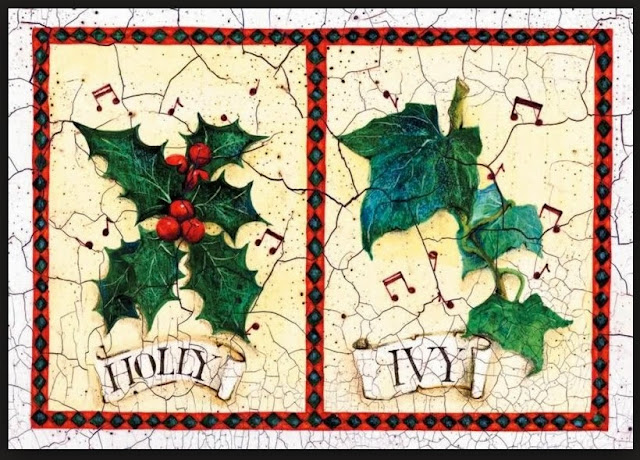
we feature one of the oldest English carols, The Holly and the Ivy.Its origins are shrouded
in the mist of time.Pagan
greenery was anointed with Christian symbolism.
The most
familiar melody of several that have
been set to the is very old and resembles the songs of the Tudor era 1485–1602 which is why it is
a favorite of Madrigal Singers.
The
earliest surviving mention of the song in print occurred in the
early 19th Century when collecting folk music became fashionable. The earliest recorded version of the lyrics was in a broadside published by H.
Wadsworth in Birmingham between
1814 and ’18. Later Victorian sources claimed that it was on a now lost broadside
published about 1710. Variations of the
words were reproduced and the form in which they are most usually sung
now first appeared inCecil Sharp’s 1911 collection English
Folk-Carols. Sharp also married
the words to the melody we now know.
The
holly’s bright red berries were
identified with the Blood of Christ
and its sharp leaves with the Crown
of Thorns and the Ivy was said to represent the purity of the Virgin Mary.Versions of the song were sung during the
Advent hanging of the greens in country parishes
and were also popular with carolers and wassailers during the Twelve
Days of Christmas.
An early broadside of The Holly & Ivy.
The
custom of decorating homes with greens around the Winter Solstice pre-dates Christianity.The Druids
apparently used the ever-green holly
and in Roman Britain greens were
hung for Saturnalia.The Christian references in the
song as we now sing it may have been grafted onto earlier pagan or rural versions that orally preserved the old
traditions.
The Holly King whose effigy was burned at Winter Solstice to be replaced by the Oak King or Green Man, the ruler of the growing light.
The
earliest recording of the song was
collected by Cecil Sharp from Mrs. Mary
Clayton, at Chipping Camden, Gloucestershire and can be found in the
British Museum.Sir Henry Walford Davies wrote a popular choral arrangement that is often
performed at the Festival of Nine
Lessons and Carols and by choirs around
the world.
In
addition to choral presentations, many artists have recorded versions of
the song.None are lovelier than the
rendition of Anne Lennox, the classically trainedcontralto
who gained fame as one half of Eurhythmics.Until
Adelle she was the “the most successful female British artist in UK music history.” As of
2008, including her work with Eurythmics, Lennox had sold over 80 million records
worldwide. She has been named the Greatest
White Soul Singer Alive by VH1 and one of the 100
Greatest Singers of All Time by Rolling Stone. In
2012, she was rated #22 on VH1’s 100
Greatest Women in Music. At the
2015 Ivor Novello Awards, Lennox was made a fellow of the British Academy of
Songwriters, Composers and Authors,
the first woman to receive the honor.
In addition to her career as a musician, Lennox is
also a political and social activist, notable for raising money and awareness for HIV/AIDS as it affects women and children in Africa. She founded the SING Campaign in 2007 and founded a women’s
empowerment charityThe Circle in 2008. In 2011, Lennox was appointed a member of the Order of the British Empire (OBE) by Queen Elizabeth II for her “tireless charity campaigns and
championing of humanitarian causes.”
Annie Lennox's 2010 album A Christmas Cornucopia is a modern classic and one of the greatest holiday recordings of all time.
Lennox considers herself an agnostic and became a vegetarian at age 29. Her work, especially on her 2010 album A
Christmas Cornucopia
which included The Holly and the Ivy
shows, distinctly pagan influences, a common
tendency of feminists interested in the environment, justice, and the divine feminine.