Showing posts with label Fredrick Douglass. Show all posts

Tuesday, February 6, 2024

Early U.S. Labor Movement Scorned The Colored National Labor Union


The founding convention of the Colored National Labor Union in Washington, D.C. in 1869 as depicted in Harper's Weekly.  Note the presence of women delegates.

Isaac Meyers did not want it this way.  Neither did William H. Sylvis.  Myers was a 34 year old Black marine caulker from Baltimore who had organized a union of Black caulkers in the Chesapeake shipyards and a cooperative association to market their services to ship builders and dry docks.  Sylvis was a white 40 year old Philadelphia iron molder who was the founder, visionary leading light, and President of the National Labor Union (NLU), American labors first stab at a national federation uniting existing trade unions.  In the wake of the recently concluded Civil War and the end of slavery, both men dreamed of a united working class undivided by race.  Alas, that was not to be.

Sylvis and other Philadelphia unionists had called a founding convention for the NLU in New York City 1866.  He was taken ill and unable to attend that meeting, but the organization was launched and over the next two years had some success in attracting local unions, municipal Central Labor bodies, and a handful of national or international trade unions.  When the NLU met in Baltimore for its convention in 1868 it was clear that Sylvis would be elected the organization’s president.

National Labor Union founder and visionary William Sylvis wanted to include Black unions but could not overcome the vigorous objections of delegates to the 1868 convention in Baltimore.

Sylvis had taken note of the work of Meyers and his Colored Caulkers Trade Union Society and invited him to address the convention held in his hometown.  Meyer reported on the progress of his union and of the co-operative shipyard and railway, the Chesapeake Marine Railway and Dry Dock Company.  He also appealed for membership in the NLU on behalf of his union and a handful of other fledgling Back unions.  Sylvis, who also envisioned worker-owned cooperatives as a model to escape from exploitive wage slavery, endorsed the application.

Aside from Sylvis, Black unionists had some support.  Delegate A.C. Cameron told the assembly, “…interests of the labor cause demand that all workingmen be included within the ranks without regard to race or nationality…”

But it was not enough.  Many organizations in attendance had Whites only rules embedded in their constitutions and bi-laws.  Others simply feared competition from Blacks who they assumed would either undercut wages or replace their members.  The convention voted overwhelmingly not to extend membership to Black organizations, although those few local bodies that accepted Black membership would be allowed to continue to do so.

                            Baltimore marine caulker Isaak Myers was the founder of the Colored National Labor Union.

Meyers was saddened, but likely not surprised.  He was also determined to find a way for Black unionists to unite nationally.  Acting quickly, Meyers and associates called for a founding convention of a new organization.  On January 5, 1869 214 Black mechanics, engineers, artisans, tradesmen and trades-women, and their supporters from 21 states assembled in Washington, D.C.  Notably absent were common laborers.  The new organization would mirror the NLU philosophically and structurally as an organization of the skilled trades.

That structure was not the only thing the new organization had in common with its inspiration.  In its founding documents it called itself simply the National Labor Union—the identical name to Sylvis’s organization.  Perhaps this reflected a forlorn hope that once established and up and running it might yet be allowed to merge.  To avoid confusion newspapers covering the founding meeting called the organization the Colored National Labor Union (CNLU).  The name stuck and quickly the organization was using that name as well.

Many issues came before the founding body.  One was a resolution calling on the Federal Government to stopimportation of contract coolie labor” to prevent it from becoming a “system of slavery.”  This was a slightly different take on Chinese exclusion passed by the NLU opposing, “the importation of a servile race, bound to fulfill contracts entered into on foreign soil.”

The wide-spread use of Chinese workers in the construction of the Southern Pacific Railroad and in large-scale mining operations had made eliminating the Yellow peril the number one issue of White unionists in California and the west.  There was a general fear that if it continued successfully it would spread east.

The CNLU, however, couched their resolution in far less racist terms than did the NLU and did not oppose free Chinese workers, unbound by servile contracts, and promised to include any who wished to join in CNLU unions.  In fact, the CNLU constitution opened the organization to Whites and any ethnicity as well as to women. 

Delegate John Mercer Langston, a former employee of the Freedmens Bureau and President of the National Equal Rights League laid out the expansive and inclusive vision of the new organization:

We know the maxim, ‘in union there is strength.’ It has its significance in the affairs of labor no less than in politics. Hence our industrial movement, emancipating itself from every national and partial sentiment, broadens and deepens its foundations so as to rear thereon a superstructure capricious enough to accommodate at the altar of common interest the Irish, the negro and the German laborer; to which, so far from being excluded, the ‘poor white’ native of the South, struggling out of moral and pecuniary death into life ‘real and earnest’ the white mechanic and laborer of the North, so long ill-taught and advised that his true interest is gained by hatred and abuse of the laborer of African descent, as well as the Chinaman, whom designing persons, partially enslaving, would make, in the plantation service of the South, the rival and competitor of the former slave class of the country, having with us one and the same interest, are all invited, earnestly urged, to join us in our movement, and thus aid in the protection and conservation of their and our interests.

Among the CNLU’s other resolves were for the extension and expansion of the Freedmen’s Bureau’s Forty Acres and a mule policy to provide of farmland for the rural Southern poor, government aid for education, and new nondiscriminatory legislation that would help black workers access the labor market.  Items like this show that the organization hoped to go beyond action over job issues to be the voice of Black labor as part of a broader movement for full emancipation and integration into society. 

Both the NLU and CNLU after initial success would find troubled waters ahead.  Sylvis died unexpectedly on July 27, just six months after the CNLU’s founding.  Without his visionary leadership the NLU slowly foundered.

Efforts at job action by CNLU member unions were met by the united opposition of not only employers but the press and government, which was quick to provide police power to break any strikes.  And all too often local White unions joined that opposition.  Unable to produce improved conditions on the job, membership began to dwindle, affiliate unions failed or disaffiliated when they could no longer afford to support a national body.

Fredrick Douglass, the most prominent Black leader in the United States, assumed the Presidency of the faltering CNLU but had no interest in administering a labor union federation.  The organization became an adjunct to his newspaper and a broader Black movement before fading away.

In 1872 Meyers was replaced as President by the veteran abolitionist and leading voice of Black aspirations, Frederick Douglass whose newspaper, the New National Era became the official organ of the union.  Douglas was an immensely talented and energetic man, but he had no experience as a trade unionist or much interest in the day-to-day administration of a labor federation.  The use of his paper helped boost its circulation.  The CNLU became just another platform for a broader Black agenda.  Within a couple of years it all but disappeared as a functioning union.

Both the NLU and CNLU were supplanted by the rising Knights of Labor, which aimed to organized skilled and unskilled labor together and which claimed, at least, to welcome members “without regard to race or color.”  Many of the NLU’s local unions and some of the surviving CNLU chapters switched affiliation to the Knights.  In practice local Knights assemblies often followed local custom in regard to Black membership.  But some strikes, including the St. Louis General Strike of 1877, a part of the broader Great Railway Strike, were notable for cooperation between Black and White unionists. 

As for Meyers, he worked as a detective at the Baltimore Post Office between 1872 and 1879 then operated a small Baltimore coal yard.  In 1883 he was rewarded for loyal service to the Republican Party with a political appointment as a Customs revenue officer for five years.   His public life continued as he organized and became President of the Maryland Colored State Industrial Fair Association, the Colored Business Mens Association of Baltimore, the Colored Building and Loan Association, and the Aged Ministers Home of the African Methodist Episcopal Church.  He died Baltimore in 1891.


Monday, February 6, 2023

The Colored National Labor Union was the Unwanted Stepchild of the Labor Movement

The founding convention of the Colored National Labor Union in Washington, D.C. in 1869 as depicted in Harper's Weekly.  Note the presence of women delegates.

Isaac Meyers did not want it this way.  Neither did William H. Sylvis.  Myers was a 34 year old Black marine caulker from Baltimore who had organized a union of Black caulkers in the Chesapeake shipyards and a cooperative association to market their services to ship builders and dry docks.  Sylvis was a white 40 year old Philadelphia iron molder who was the founder, visionary leading light, and President of the National Labor Union (NLU), American labors first stab at a national federation uniting existing trade unions.  In the wake of the recently concluded Civil War and the end of slavery, both men dreamed of a united working class undivided by race.  Alas, that was not to be.

Sylvis and other Philadelphia unionists had called a founding convention for the NLU in New York City 1866.  He was taken ill and unable to attend that meeting, but the organization was launched and over the next two years had some success in attracting local unions, municipal Central Labor bodies, and a handful of national or international trade unions.  When the NLU met in Baltimore for its convention in 1868 it was clear that Sylvis would be elected the organization’s president.

National Labor Union founder and visionary William Sylvis wanted to include Black unions but could not overcome the vigorous objections of delegates to the 1868 convention in Baltimore.

Sylvis had taken note of the work of Meyers and his Colored Caulkers Trade Union Society and invited him to address the convention held in his hometown.  Meyer reported on the progress of his union and of the co-operative shipyard and railway, the Chesapeake Marine Railway and Dry Dock Company.  He also appealed for membership in the NLU on behalf of his union and a handful of other fledgling Back unions.  Sylvis, who also envisioned worker-owned cooperatives as a model to escape from exploitive wage slavery, endorsed the application.

Aside from Sylvis, Black unionists had some support.  Delegate A.C. Cameron told the assembly, “…interests of the labor cause demand that all workingmen be included within the ranks without regard to race or nationality…”

But it was not enough.  Many organizations in attendance had Whites only rules embedded in their constitutions and bi-laws.  Others simply feared competition from Blacks who they assumed would either undercut wages or replace their members.  The convention voted overwhelmingly not to extend membership to Black organizations, although those few local bodies that accepted Black membership would be allowed to continue to do so.

                                  Baltimore marine caulker Isaak Myers was the founder of the Colored National Labor Union.

Meyers was saddened, but likely not surprised.  He was also determined to find a way for Black unionists to unite nationally.  Acting quickly, Meyers and associates called for a founding convention of a new organization.  On January 5, 1869 214 Black mechanics, engineers, artisans, tradesmen and trades-women, and their supporters from 21 states assembled in Washington, D.C.  Notably absent were common laborers.  The new organization would mirror the NLU philosophically and structurally as an organization of the skilled trades.

That structure was not the only thing the new organization had in common with its inspiration.  In its founding documents it called itself simply the National Labor Union—the identical name to Sylvis’s organization.  Perhaps this reflected a forlorn hope that once established and up and running it might yet be allowed to merge.  To avoid confusion newspapers covering the founding meeting called the organization the Colored National Labor Union (CNLU).  The name stuck and quickly the organization was using that name as well.

Many issues came before the founding body.  One was a resolution calling on the Federal Government to stopimportation of contract coolie labor” to prevent it from becoming a “system of slavery.”  This was a slightly different take on Chinese exclusion passed by the NLU opposing, “the importation of a servile race, bound to fulfill contracts entered into on foreign soil.”

The wide-spread use of Chinese workers in the construction of the Southern Pacific Railroad and in large-scale mining operations had made eliminating the Yellow peril the number one issue of White unionists in California and the west.  There was a general fear that if it continued successfully it would spread east.

The CNLU, however, couched their resolution in far less racist terms than did the NLU and did not oppose free Chinese workers, unbound by servile contracts, and promised to include any who wished to join in CNLU unions.  In fact, the CNLU constitution opened the organization to Whites and any ethnicity as well as to women. 

Delegate John Mercer Langston, a former employee of the Freedmens Bureau and President of the National Equal Rights League laid out the expansive and inclusive vision of the new organization:

We know the maxim, ‘in union there is strength.’ It has its significance in the affairs of labor no less than in politics. Hence our industrial movement, emancipating itself from every national and partial sentiment, broadens and deepens its foundations so as to rear thereon a superstructure capricious enough to accommodate at the altar of common interest the Irish, the negro and the German laborer; to which, so far from being excluded, the ‘poor white’ native of the South, struggling out of moral and pecuniary death into life ‘real and earnest’ the white mechanic and laborer of the North, so long ill-taught and advised that his true interest is gained by hatred and abuse of the laborer of African descent, as well as the Chinaman, whom designing persons, partially enslaving, would make, in the plantation service of the South, the rival and competitor of the former slave class of the country, having with us one and the same interest, are all invited, earnestly urged, to join us in our movement, and thus aid in the protection and conservation of their and our interests.

Among the CNLU’s other resolves were for the extension and expansion of the Freedmen’s Bureau’s Forty Acres and a mule policy to provide of farmland for the rural Southern poor, government aid for education, and new nondiscriminatory legislation that would help black workers access the labor market.  Items like this show that the organization hoped to go beyond action over job issues to be the voice of Black labor as part of a broader movement for full emancipation and integration into society. 

Both the NLU and CNLU after initial success would find troubled waters ahead.  Sylvis died unexpectedly on July 27, just six months after the CNLU’s founding.  Without his visionary leadership the NLU slowly foundered.

Efforts at job action by CNLU member unions were met by the united opposition of not only employers but the press and government, which was quick to provide police power to break any strikes.  And all too often local White unions joined that opposition.  Unable to produce improved conditions on the job, membership began to dwindle, affiliate unions failed or disaffiliated when they could no longer afford to support a national body.

Fredrick Douglass, the most prominent Black leader in the United States, assumed the Presidency of the faltering CNLU but had no interest in administering a labor union federation.  The organization became an adjunct to his newspaper and a broader Black movement before fading away.

In 1872 Meyers was replaced as President by the veteran abolitionist and leading voice of Black aspirations, Frederick Douglass whose newspaper, the New National Era became the official organ of the union.  Douglas was an immensely talented and energetic man, but he had no experience as a trade unionist or much interest in the day-to-day administration of a labor federation.  The use of his paper helped boost its circulation.  The CNLU became just another platform for a broader Black agenda.  Within a couple of years it all but disappeared as a functioning union.

Both the NLU and CNLU were supplanted by the rising Knights of Labor, which aimed to organized skilled and unskilled labor together and which claimed, at least, to welcome members “without regard to race or color.”  Many of the NLU’s local unions and some of the surviving CNLU chapters switched affiliation to the Knights.  In practice local Knights assemblies often followed local custom in regard to Black membership.  But some strikes, including the St. Louis General Strike of 1877, a part of the broader Great Railway Strike, were notable for cooperation between Black and White unionists. 

As for Meyers, he worked as a detective at the Baltimore Post Office between 1872 and 1879 then operated a small Baltimore coal yard.  In 1883 he was rewarded for loyal service to the Republican Party with a political appointment as a Customs revenue officer for five years.   His public life continued as he organized and became President of the Maryland Colored State Industrial Fair Association, the Colored Business Mens Association of Baltimore, the Colored Building and Loan Association, and the Aged Ministers Home of the African Methodist Episcopal Church.  He died Baltimore in 1891.


Saturday, February 6, 2021

The Colored National Labor Union was the Step Child of the Labor Movement——Focus on Black History 2021

The founding convention of the Colored National Labor Union in Washington, D.C. in 1869 as depicted in Harper's Weekly.  Note the presence of women delegates.

Isaac Meyers did not want it this way.  Neither did William H. Sylvis.  Myers was a 34 year old Black marine caulker from Baltimore who had organized a union of Black caulkers in the Chesapeake ship yards and a cooperative association to market their services to ship builders and dry docks.  Sylvis was a White 40 year old Philadelphia iron molder who was the founder, visionary leading light, and President of the National Labor Union (NLU), American labor’s first stab at a national federation uniting existing trade unions.  In the wake of the recently concluded Civil War and the end of slavery, both men dreamed of a united working class undivided by race.  Alas, that was not to be.

Sylvis and other Philadelphia unionists had called a founding convention for the NLU in New York City 1866.  He was taken ill and unable to attend that meeting, but the organization was launched and over the next two years had some success in attracting local unions, municipal Central Labor bodies, and a handful of national or international trade unions.  When he NLU met in Baltimore for its convention in 1868 it was clear that Sylvis would be elected the organization’s president.


National Labor Union founder and visionary William Sylvis wanted to include Black unions but could not overcome the vigorous objections of delegates to the 1868 convention in Baltimore.


Sylvis had taken note of the work of Meyers and his Colored Caulkers Trade Union Society and invited him to address the convention held in his home town.  Meyer reported on the progress of his union and of the co-operative shipyard and railway, the Chesapeake Marine Railway and Dry Dock Company.  He also appealed for membership in the NLU on behalf of his union and a handful of other fledgling Back unions.  Sylvis, who also envisioned worker-owned cooperatives as a model to escape from exploitive wage slavery, endorsed the application.

Aside from Sylvis, Black unionists had some support.  Delegate A.C. Cameron told the assembly, “…interests of the labor cause demand that all workingmen be included within the ranks without regard to race or nationality…”

But it was not enough.  Many organizations in attendance had Whites only rules embedded in their constitutions and bi-laws.  Others simply feared competition from Blacks who they assumed would either undercut wages or replace their members.  The convention voted overwhelmingly not to extend membership to Black organizations, although those few local bodies that accepted Black membership would be allowed to continue to do so.

                            Baltimore marine caulker Isaak Myers was the founder of the Colored National Labor Union.

Meyers was saddened, but likely not surprised.  He was also determined to find a way for Black unionists to unite nationally.  Acting quickly, Meyers and associates called for a founding convention of a new organization.  On January 5, 1869 214 Black mechanics, engineers, artisans, tradesmen and trades-women, and their supporters from 21 states assembled in Washington, D.C.  Notably absent were common laborers.  The new organization would mirror the NLU philosophically and structurally and be an organization of the skilled trades.

That structure was not the only thing the new organization had in common with its inspiration.  In its founding documents it called itself simply the National Labor Union—the identical name to Sylvis’s organization.  Perhaps this reflected a forlorn hope that once established and up and running it might yet be allowed to merge.  To avoid confusion newspapers covering the founding meeting called the organization the Colored National Labor Union (CNLU).  The name stuck and quickly the organization was using that name as well.

Many issues came before the founding body.  One was a resolution calling on the Federal Government to stopimportation of contract coolie labor” to prevent it from becoming a “system of slavery.”  This was a slightly different take on Chinese exclusion passed by the NLU opposing, “the importation of a servile race, bound to fulfill contracts entered into on foreign soil.”

The wide-spread use of Chinese workers in the construction of the Southern Pacific Railroad and in large-scale mining operations had made eliminating the Yellow peril the number one issue of White unionists in California and the west.  There was a general fear that if it continued successfully it would spread east.

The CNLU, however, couched their resolution in far less racist terms than did the NLU and did not oppose free Chinese workers, unbound by servile contracts, and promised to include any who wished to join in CNLU unions.  In fact the CNLU constitution opened the organization to Whites and any ethnicity as well as to women. 

Delegate John Mercer Langston, a former employee of the Freedmen’s Bureau and President of the National Equal Rights League laid out the expansive and inclusive vision of the new organization:

We know the maxim, ‘in union there is strength.’ It has its significance in the affairs of labor no less than in politics. Hence our industrial movement, emancipating itself from every national and partial sentiment, broadens and deepens its foundations so as to rear thereon a superstructure capricious enough to accommodate at the altar of common interest the Irish, the negro and the German laborer; to which, so far from being excluded, the ‘poor white’ native of the South, struggling out of moral and pecuniary death into life ‘real and earnest’ the white mechanic and laborer of the North, so long ill-taught and advised that his true interest is gained by hatred and abuse of the laborer of African descent, as well as the Chinaman, whom designing persons, partially enslaving, would make, in the plantation service of the South, the rival and competitor of the former slave class of the country, having with us one and the same interest, are all invited, earnestly urged, to join us in our movement, and thus aid in the protection and conservation of their and our interests.

Among the CNLU’s other resolves were for the extension and expansion of the Freedmen’s Bureau’s Forty Acres and a mule policy to provide of farmland for the rural Southern poor, government aid for education, and new nondiscriminatory legislation that would help black workers access the labor market.  Items like this show that the organization hoped to go beyond action over job issues to be the voice of Black labor as part of a broader movement for full emancipation and integration into society. 

Both the NLU and CNLU after initial success would find troubled waters ahead.  Sylvis died unexpectedly on July 27, just six months after the CNLU’s founding.  Without his visionary leadership the NLU slowly foundered.

Efforts at job action by CNLU member unions were met by the united opposition of not only employers but the press and government, which was quick to provide police power to break any strikes.  And all too often local White unions joined that opposition.  Unable to produce improved conditions on the job, membership began to dwindle, affiliate unions failed or disaffiliated when they could no longer afford to support a national body.

Fredrick Douglass, the most prominent Black leader in the United States, assumed the Presidency of the faltering CNLU but had no interest in administering a labor union federation.  The organization became an adjuct to his newspaper and a broader Black movement before fading away.

In 1872 Meyers was replaced as President by the veteran abolitionist and leading voice of Black aspirations, Frederick Douglass whose newspaper, the New National Era became the official organ of the union.  Douglas was an immensely talented and energetic man, but he had no experience as a trade unionist or much interest in the day-to-day administration of a labor federation.  The use of his paper helped boost its circulation.  The CNLU became just another platform for a broader Black agenda.  Within a couple of years it all but disappeared as a functioning union.

Both the NLU and CNLU were supplanted by the rising Knights of Labor, which aimed to organized skilled and unskilled labor together and which claimed, at least, to welcome members “without regard to race or color.”  Many of the NLU’s local unions and some of the surviving CNLU chapters switched affiliation to the Knights.  In practice local Knights assemblies often followed local custom in regard to Black membership.  But some strikes, including the St. Louis General Strike of 1877, a part of the broader Great Railway Strike, were notable for cooperation between Black and White unionists. 

As for Meyers, he worked as a detective at the Baltimore Post Office between 1872 and 1879 then operated a small Baltimore coal yard.  In 1883 he was rewarded for loyal service to the Republican Party with a political appointment as a Customs revenue officer for five years.   His public life continued as he organized and became President of the Maryland Colored State Industrial Fair Association, the Colored Business Men’s Association of Baltimore, the Colored Building and Loan Association, and the Aged Ministers Home of the African Methodist Episcopal Church.  He died Baltimore in 1891.


Friday, February 3, 2017

Black History Month and the Jim Crow Zombie Apocalypse


It is Black History Month again.  You remember.  It is when TV networks suddenly pop up with Black History tidbits mouthed by stars of their shows, PBS breaks out documentaries, and actors get work showing up at elementary school assemblies portraying Harriet Tubman, Jackie Robinson, or some other safe and approved hero.  All in all it’s a good thing, but not uncontroversial.  African-Americans are meant to feel uplifted and honored.  Whites, hopefully, get their eyes opened to both some harsh realities and have some stereotypes shattered.  Typically the President issues a Proclamation, makes a speech, or invites iconic Black figures to the White House for special events. Under President Barack Obama—remember him?—there was perhaps understandably a whole series of events every year including concerts and reunions with surviving Civil Rights Movement veterans.  Last year he and Michelle had a touching moment with a 100 year old plus proud woman voter.
This year Donald Trump took a moment out of his busy schedule of dismantling American civil society and picking fights with the world to observe the occasion.  Having already been told that he would not be welcome at the Smithsonian’s Civil Rights Museum on Martin Luther King Day, he kept it simple and did not risk being snubbed by famous and admired Blacks.  Instead he called a breakfast “listening session” with a handful of Black supporters and members of his administration.  He invited the press, too.  Big of him.  Of course he did almost no listening at all.  He launched into a patented semi-incoherent ramble in which he praised and congratulated himself for doing so well among Blacks in the election.  “Next time we’ll triple the number or quadruple it. We want to get it over 51, right. At least 51,” he said hardly realizing that he had outed himself for his pathetic support.
Most notably he made word hash and displayed profound ignorance out of his attempts to cite some of the most famous and important figures in Afro-American history.
Last month we celebrated the life of Rev. Martin Luther King, Jr. whose incredible example is unique in American history. You read all about Dr. Martin Luther King a week ago when somebody said I took the statue out of my office. And it turned out that that was fake news. The statue is cherished. It's one of the favorite things — and we have some good ones. We have Lincoln, and we have Jefferson, and we have Dr. Martin Luther King. And we have other. But they said the statue, the bust, of Dr. Martin Luther King was taken out of the office. And it was never even touched. So I think it was a disgrace, but that’s the way the press is. It’s very unfortunate. 
I am very proud now that we have a museum, National Mall, where people can learn about Reverend King, so many other things, Frederick Doug — Douglass is an example of somebody who’s done an amazing job that is being recognized more and more, I notice. Harriet TubmanRosa Parks, and millions more black Americans who made Americans what it is today. Big impact. I’m proud to honor this heritage and will be honoring it more and more. 
Huh?


The Cheeto in Charge celebrated Black History Month with in house sycophants  Omarosa and Dr. Ben Carson.
Many of his remarks were aimed at pointing out the token Blacks in attendance and in his administration.  “I want to thank Ben Carson, who's going to be heading up HUD, and it's a big job, and it’s a job that’s not only housing, it’s mind and spirit, right? And you understand that. Nobody’s going to be better than Ben.”  Ben grinned, nodded, and kept his mouth shut
The Cheeto in Charge closed his remarks with high praise for the woman sitting next to him, the villainess star of his old reality show Omarosa Manigault who is now his official Director of African-American Outreach.  Omarosa, you will recall, made headlines during the campaign when she said, “Every critic, every detractor, will have to bow down to President Trump. It’s everyone who’s ever doubted Donald, whoever disagreed, whoever challenged him—it is the ultimate revenge to become the most powerful man in the universe.”  No wonder Trump admires her—he highly values such loyalty and recognition of his supreme greatness.
The whole thing would have made a hilarious Alec Baldwin Saturday Night Live sketch guest starring Tracy Morgan as Ben Carson and Maya Rudolph as Omarosa.
But, minstrel show was a distraction from the full court press assault on every gain Blacks have made since the Jim Crow Era.  Trump rode racism to the White House like a white charger in a Ku Klux Klan parade.  He plucked every string of resentment barely bothering with the code words with which Republicans have masked their appeals since Nixon’s Southern Strategy.  Now all of those markers have been called in and Trump is producing on cue.
Here are just a few of the actions that signal a headlong rush to a vicious past.
Steve Bannon, the not-so-secret power behind the golden throne.

·        Steve Bannon, former Breitbart honcho, Alt-Right propagandist, open neo-Nazi and racist was Trump’s pick as Assistant to the President and Chief Strategist.  In a nanosecond he gathered all of the reins of power in the administration foreign and domestic. He supplanted Vice President Mike Pence, who was supposed to oversee daily government operations while Trump concentrated on the Big Picture and public swagger, as all powerful Grand Vizier to the Trump’s figure head sultan.

·         Senator Jeff Sessions of Alabama, in a heated contest to be the most right wing member of the Senate and an arch foe of voting rights protections was tapped as Attorney General.  He is as open an old style Southern segregationist as it is possible to be without actually proclaiming himself as one.  

·         Trump floated outrageous and easily disprovable allegations that millions of votes were cast illegally in the last election to downplay his loss in the popular vote by more than 3 million.  He has organized an “investigation” of those charges headed by one of the liars who made up the original allegations.  They will publish conclusions affirming their fantasies to lay the groundwork for national legislation mirroring the most extreme voting suppression laws enacted by Southern states and GOP hostage states in the north like Wisconsin. 

·         During the campaign Trump went out of his way to attack the Black Lives Matter movement and to call for more aggressive policing including the widespread use of racial profiling and stop and frisk.  He backed draconian sentencing and would expand the already vast American Gulag stuffed with Black inmates.  His continued threats to intervene in Chicago does not mean stepped up assistance to the Chicago Police by Federal law enforcement agencies, but is widely understood to mean the use of troops as an occupying army

·         Education Secretary Besty DeVos dedication to smashing public education and replacing it with private charter schools will not only destroy the main educational system for Black children and put millions of middle class Black educators out of work, but will largely complete the re-segregation of American education with Blacks isolated in poor and underfunded schools.

·         Trump plans to remove monitoring white nationalist, militia, neo-Nazi, and Klan groups from the prevue of the Countering Violent Extremism (CVE) inter-agency task force to concentrate on Islamic Terrorism despite the fact that right wing domestic terrorism has been much more deadly in the United States than attacks by Muslims.  It is a wink-and-a-nod to Steve Bannon’s people to unleash violence and night riding. 


I could go on.  There is an attack of many cuts, some small and as yet unseen, in the general attack on all administrative regulations across scores of agencies.  The hope is that the victim—Black America—will bleed to death without noticing a fatal wound.  

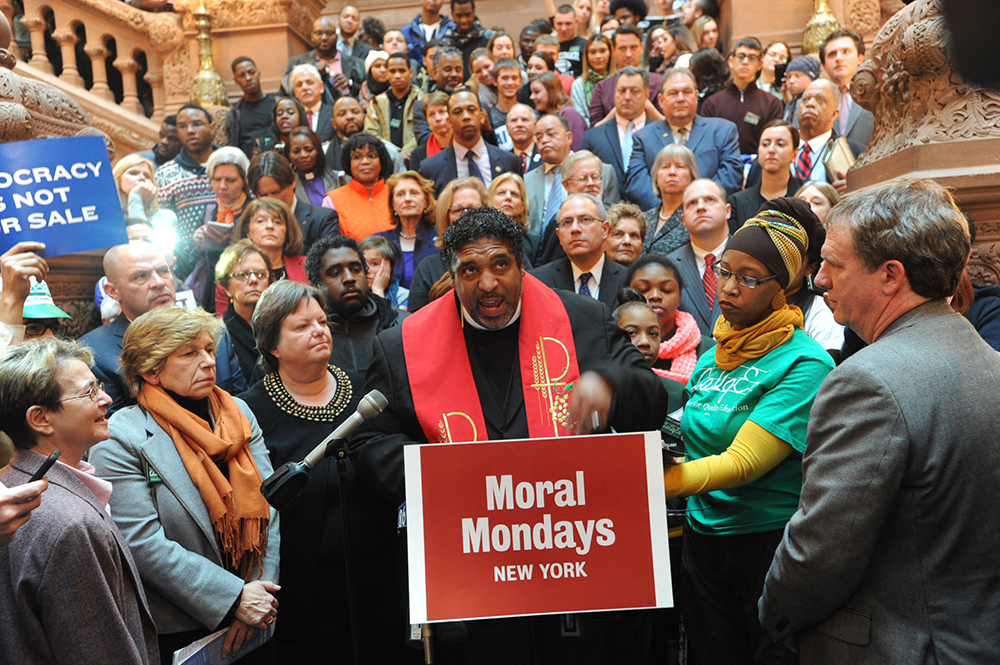
The Rev. Willliam Barber and the Moral Mondays movement represent the New Civil Right Movement.

Of course Black America does notice.  It has noticed alarming trends in this direction long before Trump emerged as the savior of white America about to slip into a demographic minority status.  And it has been building powerful responses including the so-called New Civil Rights Movement represented by the Moral Mondays organized by the Reverend William Barber and the newly re-energized North Carolina NAACP.  Especially important has been the Black Lives Matter movement organized a young generation of self-motivated activists—most of them women—in response to the wave of police shootings and murders of Blacks.  They shunned the charismatic leader model and hierarchical organization in favor of flexible and responsive collective direction of a movement.

Both of these have accepted and encouraged support and participation by white progressives while setting boundaries.  The have dramatically educated white activists, often against resistance and denial to be supportive allies rather than see themselves as saviors or dictators of style, language, and tactics.  It has been hard, but it broadened the movement.

Black Lives Matter represents a fresh vision and response to oppression.


There are many targets of Trump era oppression.  Each has organized in response.  It would be very easy for each to fight alone or even allow themselves to be divided against each other the way many working class whites have been turned against natural minority allies.  It has been far from perfect, but there is a growing sense of intersectionality between these target groups—Blacks, immigrants, Muslims, women, Native Americans, labor, the disabled, the LBGT communities and others.  Not only do memberships in all of the labeled groups overlap in multiple ways like Venn diagrams, but their oppression is related and enemies the same.  They are learning—slowly and painfully—that the old American Revolution maxim applies to them to—“We must all hang together, or surely we will hang separately.”  It is the reinvention of the neglected virtue of solidarity.

The recent Women’s March on Washington and it hundreds of sister marches like the one I attended in Chicago were far from perfect but they were not just assemblages of middle-class white women like the ERA demonstrations of the ‘70’s and ‘80’s.  Not only were the crowds much more diverse, so was the leadership and speakers reflected the broad concerns of intersectionality to roaring approval.  Millions involved that day now seem ready for continued commitment to a long, arduous, frustrating, and dangers course of action and resistance.

On the streets of Chicago this week Black Lives Matter veterans stood shoulder to shoulder with immigrants and Muslims and with many of the energized women whose first experience with protest was just the week before.  Grizzled relics of decades of protest like me found ourselves in seas of young people of all races.

Never before was Black History Month more important.  Now, more than ever before, Black History must be the text for all of us.  The lessons of Black struggle are directly applicable to the enormous challenge before us all to prevent a dissent into racist totalitarianism.  We need to learn anew the lessons intersectionality understood by Sojourner Truth, Frederick Douglass, Ida B. Wells, and Martin Luther King.