Showing posts with label Glenn Miller. Show all posts

Monday, December 16, 2019

2019 Murfin Winter Holidays Music Festival—Glenn Miller Does Jingle Bells

Jingle Bells by the Glenn Miller Orchestra.

Yesterday was the 75th anniversary of the disappearance of Major Glenn Miller in the fog over the English channel in 1944.  The most wildly popular leader of a big band in the pre-World War II years, Miller’s tight arrangements were the crowning achievements of the swing era.  At the height of his fame and popularity and after making the films Sun Valley Serenade and Orchestra Wives, he badgered his way into the Army.  

Glenn Miller leading his Army Air Forces Overseas Orchestra in a concert at an English air base.
At first assigned to lead a conventional marching band with the Army Air Forces Southeast Training Center at Maxwell Field in Montgomery, Alabama, he used his influence to convince the brass to let him form the Army Air Forces Overseas Orchestra, a 50 piece swing band to entertain the troops and boost morale.  After month of successful performances at allied air bases in England and making propaganda recordings to be broadcast to Germany—Miller spoke fluent German—Miller was flying to Paris to make arrangements for his first continental performances when the single engine light airplane he was flying in disappeared.

A promotional photo for 1941's Sun Valley Serenade with figure skater Sonja Henie and John Payne.  Miller and his big band were a bigger draw than the movie's romantic leads.
Today we feature a release by his civilian Glenn Miller Orchestra in 1941. Like many others before and after him, Miller took a crack at the oldest American secular holiday song—Jingle Bells—with Tex Beneke as the vocalist.
Jingle Bells never mentions Christmas and was never meant to be associated with the holiday at all.

Jingle Bells was first performed at Thanksgiving Sunday School program in Medford, Massachusetts.  The town claims, however, it was penned at the Simpson Tavern pictured above.  In fact it was written in Savannah, Georgia.
The song’s origins stretch back more than 150 years. James Lord Pierpont was the prodigal younger son of the Rev. John Pierpont, a close associate of William Ellery Channing and an influential figure in the founding of American Unitarianism who latter rose to prominence as an ardent abolitionist . Among James’s siblings were John Jr., another future Unitarian cleric and a sister, Juliet, who became the mother of arch capitalist J.P. Morgan.
The artistically inclined young James was the preverbal preacher’s sonrestless with restrictions at home, rebellious, and often in trouble. Born in 1822, he ran away to sea at the age of 14 aboard the clipper ship Shark. Another rebellious Unitarian lad of the same period was Richard Henry Dana, whose account of misery at sea in his book Two Years Before the Mast that shocked the sensibilities of mercantile New England

James Lord Pierpont
Returning to New England he married and fathered three children while casting about in a series of failed business ventures. Lured to California by the Gold Rush of 1849 he thought to strike it rich not by mining himself, but by taking pictures of the newly rich prospectors. But like his other ventures, his San Francisco photography shop ended in failure.
After his first wife died in 1853 he took his young family to join his brother, the Rev. John Pierpont, Jr., minister of the Unitarian Church in Savannah, Georgia, which was the largest Unitarian congregation in the South.  He took up residence and earned a modest living as organist in his brother’s church. Eventually he also set himself up in business selling house paint, varnish, wallpaper, window glass, and art supplies.  In 1857 he married the daughter of a prominent Savannah civic leader who would go on to serve as the city’s Civil War mayor.
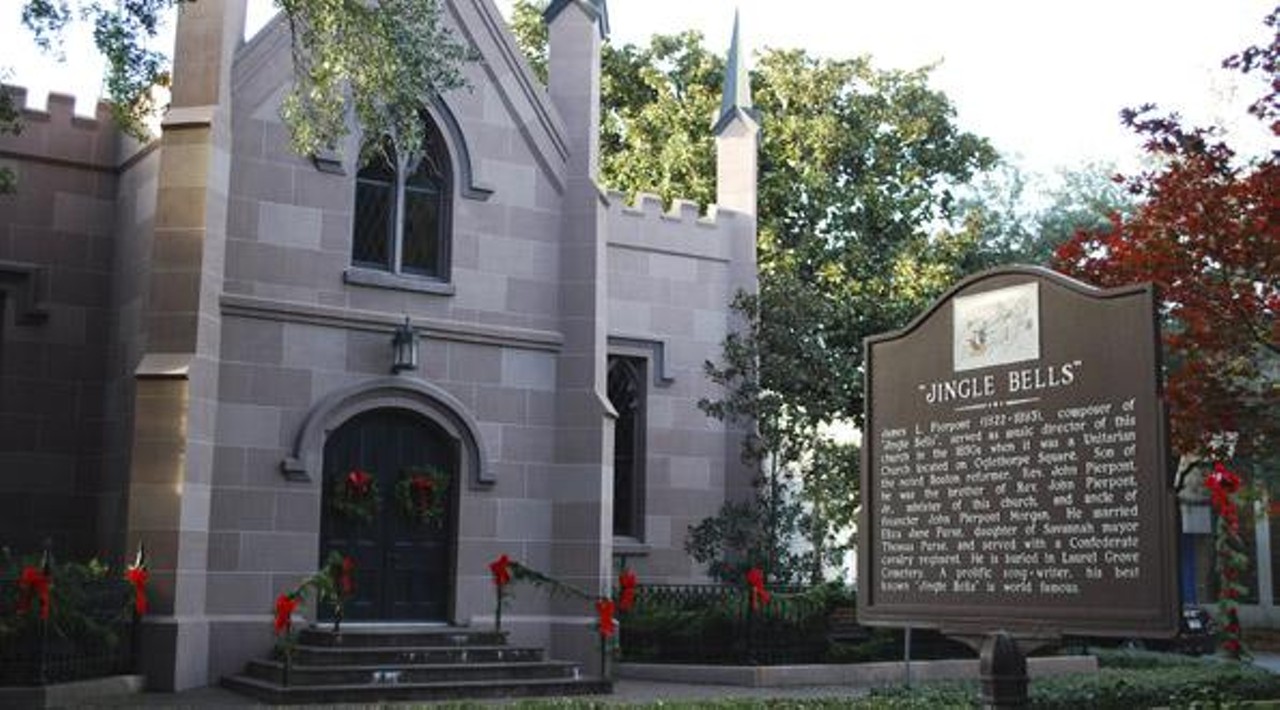

The historic Savannah Unitarian Church, the largest in the South, where Jame Pierpont's brother was the minister and where he was employed as the organist.  The church posts it claim on Jingle Bells on the historical marker out front.
Sometime during those years, restless as ever and lonesome for his lost New England childhood, he penned a song he called The One Horse Open Sleigh.  He may have drawn as inspiration a sleighing party that he had rapturously reported to his mother in an 1832 letter.
In snow bound New England the sleigh was both a necessary form of transportation and a winter diversion. There was a whole genre of sleighing songs. The best known today, Over the River and Through the Woods is associated with that quiescently New England holiday, Thanksgiving.  But it accounted a family expedition in a large, multi-passenger sled of the sort often pulled by a team. Pierpont's song was about a cutter, a fast two seat light sleigh often pulled by a thoroughbred trotter. It is a courtship song, with a young man out to impress Miss Fanny Bright with his speed and daring until he miscalculates the depth of a drift and the sleigh becomes “up sot.”
The song may have mystified his brother’s Southern parishioners, but James mailed copies home and it was sung in Medford, Massachusetts at Thanksgiving parties sometime in the mid 1850’s. This would lead to a later spurious claim that the song had been written there.
James copyrighted and published the song in 1857. Two years later it was issued in a new edition as Jingle Bells or the One Horse Open Sleigh. Within a decade it was a popular American parlor sing-a-long favorite, linked in the public’s mind with the colorful Currier and Ives prints of sleighing scenes that adorned many homes.  It was considered a winter song, but not a Christmas one.
Unfortunately, James never profited much from royalties from the song. 
Dark clouds were gathering that would change his life forever.  As  the  passions  stirred  by  the  1860 presidential election grew heated brother John,  an  abolitionist  like his  father,  was  forced to give up his pulpit and return to the North costing James his job  at  church.  James remained in Savannah, now an ardent supporter of the Southern cause.  After war broke out the combination of a war economy and the increasingly effective blockade of Southern ports destroyed James’s shaky business venture.
At the age of 40 he enlisted as a clerk in the First Georgia Battalion, which became a part of the 5th Georgia Cavalry. Although he was a gentleman with connections to a leading aristocratic family, James never rose above the rank of private. He remained in the Confederate Army for the duration of the war, although his rear echelon unit saw little action, mostly patrolling in defense of railroad lines and later scouting Yankee positions during the Atlanta campaign.  His greatest contribution to the Confederate war effort came as the composer of patriotic songs including We Conquer or Die, Our Battle Flag, and Strike for the South.   Meanwhile his father and brother served as chaplains in the Union Army.
After the war there were hard times in the South and James and his family shared in them. Eventually he found a niche as professor of music at Quitman Academy. He spent his last years in Florida at his son’s home in Winter Haven before dying in 1893.
Jingle Bells may not have been his only contribution to seasonal music. According to the 1994 book American Christmas by Jim Harrison, “For many years Martin Luther was credited with writing one of the best loved Christmas songs, Away in a Manger .. .but history now has evidence to dispute his authorship. An American, James Pierpont, is currently believed to be the author.” UUA historian Peter Hughes doubted the claim, however. Although the song is undoubtedly American dating from some time in the 1880’s, its origins are murky, probably Lutheran although the lyrics were first published as a poem in a Universalist periodical.

A book and 45 rpm single for children.
Away in a Manger aside, James Pierpont’s claim on our seasonal culture is indisputable.  By the early 20th Century, as the automobile was replacing the horse, Jingle Bells was being melded into the general sentimentality of the Christmas season. In the days before the explosion of popular secular holiday songs like White Christmas, I’ll Be Home for Christmas, Have Yourself a Merry Little Christmas, and The Christmas Song, it provided a much needed non­ religious song suitable for performance in public schools and in mixed gatherings. The simple, lively tune was easy to sing and easy to adapt to a host of musical styles. It has become an indisputable Christmas classic.

Sunday, December 15, 2013

The Night Glenn Miller Disappeared into the Fog

Major Glenn Miller and the Band of Allied Expeditionary in concert.

On night of December 15, 1944 Major Glenn Miller boarded a single engine Norseman UC-64A, a reliable light transport originally developed as an Arctic bush plane, at Twinwood Farm,  Royal Air Force (RAF) field near Bedford, Devonshire.  He was on his way to Paris to make arrangements for a two week stay by his Army Air Force Band for a round of appearances in the recently liberated city which were to kick off a tour of camps and air field on the Continent.  Somewhere over the English Channel the plane disappeared.  No wreckage was ever found or any bodies recovered.  The AAF listed Miller as missing.

Miller’s exact fate has been the object of speculation.  One theory that gets wide support is that RAF Lancaster Bombers, turned back by weather from an aborted raid on Stuttgart, may have hit the small plane with the more the 100,000 incendiary bombs that they had to be jettisoned for safety.  Most of the ordinance was dumped over the North Sea, but the log of one pilot on the mission mentions at least some were dropped over the Channel and a navigator reported seeing a small plane spiral into the sea below.  A gunner with the U.S. Army’s Battery D, 134th AAA Battalion, in Folkestone, England believed that his unit may have mistakenly shot down Miller’s plane, a contention disputed by others.  Most fancifully Lt. Col. Huton Downs, a former member of Dwight D. Eisenhower's  staff claimed that the German speaking Miller was actually on a secret mission to certain high ranking German officers to convince them to mutiny against Hitler and surrender to the Allies.   With the intrigue of a spy thriller, Downs suggested that Miller was captured, held at a Paris whorehouse where he was tortured and executed.  It is safe to say almost no one but the unusually gullible and the terminally conspiracy minded believe this to be the case.

The AAF Band made its dates in Paris and continued to perform for troops in Europe and England before being returned to the state and disbanded.

Alton Glenn Miller was born on a farm near Clarinda in southwest Iowa on March 1, 1904.  The family moved frequently.  He attended grade school in North Platt, Nebraska where he traded a battered mandolin his father gave him for an equally battered horn.  His obsession with the instrument caused his hard working parents to begin to fret whether “he would ever amount to anything.”  Later in Grant City, Missouri the boy made enough money milking cows to buy a trombone and was soon a youthful member of the town band.  A final move brought the family to Fort Morgan, Colorado on the high plains below the Eastern Slope of the Colorado Rockies.  Miller attended high school there.  Still obsessed with music, he once played trumpet on the roof of the high school building.  In 1920-21, his senior year, Miller formed his first band to play the new dance music that was being popularized by the sale of phonograph records.  

Miller wanted to be a professional musician, which his parents continued to resist.  Finally, in 1923, he relented to their pleas and enrolled at the University of Colorado at Boulder.  He joined a fraternity, sparked a pretty young co-ed named Helen Burger, and spent most of his time off campus.  He played in several local dance bands, most notably in Boyd Senter's Denver based band.  After failing three of his five classes one semester, Miller dropped out, determined to make it as a musician.

He played with various touring groups before ending up in California in 1926 with a steady gig with Ben Pollack’s popular band, which included a young clarinetist from Chicago, Benny Goodman.  Pollack gave Miller his first opportunity as an arranger.  He and Goodman teamed up to co-write Room 1411 which the band recorded on the Brunswick label in 1928.  When the band got to New York City, Miller sent for Helen Burger and married her. 

The couple settled in the city, which offered many opportunities for Miller as a free lance horn man and arranger.  He worked in various Hotel bands, and was a session musician on several records made by different companies. By 1930 he was in one of the most popular bands, led by Red Nichols.  Through Nichols he also lined up two long-running jobs in the pit bands of seminal Broadway George Gershwin shows—the 1930 revival/restaging of Strike Up the Band and Girl Crazy.  Old pal Goodman and drummer Gene Krupa were in the same orchestra.

As a studio session man, beginning in 1928 he cut sides with Goodman, Tommy Dorsey, and Joe Venuti in the All-Star Orchestra, directed by Nat Shilkret and with jazz vocalist Red McKenzie along side Krupa, clarinetist Pee Wee Russell, guitarist Eddie Condon, and Coleman Hawkins on tenor saxophone.  By 1931 he was on radio in Shilkret’s band.

Now recognized by his peers as one of the top musicians in New York, Miller signed on with the Dorsey Brothers studio band both as a horn man and arranger.  He set out in both capacities when the Dorsey’s launched their touring Big Band big band which soon fell apart amid acrimony between co-leaders Jimmy and Tommy Dorsey.

Miller moved on to form an American orchestra for British band leader Ray Nobel.  Among his picks for band mates were Claude Thornhill, Bud Freeman and Charlie Spivak.  Nobel’s band took off quickly, much of it on the strength of Miller’s arrangements.  In 1935 Miller was in the band for Paramount’s most important musical, The Big Broadcast of 1936 starring Bing Crosby, George Burns, Gracie Allen, Ethel Merman, Jack Oakie, and Bill “Bojangles” Robinson.  Also in the film were a young Dorothy Dandridge and the dancing Nicholas Brothers who so impressed Miller that he later insisted that they be featured in his first movie with his own band, Sun Valley Serenade.
In 1935 made his first recordings under his own name with a small band of six horns, a rhythm section and a string quartet.  But his Columbia releases failed to sell more than a few hundred copies and Miller kept his job with Nobel.

Miller took the big step of forming his own touring band in 1937.  Despite his original arrangements, the band was not a success.  By his own estimation, it sounded too much like all of the other dance bands making the circuit.  Deeply discouraged and broke, he disbanded his orchestra to return to New York and the life of a side man and arranger for other bands.  

He continued, however, to search for a “special sound” that could be immediately recognizable no matter what tune was played and stand out from the crowd.  He had no “moment of inspiration.”  Eventually he recalled some arrangements for Nobel featuring lead clarinet over four saxophones.  He further refined this so that a tenor sax matched the clarinet note by note while a trio of another tenor sax and two altos played in close harmony.  Further refining the sound, he picked a tenor man, Wilbur Schwartz, to play the lead clarinet, giving the liquorish stick a fullness that could not be copied. 

In 1938 he launched the second Glenn Miller Orchestra with recordings on RCA Victor’s Blue Bird label.  A timely infusion of cash from a New York businessman allowed Miller to take his large orchestra on tour with top musicians.  In the spring 1939 the touring band broke through with huge sell-out performances at top venues like the Meadowbrook Ballroom in Cedar Grove, New Jersey, and the Glen Island Casino in New Rochelle, New York.  Records were flying off store shelves. The band had 17 top ten hits in 1939 including Moonlight Serenade and Wishing (Will Make It So).  An astonished Time magazine reported that toward the end of the year, “Of the twelve to 24 discs in each of today's 300,000 U.S. jukeboxes, from two to six are usually Glenn Miller's.”  Chesterfield Cigarettes sponsored Miller three times a week on his own radio program from 1939 until Miller entered the service.  Early shows in the series also featured the Andrews Sisters. In October ASCAP crowned Miller as one of the reigning kings of the dance band at an all star Carnegie Hall concert with the bands of Goodman, Paul Whiteman and Fred Waring.
 
1939 was just the start of an astonishing run atop the music world.  In 1940 Tuxedo Junction sold an unprecedented 115,000 copies in its first week of release. It was just one of 31 top ten hits that included Pennsylvania 6-5000 and In the Mood.  1941 produced 11 more top hits including Song of the Volga Boatmen, You and I, and Elmer's TuneHollywood naturally came calling.  Miller and the Orchestra were featured in Sun Valley Serenade with skating star Sonja Henning, John Payne, and Milton Berle.  Bands in most films made essentially musical cameos, but in Sun Valley Serenade Miller and members of the orchestra were integral characters in the movie.  The film launched Chattanooga Choo Choo, which became the first ever Gold Record certifying a million copies sold.
Only the war could slow up the pace.  1942 brought a second film, Orchestra Wives staring George Montgomery, Ann Rutherford, and Cesar Romero.  The film introduced Miller standards, I Got a Gal in Kalamazoo and At Last,  Other hits from that year are identified with the war effort—Don’t Sit Under the Apple Tree and the ambitious American Patrol.  All together another 11 songs made it to the top ten, all before the Orchestra’s last concert at Passaic, New Jersey, on September 27, 1942.

It wasn’t easy for Miller to get into the service—or to talk himself into getting the job he really wanted—leading a revolutionary new style of military band.  Too old for the draft, Miller tried to volunteer in the Navy, which turned him down flat.  He then appealed to a personal acquaintance, Army Brigadier General Charles Young who pulled some strings to get the bandleader inducted.  He was assigned to the Army Specialist Corps.  It took months more of scheming to get his commission as a Captain and the chance to form a band.  

Transferred to the Army Air Corps, Capt. Miller was officially the Assistant Special Services Officer for the Army Air Forces Southeast Training Center at Maxwell Field, Montgomery, AlabamaIn addition to his regular duties he played trombone as a side man in the Rhythmaires, a 15-piece dance band that played on post and at service clubs in town.  He also appeared on Alabama radio programs promoting civilian work opportunities for women on the base.  Finally he got the go-ahead for his band.

Miller’s first effort was a modernized marching band with a swing feel.  Not only would it do the traditional marches expected of a service band, Miller introduced new material like a swing St. Louis Blues MarchWhen his band marched in review for the brass, many high ranking traditionalists were not amused by either the music or the swaggering march style of the band.  But a weekly radio program with the band I Sustain the Wings was popular with both troops and public and was credited with helping Air Corps recruiting efforts.  On the strength of those programs, Miller was given the go-ahead to organize the new Army Air Force Band 50 piece stage band bound for Europe to play for the troops.

It took months to assemble and train the band.  He recruited from top symphony musicians for a large sting section.  Miller was a strict disciplinarian and a perfectionist as a musician.  He insisted the men maintain full military discipline at all times—never easy for musicians—including hours of manual labor in addition to endless rehearsals to perfect Millers complex arrangements.  As a civilian band leader, he had always kept his trombone and joined in the play—still part of the band.  But as an officer he felt he could not encourage such familiarity and led the band with a baton.

The band was finally deployed to England in the summer of 1944.  On arrival the outfit was officially renamed the Band of the Allied Expeditionary Force and Miller was promoted to Major.  He dove into a relentless round of appearances at U.S. and allied air fields, hospitals, other installations, and at special occasions.  The performances included more than 500 broadcasts, some heard on both sides of the AtlanticMiller also made special recording in German for propaganda broadcasts.  

The band made several recordings for broadcast or other use at Abby Road Studio.  A final batch featured vocals by Dinah Shore.  These recordings were never released and held under lock and key until the European copyright on them expired 1994.  They are now available in Europe, but not the United States.  Assessing contribution of the AAF Band to the war effort General Jimmy Doolittle said, “next to a letter from home, that organization was the greatest morale builder in the European Theater of Operations.”

Miller’s loss was widely mourned, even as his band kept at its duty.  He was awarded a posthumous Bronze Star for his work.  Several memorials exist in Britain at sites where he played, including a bronze bust outside the Corn Exchange in Bedford, the venue of one of his most remembered broadcast concerts.

After the war Tex Beneke Miller’s friend and the lead sax player and vocalist with the old band was tapped by the Miller family to head a “ghost band.”  Beneke added a string section and took the band out.  He had great success, packing houses even as other big bands struggled with changing tastes.  He continued to record and the band had a few more hits.  But Beneke wanted to put his own stamp on the band, and was soon at bitter odds with the estate.   They parted ways in 1950, with the band continuing to tour under Beneke’s name but with restrictions on using Miller’s charts.

In 1954 Glenn Miller Story staring James Stewart and June Allison was released and became a top box office draw that year.  The film portrayed Miller perhaps more warmly than the sometimes aloof Miller.  But it struck a chord.  The film set off a revival of interest in Big Band music in general and the Miller band in particular. 

Taking advantage of the renewed interest, the Miller estate authorized a new ghost band under the leadership of Miller’s AAF Band drummer Ray Mckinley which included some veterans of both the military and civilian bands.  The band began touring in 1957 and as continued ever since.  It is by far the most popular of all of the bands touring under the names of former leaders and remains in demand.  Subsequent leaders have included Buddy DeFranco, Peanuts Hucko, Buddy Morrow, Jimmy Henderson, and Dick Gerhart.  The Miller estate pointedly refuses to list Tex Beneke as ever having been associated with a ghost band.  The Orchestra continues to record, including new material in the Miller style.  A Christmas compilation from 1994 was particularly popular.  The Miller estate has also authorized bands in England and in Europe. 

Despite Miller’s enduring popularity, he was long disparaged by some jazz purists for his tight arrangements and careful rehearsals that resulted in consistent, near identical performances which they charged violated the improvisational spirit of jazz.  Critics also disagreed with Miller’s use of vocalists for undermining the traded instrumental solos in much jazz.  In more traditional jazz bands, singers were used sparingly, stepping up to the microphone to take a chorus or two then stepping back to let the band take the lead.  Miller employed his vocalists with more regularity and integrated them into the arrangements.  He also used the whole band as a chorus on some songs, memorably Pennsylvania 6-5000.  Miller’s vocalists included Beneke, Ray Eberle, Paula Kelly and The Modernaires, Kay Starr, and others.  In his defense, Miller said that he didn’t want to lead a jazz band, he wanted to swing.

In retrospect most jazz aficionados now give Miller his due.  And after all of these years, new generations continue to rediscover that magic sound.