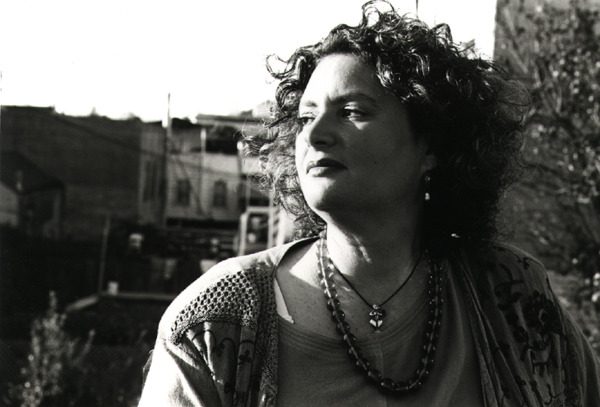
When
the history of religion and spirituality in the late 20th Century America is written it is
possible that the most influential person might not be some mega-church pastor with a perfect pompadour and dazzling white smile, a
learned theologian with a break-out
idea, a Prelate or President of some denomination, or the guru of
some eastern mysticism, but a nice Jewish girl from St. Paul, Minnesota with wild hair and a penchant for colorful
flowing robes.
Miriam Simos was born on
June 17, 1951. Both of her parents were
the children of Jewish emigrants from Russia. Her father died when she was only 5 and she
was brought up by her mother, Bertha
Claire Goldfarb Simos a professor of
social work at the University of
California at Berkley. They lived in
Venice, a beach town that was a
center of surfing and alternative lifestyles.
Miriam’s
mother was a feminist and she was an
activist herself by the time she attended high school where she was close to
fellow student Christina Hoff Sommers,
who would go on in later years to fame as a leading conservative critic of modern feminism.
Miriam
was a bright student and a sponge for the social changes swirling around
her. Enrolling at UCLA she aspired to be
a writer, graduating in 1973. While
going on to pursue a graduate degree in film
there she wrote A Weight of Gold an
autobiographical novel and screen play about growing up in Venice,
which won the prestigious Samuel Goldwyn
Writing Award.
Although
the novel was not published, the recognition and encouragement led her to try
to make a literary career in New York. She then returned to California. Basing herself in the Bay Area she was active in feminist, peace, anti-nuclear, ecological, and anarchist circles.
She
was drawn to the burgeoning neo-pagan
movement, especially Wicca and
took the craft name Starhawk, under which
she would climb to fame and influence within the movement. She studied under Victor Anderson, who synthesized various world shamanistic traditions and founded the Feri Tradition to make those beliefs accessible to Americans. She also studied with Zsuzsanna Budapest, founder of Dianic
Wicca, a monotheistic goddess worshiping
group who meet in women only covens. Budapest’s Susan B. Anthony Coven was both feminist/separatist and engaged in the politics of the world.
Starhawk
herself was also drawn deeply to a mystic connection to the earth. She was alienated by the refusal of many of
her neo-pagan contemporaries, particularly in main stream Wicca to engage in
the world. She synthesized her
experienced into a manifesto of sorts on a muscular Goddess worship, The
Spiral Dance which she completed in 1977. Frustratingly, she was
unable to find a publisher.
Feminist
religious scholar Carol P. Christ included
an article by Starhawk on witchcraft
and the Goddess movement in her influential anthology, Womanspirit Rising in
1979. In that book Starhawk explained
herself:
I am a witch, by which I mean that I am somebody who believes that the earth
is sacred, and that women and women’s bodies are one expression of that sacred
being.
My spirituality has always been linked to my feminism. Feminism is about challenging unequal power
structures. So, it also means challenging inequalities in race, class, sexual
preference. What we need to be doing is not just changing who holds power, but
changing the way we conceive of power. There is the power we’re all familiar
with—power over. But there is another kind of power—power from within. For a
woman, it is the power to be fertile either in terms of having babies or
writing books or dancing or baking bread or being a great organizer. It is the
kind of power that doesn’t depend on depriving someone else.
Inclusion
in that book led to the publication of The Spiral Dance: A Rebirth of the Ancient
Religion of the Great Goddess by Harper
and Row later the same year. It
became one of the best selling and most influential neo-pagan books ever
published. It was a compendium of
theological thought, history, and ritual practices. New editions published on the 10th and 20th
anniversaries of the first edition expanded on the original with additional
reflection on the growth and evolutions of Starhawks’s thought.
The
book was widely influential well beyond the still small and idiosyncratic world
of neo-paganism. It was avidly read by
feminists, those interested in deep
ecology, and women in small towns and cities who had felt isolated and
alone.
Meanwhile
Starhawk was also pursuing a Masters
Degree in Psychology from the University of Antioch West in San Francisco, from which she graduated
in 1982 leading to an academic career at institutions that include John F. Kennedy University, Antioch
West, the Institute of Culture and
Creation Spirituality at Holy Names College, and Wisdom University. She is currently adjunct faculty at the California
Institute of Integral Studies.
Starhawk's
deep critique of the common rhetoric of
patriarchy and her concern that connection to the Earth and nature calls
for a kind of activism in the world
that was new to neo-paganism. She
pointedly asked, “What do we
do...those of us who do believe the earth is sacred, who do believe that we
have a responsibility to care for the living systems that sustain us, and who
do believe that we have a responsibility to take care of each other?”
Brining
that activism to the public has been key.
In 1979 to celebrate the publication of her book Starhawk and friends
organized a Bay Area Samhain (Halloween) celebration including a mass
Spiral Dance. Out of that loose
association grew the Reclaiming
Community, now an international movement that fuses neo-paganism with
activism and offers classes in non-violence, civil disobedience, organizing and
the like. It is particularly active in
overcoming the sense of white privilege
which Starhawk believes has infested much of the neo-pagan community.
Starhawk
was an early and influentially active member of the Covenant of Unitarian Universalist Pagans (CUUPS). Her combinations
contributed heavily to the adoption of the Unitarian Universalist Association’s Seventh Principle, “Respect for the
Interdependent Web of All Existence of Which We Are a Part” in 1983, a move led
by the faith’s growing eco-feminist movement.
That inclusion has in many ways profoundly changed traditional Unitarian
Universalism broadening its roots form radical
Christianity and modern Humanism,
influencing the way the faith act in the world, and being a major catalyst for
a revival of spirituality in the
liberal faith. She has continued to lead
CUUPS workshops and retreats.
Although
she helped found and continues to be active in the Covenant of the Goddess, legally recognized as a church since 1977. Starhawk’s interest transcends
institutionalism in organized religion.
Through various activities, agencies, and groups she seeks to share a
broad vision that transcends any single cult or practice. To this end she has published widely. In addition for the editions of the Spiral Dance her many books include Dreaming
the Dark: Magic, Sex, and Politics in 1982, where she elaborated on the
role of ritual as an agent of societal change; Truth Or Dare: Encounters with
Power, Authority and Mystery in 1987, a synthesization her views on
personal development, political action and witchcraft into a psychology of liberation; and the ecotopian novel The Fifth Sacred Thing in
1993. In addition her articles and
essays have been widely published and translated around the world.
In
the late ‘80’s Starhawk revisited her old interest in films, writing and
staring in three films known collectively as the Women and Spirituality Trilogy for
the National Film Board of Canada. The widely hailed poetic documentaries
include Goddess Remembered in 1989, The Burning Times in 1990, and Full Circle in 1993.
In addition she has released numerous spoken word CDs.
Activism as continued to be important to
Starhawk. She leads training sessions in
mindful activism and civil disobedience for many groups. She contributes to a YouTube video series aimed at Unitarian Universalist activists and
she wrote
the call-to-action for the women’s peace organization Code Pink which
engaged in numerous high profile civil disobedience actions in protest to the wars
in Iraq and Afghanistan.
Today her earth-based, feminist spirituality is
widely influential beyond the growing neo-pagan community. She is taught in theological schools and seminaries
and theologians seek to reconcile the Divine
Feminine and active, muscular reverence for the Earth with traditional Christianity. Starhawk address this wider world as a major
contributor to Belief Net and as a
columnist for On Faith, the Newsweek/Washington Post
online forum on religion.
At
63 Starhawk lives communally with her second husband David Miller in San Francisco and also spends time at a simple hut
in the woods western Sonoma County,
California, where she practices permaculture
in her extensive gardens, meditates, and writes.