|
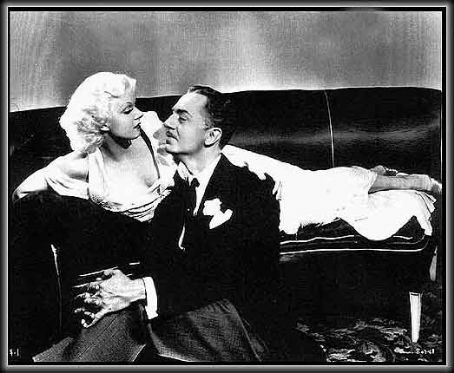
| Harlow and Powell--a real love story. |
The great love
of her life, actor William Powell, found
Jean Harlow desperately ill after she
collapsed into Clark Gable’s arms on
the set of the MGM film Saratoga
on May 20, 1937. He had been called to
her side from a near-by sound stage where he was working. He took her to her home in his car, arranged
for medical attention including doctors and attending nurses. He called his fiancé’s domineering mother,
also named Jean who was away on a
vacation lavishly spending her daughter’s money.
Harlow’s health
had deteriorated rapidly while shooting the film, alarming her close friend and
co-star Myrna Loy who noted how
bloated, listless, and ashen colored she had become. Her traditional cheerful demeanor on the set,
which made her among the most beloved of all stars by the crews with whom she
worked, was replaced by exhausted languor and uncharacteristic snappishness.
As her condition
worsened, mother Jean restricted her visits to those closest to her—herself,
Powell, and Gable who considered himself her best friend and big brother. Although she was getting the best medical
care available, her mother turned back the MGM staff doctor who she suspected
of trying to hurry her back to work with quack remedies—something quite common
at the studio under Louis B. Mayer. The miffed doctor later told reporters that
he had been barred by her mother because she was a Christian Scientist starting an unfounded legend that would be
repeated many times.
At home doctors
tried to figure out what was happening to her.
Everything from influenza to
a gall bladder attack, alcohol induced cirrhosis of the Liver to poisoning from the bleach she used on her
famous hair was considered. It wasn’t
until Gable leaned over to kiss her on a visit and smelled urine on her breath that the doctors realized she was suffering
from renal failure. Her kidneys were shutting down and her
bloated body was literally sweating urine.
Given the state
of medicine at the time—before antibiotics
to treat infection, dialysis, or
transplant—there was nothing to be done to save her.
Powell, who had
only recently finally agreed to marry Harlow after a tempestuous two year
red-hot romance, visited her daily, emerging from her room after hours at her
bedside with his face contorted with grief and wet with tears.
When he arrived on
June 6 to visit her, she sent word by a nurse that she could not see him. Alarmed, Powell called an ambulance which
took her to Good Samaritan Hospital. She
fell into a coma and died on June 7. She was only 26 years old.
The whole of Hollywood—and much of the nation that
idolized her—reacted with shock. MGM
writer Harry Ruskin recalled, “The
day the Baby died there wasn’t one sound in the commissary for three hours...
not one goddamn sound.”
Powell paid $25,000
for a private room of multicolored marble in the Great Mausoleum at Forest
Lawn Memorial Park. Gable, beside
himself with grief, managed to hold up as one of her pall bearers. She was laid to rest in one of her signature
white satin gowns from the Libeled Lady, a
film she co-starred in with Powell, Loy, and another close pal, Spenser Tracy. Before the coffin lid was closed Powell
slipped a white gardenia in her folded hands with the handwritten note, “Goodnight,
my dearest Darling.” The inscription on
the wall reads simply Our Baby. Room was left for Mother Jean and
Powell. Her mother died exactly 21 years
to the day of her daughter in the same hospital and finally joined Jean. Powell spent the rest of his life grieving
over Harlow, but remarried in 1940 and when he died in in 1984 was cremated and
his ashes scattered near Palm Springs.
Although only
two-thirds of the principle shooting of Saratoga
had been finished when Harlow was taken ill, Mayer determined to finish the
film. He ordered Gable back to
work. Using over-the-shoulder shots,
body doubles, and dubbed dialogue the film was finished and released. Gable compared holding a body double to “embracing
a ghost.” Eager to see Harlow one last
time, fans turned out in droves. It
became the studio’s second-highest grossing picture of 1937. Even critics who had often been harsh to the
blonde sex pot called it the best performance of her career.
There is nothing
like an early, tragic death, to create a cultural icon. But Jean Harlow might well have become one
even if she had died in bed at 90. The
stunning beauty had created a new persona embraced by the public, lusted after
by men, and admired for her heart and spunk by women. Her signature look—the blindingly blonde hair
which studio publicists dubbed platinum—had
millions of women reaching for the bleach bottle. Her voluptuous body, made to be swathed in
clinging white satin, ended once and for all the fad of the flat chested Flapper. Her persona as a street-smart tart and
temptress was tempered by an unexpected gift for comedy and the classic “heart
of gold” made even respectable women adore her.
She was born Harlean Harlow Carpenter on March 3, 1911
in Kansas City, Missouri where her father earned a
comfortable living as a dentist and her mother was the pampered daughter of a
wealthy real estate developer with a taste for high living, adventure and a
yearning to go on stage. From the
beginning her family called her simply The Baby, a nickname that stuck through
the rest of her life. She later claimed
she did not know her real name was Harlean until she was registered for high
school.
Her parent’s
marriage, orchestrated and supported by her paternal grandfather, was
unhappy. Mother Jean turned to her
daughter for love and support. It was a
bond, strained by the mother’s ambitions and domination, which would be the
center of most of her daughter’s life. After her parents divorced in 1922, Jean
moved with her daughter to Hollywood the next year in search of film stardom. But she quickly discovered that even
beautiful women of 34 were too old to become leading ladies in a town where
teenagers were “discovered” and turned into stars every week.
The grandfather
ordered the return of his daughter and her child to Kansas City in 1925 by threatening
to disinherit them. They spent two
unhappy years back home. One summer the
grandfather sent Harlean to a Michigan summer camp where she came down with Scarlet Fever—the disease which
probably originally damaged her kidneys.
In 1927 she was enrolled
at the toney private Ferry Hall School
in Lake Forest so that her mother
could be near her boyfriend, Marino
Bello in Chicago. Later that year
mother Jean married her suitor without her daughter being present. Hurt and bewildered, the girl eloped at age
16 with Charles “Chuck” McGrew, the
older brother of a wealthy classmate. It
set the stage for a repeating pattern for the young girl who wanted more than
anything to be a loving housewife and raise children in a stable, happy home.
When McGrew got
an inherited fortune when he turned 21 the young couple moved to Los Angeles where for a while Harlean
happily played the role of a rich young married in a fashionable home. Leading the life of idle socialites caused
both of them to drink. And McGrew drank
exceptionally heavily.
On a lark
Harlean offered a ride to a friend who was seeking an audition at the Fox Studios. She was spotted there and encouraged to
audition herself. She had no interest
and refused for several days until she gave into a dare. She was accepted at Central Casting registering under her mother’s maiden name, Jean
Harlow. Publicity still were taken and
circulated and soon she was receiving calls for parts—all of which she firmly
turned down, until her mother and Belo showed up in town and pressed her to
accept.
After one un-credited
appearance in a bit part, she found herself on call for small parts with
billing. That led to a $100 a week
contract with the Hal Roach Studio which
co-starred her in three Laurel and Hardy
two reel comedies in 1928 and ’29.
But she didn’t need the money and her husband was resentful of his wife’s
new career. When she complained to Roach
that the work was “ruining my marriage” the producer willingly tore up her
contract.
But the marriage
was doomed anyway by McGrew’s jealousy and heavy drinking. The couple divorced in 1929 and Harlow moved
in with her mother and step-father, who encouraged her to go back to work. She got her first speaking role in a Clara Bow film, The Saturday Night Kid. Bow was the quintessential flapper/vamp, just
the kind of sex symbol Harlow was on the verge of rendering obsolete.
Playboy inventor
and director Howard Hughes was
re-shooting his silent aviation epic Hell’s Angels as a talkie. Almost by fluke he was introduced to Harlow
by an actor who had spotted her on another set.
Hughes cast her as the blonde heroine, replacing a Danish actress with a
heavy accent. As was usual, Hughes
romanced his leading lady. The film was
a smash hit thanks to Hughes’s daring aerial photography and Harlow’s stunning
looks.
Although derided
by critics she was a hit with audiences and suddenly a star. But not too big a
star for her next role to an un-credited bit in Charles Chaplin’s City Lights. Under contract to Hughes, who was not a prolific
film maker, she was leant to other studios to work in mostly undistinguished
films. But one of them was The
Secret Six which paired her for the first time with another rising
star, Gable. Another was a small, but
memorable role in James Cagney’s classic Public Enemy. Most of the others were just double
bill fodder.
Then Hughes put
her back to work in a film starring one of the hottest leading ladies in the business,
Loretta Young. Harlow was cast as a scheming rival for
her husband’s attention. But after
previews, Hughes changed the name of the film to Platinum Blond and got his publicity department working overtime to
hype Harlow’s hair. It worked. Everybody forgot that Young was the real
star.
In 1932, once
again on loan, Harlow got her first starring role in Columbia’s Three Wise Girls with
Mae Clark. MGM, where she was already seeing a
producer, Paul Bern snapped her up
to co-star with Walter Houston in a
grim crime drama Beast of the City.
Although consigned to the bottom half of a double bill by Mayer, who
felt its violence and the sexy siren that lures a young man to destruction ran
against the studio’s image as a maker of wholesome films, Bern took Harlow on
an east coast barnstorming publicity tour of theaters showing the film. She shocked studio executives when fans
turned out in droves to see her.
Although Mayer
still balked at signing the unwholesome star, Bern convinced studio head of
production Irving Thalberg to buy
Harlow’s contract from Hughes. Then
Thalberg went into high gear finding her better roles showcasing her unique
talents. The deal was completed on
Harlow’s birthday.
It was Thalberg
who discovered her gift for comedy when he cast aside her signature look and
starred her in Red-Headed Woman, a romantic farce in which the heroine breaks up a marriage, has multiple affairs and
pre-marital sex, and attempts to kill a man to advance in society. It was a huge hit.
But the film,
and others which followed, cemented Harlow’s reputation as a lower class sex
pot on the make. The persona was
entirely counter to Harlow, who came from a privileged background and yearned
more than anything for a home and family.
Not that she was a prude. She was
comfortable with her sexuality and proud of her body. She posed nude several times both before and
after achieving stardom, most famously an ecstatic series of shots taken
outdoors with her draped in a diaphanous scarf.
But she was not a tramp who slept around loosely. She sought out stable, monogamous
relationship which she dreamed would be forever. Her tragedy was that these
relationships failed.
Back at MGM her
career was white hot when she was re-united with Gable in the classic Red
Dust. He became her most
enduring co-star and they were paired four more times, including the ill-fated Saratoga.
During the
making of the film Harlow married Bern.
Their union seemed happy but after just three months he was found dead
in their home—a suicide by gunshot to the head.
Harlow was suspected in the press, but she had been visiting her mother’s
house, perhaps after an argument. Bern
left a cryptic suicide note, “Dearest dear, Unfortunately this is the only way
to make good the frightful wrong I have done you and wipe out my abject
humiliation. I love you. Paul. You understand last night was only a comedy.”
It turned out
Bern had been visited that night by his mentally ill ex-common-law wife, Dorothy Milette who may have tried to
extort him. She was found three days
later, a drowning suicide. Stunned and
grieving, Harlow paid off her husband’s many debts, mostly to gamblers, and
even paid for Milette’s funeral and headstone.
Traumatized, she refused to speak about her husband or what happened to
anyone else for the rest of her life.
On the re-bound,
Harlow turned to an indiscreet affair with boxer Max Baer, whose wife threatened to sue for alienation of affections. To
hush up potential ruinous publicity in the wake of the Bern suicide, Mayer
ordered studio executives to pay off the bereaved wife and arranged a marriage
of convenience with one of Harlow’s many devoted friends from the sets,
cinematographer Harold Rossen. The platonic marriage ended quietly after
seven months.
Whatever her personal
tragedies and scandals, the audience loved her.
Never more so than in her scene stealing comedic tour de force in the classic Dinner at Eight opposite Wallace Beery. And the same year, 1933
she satirized her own life, and that of former It Girl Clara Bow in the comedy Bombshell as the Hollywood
sex goddess seeking respectability even in the face of her rapacious and eccentric
family. It is said that Mother Jean
never recognized that she was parodied in the movie.
Box office hit
after hit followed repairing her with Gable, twice each with Tracy and Powell,
and with rising stars like Franchot Tone
and Robert Taylor. Female pals like Loy, with whom she was
exceptionally close, and Una Merkle
also shared the screen with her.
By 1935 she was
MGM’s biggest, most bankable female star, eclipsing the fading stars Greta Garbo, Norma Schearer (Mrs.
Irving Thalberg), and Joan Crawford. She had also begun her love affair with
middle-aged Powell, recently divorced from the studio’s other big time blonde, Carole Lombard.
Studio boss
Mayer was dead set against the romance and Harlow told pals that “he would
never let us marry.” They often had to
sneak around, as they did one weekend when they went to Palm Springs with Powell’s Thin Man
co-star Loy. The hotel clerk imagined
that Powell and Loy were married in real life.
Despite evident
passion and mutual devotion, the relationship was sometimes strained. Harlow wanted marriage and children. Powell was gun shy about marriage after the
painful break-up with Lombard and was adamant that he was too old to become a
father. When Harlow became pregnant with
his child, her mother pressured her into an abortion which left her incapable of having a child of her
own. She was heartbroken, but never told
Powell what had happened. Powell is said
to have finally proposed officially just weeks before she fell ill. No announcement had been made to the press.
After Harlow
died the legend mill ginned up. The
death of Marilyn Monroe, another
tragic blonde bombshell, re-ignited interest in Harlow and set off a small
industry. Several biographies, some
salacious and fast and loose with the facts, climbed best seller charts. Two commercial films, both titled Harlow
were released in 1965 staring Carol
Lynley and Carol Baker. Both re-interpreted her in the light of
Monroe as hyper-sexed, troubled, and alcoholic.
In truth,
although she could belt drinks side by side with Gable and other pals, she was
not a drunk or a substance abuser. Nor
was she a tramp or for all of the travail in her life particularly troubled. Her many friends found her constantly warm, amusing,
and engaging. People on Monroe sets
often loathed to work with the troubled and temperamental actress. People on Harlow’s sets adored her and
admired her work ethic.
After one
particularly salacious book was printed in the sixties and exasperated Loy told
reporters, “It makes me wild when I think about the rubbish that is printed.” Powell was terser, “She wasn’t like that at
all.”