Showing posts with label psychedelic rock. Show all posts

Tuesday, January 14, 2025

When Flower Power Took the Stage—Frisco’s Human Be-in


                                    A poster promoting the Human Be-in at San Francisco's Golden Gate Park.

It has been dubbed it birth of the Hippie Era.  It was more like a coming out party for a counterculture that had been developing in the Bay Area for more than a decade.  

The Human Be-In held on January 14, 1967 in San Franciscos Golden Gate Park attracted as many as 20,000 people and got the attention of the national media as nothing else before it.  That night’s network television news shows featured film of the event that beamed into perplexed homes across the country.  That semi-official reflection of American culture, Life magazine affirmed its significance with a photo spread.

Soon Scott McKenzies Are You Coming to San Francisco? would hit the air waves and kids from across the continent would head to Haight-Ashbury for the Summer of Love.  By spring similar events were popping up around the country. 

Chicagos first Be-In was held at The Point near the 57th Street Beach by Hyde Park in April.  But the one on May 14 in Lincoln Park and promoted by the Seed turned into a regular event every Sunday that year and again the following summer right up to when the park was taken over for the Democratic Convention protests in August.

                                        The Human Be-In was the inspiration of artist and San Francico Oracle founder Michael Bowen.

The San Francisco Be-In was the brainchild of 30 year old Michael Bowen, an artist and sculptor who had connections to the well established Beat culture and who dabbled in mysticism.  According to poet Andrew Cohen who co-founded the pioneering counter culture paper the San Francisco Oracle with him, Bowen hopped to unite different cultural elements in the Bay Area—the Beats with their interest in mysticism, Berkley radicals who were powering the growing Anti-war movement, and the relatively apolitical Hippie culture in San Francisco with its fascination with hallucinogens and rock and roll.  He hoped for an event with would meld and synthesize these sometimes contradictory currents.

The catalyst for the event was a new California law which went into effect in October 1966 which made the possession and use of LSD a crime for the first time.  Brown envisioned an event where the law would be challenged by massive, open defiance.  He created the term Human Be-In as a synthesis of Humanism and the civil disobedience of Civil Rights Movement lunch counter sit-ins.

                                    Bowen's classic cover creation for the Oracle.

The event was promoted heavily in the Oracle as A Gathering of the Tribes and featured on the cover of its fifth edition printed in an eye-catching purple inkFlyers and posters distributed at music venues like the Fillmore, Beat coffee houses and bookstores, and on the streets generated excitement.

The program was impressive.  Beat mainstays Allan Ginsberg and Gary Snyder were on hand to lend support and lead meditations.  Former Harvard professor Dr. Timothy Leary, already famous for his advocacy of LSD, made his first West Coast appearance and for the first time urged his audience to “tune in, turn on, and drop out.” With him was his associate Richard Alpert, who would soon emerge as the guru Ram Das.

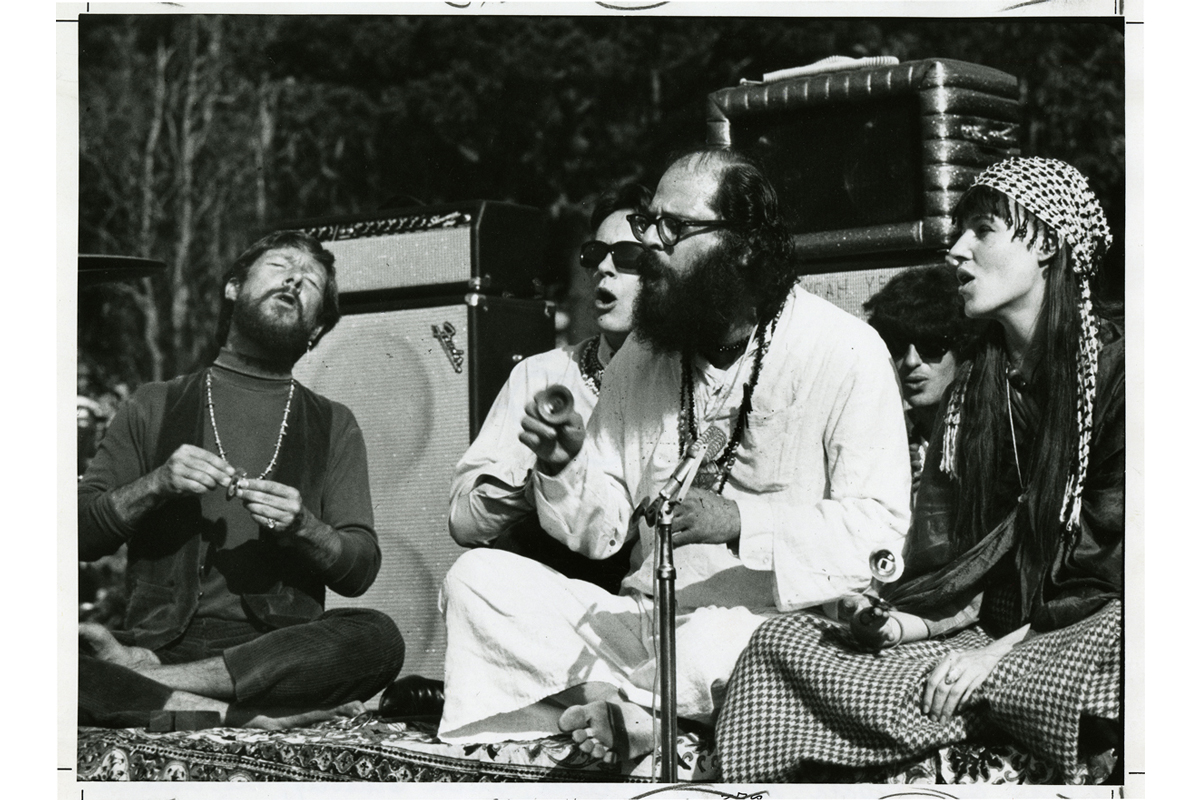
                          Gary Snyder, Michael McClure, Allen Ginsberg, Freewheelin’ Frank, and Marcetta lead chanting at the Human Be-In.

Radical political figures including the comedian/Civil Rights activist Dick Gregory and student organizer Jerry Rubin spoke.  The only woman on the program, Lenore Kandel, read erotic poetry from The Love Book, her four poem pamphlet that was at the center of a celebrated censorship case.

Although the catch phrase had not yet been coined the Human Be-In was all about sex, drugs, and rock & roll plus a dash of mysticism and of revolution.

The program was energized by performances by some of the top bands of the emerging psychedelic rock sceneJefferson Airplane, Quicksilver Messenger Service, and The Grateful Dead.

Hells Angels were on hand to provide “security” and even conducted an operation to reunite lost children with their parents Hugh Romney and the Hog Farm were there to provide foodbrown rice and veggies.  All of the classic elements of the counter culture were gathered together for the first time in one event.

                                    A rare photo of underground chemist Owsley who brought thousands of hits of pure and potent acid to the Be-In.

Most critically, the guerrilla chemist Owsley Stanley brought thousands of doses of powerful White Lighting Acid which he had manufactured just for the occasion and which was distributed freely to the crowd.

Inspired by the Be-In and Scott McKenzie’s song more than 100,000 kids descended on the overwhelmed Haight.  Despite the best efforts of locals to accommodate them, most ended up on the street and many were prey for sexual exploitation, violence, and hard drugs like heroin.  By Fall the organizers of the Be-In were eager to send a new message—don’t come to San Francisco.  Instead they wanted to young people to stay in their own towns and create community and social movements there.

Less than ten months after the Human Be-In the community staged a Death of the Hippy mock funeral to discourage the hoards of young people who had descended on the Haight during the Summer of Love.

So on October 6, 1967 The Death of the Hippie was staged as a mock funeral in the Haight.

By that time, however, pop culture had appropriated  Hippie and characters were popping up on television shows and in moviesRowan and Martins Laugh-In premiered in January 1968.

In the boonies, kids still wanted to be Hippies.  They grew their hair long, smoked dope, dropped acid, and listened endlessly to rock and roll.  At the same time the escalating Viet Nam War and police repression of protests were radicalizing many.  In early ’68 Rubin and Abbie Hoffman would create the Yippies out of thin air to politicize the counter culture as never before.

The rest, as they say, is history.


Sunday, May 31, 2020

Sunshine of Your Love—Murfin Home Confinement Music Festival 2020

Sunshine of Your Love by Cream.

And now in honor of a glorious sunny day hereabouts, something completely different, psychedelic, loud we present Sunshine of Your Love from 1967 by what some consider to be the first rock super group Cream.
The band was formed in 1965 by lead guitarist Eric Clapton formerly with the Yardbirds and John Mayall & the Bluesbreakers; drummer Ginger Baker of The Graham Bond Organisation; and lead singer, bassist, and piano player Jack Bruce also of The Graham Bond and briefly with the Bluesbreakers as well.   Despite their close association Baker and Bruce detested each other and often fought to the edge of physical violence.  The laid-back Clapton got along well with both and facilitated mutual cooperation.

Cream--Ginger Baker, Jack Bruce, and Eric Clapton in 1967.
The band was a stripped down trio and eschewed back-up studio musicians or singers and their first English record producers worried that they would produce enough “sound to fill up the record.”  Boy, were they wrong.
Their first album Fresh Cream included immediate British hits Rollin’ and Tumblin’, Spoonful, and I’m So Glad.
Despite the success because they were so different from other British Invasion groups they were little known in the U.S.  Disc jockey and rock producer Murray the K booked them for the bottom act of a six band bill to play nine dates at the RKO 58th Street Theatre in New York City. for one of his tour packages in 1967, effectively limiting them to one song per set.
Between appearances they recorded their second album Disraeli Gears at Atlantic Studios in New York during May 1967.  Despite a volume of material, the album only took three and a half days to complete and the band’s work visas expired the day of the last session.  Released on November 2, the album was a huge success this time on both sides of the puddle as well as Australia.  And in the wake of that chart-topping success Fresh Cream finally broke out in the U.S.
Sunshine of Your Love which became Cream’s signature anthem and their biggest single hit began as a bass phrase or riff developed by Jack Bruce after being inspired by Jimmy Hendrix.  Clapton and lyricist Pete Brown later contributed to the song while a distinctive tom-tom drum rhythm was developed by Baker and sound engineer Tom Dowd.  It was truly a collaborative effort pulled together in record time.

Bruce, Baker, and Clapton reunited for the first time in 25 years for their Rock and Roll Hall of Fame induction.
The Recording Industry Association of America (RIAA) certified the single gold on September 26, 1968, signifying sales in excess of 1,000,000 copies.  In the US, it became one of the best-selling singles of 1968 and one of the best-selling at the time for the Atlantic group of labels.  In 2004, the song ranked # 65 on Rolling Stone magazine’s list of the 500 Greatest Songs of All Time, in 2005, Q magazine placed it at #19 on its list of the 100 Greatest Guitar Tracks Ever!, and in 2009, VH1 included it at #44 on its list of the Top 100 Hard Rock Songs. The song is on the Rock and Roll Hall of Fame’s list of the 500 Songs That Shaped Rock and Roll.
As for Cream, they were inducted collectively and individually in the Rock and Roll Hall of Fame.  But their shooting star burned out quickly mostly due to the clashes between Baker and Bruce.  After their 1968 album Wheels of Fire the group officially broke up but reunited in 1969 for a final studio album Goodbye after a short farewell tour.  The trio did not perform together again for 25 years when they somewhat reluctantly took the stage together for a performance at the Hall of Fame induction.

Cream lead guitarist Eric Clapton.
Individually Clapton was the most successful post-Cream with Blind Faith, another super group which included Baker, Steve Winwood of Traffic, and Ric Grech of Family.  Then came a stint as lead guitarist for Delaney and Bonnie and Friends, and fronting his own group Derek and the Dominos as well as a very successful solo career. 

Ginger Baker revolutionized rock drumming including being the first to have an extended drum solo in a number the way the Gene Krupa did in big band jazz.
Baker formed his own group Ginger Baker’s Air Force and surprisingly worked on several projects with Bruce despite their continued antagonism.  After less successful efforts he mostly dropped from sight for years to establish a recording studio in Lagos, Nigeria where he recorded African musicians and western artists, most significantly Paul McCarty and Wings for Band on the Run.  After a brief reunion tour with Cream, Baker was mostly inactive on the musical scene while he battled heroin addiction and an array of health issues.  He died on October 6, 2019 at the age of 80 at a hospital in Canterbury after being injured in a home fall and suffering a heart attack requiring surgery.

Bruce was a lead guitarist, singer, and songwriter for Cream and a restless seeker of new musical horizons while battling addiction.
Bruce was considered to be one of the most important and influential bass guitarists of all time. Rolling Stone magazine readers ranked him #eight on their list of 10 Greatest Bass Guitarist Of All Time,  In his post-Cream years he collaborated with several different artists and began to move from hard rock and blues to new forms including jazz and jazz fusion.  He released several critically acclaimed solo and collaboration albums that were not, on the whole, very commercially successful.  As noted he frequently worked with Baker, an association than neither could every really break.  His battles with alcohol and addiction were even more serious and destructive than Clapton’s and Baker’s.  After he finally beat addiction in 2003 he was diagnosed with liver cancer.  In 2003, he underwent a liver transplant, which was almost fatal, as his body initially rejected the new organ. He recovered, and in 2004 re-appeared to perform Sunshine of Your Love at a Rock Legends concert in Germany organized by the singer Mandoki.  He followed that with the Cream reunion concert in 2005.
Bruce died of liver disease on October 25, 2014, in Suffolk, England, at age 71. His funeral was held in London on November 5, 2014 and was attended by Clapton, Baker and noted musicians Phil Manzanera, Gary Brooker, Vernon Reid and Nitin Sawhney among others. Dozens assembled at the Golders Green Crematorium paying a last tribute singing together including Bruce’s best frenemy, Ginger Baker.


Monday, January 14, 2019

Flower Power Takes the Stage—The Human Be-in

A poster promoting the Human Be-in at San Francisco's Golden Gate Park.

It has been dubbed it beginning to the Hippie Era.  It was more like a coming out party for a counterculture that had been developing in the Bay Area for more than a decade. 
The Human Be-In held on January 14, 1967 in San Francisco’s Golden Gate Park attracted as many as 20,000 people and got the attention of the national media as nothing else before it.  That night’s network television news shows featured film of the event that beamed into perplexed homes across the country.  That semi-official reflection of American culture Life magazine affirmed its significance with a photo spread.
Soon Scott McKenzie’s Are You Coming to San Francisco would hit the air waves and kids from across the continent would head to Haight-Ashbury for the Summer of Love.  By spring similar events were popping up around the country.
Chicago’s first Be-In would be held at The Point near the 57th Street Beach by Hyde Park in April.  But the one held on May 14 in Lincoln Park and promoted by the Seed turned into a regular event every Sunday that year and again the following summer right up to when the park was taken over for the Democratic Convention protests in August.

The Human Be-In was the inspriation of artist and San Francico Oracle founder Michael Bowen.
The San Francisco Be-In was the brainchild of 30 year old Michael Bowen, an artist and sculptor who had connections to the well established Beat culture and who dabbled in mysticism.  According to poet Andrew Cohen who co-founded the pioneering counter culture paper the San Francisco Oracle with him, Bowen hopped to unite different cultural elements in the Bay Area—the Beats with their interest in mysticism, Berkley radicals who were powering the growing Anti-war movement, and the relatively apolitical Hippie culture in San Francisco with its fascination with hallucinogens and rock and roll.  He hoped for an event with would meld and synthesize these sometimes contradictory currents.
The catalyst for the event was a new California law which went into effect in October 1966 which made the possession and use of LSD a crime for the first time.  Brown envisioned an event where the law would be challenged by massive, open defiance.  He created the term Human Be-In as a synthesis of Humanism and the civil disobedience of Civil Rights Movement lunch counter sit-ins.

Bowen's classic creation for the Oracle.
The event was promoted heavily in the Oracle as A Gathering of the Tribes and featured on the cover of its fifth edition printed in an eye-catching purple ink.  Flyers and posters distributed at music venues like the Fillmore, Beat coffee houses and bookstores, and on the streets generated excitement.
The program was impressive.  Beat mainstays Allan Ginsberg and Gary Snyder were on hand to lend support and lead meditations.  Former Harvard professor Dr. Timothy Leary, already famous for his advocacy of LSD, made his first West Coast appearance and for the first time urged his audience to “tune in, turn on, and drop out.” With him was his associate Richard Alpert, who would soon emerge as the guru Ram Das.

Gary Snyder, Michael McClure, Allen Ginsberg, Freewheelin’ Frank, and Marcetta lead chanting at the Human Be-In
Radical political figures including the comedian/Civil Rights activist Dick Gregory and student organizer Jerry Rubin spoke.  The only woman on the program, Lenore Kandel, read erotic poetry from The Love Book, her four poem pamphlet that was at the center of a celebrated censorship case.

Although the catch phrase had not yet been coined the Human Be-In was all about sex, drugs, and rock and roll pluss a dash of mysticism and of revolution.
The program was energized by performances by some of the top bands of the emerging psychedelic rock sceneJefferson Airplane, Quicksilver Messenger Service, and The Grateful Dead.
Hell’s Angels were on hand to provide “security” and even conducted an operation to reunite lost children with their parents.  Hugh Romney and the Hog Farm were there to provide food—brown rice and veggies.  All of the classic elements of the counter culture were gathered together for the first time in one event.

A rare photo of underground chemist Owsley who brout thousands of hits of pure and potent acid to the Be-In
Most critically, the guerrilla chemist Owsley Stanley brought thousands of doses of powerful White Lighting Acid which he had manufactured just for the occasion and which was distributed freely to the crowd.
Inspired by the Be-In and Scott McKenzie’s song more than 100,000 kids descended on the overwhelmed Haight.  Despite the best efforts of locals to accommodate them, most ended up on the street and many were pray for sexual exploitation, violence, and hard drugs like heroin.  By fall the organizers of the Be-In were eager to send a new message—don’t come to San Francisco.  Instead they wanted to young people to stay in their own towns and created community and social movements there.

Less than ten months after the Human Be-In the community staged a Death of the Hippy mock funeral to discourage the hoards of young people who had descended on the Haight during the Summer of Love.
So on October 6, 1967 The Death of the Hippie was staged as a mock funeral in the Haight.
By that time, however, pop culture had appropriated the Hippie and characters were popping up on television shows and in movies.  Rowan and Martin’s Laugh-In premiered in January 1968.
In the boonies, kids still wanted to be Hippies.  They grew their hair long, smoked dope, dropped acid, and listened endlessly to rock and roll.  At the same time the escalating Viet Nam War and police repression of protests were radicalizing many.  In early ’68 Rubin and Abbie Hoffman would create the Yippies out of thin air to politicize the counter culture as never before.
The rest, as they say, is history.