.jpg)
Note—While many of my Jewish friends have liked and shared this post in the past, at least a couple have said it was hurtful and disrespectful. I acknowledge those feelings and apologize for offense taken. More of my own UUs have taken offense. General feedback has been overwhelmingly positive, however. Feel free to let me know what you think. Also of note my Tree of Life UU Congregation welcomed the McHenry County Jewish Congregation to share our building in McHenry, Illinois and they will be moving with us to a new shared worship space to be announced soon. I also have had a long time relationship with their Rabbi Maralee Gordon, a frequent guest in the pulpit in recent years. She does not necessarily endorse the sentiment here or how I expressed it.
This poem has appeared on this blog many times for Yom Kippur. I guess that this makes it an official tradition. It was inspired not only by my genuine admiration for the Holy Day, but by an ongoing controversy in my own Unitarian Universalist faith. For many years UUs have gone blithely on incorporating snatches of prayers, ritual, and tradition from other religions into our own worship. We do it mostly in good faith claiming “The Living Tradition which we share draws from many sources…”

The Jewish window from the nine faith traditions that inspire Unitarian Universalist series designed by Pam Lopatin and now on display in the Tree of Life UU Congregation in McHenry, Illinois.
But a few years ago we began hearing grief from Native Americans for adopting willy-nilly rituals and prayers which we don’t fully understand and take out of context, many of which, frankly, turned out to be New Age touchy-feely faux traditions. And from African-Americans for Kwanza being widely celebrated is in almost all-white UU Sunday Schools.
Being UU’s, many of us were stung that our well-meaning gestures were not gratefully accepted as a sort of homage. Others busily set themselves up to the task of wiping the scourge of cultural appropriation from our midst, preferably with a judicious dollop of self-flagellation with knotted whips—oops! Stole that one from 4th Century monks…No, what they did was form committees and commissions to issue long, high minded reports to be translated into deep retreats. Seminary training was amended for proper sensitivity, and scolding monitors were appointed to detect insufficient rigor in rooting out the offense at General Assemblies and meetings.

In 2020 the UU Church of Worcester in Massachusetts, the cradle church of Universalism in the U.S., celebrated Yom Kippur. Many cultural, ethnic, and secularized Jews belong to UU congregations which also welcome many interfaith families. Some Jews belong to both local synagogues and UU congregations. Ministers frequently include elements of Jewish worship even in congregations with few Jewish members.
In that spirit I offer you my poem.
And, yeah, I may also have been reading a lot of Carl Sandburg when I wrote this. Think it shows?
Cultural Appropriation
See, the Jews have this thing.
Yahweh, or whatever they call their Sky God,
keeps a list like Santa Claus.
You know, who’s been naughty and nice.
But before He puts it in your Permanent Record
and doles out the lumps of coal
He gives you one more chance
to set things straight.
So to get ready for this one day of the year—
they call it Yom Kippur
but it’s hard to pin down because
it wanders around the fall calendar
like an orphan pup looking for its ma—
the Jews run around saying they are sorry
to everyone they screwed over last year
and even to those whose toes
they stepped on by accident.
The trick is, they gotta really mean it.
None of this “I’m sorry if my words offended” crap,
that won’t cut no ice with the Great Jehovah.
And they gotta, you know, make amends,
do something, anything, to make things right
even if it’s kind of a pain in the ass.
Then the Jews all go to Temple—
even the ones who never set foot in it
the whole rest of the year
and those who think that,
when you get right down to it,
that this Yahweh business is pretty iffy—
and they tell Him all about it.
First a guy with a big voice sings something.
And then they pray—man do they ever pray,
for hours in a language that sounds
like gargling nails
that most of ‘em don’t even savvy.
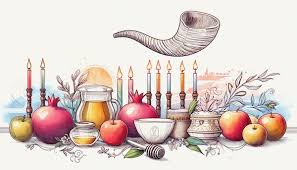
A guy blows an old ram’s horn,
maybe to celebrate, I don’t know
When it’s all over, they get up and go home
feeling kind of fresh and new.
If they did it right that old list
was run through the celestial shredder.
Then next week, they can go out
and start screwing up again.
It sounds like a sweet deal to me.
Look, I’m not much of one for hours in the Temple—
an hour on Sunday morning
when the choir sings sweet
is more than enough for me, thank you.
And I have my serious doubts about this
Old Man in the Sky crap.
But this idea of being sorry and meaning it
of fixing things up that I broke
and starting fresh
has legs.
I think I’ll swipe it.
I’ll start right now.
To my wife Kathy—
I’m sorry for being such
a crabby dickhead most of the time…
Anybody got a horn?
—Patrick Murfin



.jpg)
