Showing posts with label ICE. Show all posts

Monday, October 12, 2026

Indigenous People's Day Threatened by a MAGA Strongarm to Restore Collumbus


 Note—Just as the celebration of Indigenous People’s Day as a replacement for an official Columbus Day holiday finally seemed widely accepted the Trump DEI scourge and purge threatens to erase it—and the true story of the people it represents.  Federal institutions have been ordered to ignore it and to only mention Columbus Day.  Curricula from kindergarten to post-doc are ordered to scrub Native Americans except as a threat to European/colonialist/American expansion.  The “untrustworthy” National Park Service, Smithsonian, National Archives, and other institutions are silenced this day.  We are not.

Today is the Federal Holiday honoring Christopher Columbus, the alleged discover of the New World, who made his first landfall on the island of San Salvador on October 12, 1492.  Years ago, Congress, in all of its wisdom, assigned the holiday to the second Monday in October to make way for a possible three-day weekend for the few people who get the day off—or possibly to extend the giant mattress sales that seem to have become one of the most visible traditions of the holiday.

The trouble is Columbus has been falling out of favor for some time, except among the Italian-Americans who used his Italian roots to claim their seat at the American table.  The Columbus Day parades in the big cities are less about the Navigator—an ironic title for someone who didn’t know where the hell he was—and more about, as an Italian friend once put it, Gumba Pride.  

Columbus Day Parade - JCCIA 

                 Italian Americans display their ethnic pride and flex their political muscles at Chicago's big Columbus Day Parade.

In 2021 Puerto Rican Alderman Carlos Ramirez-Rosa of Chicago’s 35th Ward sponsored replacement official recognition of Columbus Day with Indigenous People’s Day in 2020.  It did not cancel the privately sponsored Columbus Day parade which could continue to roll.  The city sponsored music and cultural events over a two-day period.

The original holiday worked as long as the Columbus story told in 19th Century school primers was the only information out there.  But those damn historians insisted on poking around.  Lo and behold it turns out Columbus was not a very nice man.  In fact, when King Ferdinand and Queen Isabella rewarded him for his voyages with the title of Admiral of the Ocean Sea and the job of Viceroy to rule the new lands, he was so brutal, venal, and corrupt that the Catholic Priests sent to save the souls of the natives petitioned their Majesties to have him removed.  So did various adventurers and would-be Conquistadors who he slapped in irons for horning in on his exclusive franchise.
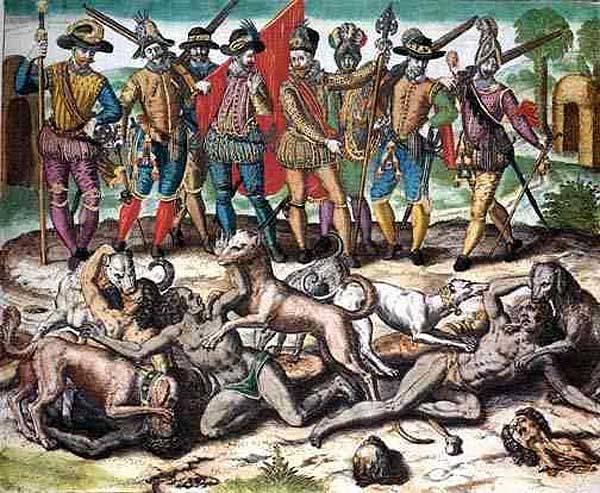
 

Columbus was personally responsible for the genocide of the Carib nation and opened the door to centuries of atrocities, exploitation, colonialist oppression, and settler replacement across Americas.

In the end he was stripped of his titles and put in irons himself.

One of the offenses with which he was charged was virtually wiping out the Carib nation which populated most of the islands of the Caribbean by turning them into slaves.  Within ten years the once numerous people were gone and the Spanish had to replace them by buying Black Africans from Arab dealers.  


An early Native American protest to Columbus Day--marching at Michigan Avenue and Wacker Drive in Chicago after being turned away from the Columbus Day Parade in 1970.    From such modest beginnings a mighty movement grew. 

By the 1960’s Native peoples in both North and South America were protesting celebrations of Columbus and demanding that the people who were his victims should be the honorees, not the thief.

In 1977 at a United Nations sponsored International Conference on Discrimination Against Indigenous Populations in the Americas held in Geneva, Switzerland the idea of replacing Columbus Day celebrations with a day honoring Indigenous Peoples was first proposed.  As the 500 year anniversary of the “Discovery” approached, Native delegates to a conference held in Quito, Ecuador in 1990 determined to plan protests and demand recognition.  “Nobody discovered us,” they asserted, “We knew where we were.”

Native groups in California were among the most vocal and organized in the protests in 1992. They persuaded the city of Berkley to become the first to rename the holiday locally to the Day of Solidarity with Indigenous People, better known as Indigenous Peoples Day.  The movement spread across the state.  Although only two other cities followed Berkley’s lead in officially adopting the name for the local holiday, school systems, libraries, and colleges began holding alternative events.  And activists began marching and sometimes disrupting official Columbus Day festivities.

South Dakota, with a large Tribal population, became the first state to jettison Columbus and adopt what they call Native American Day.  That name is also used by several Oklahoma based tribes.  Hawaii replaced Columbus Day with Discoverer’s Day, commemorating the Polynesian discoverers of the Islands. 

Several cities, including Columbus, Ohio have simply dropped the holiday entirely and canceled the traditional parades.  In San Francisco, with its large Italian community axed Columbus declared the day Italian Heritage Day instead but in 2018 also adopted Indigenous Peoples Day.

By the year 2024 20 states joined the parade to replace or co-celebrate Columbus Day with Indigenous Peoples Day in addition to countless municipalities, counties, and other units of local government. 

So far Congress has ignored calls to make a change on the Federal level.

This year Chicago is one of those cities still going ahead with its giant parade down State Street today but it will not be an official City celebration. 

Relations between Native American and Italian communities were completely ruptured after statues of Columbus were vandalized in the wake of Black Lives Matter protests that demanded monuments to historic figures who despite other accomplishments were perpetrators of oppression to People of Color and other minorities.  The City removed the statues for “safe keeping” but waffled for years on restoring at least one in place until this year when Mayor Brandon Johnson finally announced that none of the three Columbus statues on City or Park District property will be restored. 
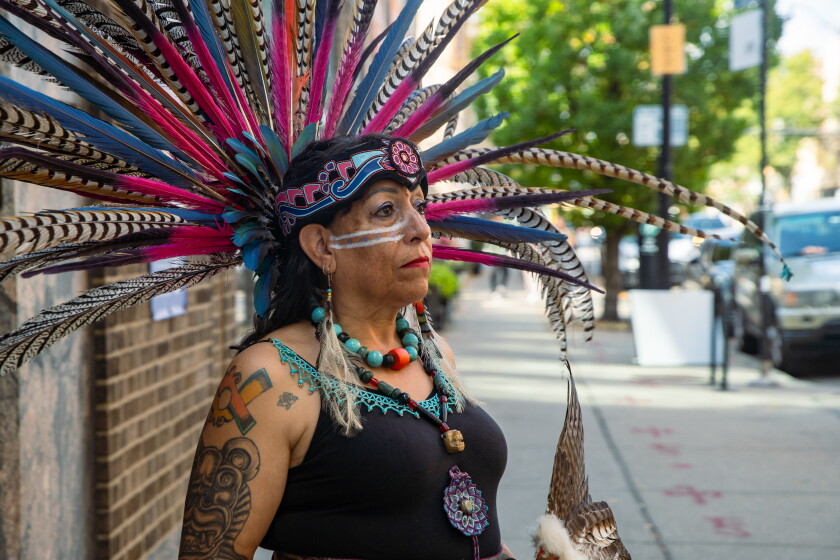
Native and Afro-Mexican traditions take center stage at Old Town School  concert for Indigenous Peoples Day - Chicago Sun-Times

                                            Native and Afro-Mexican traditions took center stage at an Old Town School of Folk Music concert.  

Ironically this year Indigenous People’s Day observations in Chicago may be threatened by targeted ICE actions because immigrants and refugees from Mexico, Central America, the Caribbean, South America and elsewhere often want to celebrate their own indigenous roots.  


Monday, October 9, 2023

Let’s Ditch Columbus to Celebrate the People Who Knew Where they Were


Today is the Federal Holiday honoring Christopher Columbus, the alleged discover of the New World, who made his first landfall on the island of San Salvador on October 12, 1492.  Years ago, Congress, in all of its wisdom assigned the holiday to the second Monday in October to make way for a possible three day week-end for the few people who get the day off—or possibly to extend the giant mattress sales that seem to have become one of the most visible traditions of the holiday.

The trouble is Columbus has been falling out of favor for some time, except among the Italian-Americans who used his Italian roots to claim their spot at the American table.  The Columbus Day parades in the big cities are less about the Navigator—an ironic title for someone who didn’t know where the hell he was—and more about, as an Italian friend once put it, Gumba Pride.  

Italian Americans display their ethnic pride and flex their political muscles at Chicago's big Columbus Day Parade.

Chicago is one of those cities plunging ahead with its giant parade today, but Mayor Brandon Johnson may not participate to court this important ethnic block.  In 2021 Puerto Rican Alderman Carlos Ramirez-Rosa of the 35th Ward sponsored replacement official recognition of Columbus Day with  Indigenous People’s Day in 2020  It would not cancel the privately sponsored Columbus Day parade which could continue to roll.  The city will sponsor music and cultural events over a two day period.

The original holiday worked as long as the Columbus story told in 19th Century school primers was the only information out there.  But those damn historians insisted on poking around.  Lo and behold it turns out Columbus was not a very nice man.  In fact, when King Ferdinand and Queen Isabella rewarded him for his voyages with the title of Admiral of the Ocean Sea and the job of Viceroy to rule the new lands, he was so brutal, venal, and corrupt that the Catholic Priests sent to save the souls of the natives petitioned their Majesties to have him removed.  So did various adventurers and would-be Conquistadors who he slapped in irons for horning in on his exclusive franchise.

In the end he was stripped of his titles and slapped in irons himself.

Columbus was personally responsible for the genocide of the Carib nation and opened the door to centuries of atrocities, exploitation, colonialist oppression, and settler replacement across Americas.

One of the offenses with which he was charged was virtually wiping out the Carib nation which populated most of the islands of the Caribbean by turning them into slaves.  Within ten years the once numerous people were gone and the Spanish had to replace them by buying Black Africans from Arab dealers. 

By the 1960’s Native peoples in both North and South America were protesting celebrations of Columbus and demanding that the people who were his victims should be the honorees, not the thief.

An early Native American protest to Columbus Day--marching at Michigan Avenue and Wacker Drive in Chicago after being turned away from the Columbus Day Parade in 1970.    From such modest beginnings a mighty movement grew.

In 1977 at a United Nations sponsored International Conference on Discrimination Against Indigenous Populations in the Americas held in Geneva, Switzerland the idea of replacing Columbus Day celebrations with a day honoring Indigenous Peoples was first proposed.  As the 500 year anniversary of the “Discovery” approached, Native delegates to a conference held in Quito, Ecuador in 1990 determined to plan protests and demand recognition.  “Nobody discovered us,” they asserted, “We knew where we were.”

Native groups in California were among the most vocal and organized in the protests in 1992. They persuaded the city of Berkley to become the first to rename the holiday locally to the Day of Solidarity with Indigenous People, better known as Indigenous Peoples Day.  The movement spread across the state.  Although only two other cities followed Berkley’s lead in officially adopting the name for the local holiday, school systems, libraries, and colleges began holding alternative events.  And activists began marching and sometimes disrupting official Columbus Day festivities.

South Dakota, with a large Tribal population, became the first state to jettison Columbus and adopt what they call Native American Day.  That name is also used by several Oklahoma based tribes.  Hawaii replaced Columbus Day with Discoverer’s Day, commemorating the Polynesian discoverers of the Islands. 

Several cities, including Columbus, Ohio have simply dropped the holiday entirely and canceled the traditional parades.  In San Francisco, with its large Italian community axed Columbus and simply declared the day Italian Heritage Day instead but in 2018 also adopted Indigenous Peoples Day.

Chicano Students at the University of Wisconsin at Madison marched for Indigenous People's Day in 2021.  The State of Wisconsin recognized the holiday that year.
 

By his year 20 states have joined the parade to replace or co-celebrate Columbus Day with Indigenous Peoples Day in addition to countless municipalities, counties, and other units of local government. 

So far Congress has ignored calls to make a change on the Federal level.

Thursday, April 2, 2026

Amanda Gorman's Minnesota Elegies--National Poetry Month 2026


                            Amanda Gorman. 

The murders of Renee Nichole Good and Alex Jeffrey Pretti at the hands of Federal paramilitary goons galvanized national attention to the brutal occupation of Minnesota and the massive resistance in the streets thousands of ordinary folks defending their neighbors.  Some will roll their eyes that once again it took White blood and brains to stir folks up who barely noticed Brown and Black victims.  Fair enough, I guess.

But Neither Good or Pretti set out to be martyrs and symbols.  They met their fates almost accidently.  Wrong place, wring time.

Amanda Gorman, the youthful Biden inauguration poet, Pulitzer Prize winner, and fashion icon has become a self-appointed Lauriat with pointed words for those who need to hear them.  Much to chic for a rebel in the streets and an anti-firebrand style,  she none the less speaks to many.


For Renee Nicole Good 

Killed by I.C.E. on January 7, 2026

They say she is no more,

That there her absence roars,

Blood-blown like a rose.

Iced wheels flinched & froze.

Now, bare riot of candles,

Dark fury of flowers,

Pure howling of hymns.

If for us she arose,

Somewhere, in the pitched deep of our grief,

Crouches our power,

The howl where we begin,

Straining upon the edge of the crooked crater

Of the worst of what we’ve been.

Change is only possible,

& all the greater,

When the labour

& bitter anger of our neighbors

Is moved by the love

& better angels of our nature.

What they call death & void,

We know is breath & voice;

In the end, gorgeously,

Endures our enormity.

You could believe departed to be the dawn

When the blank night has so long stood.

But our bright-fled angels will never be fully gone,

When they forever are so fiercely Good.

            --Amanda Goreman 


More Minnesota Resistance inspired verse coming up.

Friday, February 20, 2026

Lasting Shame of World War II Internment Camps Haunts Trump Detention Centers


Note—Despite an alleged draw down of ICE, Border, U.S. Customs and Border Protection (CBP) agents, and other masked Federal police in Minneapolis and despite Department of Homeland Security funding being blocked by Democrats in Congress, the Trump administration has access to bonanza of billions of special funding in the “Big Beautiful Bill” to press immediately forward to build 8-10 large-scale “Processing Mega-Centers,” to house between 7,000 and 10,000 detainees each for “periods averaging less than 60 days,” and serve as the site of international removals. It said it aims to detain 100,000 people at any given time.  That would indicate plans to massively increase raids, sweeps, and kidnappings nation-wide. Separately, the Justice Department has floated the arrest and detention of “domestic terrorists” including anyone identified at the scene of “interference with enforcement” including neighbors, by standers, and reporters; government officials who impeded enforcement and encouraged resistance, members of organizations endorsing or assisting resistance, and even casual social media users who expressed support for defiance or shared critical media and documented proof contrary to government claims.  It is a horrifying scenario requiring the complete destruction of Constitutional norms or democratic institutions.  It is instructive today to recall the last American mass detention. 


Japanese-American families being hauled to internment camps in a U.S. Army truck..

On February 19, 1942 President Franklin Roosevelt signed Executive Order 9066 which gave local military commanders the authority to declare military areas where exclusion zones could be established from which any or all persons could be removed.  Although the order did not specifically identify Japanese aliens and citizens, they were overwhelmingly the greatest number involved.  

A few thousand people of, German and Italian origin or lineage, mostly those actively identified with the pro-Nazi German American Bund or various Fascist organizations, were affected.  But around 120,000 Japanese of all status were rounded up and placed in War Relocation Camps—virtual concentration camps—far from their homes.   


War-time panic was stoked by a deep and wide-spread anti-Asian culture on the West Coast.  The Chinese may have been the first targets against the "Yellow Peril" but when Japanese started arriving in family groups instead of as impoverished Coolie laborers with the resources and education to establish successful businesses and productive farms, they were even more bitterly resented by the White middle class which was struggling to emerge from the Great Depression. 

Of these the vast majority were from the West Coast, which was amid a panic about a possible Japanese invasion stoked by newspaper fantasies that local Japanese would form a fifth column and sabotage defense efforts.  The war fed anti-Asian bigotry that had long been a staple of West Coast social and political life.  Yet in Hawaii, which actually came under attack and where Japanese were nearly a third of the total population, only 1,800 were interred.  

Families were typically given 48 hours to a maximum of two weeks to prepare for relocation and allowed to bring only what they could personally carry.  Many had to simply abandon homes, businesses, farms, and automobiles or were forced to sell them far below value.  


 Internment orders taped to the window of a Japanese owned business.

Camps were scattered inland over most of the states west of the Mississippi, many in inhospitable and remote areas.  Families were allowed to remain together and were generally held in barracks-like buildings hastily erected with little or no insulation.  Although rations were adequate, schools were allowed to operate, and some degree of self-government allowed within the camps, conditions were generally harsh and many military guards hostile.   


An armed sentry stands guard outside of a row of hastily constructed quarters at a remote Wyoming camp.

As time went on, individuals who could find work and sponsors away from the coast were allowed to leave the camps.  Many were sponsored by religious organizations and found work in hospitals, on farms, and even in war production plants.  

Despite these conditions, many young men, particularly the American-born Nisei generation, voluntarily enlisted in the Armed Forces.  Others were drafted.  Many served in the most highly decorated unit of the U.S. Army, the 442 Regimental Combat Team while their families remained behind barbed wire.   

Members of the all Japanese-American 422 Regimental Combat Team at the front in Italy in 1944.  They were the most decorated U.S. combat unit of World War II.  Most of their families were still being held in internment camps.

In December of 1944, the Supreme Court declared the detention of loyal citizens unconstitutional but did not overturn the whole relocation program.  

On January 2, 1945, the program officially ended.  Internees were given $25 and tickets to homes most of them no longer had.  Some camps had to remain open to accommodate those who had nowhere to go.  

In 1988, after years of petitions for redress, Congress finally passed an act apologizing for the Internment and acknowledging that it was the result of “race prejudice, war hysteria, and a failure of political leadership.”  The act included reparations for survivors. It was signed by President Ronald Regan, who many believe did so only because it was a slap to the memory of F.D.R.   

Even though Supreme Court decisions on the most famous test cases during the war were overturned in the 1980’s because the War Department was found to have lied about or hidden facts in the cases, the underlying law allowing “emergency” internment has never been overturned.  

In 1950 the McCarran Internal Security Act was passed over the veto of President Harry Truman.  It allowed the internment of… 

each person as to whom there is a reasonable ground to believe that such person probably will engage in, or probably will conspire with others to engage in, acts of espionage or sabotage.   

That meant members of the Communist Party or their agents, dupes, and tools.  The Army was directed to designate holding camps and actually began construction of some.  Some were former Japanese internment camps or Prisoner of War camps. 


Labor unions and civil libertarians placed advertisements like these in newspapers to protest the McCarran Act and the authorization of new internment camps.  In the midst of McCarthy era anti-Communist hysteria they were howling into the wind.  In the 21st Century so called Patriot Militia and White Nationalists charged that the Obama administration was reviving the camps to contain them.  Now American Muslims and detained immigrants consider themselves potential inmates.

Although the camps were never used, their existence was a continued threat.  After it was learned that the Nixon Administration considered invoking the Act to detain anti-war protestors and Black militants like the Black Panthers, Congress revoked most of the internment provisions of the McCarran Act in 1971 substituting criminal trial and prison sentences for certain overt acts. 

In 1993, the Supreme Court overturned many of the remaining sections of the law as an unconstitutional abridgement of free speech. 

But vestiges of the act remain in force and have been cited in prosecutions like the Pentagon Papers case in 1972, the American Israel Public Affairs Committee (AIPAC) involvement the collection of intelligence by pro-Israeli lobbyists in 2005, and the Bradley (Chelsea) Manning case. 

In the days following the 9/11 attacks there were public calls for the rounding up and detention of Arabs and other practicing Muslim aliens of both illegal and legal status.  Broad new powers, some barely understood by the public, were granted to the government under the so-called Patriot Act which again could lead to possible widespread detention in “the interest of national security.” 

One thing that united the radical right and the American left is a conviction that the McCarran Act camps were being readied for use against them.  An elaborate scenario involving UN Black Helicopters, a New World Order, and jackbooted Federal thugs kicking down doors to seize guns was a staple paranoia of the right which took on new urgency with them during the administration of Barak Obama, the Muslim/Communist/Fascist/American-Hater. 

The enhanced use of domestic surveillance and the coordination by Federal authorities in attacks on Occupy Movement encampments and on Black Lives Matter demonstrators across the country and the election of Donald Trump fueled similar fears on the left. 

While both paranoid scenarios seemed farfetched, the nagging truth is that they don’t now seem entirely impossible in the aftermath of an actual failed uprising and deepening divisions leading to possible civil war.  After all, it happened before.  It could happen again. 


Lea Salonga, George Takei, and Telly Leung take their bows on the opening night of Takei's acclaimed play Allegiance which raised awareness of the World War II internment camps.

Not surprisingly, survivors of the war-time camps like beloved actor and internet icon George Takei and their descendants have led the way in sounding the alarm as the nation inches closer to repeating the horror.