Showing posts with label Native Americans. Show all posts

Monday, October 13, 2025

Indigenous People’s Day Eclipse of Columbus Day Threatened

Honoring Heritage Celebration Indigenous Peoples Day Culture Stock Photos -  Free & Royalty-Free Stock Photos from Dreamstime 

Note—Just as the celebration of Indigenous People’s Day as a replacement for an official Columbus Day holiday finally seemed widely accepted the Trump DEI scourge and purge threatens to erase it—and the true story of the people it represents.  Federal institutions have been ordered to ignore it and to only mention Columbus Day.  Curricula from kindergarten to post-doc are ordered to scrub Native Americans except as a threat to European/colonialist/American expansion.  Now abetted by the Government Shutdown the “untrustworthy” National Park Service, Smithsonian, National Archives, and other institutions are silenced this day.  We are not.

Today is the Federal Holiday honoring Christopher Columbus, the alleged discover of the New World, who made his first landfall on the island of San Salvador on October 12, 1492.  Years ago, Congress, in all of its wisdom, assigned the holiday to the second Monday in October to make way for a possible three day week-end for the few people who get the day off—or possibly to extend the giant mattress sales that seem to have become one of the most visible traditions of the holiday.

The trouble is Columbus has been falling out of favor for some time, except among the Italian-Americans who used his Italian roots to claim their seat at the American table.  The Columbus Day parades in the big cities are less about the Navigator—an ironic title for someone who didn’t know where the hell he was—and more about, as an Italian friend once put it, Gumba Pride.  

Columbus Day Parade - JCCIA 

                 Italian Americans display their ethnic pride and flex their political muscles at Chicago's big Columbus Day Parade.

In 2021 Puerto Rican Alderman Carlos Ramirez-Rosa of Chicago’s 35th Ward sponsored replacement official recognition of Columbus Day with  Indigenous People’s Day in 2020  It did not cancel the privately sponsored Columbus Day parade which could continue to roll.  The city sponsored music and cultural events over a two day period.

The original holiday worked as long as the Columbus story told in 19th Century school primers was the only information out there.  But those damn historians insisted on poking around.  Lo and behold it turns out Columbus was not a very nice man.  In fact, when King Ferdinand and Queen Isabella rewarded him for his voyages with the title of Admiral of the Ocean Sea and the job of Viceroy to rule the new lands, he was so brutal, venal, and corrupt that the Catholic Priests sent to save the souls of the natives petitioned their Majesties to have him removed.  So did various adventurers and would-be Conquistadors who he slapped in irons for horning in on his exclusive franchise.
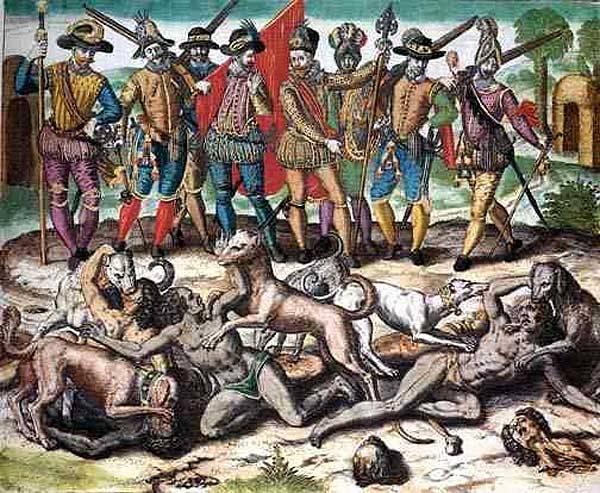
 

Columbus was personally responsible for the genocide of the Carib nation and opened the door to centuries of atrocities, exploitation, colonialist oppression, and settler replacement across Americas.

In the end he was stripped of his titles and put in irons himself.

One of the offenses with which he was charged was virtually wiping out the Carib nation which populated most of the islands of the Caribbean by turning them into slaves.  Within ten years the once numerous people were gone and the Spanish had to replace them by buying Black Africans from Arab dealers.  


An early Native American protest to Columbus Day--marching at Michigan Avenue and Wacker Drive in Chicago after being turned away from the Columbus Day Parade in 1970.    From such modest beginnings a mighty movement grew. 

By the 1960’s Native peoples in both North and South America were protesting celebrations of Columbus and demanding that the people who were his victims should be the honorees, not the thief.

In 1977 at a United Nations sponsored International Conference on Discrimination Against Indigenous Populations in the Americas held in Geneva, Switzerland the idea of replacing Columbus Day celebrations with a day honoring Indigenous Peoples was first proposed.  As the 500 year anniversary of the “Discovery” approached, Native delegates to a conference held in Quito, Ecuador in 1990 determined to plan protests and demand recognition.  “Nobody discovered us,” they asserted, “We knew where we were.”

Native groups in California were among the most vocal and organized in the protests in 1992. They persuaded the city of Berkley to become the first to rename the holiday locally to the Day of Solidarity with Indigenous People, better known as Indigenous Peoples Day.  The movement spread across the state.  Although only two other cities followed Berkley’s lead in officially adopting the name for the local holiday, school systems, libraries, and colleges began holding alternative events.  And activists began marching and sometimes disrupting official Columbus Day festivities.

South Dakota, with a large Tribal population, became the first state to jettison Columbus and adopt what they call Native American Day.  That name is also used by several Oklahoma based tribes.  Hawaii replaced Columbus Day with Discoverers Day, commemorating the Polynesian discoverers of the Islands. 

Several cities, including Columbus, Ohio have simply dropped the holiday entirely and canceled the traditional parades.  In San Francisco, with its large Italian community axed Columbus and simply declared the day Italian Heritage Day instead but in 2018 also adopted Indigenous Peoples Day.

By this year 20 states have joined the parade to replace or co-celebrate Columbus Day with Indigenous Peoples Day in addition to countless municipalities, counties, and other units of local government. 

So far Congress has ignored calls to make a change on the Federal level.

This year Chicago is one of those cities still going ahead with its giant parade down State Street today but it will not be an official City celebration. 

Relations between Native American and Italian communities were completely ruptured after statues of Columbus were vandalized in the wake of Black Lives Matter protests that demanded monuments to historic figures who despite other accomplishments were perpetrators of oppression to People of Color and other minorities.  The City removed the statues for “safe keeping” but  waffled for years on restoring at least one in place until this year when Mayor Brandon Johnson finally announced that none of the three Columbus statues on City or Park District property will be restored. 
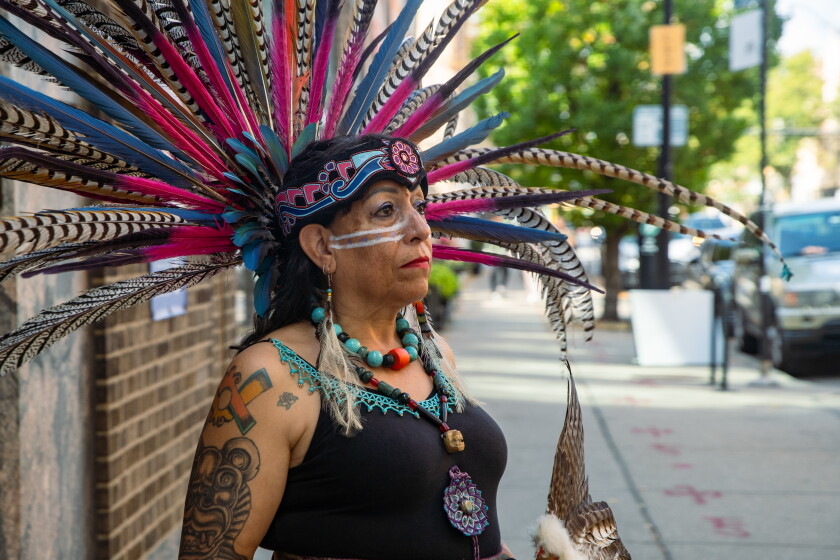
Native and Afro-Mexican traditions take center stage at Old Town School  concert for Indigenous Peoples Day - Chicago Sun-Times 

      Native and Afro-Mexican traditions took center stage at an Old Town School of Folk Music concert.  Events like it may draw ICE kidnappers.

Ironically this year Indigenous People’s Day observations in Chicago may be threatened by targeted ICE actions because immigrants and refugees from Mexico, Central America, the Caribbean, South America and elsewhere often want to celebrate their own indigenous roots.  


Wednesday, September 24, 2025

Native Holy Site Devils Tower Became the First U.S. National Monument


                                            A 1950's era National Park Service poster promoted visits to Devils Tower National Monument in Wyoming. 

My old home state of Wyoming has a lot of memorable, iconic sights—the Yellowstone geyser Old Faithful, the front range of the Grand Tetons, Independence Rock on the old Oregon Trail But nothing is more unusual or more recognized than the formation that looks like a giant tree stump rising high above the winding Belle Fouche River in a remote corner of the state—Devils Tower

After 10 years of futile efforts by the Wyoming Congressional delegation to have a much larger area including the formation declared a National Park on September 24, 1906 President Theodore Roosevelt, proclaimed Devils Tower a National Monument. It was the first ever use of that designation.  Only 1,152.91 acres of the originally proposed park were protected.  

Two years later the rest of the abortive park in the drainage, including the nearby Little Missouri Buttes, were opened for public use—a victory for both timber interests and cattlemen seeking yet more open range grazing.

No one is exactly sure when the imposing feature was first seen by Whites.  Likely early trappers caught a glimpse, but accounts have not been found.  In 1857 Lt. G. K. Warrens expedition to reach the Black Hills from Ft. Laramie was turned away from the area by a large party of hostile Lakota Warren’s log mentions seeing the Bear Lodge—one of several indigenous names for the rock—and the Little Missouri Buttes in the distance through a powerful telescope.  But some scholars believe, because he did not remark on its unusual configuration, that he was probably referring to the Bear Lodge Mountains also nearby.

On July 20, 1859 topographer J. T. Hutton and Sioux scout Zephyr Recontre reached the formation.  They were a small party from the larger Capt. W. F. Raynolds Yellowstone Expedition But once again neither Hutton nor Raynolds left a detailed account.  


 A 1900 photograph of Devil's Tower.  Few visitors came to the remote location far from rail lines and improved roads of any kind.  Most visitors packed in by horse and mule for days to see the marvel.

It wasn’t until 1875 that a U.S. Geological Survey expedition and its military escort under Col. Richard I. Dodge studied the formation and described in detail.  Expedition member Henry Newt wrote: 

Its remarkable structure, its symmetry, and its prominence made it an unfailing object of wonder. . . It is a great remarkable obelisk of trachyte, with a columnar structure, giving it a vertically striated appearance, and it rises 625 feet almost perpendicular, from its base. Its summit is so entirely inaccessible that the energetic explorer, to whom the ascent of an ordinarily difficult crag is but a pleasant pastime, standing at its base could only look upward in despair of ever planting his feet on the top.

Dodge was credited with giving the formation its now familiar English name.  As was so often the case, it came from a misunderstanding about a native name.  An interpreter mistranslated one of the native names—most of which were some variation of Bear’s Lodge in several different Plains tribe tongues—to Bad Gods Tower.  Expedition members converted this to “Devil’s Tower.”  Following standard topographical practice, the apostrophe was dropped from the official name given the formation.  We can be fairly certain that the translation somehow went awry because none of the many native legends associated with the rock have anything remotely to do with a “bad god.” 

Of course, Native tribes had been aware of the Tower.  It was considered magical or sacred by many tribes—in addition to the Lakota and other Sioux the Arapaho, Cheyenne, Crow, and Kiowa The Lakota, the dominant tribe in the since their arrival from the area around the headwaters of the Mississippi in the late 18th Century and their spectacularly successful adoption of the horse centered Plains Indian culture, regarded the Bear Lodge—Matho Thípila—as a sacred location second only to the Black Hills

The various tribes have different origin stories for the great rock and many associations with mythic figures or great heroes.  Many used the Tower as the site of individual cleansing rituals, group spiritual practice such as the Sun Dance and Sweat Lodge purifications, and as a sacred burial ground for heroes and great shamans.  The Lakota associated it with one of their most sacred objects, the White Buffalo Pipe, a gift of White Buffalo Woman, a great spiritual mythic or semi-mythic presence. 


Of several origin stories from various tribes, the Park Service has heavily promoted the somewhat dubious Bear Legend connecting the tower to the Pleiades star formation--a Lakota tale grafted to stories of European origin.  This painting is on display at the visitor's center and is regularly used in Park Service literature. 

Among the many legends associated with the tower, the National Park Service, custodians of the Monument, heavily promoted one story in their literature.  In this tale, shared in slightly different forms by the Kiowa and Lakota, seven Indian girls were playing or gathering food near the river when a giant bear attacked them.  The girls fled and ran to a large stump.  They jumped on it and began to pray to the Great Spirit (this language is a tip-off that the story has been laundered through Whites and not collected directly from the people) for help.  Hearing their prayers, he began to raise the stump to the heavens.  As it grew and grew, the enormous Bear tried to climb the stump leaving his claw marks on the side and littering the base with the shredded bark.  The Bear could not reach the girls and went away.  But by then the stump had grown so high that the girls could not climb down.  Taking pity on their plight, the Great Spirit transformed the girls into seven stars directly above the tower, stars known to Europeans as the Pleiades.  It is difficult to tell know exactly how much of this popular story—I was entranced with it as boy—came from authentic tradition, and how much grafted from similar tales in Western mythology.


Standing in a spring snow, this Park Service Sign warns visitors to leave Native sacred objects alone.  Despite the admonition tourists steal or attempt to steal objects as souvenirs. 

Today members of several tribes continue to hold ritual observances at the Tower, although burials are now forbidden by the Park Service. 

It is also a popular tourist attraction, although it takes a fairly determined tourist to get there.  Located hours away from the nearest attractions in the Black Hills, far from any town of even modest size, well away from major highways, most visitors have to dedicate an entire day to seeing just this one sight.  There is only one café at road junction miles away and a Park Service concession stand on site for food.  There are a couple of 1950’s style motels nearby, dude ranches in the area, and camping at Monument.


Devils Tower became an alien landing place in Stephen Spielberg's Close Encounters of a Third Kind sparking new waves of visitors to the remote location. 

Yet people come.  Visits took a dramatic jump when Steven Spielberg featured the Tower as the alien landing spot in Close Encounters of the Third Kind.  And it has become a Mecca for the growing sport of rock climbing.  Hundreds make the climb every season, as many as a dozen a day, using several well established routes to the top on every side. 

Native tribes, for home the site is sacred, objected to any climbing.  White climbers and the tribes were at odds for years until the Park Service brokered a “voluntary” compromise.  Since most tribes hold their holiest ceremonies at the Tower in June, the Park Service asked climbers to voluntarily refrain from ascending the rock in that month.  They estimate that 85% of climbers honor that agreement.  But authorities are powerless to stop those who do not.  A climbing group and local tourist interests have sued the Park Service for even suggesting self-restraint.


On a nice summer day dozens of parties can be seen ascending the tower.  Here two groups are rappelling down from the top. 

I visited Devils Tower several times as a boy.  Years ago, when my two oldest daughters were still children my wife and I made the long trip from the Black Hills to show it to them.  It was one of the few natural wonders that they saw on that Western trip that actually impressed them.  They even managed to hike the trail that encircles the rock, quite an achievement for kids allergic to walking.