 |
Irish Volunteers on the march in Dublin in the outset of the 1916 Easter Rebellion.
Last Friday, April 24 was 104th anniversary of the day when the Irish
Volunteers, Irish Citizen’s Army, the 200 women members of Cumann
na mBan, and a small force of Hibernian Rifles seized key buildings in Dublin,
including the General Post Office and read the Proclamation of the Irish Republic.
It was, by no coincidence, Easter
Monday.
In the
five bloody days that followed the Royal Navy shelled the city and
thousands of troops poured in
eventually crushing the rebellion
with heavy casualties. All seven signatories of the Proclamation
including Padraig Pearce and
the wounded socialist and radical labor unionist James Connolly and seven others,
including men who were not even directly
involved, were executed by firing squads.

Over 1,500 rebels
were placed in virtual concentration
camps where they met in secret
and plotted revolution.
The Rebellion was crushed
but despite epic British repression,
the flame of Irish independence and
liberty was never extinguished. Survivors of the insurrection and those
inspired by the sacrifices the Irish martyrs met and organized in secret over the next years under the
political leadership of the Sinn Féin
party and the creation of the Irish Republican Army. The Declaration of Independence was a document adopted by Dáil Éireann,
the revolutionary parliament of the
Irish Republic, at its first meeting in the Mansion House in Dublin on January 21, 1919.
A bloody and remorseless year a half guerilla war revolution followed. By mid-1920
revolutionary forces we in de facto control of most of the country except for
the capital in Dublin and majority Protestant
Ulster where a particularly savage civil war was contested. The British were exhausted by the monumental
losses of the Great War of
1914-1918 public opinion was rising
against continuing a war in Ireland.
In May 1921, Ireland was partitioned under British law by the Government of Ireland Act, which created Northern Ireland.
Both sides agreed to a truce on July
11. The post-ceasefire talks led to the signing of the Anglo-Irish Treaty on December 6.1921. This ended British rule in most of Ireland
and, after a ten-month transitional
period overseen by a provisional
government, the Irish Free State
was created as a self-governing Dominion
of the British Empire on December 6,
1922 while Northern Ireland remained within the United Kingdom.

But Republicans were bitterly divided over the exclusion of
Ulster from the rest of the country. After the ceasefire, violence in Belfast and fighting in border areas of Northern Ireland
continued, and the factions of the IRA launched a failed Northern offensive
in May 1922. In June disagreement among republicans over the Anglo-Irish Treaty
broke out into the eleven-month Irish
Civil War. Eamon DeVallera rallied forces against the Provisional Government
headed by Michael Collins, IRA commander
during the revolution. Collins was assassinated August and many
anti-treaty Republican leaders were also killed. Casualties probably greatly exceeded those
lost during the Revolution. The Free
State government finally prevailed.
But DeVallera and his hyper-Catholic
nationalists made steady political gains over the next decade and a half
while the anti-treaty or irregular IRA continued
to operate on a low level in the North. Following a national plebiscite in July 1937 a new Constitution of Ireland replaced the Constitution of the Irish Free
State and adopted Éire as the new
name of the country. While Articles 2
and 3 of the Constitution defined the national
territory to be the whole island, they also confined the state’s jurisdiction to the area that had been
the Irish Free State.
DeVallera’s Fianna
Fáil party became the dominant force in the country and he became Taoiseach—prime
minister serving three times.

The dream of uniting Ireland never went away and there were periodic campaigns by IRA elements in
Ulster for years. The late 1960’s saw
the beginning of The Troubles that
continued for decades until 1998 when a shaky
cease fire and a drawn-out peace
process began. Finally the St Andrews Agreement between the British
and Irish governments and Northern Ireland's political parties in relation to
the devolution of power in the region led to a final withdrawal
of British troops in Northern Ireland and Sinn Féin finally agreeing to participate in Northern Ireland’s parliament.

The ride has not been all smooth since then, but general
peace has prevailed. Brexit has threatened to erect a tariff wall between the Republic and
the North since Éire remained staunchly
attached to the European Union
which could destroy the common economy of the island.
On the other hand the government in the South has finally
shaken domination by the Catholic Church
and adopted liberal reforms allowing for divorce and even abortion which
makes the South less threatening to Protestants in the North. Even those Protestants, now on the verge of
becoming a minority in Ulster, also
rejected Brexit although they were dragged
into it. It is not inconceivable the Northern Ireland like
Scotland and perhaps Wales could seek to leave the United Kingdom to rejoin Europe which
could finally lead to the reunification of Ireland.

That’s a lot of history and drama. Which makes William Butler Yeats’ powerful poem Easter 1916 seem more prophetic. Yeats, generally listed
along with Anglo-American T.S. Eliot
as one of the greatest English Language
poets of the 20th Century,
witnessed the Rising but did not participate.
In fact at first he was ambivalent
at first as were many surprised Dubliners.
But he was moved by the executions of the leaders. Easter,
1916 became a Republican rallying
cry. It is always read at annual commemorations of the Rising in
Dublin.

Easter, 1916
I have met them at close of day
Coming with vivid faces
From counter or desk among grey
Eighteenth-century houses.
I have passed with a nod of the head
Or polite meaningless words,
Or have lingered awhile and said
Polite meaningless words,
And thought before I had done
Of a mocking tale or a gibe
To please a companion
Around the fire at the club,
Being certain that they and I
But lived where motley is worn:
All changed, changed utterly:
A terrible beauty is born.
That woman's days were spent
In ignorant good-will,
Her nights in argument
Until her voice grew shrill.
What voice more sweet than hers
When, young and beautiful,
She rode to harriers?
This man had kept a school
And rode our wingèd horse;
This other his helper and friend
Was coming into his force;
He might have won fame in the end,
So sensitive his nature seemed,
So daring and sweet his thought.
This other man I had dreamed
A drunken, vainglorious lout.
He had done most bitter wrong
To some who are near my heart,
Yet I number him in the song;
He, too, has resigned his part
In the casual comedy;
He, too, has been changed in his turn,
Transformed utterly:
A terrible beauty is born.
Hearts with one purpose alone
Through summer and winter seem
Enchanted to a stone
To trouble the living stream.
The horse that comes from the road,
The rider, the birds that range
From cloud to tumbling cloud,
Minute by minute they change;
A shadow of cloud on the stream
Changes minute by minute;
A horse-hoof slides on the brim,
And a horse plashes within it;
The long-legged moor-hens dive,
And hens to moor-cocks call;
Minute by minute they live:
The stone's in the midst of all.
Too long a sacrifice
Can make a stone of the heart.
O when may it suffice?
That is Heaven's part, our part
To murmur name upon name,
As a mother names her child
When sleep at last has come
On limbs that had run wild.
What is it but nightfall?
No, no, not night but death;
Was it needless death after all?
For England may keep faith
For all that is done and said.
We know their dream; enough
To know they dreamed and are dead;
And what if excess of love
Bewildered them till they died?
I write it out in a verse—
MacDonagh and MacBride
And Connolly and Pearse
Now and in time to be,
Wherever green is worn,
Are changed, changed utterly:
A terrible beauty is born.
—William Butler Yeats
|
Showing posts with label Irish Civil War. Show all posts
Showing posts with label Irish Civil War. Show all posts
Monday, April 27, 2020
Easter, 1916—National Poetry Month 2020


Sunday, January 26, 2014
From the IRA to Amnesty—The Long, Strange Path of Seán MacBride
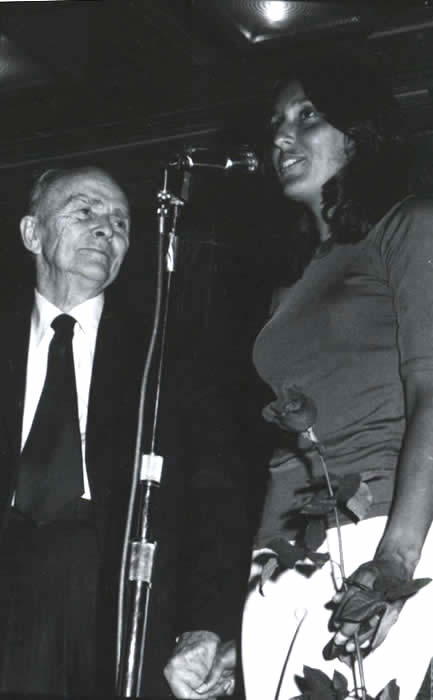 |
| Joan Baez salute Sean MacBride on his retirement as International Chairman of Amnesty International. |
When Seán MacBride died in Dublin, Ireland in 1988 at the age of
84 he was the most honored human rights leader in the world. He had taken a leading role in almost every
international initiative on human rights since World War II and had founded and led several important
organizations, most notably Amnesty International. He was the only man to win both the both the Nobel and Lenin Peace Prizes. But his
path to those honors went through revolution,
civil war, prison, and politics.
Seán
MacBride was bon the son of Major John MacBride and Maude Gonne on January 26, 1904. His father was an ardent Irish nationalist and a
leading member of the Irish Republican
Brotherhood who had raised an Irish commando
to fight with the Boers against
the British in South Africa. Maude Gonne,
most famous as the muse and obsessive love object of William Butler Yeats, was a beautiful and equally ardent nationalist
who was prominent in the Gaelic Revival movement. She had organized pro-Boer demonstrations in Dublin and encouraged enlistment it the
far away war as way of “twisting the Lion’s tail.”
Gonne
was living in Paris where MacBride visited her after the war. They wed in 1902 to Yeats’s deep anguish. Despite the birth of their son the next year,
the marriage was not a happy one. Gonne
would later confide in Yeats that there was abuse and that the soldier may have
molester her 11 year old daughter Iseult.
Sean’s parents were separated in 1905 and he
was raised on the continent speaking French as a first language.
His
father returned to Ireland was active in Republican circles. But he was too well known and closely watched
by British authorities so that despite his military experience, he was not
included in the leadership of those planning an uprising. When it broke out at Eastertide 1916, the Major was caught unawares. But he volunteered his services on the spot
and was appointed by Thomas MacDonagh as second in
command of a contingent defending the Jacobs
biscuit factory. After his capture
he was executed by the British.
Although
young Sean had not seen his father since infancy, he was a flame with desire to
join the cause for which he was a Martyr.
He mother did little to dissuade him.
She sent him in 1919 to school at Mount
St. Benedic’s in Gorey, County Wexford. Although he was only 15, she must have
known that he would join the new rebellion against British rule. He joined the new Irish Republican Army (IRA), the decedent of the Irish Republican
Brotherhood and the remnant of the Irish
Volunteers of the Easter Rebellion, in
the War for Independence.
He
among those opposed to the 1921 Anglo-Irish
Treaty ended the war, with the new Irish
Free State still a part of the Empire
and without the provinces of Ulster which
remained under British rule. He joined forces IRA favoring total independence,
and was jailed by Free State
authorities during the Civil War.
Upon
release in 1924 MacBride took up studies for the law at University College Dublin and resumed his IRA activities. He served briefly as Éamon de Valera’s personal aide.
In
1925 MacBride married Catalina “Kid”
Bulfin, four years his senior and also an ardent Republican. Under close surveillance by the Free State
government, the young couple went abroad where MacBride worked as a journalist in
Paris and London—and likely as an
IRA covert agent.
He
returned to Ireland in 1927 but was arrested on charges of assassinating a Free
State figure. Able to prove that he was
non shipboard when the killing took place, he was none the less kept in custody
and charged with subversive activities.
When
finally released, MacBride became involved with an IRA faction that was
becoming disillusioned by de Valera’s Fianna
Fáil. They favored a more socialist agenda. MacBride founded the political grouping Saor Éire (Free Ireland) separate from
the IRA command while remaining loyal to the army. It and nine other groups were declared unlawful
alongside of the IRA. MacBride became
the chief target of Free State security forces
Meanwhile
MacBride rose in the IRA command structure.
In 1936 he became Chief of Staff. He did not last long in that position,
however. He was replaced by Tom Barry who was given permission to
launch new operations against the British in Ulster and to explore possible
support from Nazi Germany, both
policies opposed by MacBride.
In
1937 after the passage of the new Constitution of
Ireland
he resigned his commission and membership in the IRA, although he remained
politically close to many old comrades. He finally passed the Bar and began a career as a lawyer. The IRA, however kept up its low grade
guerilla war in Ulster and despite his personal disapproval, Barry acted as a
lawyer for many charged by the new government.
Over the next few years, into the World War II era he would become increasingly known for defending the rights of
political prisoners.
In
1946, MacBride founded the republican/socialist party Clann na Poblachta in the hopes that it would replace Fianna Fáil
as Ireland’s major political party. In October 1947, he won a seat in Dáil
Éireann at a by-election in the Dublin
County constituency. Despite his high hopes, his new party won only 10
seats in the 1948 election, in which no party emerged with a majority. He brought the party into a coalition government under Fine Gael Taoiseach (prime minister) John A. Costello. MacBride entered the government as Minister of External Affairs. It was in this position that he brought
his increasing passion for human rights to the international area.
MacBride
stepped out in the world, and particularly the European stage, in a big
way. First, he was delighted to play a
leading role in the Repeal of the
External Relations Act and the Declaration
of the Republic of Ireland which severed the last tenuous ties to Britain
by exiting the Commonwealth of Nations on
Easter Monday, April 18, 1949.
The
same year he was elected as President of
the Committee of Ministers of the Council of Europe, which could only be
considered a stinging rebuke to the British.
In that role he helped draft the European
Convention on Human Rights and pressed for its adoption at Rome in
1950. That year he was elevated to President of the Council of Foreign
Ministers of the Council of Europe, and he was vice-president of the Organization for European Economic
Co-operation (OEEC.) Although a supporter of greater European
cooperation, he did not want it to come at the expense of being dragged into a
military alliance with the West against
the East. He kept Ireland out of NATO.
Despite
his personal popularity and the esteem in which he was regarded internationally,
however, there was trouble at home. His
political party was falling apart, particularly after he forced the resignation
from the cabinet of the only other Clann na Poblachta member, Health Minister and former close ally Dr. Noël Browne who was promoting the controversial
Mother and Child Scheme of public
health coverage for mothers and children under 16 over the voracious opposition
of the Catholic Hierarchy.
In
the 1951 elections, due in no small measure to the health care controversy,
MacBride’s party was reduced to two seats although he won re-election. The Multi-Party
Government fell and Éamon de Valera’s increasingly conservative Fianna Fáil
was swept back to power. MacBride was
reduced to a virtual back bencher, although he won re-election in 1954.
After
the IRA Cross Border Campaign in Ulster began in 1956, MacBride spoke
out against internment of Republican suspects by the Irish government. He campaigned on the issue in 1957 and ’61 but
was defeated both times by an electorate tired of never ending conflict and
willing to back de Valera’s harsh policy.
MacBride
retired from active politics after the second defeat, and concentrated on his
legal practice. Yet his attention was
once again drawn to the world stage. He
was served as Secretary-General of the
International Commission of Jurists from 1963 to 1971then was elected Chair (1968–1974) and later President (1974–1985) of the International Peace Bureau in Geneva.
As
a lawyer, he became interested in Anti-colonialism,
especially in Africa. He was called upon to help draft the constitution
of the Organization of African Unity
(OAU) and also the first
constitution of Ghana, the first of
Britain’s African colonies to gain independence.
MacBride
also became deeply involved in the United
Nations which he served in many capacities including, President of the General
Assembly, High Commissioner for Refugees, and High Commissioner for Human
Rights. As High Commissioner for Namibia he was also named Assistant Secretary-General. He was President of UNESCO's International
Commission for the Study of Communications Problems, which produced the
controversial 1980 MacBride Report which
recommended democratization of communication.
But
MacBride is best remembered for his work with Amnesty International. He
was a close ally of British lawyer Peter
Benenson in founding the organization in 1971 and served as its International Chairman and most visible
public face from 1965 to’74.
MacBride’s
work was recognized with the Nobel Peace Prize in 1974, the Lenin Peace Prize
for 1975–76, and the UNESCO Silver Medal
for Service in 1980.
His
additional work for peace included the Appeal
by Lawyers against Nuclear War which eventually resulted in an Advisory Opinion by the International Court of Justice on the Legality
of the Threat or Use of Nuclear in 1996/
He
was Chairman of the International Convention to investigate
violations of International Law by Israel during its invasion of the Lebanon.
The commission reported numerous violations and was harshly criticized
by Israel and in America by a vocal Jewish lobby.
In
the MacBride Principles he laid out
a serious of standards of behavior for fair
employment by American corporations doing business in Northern Ireland for Catholics who were the traditional
victims of discriminated in Ulster. The
nine point plan was rejected flatly by the British government and ruling Ulster
Protestants and was even criticized as “counterproductive” by the Irish
government. None-the-less the Principles
were endorsed by 18 state governments and over 40 cities. They are now considered a model for American
action in support of oppressed populations around the world.
Active
almost to his last days, MacBride spent his later years dividing his time
between his mother’s famous estate, Roebuck
House and the Paris arrondissement where he grew up with
his mother.
He
died in Dublin on January 15, 1988 just days shy of his 84h birthday and was
laid to rest next to his mother and wife at Glasnevin Cemetery where many Irish patriots were buried.
Subscribe to:
Posts (Atom)