 |
Irish Volunteers on the march in Dublin in the outset of the 1916 Easter Rebellion.
Last Friday, April 24 was 104th anniversary of the day when the Irish
Volunteers, Irish Citizen’s Army, the 200 women members of Cumann
na mBan, and a small force of Hibernian Rifles seized key buildings in Dublin,
including the General Post Office and read the Proclamation of the Irish Republic.
It was, by no coincidence, Easter
Monday.
In the
five bloody days that followed the Royal Navy shelled the city and
thousands of troops poured in
eventually crushing the rebellion
with heavy casualties. All seven signatories of the Proclamation
including Padraig Pearce and
the wounded socialist and radical labor unionist James Connolly and seven others,
including men who were not even directly
involved, were executed by firing squads.

Over 1,500 rebels
were placed in virtual concentration
camps where they met in secret
and plotted revolution.
The Rebellion was crushed
but despite epic British repression,
the flame of Irish independence and
liberty was never extinguished. Survivors of the insurrection and those
inspired by the sacrifices the Irish martyrs met and organized in secret over the next years under the
political leadership of the Sinn Féin
party and the creation of the Irish Republican Army. The Declaration of Independence was a document adopted by Dáil Éireann,
the revolutionary parliament of the
Irish Republic, at its first meeting in the Mansion House in Dublin on January 21, 1919.
A bloody and remorseless year a half guerilla war revolution followed. By mid-1920
revolutionary forces we in de facto control of most of the country except for
the capital in Dublin and majority Protestant
Ulster where a particularly savage civil war was contested. The British were exhausted by the monumental
losses of the Great War of
1914-1918 public opinion was rising
against continuing a war in Ireland.
In May 1921, Ireland was partitioned under British law by the Government of Ireland Act, which created Northern Ireland.
Both sides agreed to a truce on July
11. The post-ceasefire talks led to the signing of the Anglo-Irish Treaty on December 6.1921. This ended British rule in most of Ireland
and, after a ten-month transitional
period overseen by a provisional
government, the Irish Free State
was created as a self-governing Dominion
of the British Empire on December 6,
1922 while Northern Ireland remained within the United Kingdom.

But Republicans were bitterly divided over the exclusion of
Ulster from the rest of the country. After the ceasefire, violence in Belfast and fighting in border areas of Northern Ireland
continued, and the factions of the IRA launched a failed Northern offensive
in May 1922. In June disagreement among republicans over the Anglo-Irish Treaty
broke out into the eleven-month Irish
Civil War. Eamon DeVallera rallied forces against the Provisional Government
headed by Michael Collins, IRA commander
during the revolution. Collins was assassinated August and many
anti-treaty Republican leaders were also killed. Casualties probably greatly exceeded those
lost during the Revolution. The Free
State government finally prevailed.
But DeVallera and his hyper-Catholic
nationalists made steady political gains over the next decade and a half
while the anti-treaty or irregular IRA continued
to operate on a low level in the North. Following a national plebiscite in July 1937 a new Constitution of Ireland replaced the Constitution of the Irish Free
State and adopted Éire as the new
name of the country. While Articles 2
and 3 of the Constitution defined the national
territory to be the whole island, they also confined the state’s jurisdiction to the area that had been
the Irish Free State.
DeVallera’s Fianna
Fáil party became the dominant force in the country and he became Taoiseach—prime
minister serving three times.

The dream of uniting Ireland never went away and there were periodic campaigns by IRA elements in
Ulster for years. The late 1960’s saw
the beginning of The Troubles that
continued for decades until 1998 when a shaky
cease fire and a drawn-out peace
process began. Finally the St Andrews Agreement between the British
and Irish governments and Northern Ireland's political parties in relation to
the devolution of power in the region led to a final withdrawal
of British troops in Northern Ireland and Sinn Féin finally agreeing to participate in Northern Ireland’s parliament.

The ride has not been all smooth since then, but general
peace has prevailed. Brexit has threatened to erect a tariff wall between the Republic and
the North since Éire remained staunchly
attached to the European Union
which could destroy the common economy of the island.
On the other hand the government in the South has finally
shaken domination by the Catholic Church
and adopted liberal reforms allowing for divorce and even abortion which
makes the South less threatening to Protestants in the North. Even those Protestants, now on the verge of
becoming a minority in Ulster, also
rejected Brexit although they were dragged
into it. It is not inconceivable the Northern Ireland like
Scotland and perhaps Wales could seek to leave the United Kingdom to rejoin Europe which
could finally lead to the reunification of Ireland.

That’s a lot of history and drama. Which makes William Butler Yeats’ powerful poem Easter 1916 seem more prophetic. Yeats, generally listed
along with Anglo-American T.S. Eliot
as one of the greatest English Language
poets of the 20th Century,
witnessed the Rising but did not participate.
In fact at first he was ambivalent
at first as were many surprised Dubliners.
But he was moved by the executions of the leaders. Easter,
1916 became a Republican rallying
cry. It is always read at annual commemorations of the Rising in
Dublin.

Easter, 1916
I have met them at close of day
Coming with vivid faces
From counter or desk among grey
Eighteenth-century houses.
I have passed with a nod of the head
Or polite meaningless words,
Or have lingered awhile and said
Polite meaningless words,
And thought before I had done
Of a mocking tale or a gibe
To please a companion
Around the fire at the club,
Being certain that they and I
But lived where motley is worn:
All changed, changed utterly:
A terrible beauty is born.
That woman's days were spent
In ignorant good-will,
Her nights in argument
Until her voice grew shrill.
What voice more sweet than hers
When, young and beautiful,
She rode to harriers?
This man had kept a school
And rode our wingèd horse;
This other his helper and friend
Was coming into his force;
He might have won fame in the end,
So sensitive his nature seemed,
So daring and sweet his thought.
This other man I had dreamed
A drunken, vainglorious lout.
He had done most bitter wrong
To some who are near my heart,
Yet I number him in the song;
He, too, has resigned his part
In the casual comedy;
He, too, has been changed in his turn,
Transformed utterly:
A terrible beauty is born.
Hearts with one purpose alone
Through summer and winter seem
Enchanted to a stone
To trouble the living stream.
The horse that comes from the road,
The rider, the birds that range
From cloud to tumbling cloud,
Minute by minute they change;
A shadow of cloud on the stream
Changes minute by minute;
A horse-hoof slides on the brim,
And a horse plashes within it;
The long-legged moor-hens dive,
And hens to moor-cocks call;
Minute by minute they live:
The stone's in the midst of all.
Too long a sacrifice
Can make a stone of the heart.
O when may it suffice?
That is Heaven's part, our part
To murmur name upon name,
As a mother names her child
When sleep at last has come
On limbs that had run wild.
What is it but nightfall?
No, no, not night but death;
Was it needless death after all?
For England may keep faith
For all that is done and said.
We know their dream; enough
To know they dreamed and are dead;
And what if excess of love
Bewildered them till they died?
I write it out in a verse—
MacDonagh and MacBride
And Connolly and Pearse
Now and in time to be,
Wherever green is worn,
Are changed, changed utterly:
A terrible beauty is born.
—William Butler Yeats
|
Showing posts with label James Connolly. Show all posts
Showing posts with label James Connolly. Show all posts
Monday, April 27, 2020
Easter, 1916—National Poetry Month 2020


Saturday, February 15, 2020
Richard Reilly, Tireless Champion of Solidarity and Justice Completed His Mission—Presente!
 |
Richard Reilly as a Street Medic at a 2015 Chicago May Day March.
|
When
news of the passing of Richard Reilly hit
Facebook on Tuesday the internet exploded with messages of grief, condolences, and memories of
one of the most devoted and enduring activists for social justice and international
solidarity. And they have not
stopped flowing in since from occupied
Palestine, Free Derry, militant
liberationists from around the world, and from hundreds whose lives he touched and inspired.
His
death was not unexpected. Dick had been
battling lung cancer for three years
and shortly before the end of last year announced to his friends and followers
that he would not “complete another orbit.”
But despite pain and weakness
he soldiered on to the end. On Sunday he posted his final reports
on depredations in Palestine,
keeping up a self-imposed more than 40-year-long mission of sharing the news of the world that the mainstream
media never seemed to carry.
 |
Dick Reilly, right, and Michael Hargis on UFW lettuce and grape boycott duty with the IWW in Orono, Main in early 1974, The photo appeared in the Industrial Worker, Shortly after both arrived in Chicago to join a lively and active Chicago Branch.
|
I
first met Dick back in 1974. He was just
21 years old then, but already a veteran
activist. Dick was born November 21,
1952 in Los Angeles to Scott Reilly an Irish-American and Catherine
Freeman who was Jewish. He grew up in many places around the US,
attending schools in California, Maine, and grew up in many places around the
US, attending schools in California, Maine, and Alaska. He
attended the University of Main at Orono.
He had already volunteered in California with the United Farm Workers (UFW) and was
active in the campus anti-Vietnam War
movement. He ran afoul of the Selective Service System and served a
three month prison sentence for draft resistance.
In
Maine also found the Industrial Workers
of the World (IWW), the
legendary revolutionary industrial union
which was active on campus and
looking for ways to connect to the state’s blue
collar workers. He teamed with
another radical student, Mike Hargis and
together organized local grape and lettuce boycotts in support of the United Farm Worker Union. Shortly after a photo of the pair bundled
up for Maine’s harsh winter appeared in the Industrial Worker both
came to Chicago.
The
early ‘70’s was a time when several young Wobblies
from around the nation came to Chicago.
That was where the action was—not
only as the union’s General Headquarters
and home of the Industrial Worker—but
as a hot bed of action by the Chicago General Membership Branch. In addition to Reilly and Hargis Dean Nolan and came from Portland, Oregon, Penny Pixler from Iowa, John Hodgson from Long
Beach, California, Richard Christopher
and Rita Bakunin from Boston, and Craig Ledford from Milwaukee.
I
was on the staff collective of the IW, and Chicago Branch Secretary.
Reilly and Hargis came specifically for an ambitious Metal and Machinery Workers I.U. 440 drive
in small machine and metal casting shops. Meanwhile there were organizing drives at a
manufacturer of plastic parsons tables,
print shops, fast food restaurants, and in health
care.
Dick
Reilly quickly found his niche in solidarity work. The Chicago Branch was a leader of a
local labor support committee for
the UFW and Dick was key in organizing weekly pickets at supermarkets across
the city and suburbs. During a strike by
private waste haulers, he organized
flying squads to shadow scab Browning and Ferris drivers as they
tried to make deliveries to suburban
landfills. He was especially active in support of a
36 day-long strike by nurses at Cook County Hospital in 1976 not only
joining picket lines, but helping organize relief
for the nurses and their families and throwing a Christmas party for their children.
International solidarity also drew his
attention. He organized pickets at the British Consulate in support Irish
Republican prisoners and actions against apartheid in South
Africa. Ireland became a particular
focus. With other Wobblies Dick
organized leafletting of the annual St. Patrick’s Day Parade under the name
The James Connolly Combination,
urging revelers to support Northern
Irish rebels.
 |
Dick Reilly at a Chicago monument to James Connolly, his inspiration as a Marxist and liberation activist.
|
Dick
made a special study of the work of James Connolly, the Irish socialist and labor leader who spent time in America
as an IWW organizer before returning to Dublin and organizing the working class Citizen Army which was a key part of the Easter Rebellion of 1916. Connolly was wounded in the fighting and
subsequently executed by firing squad by the British.
While many others of his cohort
of young Wobblies were anarchists or
anarcho-syndicalist, Connolly’s
writing moved Dick to embrace Marxism.
His
was a non-doctrinaire Marxism steeped in the principles of solidarity.
He avoided the doctrinaire
struggles that often prevented effective
action seeking instead to build broad,
effective, and inclusive movements. Like
Connolly he envisioned an anti-colonialist
working class movement for self-determination
and national liberation. Through the late ‘70’s Reilly shifted
more and more of his time and attention to his Irish Republican support work.
He
was also developing a deepening sympathy for the Palestinians. This was quite
controversial even on the left.
There was deep and abiding sympathy for Israel as a haven and refuge following the Holocaust than went far beyond the Jewish community. And there was revulsion at acts of
international terrorism like the 1972 Munich
Olympics massacre. But Reilly knew
that the Irgun introduced terrorism
to the Middle East when they blew up the King David Hotel in Jerusalem
during the Jewish insurgency in
Mandatory Palestine in 1946. He also
saw a rising left-wing Palestinian movement gathering momentum to press for a homeland on the ground. Many
old friends and comrades turned against him when he became committed to the Palestrina
cause. He tried to answer them with
programs of information on campuses and in the communities. Slowly, he made headway.
 |
Within hours of the news of his death, Dick Reilly was saluted by his friends at Popular Front for the Liberation of Palestine and others from the international movements he supported,
|
He
was one of the founders and the Midwest coordinator of the Palestine Solidarity Committee in the
1980s. During the Israeli invasion of Lebanon in 1982, he was involved in
launching widespread media, political and popular campaigns to defend Beirut
in the U.S. He frequently visited
occupied Palestine and in 1988, during the first
Intifada, he led a solidarity
delegation that joined a march
in Ramallah organized by Palestinian
women’s organizations on the anniversary of the Sabra and Shatila massacre. He was one of the Ramallah Seven seized by occupation troops and taken to the infamous Moskobiyeh detention center
before deportation. He has been permanently banned from
entering Israel or the Palestinian territories ever since.
But
he encouraged hundreds of other to make the trip and make abiding connections
to the Palestinian cause just as he encouraged others to visit Ireland and Free Derry. In fact he
helped facilitate the remarkable mutual support of Irish Republicans and
Palestinians and brought those connections back to the U.S.
During
the First Intifada Dick began his personal solidarity education project, first
as a rapidly growing e-mail group
and later on social media,
especially Facebook. Despite
working full time as a psychiatric social worker specializing
in helping those in acute crisis and
a busy schedule of meetings, programs,
and street actions, he posted
bulletins from around the world every night to an ever-growing audience—not only news from Palestine and Ireland, but
from Puerto Rico, Central America, Greece, anti-austerity uprisings in Europe, and homegrown American movements.
Although
Dick had long informally attended demonstrations with handy first aid and medical supplies, his life took a turn during the mass
demonstrations and marches protesting Iraq
War. He became a founding member of Chicago Action Medical Street Medics,
was ever ready at protests large and small, orderly and non-violent,
or the chaotic targets of police violence and repression. He inspired many to join him and conducted
many of the training sessions for
new volunteers.
Scott Mechanic, then a young
high school activist, described those days in a Facebook memorial post:
In 2003 I was a
teenage anti-war activist, on the verge of dropping out of high school I found
meaning as I joined thousands of students from across Chicago in school
walkouts, marches, rallies. Our tactics escalated as mainstream media and
politicians fell in line to push for the disastrous war in Iraq. Finally, on
March 20, the night of the invasion, a rally spilled out Federal Plaza to march
upon Lake Shore Drive, paralyzing much of the Chicago's commercial districts.
The successful expression of our anger was made possible by a misdirection
campaign that fooled the police, lead by the Chicago Coalition Against War and Racism, of which Dick Reilly was
a key member. Dick Reilly was also there as the police eventually kettled the
crowd, providing medical care as police beat protesters before arresting
hundreds, including me.
At an event for
arrestees, Dick announced a street medic training, and I found myself among
dozens of Chicago area activists at Chicago Action Medical's second ever street
medic training, led by Dick's friend Doc Rosen, with help from Dick and other
experienced medics. Still a new medic I traveled with Dick and half a dozen
other CAM members to Miami for the FTAA (Free Trade Area of the Americas)
protests in 2002. Dick and I ran as buddies in the streets for a violently
surreal three days of protests, Dick modeled a calm but determined medic,
always determined to be on the front lines of resistance. As I was faced with
the unhinged brutality of a police state, Dick found ways to create a joyful
resistance. My memories of Miami that are not blood stained or sweat drenched
involve rum and Cuban restaurants, stories of Latin American resistance to
colonialism and empire, building support and connections with activists across
the continents.
Sometimes
Street Medics had little more to do than stand-by
with first aid for blisters and turned ankles, sun burn and heat stroke
in hot weather, frostbite and hypothermia in cold. Buy when things got hairy there were busted
heads, tear gas, Taser, and Mace injuries to attend to, often on
the run. And Street Medics themselves
were often singled out and targeted.
Dick remained unflappable.
Over
the next years he had ample opportunity
to be of service—at World Trade
Association (WTA) protests, Occupation movement marches, May Day marches and immigration justice protests, police brutality protests and Black Lives Matter marches, and the
almost daily marches during the Chicago
Teachers Union strike to mention just a few of the causes. Before he died, Dick probably tallied more street protests than any
other American.
 |
Dick with his life partner and comrade Christine Geovanis.
|
Through
it all he enjoyed the love and support of his life partner and comrade, Christine
Geovanis, a significant activist herself and a photo journalist who chronicled
much of the action. She is now the Communications Director for the Chicago
Teachers Union (CTU.)
In
his long activism Dick touched and inspired many lives.
Dick
will be waked at Cooney Funeral Home, 3918 W Irving Park Road, in Chicago on Sunday February 16 from 4 to 8 pm and on Monday February 17 from 8 to
9 pm.
The last hour of both days will be dedicated to commemorations and remembrances. I plan to be in attendance Monday evening.
The
funeral will be held at 10:30 Tuesday with burial at Forest Home
Cemetery, 863 Des Plaines Avenue
in Oak Park. He will be laid to rest near the Haymarket Memorial among the illustrious heroes of the anarchist,
Socialist, Communist, the labor movements.
To
help defray the enormous medical bills
from his long battle with cancer and the cost of his final arrangements, friends have organized a Memorial Fund. Those who can
come to the wake or funeral are encouraged to bring checks. Other can contribute
to a GoFundMe
page.
In
accordance with Jewish custom Christine
and friends are planning a 40 day
memorial where Dick’s life can be joyously celebrated. Details, date, and venue will be announced
later.
Sunday, April 24, 2016
Easter 1916—William Butler Yeats
 |
| Irish Volunteers on the March, April 24, 1916. |
Today
is the 100th anniversary of the Declaration
of Martial Law in Dublin after the Irish Volunteers, Irish
Citizen’s Army, the 200 women members of Cumann na mBan, and a small
force of Hibernian Rifles seized key
buildings in Dublin, including the General Post Office and
read the Proclamation of the Irish
Republic. It was, by no coincidence,
Easter Monday.
In the five bloody days that followed the Royal
Navy shelled the
city and thousands of troops poured in eventually crushing the rebellion with heavy casualties. All seven signatories of the Proclamation
including Padraig
Pearce and the wounded socialist and
radical labor
unionist James Connolly and
seven others, including men who were not even directly involved, were executed
by firing squads.
Over 1,500
rebels were placed in virtual concentration camps where they met in secret and plotted revolution.
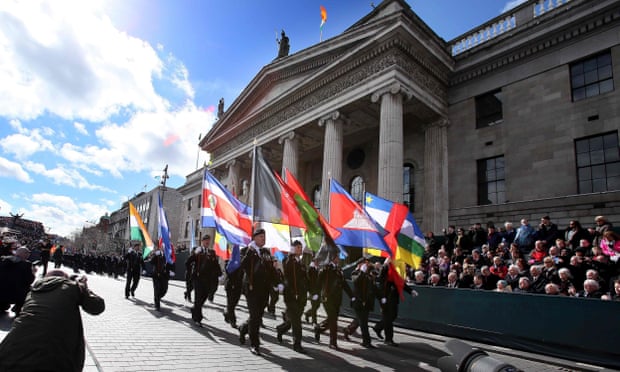 | |
| The official Dublin observance of the Centennial included a military parade past the General Post Office, site of the most intense battle of the Rising. |
In
Ireland the centennial will be celebrated
and observed all year. There are ongoing museum exhibitions, academic
conferences, broadcast programing,
and loads of cultural events. There
have been and will continue to be street
demonstrations and political manifestations
that tie the Rebelion to today’s
events. But the official Dublin observations of the
anniversary will not occur today. They
happened weeks ago centering around a grand
parade, fireworks, and oratory
on Easter Sunday. If following the ancient Hebrew lunar calendar that made Easter a movable feast seems odd, you fail to
comprehend the iron cultural grip of
the Catholic Church on the Irish Republic which only now is beginning to crumble.
When the crypto-fascist
and hyper Catholic Eamon DeVallera and his Fianna Fáil political party
took power after the Irish Civil War,
all authority over Irish education, health care, and social
welfare programs was simply turned
over to the Catholic Church which also dictated moral and social
legislation. The strictest bans on divorce and abortion in Europe have continued long after social change overtook the rest of the western world.
But in recent years the Church’s dominance has been severely weakened first
by wave upon wave of revelations of pedophilia and sexual abuse
by the clergy and more recently the scandals around the Magaline laundries where single mothers were sent, kept in virtual slavery in harsh conditions, and where thousands of their children died of neglect, disease, and malnutrition or were adopted out without the mother’s consent or knowledge. In addition,
young Irish men and women are among the best
educated in Europe and many have spent years living and working
abroad. They have come back to Ireland
with the cosmopolitan values of the wider world. Many have adopted the secularism that is the European
norm. Apostasy is up, church attendance has plummeted, and even among the remaining faithful there is a rejection of many traditional Catholic social teachings.
One result is, for the first time, a secular movement in favor of strong church-state separation
including, among other things, moving future Easter Rebellion commemorations to
the calendar anniversary.
In
1918 led by American
born DeVallera and Michael Collins, both Republican veterans formed the Sinn Fein political party which swept elections for the Irish members of the British Parliament. Instead the erstwhile MPs met in
Dublin, established the revolutionary
parliament, Dáil
Éireann and a made a new Declaration of Independence in January 1919.
That set off a bloody revolutionary war.
There
is far more to the tragic story than
there is space here to tell it.
The sacrifices of the men and women of
the 1916 Rising continue to reverberate
to this day on the still divided island
of Ireland.
William Butler Yeats, generally listed along with Anglo-American T.S.
Eliot as one of the greatest
English Language poets of the 20th Century, witnessed the Rising but did not participate. In fact at first he
was ambivalent at first as were many
surprised Dubliners. But he
was moved by the executions of the
leaders. Easter, 1916
is one of his most powerful poems
and became a Republican rallying cry.
It is always read at annual
commemorations of the Rising in Dublin.
 |
| William Butler Yeats. |
Passover/Earth
Day
April 23, 2016
What if there
were no Passover?
What if no sacrificial blood
smeared on the lintel
offered any protection?
What if there
were no Us and Them?
What if the Pharaoh’s son
and our sons fell alike
from the same dark curse?
What if the Dark
Angels were not Yahweh’s?
What if they were our creation,
evoked by our carelessness
and fed by our greed?
What if there
were no where to flee?
What if no haven or Promise Land
lay waiting even after wandering
because we have laid waste to it
too?
What if there
were no Milk and Honey?
What if our goats all starved,
we killed the bees
and parched the earth bare?
What if there were
no Seder tables to lay?
What if there were no progeny
to ask what makes this night different,
no generations ever again?
What if this is
no mere nightmare?
—Patrick
Murfin
Subscribe to:
Posts (Atom)