Showing posts with label Irving Berlin. Show all posts

Monday, May 11, 2026

The Songwriter of the American Century--Israel Isidore Baline Alias Irving Berlin


Irving Berlin--American master song smith.

There was a lot of buzz over Rolling Stones list of the “100 Greatest Songwriters of All Time.”  There is always room for entertaining debate about such lists.  But this one doesn’t come close to living up to the claim of representing “All Time.”  The earliest on the list were Woody Guthrie and Fats Domino.  Most were active from the 1970’s—the magazine’s birth decade—and were limited to rock, pop, R&B, and a smidgen of rap.  Not a single mention of any of the composers and lyricists from the Great American Song Book who were active from about 1900 to the ‘60s.  That’s a lot of enormous talent to overlook.  And the most egregious omission was this guy.

Say happy birthday to Israel Isidore Baline, born May 11, 1888 in the city of Tyumen in the Ural Mountains 1200 miles west of Moscow.  His father, a Canter, moved his family to the relative safety of the United States in 1893 after Cossacks burned the Jewish Quarter of Tyumen to the ground.  Only three years later his father was dead and the eight-year-old boy had to quit school and work as a news butchera street peddling paper boy—for pennies a day.

He left home at 14 so his mother would have one less mouth to feed and began to support himself singing for tips in saloons, eventually working up to being a song plugger at Tony Pastor’s seminal night club in New York City


                                        Berlin in costume in some sort of parade in New York City in 1911, his break-out year with Alexanders Rag Time Band.

He changed his name to Irving Berlin and began to try his hand at songwriting.  His first success was Alexander’s Rag Time Band in 1911which became a sensation after he wrote words to go with his music and got it placed in a Broadway revue.  Its fresh sound and syncopated rhythm helped set off a new national rage for Rag Time music, which had gone out of fashion a decade earlier.  

Self-taught on the piano—he never could play in any key but F—and unable to read music, he none-the-less eagerly launched himself on a career as a songwriter.  His first Broadway show, Watch You Step in 1914, starred dancing sensations Verne and Irene Castle and included several hits including Play a Simple Melody, the first of his famous “double” songs in which two different melodies and lyrics are counterpointed against one another. 

He continued to write for Broadway and films for the next 60 years producing an unrivaled string of hits that included, A Pretty Girl is Like a Melody, Always, Blue Skies, God Bless America, and There’s No Business Like Show Business to name just a few. 

                           
                                             Sheet music for one of the songs from Belin's Doughboy revue Yip Yip Yaphank

Nearly as patriotic as George M. Cohan, Berlin penned Oh, How I Hate to Get Up in the Morning for his World War I camp show with an all-doughboy cast, Yip Yip Yaphank.   God Bless America was also written for that revue but somehow failed to make the cut.  In 1938 he gave it to Kate Smith for a special 20th anniversary Armistice Day broadcast, and it became a virtual second National Anthem.   He toured for three and a half years to posts in the U.S. and Europe with a second all-GI review This Is the Army in which he sang This is the Army Mr. Jones in GI uniform.  The show became the basis of a 1945 film of the same name staring Ronald Regan and Joan Leslie in which Smith reprised God Bless America. Berlin signed over all royalties from that song to benefit the Boy Scouts of America earning them millions of dollars. 

Berlin, a secularized Jew, is also known for his holiday songs including Easter Parade and White Christmas both of which were featured in the 1940 film Holiday Inn with Bing Crosby and Fred Astaire.  Easter Parade was the only song not written for the movie.  It first appeared in the 1933 revue As Thousands Cheer which presented each number as an item in a newspaper, Marilyn Miller and Clifton Webb originally sang it.  Holiday Inn essentially transformed the newspaper items for holidays throughout the year stitched together by the thinnest of plots.  Both Easter Parade and White Christmas were again featured two in enormously successful self-titled movie musicals.  Crosby’s 1948 re-recording of White Christmas remains America’s favorite secular Christmas song and is an annual seasonal hit.  For decades it held the record as the bestselling recording of all time.


The Easter Parade number with Clifton Webb and Marilyn Miller from As Thousands Cheer on Broadway in 1933.

Early Berlin Broadway revues included now embarrassing blackface minstrel numbers and some of those were carried over to the silver screen.  But Berlin was a staunch advocate of civil rights and a long-time member of the NAACP.  In As Thousands Cheer Ethel Waters sang Supper Time, a lament for the lynching of her husband of which she said “If one song can tell the whole tragic history of a race, Supper Time was that song. In singing it I was telling my comfortable, well-fed, well-dressed listeners about my people...those who had been slaves and those who were now downtrodden and oppressed.”  Not surprisingly Hollywood film makers concerned with being able to show films in the segregated South never included Supper Time in any of the several movies they built around the Berlin song book.

Show business itself was often a theme for Berlin including numbers presented as vaudeville acts like A Couple of Swells.  And of course, There’s No Business Like Show Business from his most successful book musical Annie Get Your Gun has become the enduring anthem of the entertainment industry.


Berlin and bride Dorothy depart on their ill-fated honeymoon to Cuba.

Berlin’s personal life from the days when he was singing on the streets for pennies on was reflected in his music.  His first wife, 20-year-old Dorothy Goetz was the sister of E. Ray Goetz one of his early collaborators.  She died tragically of typhoid contracted during their Cuban honeymoon in 1912.  Grief stricken, Berlin could not write for months. Then his first composition was also his first ballad, the heart felt When I Lost You.


                                    Berlin and his second wife Ellin MacKay at their New York City Hall wedding--the beginning of an enduring 63-year marriage.
  

In 1924 Berlin married Ellin Mackay, and Irish-American Catholic heiress whose father bitterly opposed the marriage.  He wrote the enduring classic love song Always for her and signed over to her personally rights to the song to make up for being disinherited by her father. The rights to that one song alone would make her independently wealthy.  Their marriage remained a love affair and they were inseparable until Ellin died in July 1988 at the age of 85. They had four children during their 63 years of marriage: Irving, who died in infancy on Christmas Day 1928; Mary Ellin, Elizabeth Irving, and Linda Louise.  Blue Skies in 1926 was a jubilant celebration of his first daughter’s birth.

Berlin wrote in many styles over his long career but is perhaps best remembered for his simple, direct, and heartfelt love songs with lilting melodies and lyrics that seemed an extension of everyday speech.  A classic example was What’ll I Do? From 1924.
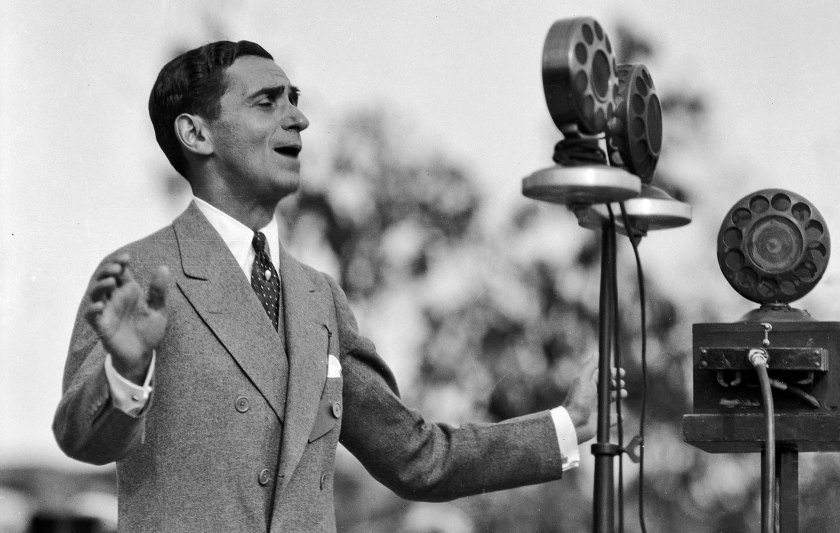

Berlin never gave up his love of singing his own songs.  This is from a 1930's outdoor concert and radio broadcast.

In all Berlin wrote around 15,000 songs.  Many of them are as fresh today as when first written and continue to be recorded by artists in many styles.  Berlin died in his adopted hometown of New York in 1989 a year after Ellin at the age of 101.

Wednesday, July 9, 2025

Flo Ziegfeld Listened to His Wife’s Good Advice


Polish star Anna Held toasts her husband, producer Florenz Ziegfeld in 1905 two years before she advised him to introduce an American version of the Folies Bergère at his new venue. 

Showman Florenz Ziegfeld had the good sense to listen to his wife.  He had been named manager of the former Roof Garden Theater in New York City, an intimate venue on the top of Oscar Hamersteins Olympic Theater.  The new owners needed a hit to fill the seats and Ziegfeld needed a new idea for a show to open the room which had been rechristened the Jardin de Paris. 

The showman’s wife was the Polish born curvaceous and highly successful stage performer Anna Held who Ziegfeld had wed in Europe.  She was a huge star in her own right in this country since her arrival here in the mid 1890’s.  Held suggested an American version of the famed Folies Bergères of Paris—a lavish production featuring beautiful chorus girls and top talent from the Broadway and vaudeville stage.  Held hoped to star in the show but could not when she became pregnant.  Eventually she either lost or aborted the baby, but it was too late to be featured in the show.  The loss caused a rift with her husband who was soon busying himself with other beautiful actresses.  Anna never got to be a Ziegfeld girl, although she continued to have a successful career until her early death at the age of 45 in 1918.


Not quite yet Ziegfeld Girls--the first Follies chorus line performed at the Jardin de Paris on the roof of Oscar Hamerstein's theater in 1907. 

The first edition of the Ziegfeld Follies opened on July 8, 1907.  The first cast included Grace La Rue, Emma Carus, Harry Watson, Helen Broderick, and Nora Bayes.  Although only Bayes is much remembered now, all were solid, well known performers if not yet top stars.  The show was a success.

But the Follies really established themselves as a Broadway fixture the next year when the lovely chorines were dubbed the Ziegfeld Girls for the first time.  Among the beauties was Mae Murray, who would be headlining the show in a few years and who became a leading star on the silent screen.  Nora Bayes returned, this time with her new husband John Northwood.  Together they introduced a little ditty of their own composition, Shine On, Harvest Moon.  It was the first of dozens of familiar tunes introduced in the Follies.


The Follies featured many great stars but the biggest of all was Will Rogers seen here in 1915 with the girls from the late night frolic on the roof--a version of the show with much racier material and flashes of nudity.

Over the years the biggest names in show business got bigger by headlining the Follies.  The rollcall included Sophie Tucker, Fanny Brice, Burt Williams, Ann Pennington, Ed Wynn, W. C. Fields, Ina Clair, Will Rogers, Eddie Cantor, Marilyn Miller, Gallagher & Sheen, Olsen & Johnson, Bert Wheeler, “Gentleman JimCorbett, Paul Whiteman, Ruth Etting, Billie Burke, Helen Morgan, John Bubbles, Ruth Etting, Jane Forman, Buddy Ebbsen, and Eve Arden.

Irving Berlin wrote the songs for three Follies.  Jerome Kern and a parade of other notables contributed many more.


For many years photographer Alfred Cheney Jonhston made artistic publicity shots of every Ziegfeld Girl--and nude shots for the boss's personal collection and to be discretely shared.  Many future stars were included  This is Mae Clark, who went on to star in silent films and early talkies and is best remembered for getting a grapefruit smashed in her face by James Cagney.

Many young performers got their starts as Ziegfeld Girls including Murray, Marion Davies, Olive Thomas, Doris Eaton, Barbara Stanwyck, Louise Brooks, Paulette Goddard, and Joan Blondell.

Chicago born Ziegfeld was 40 years old when the first Follies opened in 1907.  He would continue to produce ever more elaborate editions of the show until his death in 1932.  He also produced many other acclaimed Broadway shows, most notably Sally in both 1920 and ’23; Rio Rita and Show Boat in 1927; and Rosalie, The Three Musketeers, and the Eddie Cantor vehicle Whoopie! all in 1928.

Ziegfeld suspended production of the Follies after 1927 to concentrate on the production of these plays and the construction of his own elaborate Ziegfeld Theater.

Despite all of his success, Ziegfeld lost his fortune in the Stock Market Crash of 1929.  He mortgaged his namesake theater to publisher William Randolph Hearst


Florenz Ziegfeld and another one of his brightest stars Eddie Cantor who by this time--about 1930--was Hollywood's biggest musical comedy star. 

In an attempt to re-coupe his fortune he mounted a new edition of the Follies in 1931.  Although it was successful, as were films made from his stage plays, Ria Rita, Show Boat, and Whoopie! it was not enough to repay his creditors.  The great impresario died broke in California in 1934 after a lingering illness.  Hearst foreclosed on the Ziegfeld Theater.  His second wife, the comedienne Billie Burke, was left in poverty.  She went on to work in films, usually playing ditzy matrons in comedies.  She is best remembered now as Glenda the Good in the 1939 production of The Wizard of Oz.

Two versions of the Follies were mounted with middling success after Ziegfeld’s death.  His memory was preserved in an MGM musical biography The Great Ziegfeld released in 1936.  William Powell played the producer, Louise Rainer as Anna Held, and a blonde Myrna Loy as Billie Burke.  The film won the Academy Award for Best Picture and Rainer took home the trophy for Best Actress.  The film featured many original Ziegfeld stars but is best remembered for its elaborate production number of A Pretty Girl is Like a Melody.  The cost of that one scene was greater than the cost of any edition of the Follies on the stage.


The Great Ziegfeld stared MGM's most bankable screen couple--William Powell and Myrna Loy--was one of the biggest hits of 1936, and took home the Academy Award for Best Picture in a year when its competition included certified  classics like Dodsworth, Libeled Lady, Mr. Deeds Goes to Town, San Francisco, The Story of Louis Pasture, and A Tale of Two Cities.  Austrian born Louise Rainer walked away with the first of her two Oscars for her roll as Anna Held.

In 1941William Powell was unavailable when MGM decided to do another big picture based on the Follies, but he was so associated with the part of Flo Ziegfeld that they elected never to show the producer on screen for Ziegfeld Girl, a star studded extravaganza staring Judy Garland, Lana Turner, and Heddy Lamarr as three chorus girls whose lives were changed in dramatically different ways after becoming Ziegfeld Girls.  The cast also featured James Stewart—top billed despite not having much to do but moon over Lana Turner—Jackie  Cooper, Tony Martin, and a host of familiar faces from the studio’s large stable of character actors.  Also in the mix of supporting players were Al Sheen, half of the classic comedy duo Gallagher and Sheen, former Ziegfeld Girls Mae Bush and Eve Arden, and future song and dance star Dan Dailey.

In 1945 producer Arthur Freed tried to reproduce the feel of the original reviews in his MGM Technicolor extravaganza The Ziegfeld Follies.  Powell reprised his role as the showman and a parade of studio talent appeared in production numbers and sketches including Fred Astaire, Gene Kelly, Cyd Charise, Judy Garland, Katherine Grayson, Red Skelton, Lucile Ball, Lena Horne, and Esther Williams.  Only one star, Fanny Brice, actually ever appeared in the Follies while Ziegfeld was alive. 

All in all, Flo Ziegfeld left a hefty show biz legacy.