Showing posts with label Jazz Age. Show all posts

Sunday, April 3, 2022

Barbara Hamby on Betty Boop—National Poetry Month 2022

Poet Barbara Hamby.

Born in New Orleans and raised in Hawaii, Barbara Hamby earned an MA at Florida State University. She is the author of several poetry collections, including Delirium which won the Vassar Miller Prize, the Kate Tufts Discovery Award, and the Poetry Society of America’s Norma Farber First Book Award in 1995; Babel which won the Association of Writers & Writing Programs’ Donald Hall Prize in 2004; and All-Night Lingo Tango in 2009. Her short story collection, Lester Higata’s 20th Century in 2010 won the Iowa Short Fiction Prize/John Simmons Award. With her husband, poet and musician David Kirby, she coedited the anthology Seriously Funny in 2010. Hamby’s poetry has been featured in numerous anthologies, including The Penguin Anthology of 20th Century American Poetry in 2011); three editions of Best American Poetry 2010, 2009, and 2000; and Good Poems for Hard Times in 2006.

Hamby and Kirby have been called “the cultural power couple” of Tallahassee, Florida where they reside.

                            Betty Boop's Be Bop was included in Hamby's 2009 collection All-Night Lingo Tango.

Hamby has won fellowships from the Guggenheim Foundation and the National Endowment for the Arts as well as several grants from the Florida Arts Council. In 2010, she was named a Distinguished University Scholar at Florida State University.

According to the Poetry Foundation:

Hamby weaves together a mix of high and pop cultural references into formally strict, lyrically extravagant poems. A reviewer for Publishers Weekly described Hamby’s fourth collection, All-Night Lingo Tango, as “[c]hatty and whimsical, literary and (at its best) laugh-out-loud funny,” and observed, “Long-lined Odes, most in monorhyme or in loose couplets, give her extroverted, digressive imagination free play.” In an interview with BOMBLOG, Hamby spoke to her interest in formal constraints: “When I was writing my first book, I found myself being pleased when I was working under certain formal constraints. Whether it was an anaphora that I had to repeat, the abecedarian corset, or a sound I was repeating—I found that the constraint forced me to dig deep into language and, more interestingly, into myself.”

A title card from a Fleischer Betty Boop cartoon.

Last month I considered making a Women’s History Month blog post about Betty Boop who first appeared in Max Fleischer cartoons released by Paramount in March of 1930.  The black and white cutie pie made her bow in Dizzy Dishes in his Talkartoons series and was soon starring in her own shorts.

With her over-size head, pouty bee stung lips, big round eyes, spit curl bobbed hair, overtly sexual small body in a skimp dress threatening to slip off her breasts and ending mid-thigh to expose glam dancer legs, Betty Boop was an instant star.  

Prototype Betty as the anthropomorphic poodle love interest of Bimbo the dog.  As a human here long dog ears were replaced with hoop earrings.

Fleischer’s often surrealistic cartoons were in stark contrast to their main competitionWalt Disney’s early sound Silly Symphonies.  The music was loud, modern, and brassy.   Fleischer originally conceived her as an anthropomorphic French Poodle and was early studio star Bimbo’s—a dog—girlfriend.  They co-starred together in Minnie the Moocher with music by Cab Calloway.  It was not the last time she was associated with Black musicians which shocked Southern audiences.  After the first handful of films, she was fully human—supposedly a wild but innocent 16 year-old and was paired with Koko the Clown from the Out of the Inkwell series.

Betty’s appearance, little girl voice, and signature Boop Oop a Doop line were all inspired by popular stage, recording, and early sound musical star Helen Kane.  In fact, the connection was so obvious that Kane sued Fleischer.  But Kane herself ripped off the look and signature sound from Black Harlem jazz singer Esther Jones who often performed as Baby Esther.  Kane lost her suit against Fleischer when that came to light.  Jones is sometimes credited as being the real and original Betty Boop.

Betty Boop with Boop Oop a Doop inspirations Esther Jones, left, and Helen Kane, right.

When Betty first appeared in the early ‘30’s her persona as a Jazz Age flapper was already outdated.  Although she cheered Depression Era audiences, fashions were quickly changing to longer mid-calf skirts and music was moving into the Big Band Swing era.  Betty also drew the ire of Will Hayes, enforcer of the Motion Picture Production Code in 1934.  He found everything about Betty “suggestive of immorality.”  To comply with the demands her skirts were lowered to knee and she was often shown with short sleeves and a shop-girl peter pan collar.  She was also changed to an adult woman, sometimes given a human boyfriend/husband, and even portrayed as the mother of a brood of children in at least one film.

Fleischer studio's specifications for a late post-code version of Betty. Gone were her earrings and bangle bracelets as well as her flapper dress.  He thigh garter remained but would be obscured in most shots.

By 1939 her films were discontinued, although a daily newspaper comic strip continued for a few years.  During World War II her image was painted on bombers.  Various attempts to revive her came and went over the years.  Her original cartoons were eventually released for television but there was not much market for black and whites shorts.

There was a revival of interest in her as a result of the underground comix and hippie counterculture of the late 1960s and ‘70s.  Soon her image was adorning posters, T-shirts, coffee mugs, figurines, and an astonishing variety of merchandise.  She remains a popular collectable to this day.  In fact, my oldest daughter Carolynne had a large collection which decorated her apartment.

T-shirts were among the first merchandise offered during the '60s and '70s rediscovery.

Here is Barbara Hamby’s take on Betty from her collection All-Night Lingo Tango

Betty Boop’s Bebop

Because I’m a cartoon airhead, people think it’s a picnic

down on these mean streets. Sure, my skirt’s short, but it’s a crime,

fellows, how you give a frail the slip, leave her simmering,

hot and bothered. I have feelings, cardboard, but bordering on ennui,

just this side of tristesse. I may not be human, but I can kick

like one and bite and pinch, too. Don’t forget, mister, I’m

not just a bimbo with a helium voice. I’m no rococo

parvenu pillhead. I’ve read your Rilke, your Montesquieu.

Really, I’m not as dumb as I look. Or maybe I am. Less

tries to be more, but ends up being nothing. My last beau

vetoed the philosophy of religion class in favor of pre-law,

exactly why I don’t know, but I’m getting a glimmer. Stay

zany, the cartoonists tell me, and next year you’ll play Cinderella.


Barbara Hamby


Wednesday, April 7, 2021

Poetry on the Side—Ernest Hemingway—National Poetry Month 2021

Ernest Hemingway at his trusty Underwood #5 portable hunt-and-peck typing in the great outdoors with a pile of already completed pages on his make-shift desk.  Just as he imagined himself--the writer as hero. 

PBS ran Ken Burns’s new four hour documentary about Ernest Hemingway the last two evenings.  I have to admit that as much as I admire Burns’s work, I haven’t seen it yet.  I have recorded it but will have to wait for chunks of time when my wife Kathy doesn’t want the TV set.  She would never sit down that long for an examination of figure who she has never read but thinks of as a misogynistic, macho creep

And that has been Hemingway’s problem. Once considered the most important American novelist of the 20th Century—and there was plenty of competition for that honorwidely read and the recipient of the Nobel Prize for Literature.  He has fallen deeply out of favor in more recent decades.  That has been due as much as anything to his carefully constructed public image as a rugged he-man adventurer, a lover of war and blood sports, a two-fisted drinker, and a man who carelessly used women.

His forthright, Spartan, and straight forward style once considered a revolutionary liberation from ornate prose and sentimentalism is now viewed by modern critics as too anchored in time and place, too bland, and worst of all lacking introspection.  Feminists set him up to be an idol of patriarchy to be brought crashing down.

There is truth to all of that, of course.  But it also is not always supported by either his life or work.  Seen by modern conservatives as a model of masculinity and a lover of guns and glory, he was a life-long leftist and often wracked by the depression and self-doubt that lead him ultimately to swallow a shotgun blast.  He admired and loved strong women and his female characters were well developed and usually the moral superior to the flawed men who loved them.  For every drop if heroism in his male protagonists there was plenty of ambiguity and angst.

Hemingway, no matter what we think of him, is so identified as a novelist, short story writer, reporter, and essayist that it may come as a shock that he also wrote poetry.  He wrote verse his entire life but most frequently in his younger years spanning his Nick Adams in the woods days, World War I, and jazz age Paris.  88 of those poems were included in Hemingway’s first privately printed book along with short stories.  Those poems were well served by the same economy of style and clarity as his prose.  They have stood up very well.

Along With Youth comes from those days when Hemingway was escaping the “broad lawns and narrow minds” of his native Oak Park, Illinois by tramping around the woods and streams of Michigan fishing, hunting, and trapping.

Along With Youth

A porcupine skin,

Stiff with bad tanning,

It must have ended somewhere.

Stuffed horned owl

Pompous

Yellow eyed;

Chuck-wills-widow on a biassed twig

Sooted with dust.

Piles of old magazines,

Drawers of boy’s letters

And the line of love

They must have ended somewhere.

Yesterday’s Tribune is gone

Along with youth

And the canoe that went to pieces on the beach

The year of the big storm

When the hotel burned down

At Seney, Michigan.


—Ernest Hemingway


Hemingway in an Italian military hospital in his Red Cross ambulance corps uniform with Agnes von Kurowsky, the lovely nurse eight years his senior he fell madly in love with.

Champs d’Honneur was written after the Great War where Hemmingway served as an ambulance driver in Italy and was gravely wounded.  Not much glorifying war here,

Champs d’Honneur

Soldiers never do die well;

         Crosses mark the places—

Wooden crosses where they fell,

         Stuck above their faces.

Soldiers pitch and cough and twitch—

         All the world roars red and black;

Soldiers smother in a ditch,

         Choking through the whole attack.


—Ernest Hemingway


“All Armies are the Same” is another bitter anti-war verse.


“All Armies are the Same”


All armies are the same

Publicity is fame

Artillery makes the same old noise

Valor is an attribute of boys

Old soldiers all have tired eyes

All soldiers hear the same old lies

Dead bodies always have drawn flies


—Ernest Hemingway


                                    Hemingway outside his Paris apartment about the time he wrote these short poems.

The Age Demanded was written in post-war Paris.  The iron pants in the verse referred to the braces he had to wear on his legs in his long recovery from his war wounds.

The Age Demanded


The age demanded that we sing

And cut away our tongue.


The age demanded that we flow

And hammered in the bung.


The age demanded that we dance

And jammed us into iron pants.


And in the end the age was handed

The sort of shit that it demanded.


—Ernest Hemingway


Tuesday, December 2, 2014

Introducing the All New Ford Model A for 1928!

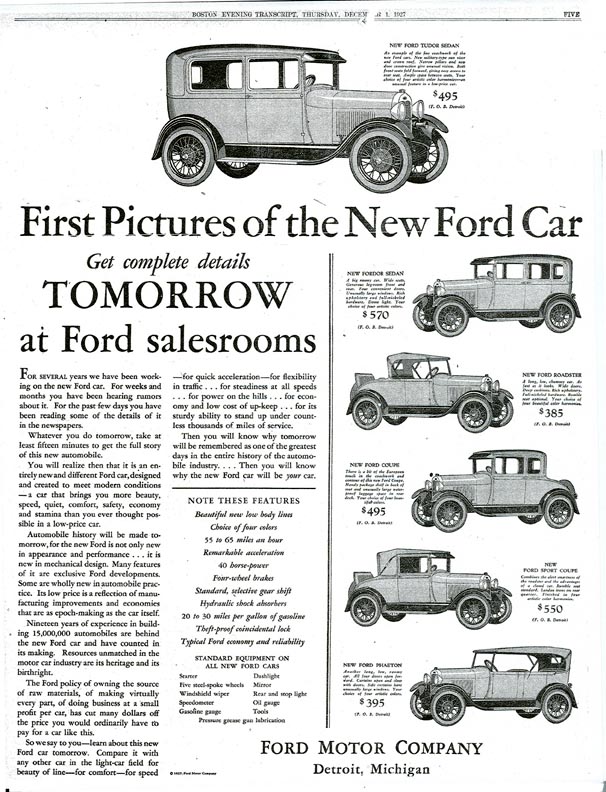
Launching the new model with pictures of body styles.


Henry Ford finally did it.  It was like pulling teeth and the man who once revolutionized an industry and put Americans behind to wheels of affordable automobiles was dragged into the wild new world of the Jazz Age and motorists with money burning holes in their pockets.  On December 2, 1927 Ford dealers began offering the brand new Model A replacing at long last 18 years of Model T production.
The Tin Lizzie had been the most successful automobile ever sold.  Using Ford’s innovative moving assembly line and a simple design it had been marketed at prices that any reasonably middle class American could afford.  Autos were no longer the exclusive plaything of the rich. And as they were produced year after year, millions of working class and even poor citizen were made mobile in second hand Flivers.
Ford was loath to make changes.  He was deep in his heart a stubborn conservative.  Moreover, he had peculiar ideas about the morality of automobile ownership.  He regarded such things as color choices or personalized options offered by competitors as vanities.  Of course his any-color-as-long-as-it’s-black philosophy also streamlined the production process and kept the per unit price of his cars low.  He considered innovations now common on competitors like electronic ignition and cabin heat in enclosed models as unnecessary frills.  But the public was growing tired of breaking their arms trying to turn over the Model T engine with a crank.  They were also wearing of an engine that by then was underpowered compared to other brands.  It may have been fine with Ford, who was in no hurry, by customers were tiring of a vehicle that could be passed by anything else on wheels on the road including a determined milk wagon.
Sales of the beloved Model T had been sinking as competitors, especially Chevrolet, matched Ford’s production innovations and added some of their own.  Chevy, and the turncoat former Ford engineers the Dodge Brothers were turning out their own right-priced mass produced cars and were regularly updating them.
Ford’s Board and his son Edsel finally convinced the old man it was time for a change.  Henry did not make the transition, mostly overseen by Edsel, easy.  He meddled in production maters—he tried to convert from die stamping body parts from sheet steel with more expensive drop forge technology which not only added production costs, but made the cars so heavy that even a new more powerful engine could not produce more speed.  The idea had to be junked at the cost of millions.  Edsel supervised the design which was much more modern and slightly less boxy than the Model T.  It was only after the new car was a success that Henry pushed his son aside and took the credit for himself.

New Model As on Edsel Ford's newly revamped assembly line at the giant River Rouge Plant in Dearborn, Michigan.

Edsel also tinkered with his father’s assembly line process, introducing flexible mass production, which allowed individual units on the line to be individualized including the use of four colors plus black and customer-ordered options.
The car was powered by a new water-cooled L-head 4-cylinder engine that could produce cruising speeds of 65 miles per hour.  It also contained industry innovations including the first use of shatter proof glass.
Six body styles could be built on the basic Model A chassis plus variation of each—a Coupe, a Roadster, a Four Door Sedan, a Four Door Convertible, a Station wagon or van, and a pick-up Truck.  A simple Roadster could be had for as little as $385 while a top-of-the-line Town Car with all the options ran to $1,200, not far below the price of luxury Cadillacs and Packards.
In the midst of the biggest economic boom in the country’s history, customers were ready, willing, and able to buy and spend.  By February 1929, one million Model As had been sold, and by that July, two million.  Even with the Wall Street Crash that October and the ensuing plunge into the Great Depression, Ford was able to sell more than three million units domestically before the car was taken out of production at the end of the 1932 model year.  In no time at all in its various forms the Model A was the most common sight on the road.

The actual 1930 Model A Roadster hijacked--along with its driver--in John Dillingers escape from the FBI attack on his gang at the Little Bohemia Lodge in Manitowish Waters, Wisconsin on April 23, 1934.  Just one of three million Model A stories.

Henry Ford had learned his lesson.  He did not become too attached to his new baby and replaced it in the 1933 model year with still more modern Model B with available with a flathead V-8 engine.  And after the mid-30’s the company began offering new models yearly.
The model A became, largely because of its widespread availability, the car on which the original hot rods were built.  It remains a starting point car for many classic car restorers and is still commonly customized.  Both historically accurate restorations and custom versions are common sights at car shows and in local parades.