Showing posts with label criticism. Show all posts

Wednesday, April 7, 2021

Poetry on the Side—Ernest Hemingway—National Poetry Month 2021

Ernest Hemingway at his trusty Underwood #5 portable hunt-and-peck typing in the great outdoors with a pile of already completed pages on his make-shift desk.  Just as he imagined himself--the writer as hero. 

PBS ran Ken Burns’s new four hour documentary about Ernest Hemingway the last two evenings.  I have to admit that as much as I admire Burns’s work, I haven’t seen it yet.  I have recorded it but will have to wait for chunks of time when my wife Kathy doesn’t want the TV set.  She would never sit down that long for an examination of figure who she has never read but thinks of as a misogynistic, macho creep

And that has been Hemingway’s problem. Once considered the most important American novelist of the 20th Century—and there was plenty of competition for that honorwidely read and the recipient of the Nobel Prize for Literature.  He has fallen deeply out of favor in more recent decades.  That has been due as much as anything to his carefully constructed public image as a rugged he-man adventurer, a lover of war and blood sports, a two-fisted drinker, and a man who carelessly used women.

His forthright, Spartan, and straight forward style once considered a revolutionary liberation from ornate prose and sentimentalism is now viewed by modern critics as too anchored in time and place, too bland, and worst of all lacking introspection.  Feminists set him up to be an idol of patriarchy to be brought crashing down.

There is truth to all of that, of course.  But it also is not always supported by either his life or work.  Seen by modern conservatives as a model of masculinity and a lover of guns and glory, he was a life-long leftist and often wracked by the depression and self-doubt that lead him ultimately to swallow a shotgun blast.  He admired and loved strong women and his female characters were well developed and usually the moral superior to the flawed men who loved them.  For every drop if heroism in his male protagonists there was plenty of ambiguity and angst.

Hemingway, no matter what we think of him, is so identified as a novelist, short story writer, reporter, and essayist that it may come as a shock that he also wrote poetry.  He wrote verse his entire life but most frequently in his younger years spanning his Nick Adams in the woods days, World War I, and jazz age Paris.  88 of those poems were included in Hemingway’s first privately printed book along with short stories.  Those poems were well served by the same economy of style and clarity as his prose.  They have stood up very well.

Along With Youth comes from those days when Hemingway was escaping the “broad lawns and narrow minds” of his native Oak Park, Illinois by tramping around the woods and streams of Michigan fishing, hunting, and trapping.

Along With Youth

A porcupine skin,

Stiff with bad tanning,

It must have ended somewhere.

Stuffed horned owl

Pompous

Yellow eyed;

Chuck-wills-widow on a biassed twig

Sooted with dust.

Piles of old magazines,

Drawers of boy’s letters

And the line of love

They must have ended somewhere.

Yesterday’s Tribune is gone

Along with youth

And the canoe that went to pieces on the beach

The year of the big storm

When the hotel burned down

At Seney, Michigan.


—Ernest Hemingway


Hemingway in an Italian military hospital in his Red Cross ambulance corps uniform with Agnes von Kurowsky, the lovely nurse eight years his senior he fell madly in love with.

Champs d’Honneur was written after the Great War where Hemmingway served as an ambulance driver in Italy and was gravely wounded.  Not much glorifying war here,

Champs d’Honneur

Soldiers never do die well;

         Crosses mark the places—

Wooden crosses where they fell,

         Stuck above their faces.

Soldiers pitch and cough and twitch—

         All the world roars red and black;

Soldiers smother in a ditch,

         Choking through the whole attack.


—Ernest Hemingway


“All Armies are the Same” is another bitter anti-war verse.


“All Armies are the Same”


All armies are the same

Publicity is fame

Artillery makes the same old noise

Valor is an attribute of boys

Old soldiers all have tired eyes

All soldiers hear the same old lies

Dead bodies always have drawn flies


—Ernest Hemingway


                                    Hemingway outside his Paris apartment about the time he wrote these short poems.

The Age Demanded was written in post-war Paris.  The iron pants in the verse referred to the braces he had to wear on his legs in his long recovery from his war wounds.

The Age Demanded


The age demanded that we sing

And cut away our tongue.


The age demanded that we flow

And hammered in the bung.


The age demanded that we dance

And jammed us into iron pants.


And in the end the age was handed

The sort of shit that it demanded.


—Ernest Hemingway


Friday, April 5, 2013

National Poetry Month—Dylan Thomas "Do Not Go Gentle Into That Goodnight"


Why, you may well ask,  is a picture of a film critic at the head of a poetry post?
Just two days after announcing the return of cancer and his “leave of presence” from his heavy schedule of multiple reviews a week plus other writing long time Chicago Sun-Times movie critic and cultural icon Roger Ebert died yesterday.   
When we were both very young men, but when he was already making his mark at the Sun-Times and I was an obscure wanna-be writer and contributor to the Chicago Seed, I used to hang out on the periphery of rollicking bull sessions at O’Rourke’s and other writer hang outs with Roger and a gaggle of other reporters. They tolerated me and occasionally let me get a word in edgewise.
When I helped lead an IWW strike at one of his favorite art-house venues, the Three Penny Cinema, he was furious with me. Hope he finally forgave me.
Roger was not only the greatest movie reviewer of his or any other generation, he also was a great and insightful social critic and progressive, which he showed off in his great blog in recent years. He was the most loved and admired Chicagoan since Studs Terkel. They might have to rent Soldier Field for his funeral to accommodate all of his personal friends, admirers and fans.
The last decade of his storied life was marked by medical crisis, recovery, and worse crisis.  He had reoccurring cancer and the surgery to save his life was botched costing him first his jaw and then his voice.  He was often bed ridden or confined to a wheelchair.  But through it all, except for the days of most extreme crisis, Roger continued to write passionately.  He reviewed as many as ten movies a week, wrote new pieces on the film industry and other reporting, penned several books, managed his TV series, and kept up maybe the best, most readable blog in America.
Eventually, thanks to exotic technology, he regained the ability speak through a computer program.  With the aid of his loving and devoted wife Chaz, Roger not only endured, he seemed to thrive.
Roger Ebert was why the word indomitable was invented.
In his book Life Itself  Roger wrote:
I know it is coming, and I do not fear it, because I believe there is nothing on the other side of death to fear. I hope to be spared as much pain as possible on the approach path. I was perfectly content before I was born, and I think of death as the same state. I am grateful for the gifts of intelligence, love, wonder and laughter. You can’t say it wasn’t interesting. My lifetime’s memories are what I have brought home from the trip. I will require them for eternity no more than that little souvenir of the Eiffel Tower I brought home from Paris.
Still despite this gentle acceptance of the inevitable, Roger as the old timers used to say, “sucked the marrow out of life.”  He lived it to the last instant when he turned and smiled at Chaz and slipped away.
I could not help but think of the poem that Dylan Thomas wrote when his father was dying and which I read at a memorial service for my Dad after his long painful battle with brain cancer.
Do Not Go Gentle Into That Goodnight
Do not go gentle into that good night,
Old age should burn and rave at close of day;
Rage, rage against the dying of the light.

Though wise men at their end know dark is right,
Because their words had forked no lightning they
Do not go gentle into that good night.

Good men, the last wave by, crying how bright
Their frail deeds might have danced in a green bay,
Rage, rage against the dying of the light.

Wild men who caught and sang the sun in flight,
And learn, too late, they grieved it on its way,
Do not go gentle into that good night.

Grave men, near death, who see with blinding sight
Blind eyes could blaze like meteors and be gay,
Rage, rage against the dying of the light.

And you, my father, there on the sad height,
Curse, bless, me now with your fierce tears, I pray.
Do not go gentle into that good night.
Rage, rage against the dying of the light.

—Dylan Thomas

Thursday, July 26, 2012

G.B.S.—Witty, Brilliant, Insightful, and Apt to Go Off on Unfortunate Tangents

Shaw at about 40, an emerging genius.

Note:  Adapted from a post on July 26, 2012
On July 26, 1856 the only man ever to win a Nobel Prize and an Academy AwardAl Gore doesn’t count because his movie won the Oscar, but he personally did not—was born in Dublin, Ireland to a minor civil servant and an aspiring singer. 
George Bernard Shaw was also a major influence on my young life when I was type cast in blow in another blowhard character part cast as Alfred E. Doolittle in a high school production of Pygmalion Just as a role in Inherit the Wind led me to the treasure trove of Clarence Darrow, American radicalism, and the labor movement, this role introduced me to the wonders of Shavian wit and wisdom and to socialism. 
For several months, until actual factory employment started me down the road that would lead to the direct action radical labor movement of the IWW, I bemused and confounded friends with declarations that what America needed was a Fabian Socialist movement to make socialism palatable to the middle classes.  
My infatuation with Fabianism may have been brief; my fascination with Shaw genius was not.  Not that I am an expert in all things Shaw.  I have read his best known plays, some of his socialist screeds, and some of his essays, but that just skims the surface of the prodigious production of words that when issued in a uniform set of complete works took  36 volumes and twenty years to produce before the playwright’s death in 1950. 
Shaw got an indifferent education in Protestant schools in Dublin because he rebelled against the mind numbing crushing of creativity by rote learning and especially against the physically abusive culture of repeated discipline by caning
After his mother abandoned the family to pursue her dreams of a singing career in London taking his sisters with her, Shaw stayed in Dublin with his alcoholic father.  He dropped out of school and became an estate agent managing the affairs of landowner to get away from home and earn a living.
After a few years he joined his mother and sisters in 1876 to pursue his dreams of improving his education by personal application.  They subsidized him to the tune of a Pound Sterling a week as he educated himself in the reading rooms of the British Museum. 
He supplemented this meager keep by ghost writing a music criticism column for his mother’s voice teacher, Vandeleur Lee.  That eventually launched him on his first successful career as a critic of the arts. 
Meanwhile he tried his hand as a novelist, completing five manuscripts over the next five years, none accepted by a publisher.  After he became famous the novels were each published over a period of several years and none of them were very good, although the later ones previewed his moral vision and taste for the didactic.  But he was learning a craft. 
In 1885 he finally became a self-supporting writer when he was hired as a reviewer fashionable Pall Mall Gazette writing first under pen name Corno di Bassetto (Basset Horn) and later simply under the initials GBS.  He also published occasional pieces in other journals. 
As a critic, Shaw was disgusted by what he considered the vapid conventions of the popular stage which catered to a self-congratulatory ruling class.  He became one of the first great English language champions of the new realistic drama of Norwegian playwright Henrik Ibsen, whose work shocked Victorian sensibilities.   His extended essay Quintessence of Ibsenism published in 1891 was a major breakthrough both for the critic and for Ibsen in the English speaking world. 
In 1895 he became the lead drama critic of the Saturday Review finally publishing under his full name.  His columns, written in a lively, accessible style enchanted a public used to a dry, self-serious style of commentary.  Shaw, at age 40 was just starting to make his mark. 
Meanwhile Shaw’s social and political views had taken a radical turn when he became an early and ardent member of the Fabian Society, named in honor of the Roman general Quintus Fabius Maximus who had advocated tactics of harassment and attrition rather than head-on battles against the Hannibal.  In practice the society rejected violent revolution, urged adoption of a simple life style—including vegetarianism—and used written persuasion to enlist the middling classes in support of the workers. 
With leading spirits Sidney and Beatrice Webb, Shaw was soon one of the Society’s top polemicists.  He authored several pamphlets, many gathered into Fabian Essays in Socialism, published in 1881.  Shaw became a dedicated vegetarian, anti-vivisectionist, and rejected much of modern medicine—including vaccination—advocating a healthy diet, simple life, and excersize.  He tended to be more pacifistic than other Fabians, many of whom explicitly embraced the Empire and believed that adoption of a cooperative commonwealth in Britain would thus further its spread around the world.  The Fabians were influential founders of the British Labor Party in 1906, and many of their proposed social reforms became the heart of the Party platform. 
Mirroring his relationship with his mother, Shaw’s relationships with women were complicated.  On one hand he adored them and on many occasions wrote about his conviction that they were in every way possible the “moral superiors” of men.  He conducted protracted, passionate relationships by letter with actress Mrs. Patrick Campbell and others, but is never known to have consummated a relationship.  
In 1898 he married Anglo-Irish fellow Fabian and feminist Charlotte Payne-Townshend. The couple were devoted to each other and remained together until her death in 1943 despite their mutual vow of sexual abstinence.  For most of their marriage they lived in a rural village of Ayot St Lawrence, Herefordshire at the house that became famous as Shaw’s Corners while maintaining a London flat.  
In 1885 Shaw’s friend and mentor, the critic William Archer, suggested that he not just complain about the theater as he found it, but that he should teach by example.  Together the two men began collaboration on a play based on an outline by Archer.  The project floundered and Archer withdrew.  Years later Shaw completed the play on his own as Widowers’ Houses, a scathing attack on slumlords which was first produced in 1892.  Shaw was never satisfied with it, but work on it convinced him that he had found his medium. 
Over the next twenty years he would enter into a period of enormous productivity and creativity and write some of the most enduring plays in English.  All cast as comedies, they tackled the deepest issues of society in a witty, approachable way.  They were definitely talking plays—long monologues expounded themes and back and forth banter sharpened them. 
The topics of many of the plays were so controversial that they first met with success in production on the Continent or America before they were accepted by British audiences.  The Devil’s Disciple (1897) set during the American Revolution and sharply critical of Imperialism, was a hit on Broadway before London.  Other plays of enduring appeal and still frequently performed roughly in order of their production were:  Mrs. Warren's Profession (1893),  Arms and the Man (1894), Candida (1894),  Caesar and Cleopatra (1898), Man and Superman (1902–03), John Bull’s Other Island (1904), Major Barbara (1905), The Doctor's Dilemma (1906), The Dark Lady of the Sonnets (1910), Androcles and the Lion (1912), and Pygmalion (1912–13) which was destined to become his most famous and beloved play. 
Not only were these works successful on the stage, but unlike most scripts, became avidly read by the general public.  Shaw produced three collections of plays and others were issued individually in this era.  Many had long, elaborate prefaces that were as popular as the plays themselves. 
The bloody mayhem of World War I was a disappointment and a discouraging shock to Shaw.  His beloved socialist movement had failed worldwide to prevent the conflict.  Militant workers became jingoistic patriots over night and willing cannon fodder.  He had to revise many of the sunny expectations of Fabian socialism.  Shaw grew to believe that the working class was so abased by its dominance by Capitalists and the social elite that they were incapable of taking effective electoral or other political action on their own behalf. 
After the Bolshevik revolution, he reluctantly concluded that revolution and the true transformation of society had to be placed in the hands of benign supermen, who would be selectively bread by wise women selecting worthy mates.  These leaders would be able to take action on behalf of the disempowered working class.  Shaw embraced a kind of eugenics in pursuit of the goal.  These ideas were explored in his most important post war plays.  Back to Methuselah (1921) was an epic consisting of 5 one act plays covering the history of humanity from the age of Genesis into the future. 
In 1924, with his reputation in Britain at a low ebb after a string of less distinguished plays and public anger at his war time pacifism lingering, Shaw had St. Joan premiered in New York.  Coming shortly after the Catholic Church’s canonization of the Maid of Orleans, Shaw spent considerable time researching trial documents and other evidence available at the time.  He found that everyone concerned from the peasant to her accusers and inquisitors were acting in good faith according to their beliefs.  A critic called it a tragedy without villains.  Shaw had anticipated Hannah Arendt and the banality of evil.
The play was an international sensation and was the immediate cause for the playwright’s selection for the Nobel Prize for Literature in 1925.  Shaw, who did not believe in honors, was first inclined to turn down the award but his wife convinced him to accept because it would reflect well on Ireland, the homeland he had abandoned 50 years earlier.  He did refuse the money prize and directed that it be used to “translate good Swedish books into English.” 
After St. Joan few of Shaw’s plays were memorable, although some met with initial success on the stage.  He often attracted more attention as a social commentator and as a recognizable international celebrity with his trademark 19th Century white whiskers, old fashion tweed suites, and innumerable eccentricities.  
In 1938 Leslie Howard prevailed upon Shaw to undertake the screen play for Pygmalion, which became an enormous international hit staring Howard and Wendy Hiller as Eliza DoolittleHe was awarded the 1938 Academy Award for Best Adapted Screenplay.  Later, Alan J. Lerner used the film script as the basis for his libretto adaption, My Fair Lady.  
Through the ‘30’s Shaw’s political opinions were drifting more and more authoritarian. He had an early infatuation with Mussolini until it became clear that the Italian had abandoned his early socialism.  After a visit to the Soviet Union in the early ‘30’s where he met and appreciated Josef Stalin, he even endorsed “humane” elimination of those “useless to society.” 
In 1938, with the world on the cusp of war, Shaw published an essay, Dictators—Let Us Have More of Them.  Shaw’s authoritarianism and favoring of eugenics—although Shaw’s version of eugenics was opposed to selection on racial or anti-Semitic grounds—has left many modern writers and critics bitterly critical of him and sometimes dismissive of his whole body of work.
Shaw did not make himself popular in Britain by maintaining his pacifism in World War II and likewise earned the bitter enmity of former Communist admirers for not supporting the Soviet Union when it was under attack.  He congratulated Eamonn de Valera and the Irish Free State for resisting Britain’s threats against neutral nations. 
But just as the first Great War changed his opinions, so did the second.  Shaw was not above admitting his mistakes.  In 1944 he published a rambling reassessment of socialism and his own views, Everybody’s Political What’s What which regretted the excesses of what would later be called Stalinism and called for a replacement of simple 19th Century socialism with scientific humanism.   It was very nearly a swan song for the old man. 
There would be one more full length play, not very well written or received.  In 1949 Shaw penned a twenty minute puppet play, Shakes versus Shaw, a kind of intellectual Punch and Judy Show with Shaw and Shakespeare as the combatants. 
The next year he was dead following complications after a fall in his garden at the age of 94.  As requested there was no religious service nor was there any use of a “torture device”—the Cross allowed.  He had directed that his ashes be mixed with those of his wife and that they be scattered together around the statue of St. Joan in the garden at Shaw’s Corners. 
After his death a spate of revivals of his classic works in Britain, Canada, and the United States revived his tarnished reputation.  Today he is second only to the Bard himself in the number of his plays still regularly in production around the word.  The Old Man evidently still has something to say to us. 


Friday, April 27, 2012

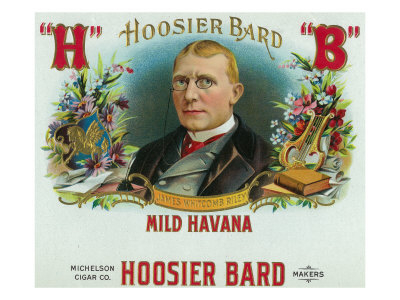
National Poetry Month—James Whitcomb Riley "Our Hired Girl"

Who can resist a poet so famous he could sell cigars?

At least once during National Poetry Month I like to give the poetry snobs the vapors.  Those are the high minded, serious folk— the worst high school English teachers, academics whose careers depend on culling ever diminish heard of obscure poets for publish-or-perish theses the no one reads, and critics convinced that only the obscure and arcane are worthy of notice and that popularity is vulgar.  Together these folks have just about beat to death any chance that the general public might consider reading and enjoying poetry.

Today we offer up a poet sure to set fire to these folks hair.

The Hoosier poet James Whitcomb Riley may not have been the greatest American poet.  But for a good many years he was the most popular—and the most beloved.  Many of his verses were written for, and loved, by children and there was a time when most could recite at least one of his poems by heart.

Riley was born on October 7, 1849 in the extremely rustic village of Greenfield, Indiana.  Although his father was a lawyer with political ambitions—the boy was named for a governor of the state—the family was still crowded into a two room log cabin.  

What passed for a super highway, the planked National Road, ran by the cabin’s dooryard.  In those days with inns and taverns scarce, travelers on the road often pulled up at the cabin, the largest in the village, for supper or a place to sleep by the hearth or in the soft hay of the barn.  From the time he was a small boy, James listened to and absorbed the accents and the stories of the visitors and entertained his family and friends with imitations.

As the village and fortunes of the family grew, they replaced the cabin with a handsome two story white frame house.

James was an indifferent, make that horrible, student in the local one room academy.  His mind was always wandering to the meadows, woods, and creeks and the play of his friends.  He learned well enough to read and write, but seemed totally indifferent to anything else. One teacher told his exasperated father, “He doesn’t know which is more—twice ten or twice eternity.”  He dropped out of school to work odd jobs in town and on nearby farms.

His father convinced him to try reading law with him.  But that was a failure, too.

Despite his love of his town and his friends among the lively local youths, Riley had itchy feet and a hankering to see a bit more of the world.  He took up the tramp profession of traveling sign painter, roaming the Mid West.  Later, he became a barker in a traveling medicine show where he honed stage skills that would later help make him famous and where he cultivated a lifelong taste for product, heavily laced with alcohol.

Riley didn’t write his first known poem until the age of 21 in 1870.  He sent it to a newspaper, which published it.  It became a habit.  The poems, usually in dialect, reflected his memories of the rural childhood.  Newspapers began, in the custom of the time, to reprint the poems “on exchange.”  He even started to get paid a dollar or two for a submission.

Despite this modest success, Riley suspected that as a rural bumpkin he would never be taken seriously as a poet by the Eastern literary establishment.  To prove his point, he perpetuated a hoax.  He submitted Leonanie an “undiscovered poem” by Edgar Allan Poe which was universally proclaimed as a masterpiece.  The Eastern critics failed to note that Poe himself was a famous hoaxer, having published at least six in his life, the most famous about a supposed 1844 crossing of the Atlantic by balloon.  When Riley revealed himself there were a lot of embarrassed—and angry—critics.  It is seems likely that tribe holds the grudge to this day. 

He established himself enough as a writer to get a full time job on the Indianapolis Journal where he did reporting and regularly contributed verse, still a popular part of any American newspaper. 

In 1883 he self published an edition of 1000 copies of a collection, The Old Swimmin’ Hole and ‘Leven More Poems under the pen name of Benjamin F. Johnson, of Boone.  Most poets trying this gambit ended up with crates full of unsold books and ruinous debts to the printer.  Riley’s book sold out its first printing in only a few months.

That got the attention of local Indianapolis publisher Merrill, Meigs and Company which published a beautifully bound second edition under his real name.  It sold like hot cakes.  Riley would be associated with the company, which eventually became Bobbs-Merrill, for the rest of his lifeIn fact that well known publishing house was largely built on the success of its Riley books.  The first of the original ones was The Boss Girl.

Riley was able to give up his day job, cater to his wanderlust, and promote his books when he took to the lecture platform.  With his charming wit, and theatrical style of reading he became one of the most sought after public speakers in the country, a genuine star of the Lyceum Circuit.  And everywhere he spoke, he sold even more books.  

One of the few critics who appreciated him, fellow Mid Westerner Hamlin Garland, noted that of American writer only Mark Twain  “who had the same amazing flow of quaint conceits.  He spoke ‘copy’ all the time.”  In an interview in 1892 in Greenfield, Riley told him, “My work did itself.  I'm only the willer bark through which the whistle comes.”

Twain, by the way, was not fond of Riley.  In their only appearance together on the same program, he felt that he was upstaged by someone plowing similar ground.  There after he avoided those literary dinners where Riley might make an appearance and occasionally derided his adversary. 

Riley’s lectures and book sales made him the best paid writer America for a while, surely another bitter pill for struggling “serious” scribes.  It was said copies of his books were found in homes that contained no other save the Bible.

Riley never married.  He said a failed teenage romance back in Greenfield had made him decide not to commit his heart.  But serious alcoholism, that all too common malady of writers, was more likely the cause.  At least one lecture tour was aborted do to drunkenness.  Several attempts of stop drinking all ultimately failed.

In 1893 Riley began boarding at the home of his friends, Charles and Magdalena Holstein in the Indianapolis neighborhood of Lockerbie.  It was his home for the rest of his life and his friends took care of him through bouts of drinking and later severe health problems.

By 1895 he had largely stopped touring and his attempts to publish more “serious” poems were savaged even by critics who had warmed to his rustic style.  At home in Lockerbie he appointed himself an uncle to neighborhood children who flocked to hear his stories and tales. 

That inspired his last, and ultimately most successful, original book, Rhymes of Childhood with illustrations by Howard Chandler Christy.  It was so popular through so many editions—it remains in print today—that Riley was proclaimed the Children’s Poet, much as Henry Wadsworth Longfellow had been years before.  Twain was so moved by this collection—and probably the memory of his dead children—that he finally had good things to say about Riley.

In 1902 Boobs-Merrill began issuing elegantly appointed volumes of his complete works, an honor few poets lived to see.  Riley spent his last years editing the texts.  Eventually 16 volumes were issued.

Riley purchased the family homestead in Greenfield and his brother John lived in the house.  Riley would make occasional visits. 

Riley’s health had been in steady decline since 1901.  He suffered a debilitating stroke in 1910 which confined him to a wheel chair.  The loss of the use of his writing hand bothered him and he later relied on dictation to George Ade for his last poems and biographical sketches.  By 1912 he had recovered enough to begin recording readings for Edison cylinders.  The same year the Governor of Indiana declared his birthday James Whitcomb Riley Day, a state holiday observed until 1968.

He made his last visit to Greenfield in 1916 for the funeral of a boyhood friend.  A week later back in Lockerbie, he suffered a second stroke and died on July 22nd.

Riley was widely mourned.  His books continued to be popular through the next two decades, finally falling out of favor.

His boyhood home in Greenfield is now a preserved historical site and his home in Lockerbie is the James Whitcomb Riley Museum Home and a designated National Historic Site.

Our Hired Girl

Our hired girl, she’s ‘Lizabuth Ann;
An’ she can cook best things to eat!
She ist puts dough in our pie-pan,
An’ pours in somepin’ ‘at's good an’ sweet;
An’ nen she salts it all on top
With cinnamon; an’ nen she’ll stop
An’ stoop an' slide it, ist as slow,
In th’ old cook-stove, so's 'twon't slop
An’ git all spilled; nen bakes it, so
It's custard-pie, first thing you know!
An’ nen she’ll say,
“Clear out o’ my way!
They’s time fer work, an’ time fer play!
Take yer dough, an’ run, child, run!
Er I cain’t git no cookin’ done!”
 
When our hired girl ‘tends like she’s mad,
An’ says folks got to walk the chalk
When she's around, er wisht they had!
I play out on our porch an' talk
To Th’ Raggedy Man ‘at mows our lawn;
An’ he says, “Whew!” an’ nen leans on
His old crook-scythe, and blinks his eyes,
An’ sniffs all ‘round an’ says, “I swawn!
Ef my old nose don’t tell me lies,
It ‘pears like I smell custard-pies!”
An’ nen he’ll say,
“Clear out o’ my way!
They’s time fer work, an’ time fer play!
Take yer dough, an’ run, child, run!
Er she cain’t git no cookin’ done!
 
Wunst our hired girl, when she
Got the supper, an we all et,
An’ it wuz night, an’ Ma an’ me
An’ Pa went wher’ the “Social’ met,--
An’  nen when we come home, an’ see
A light in the kitchen door, an’ we
Heerd a maccordeun, Pa says, “Lan’--
O’-Gracious! who can her beau be?’
An’ I marched in, an’ ‘Lizabuth Ann
Wuz parchin’ corn fer The Raggedy Man!
Better say,
“Clear out o’ the way!
They’s time fer work, an’ time fer play!
Take the hint, an’ run, child, run!
Er we cain’t git no courtin’ done!”

—James Whitcomb Riley