Showing posts with label John Keats. Show all posts

Sunday, February 23, 2025

John Keats Was the Quintessential Tragic Romantic

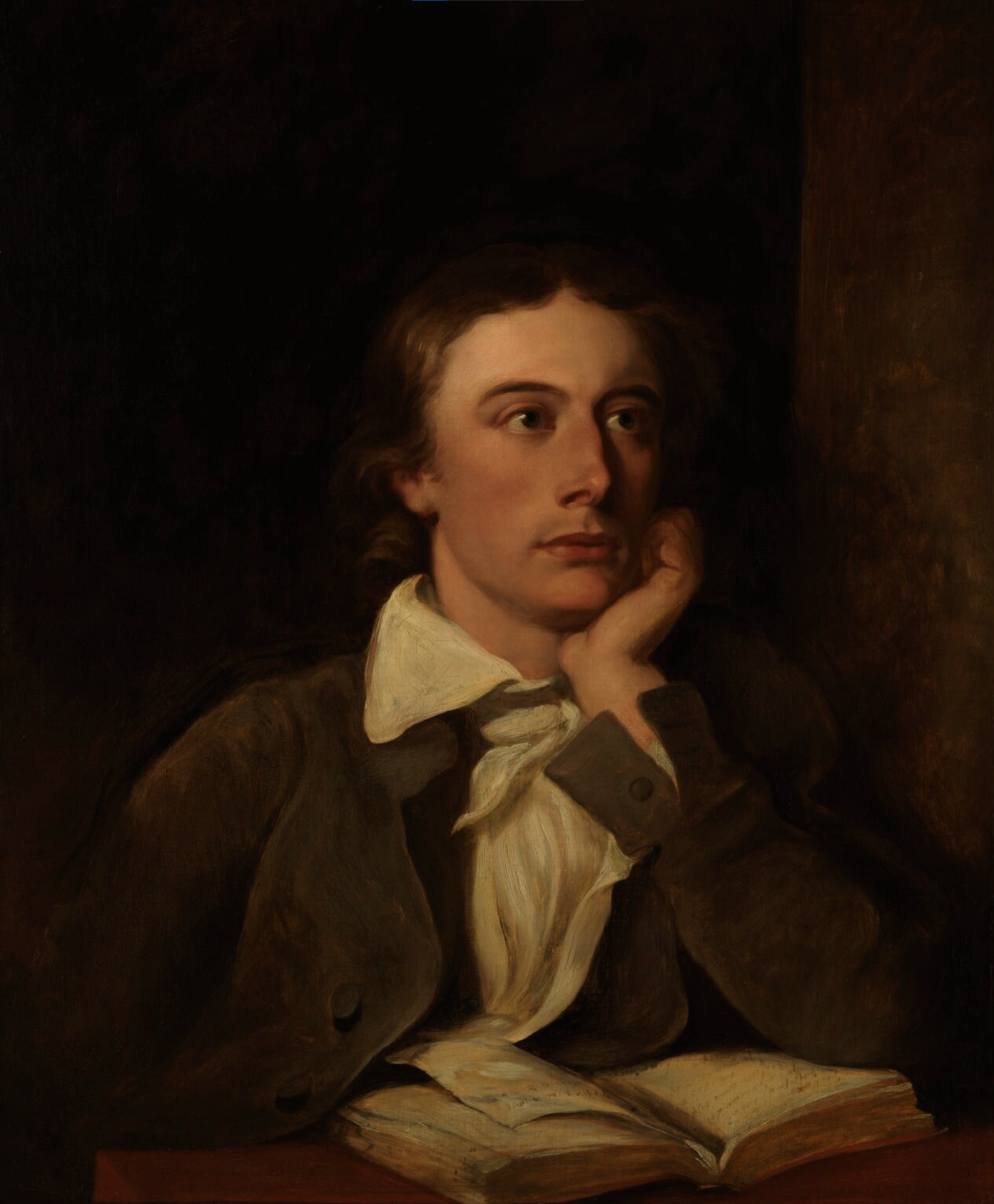
                    John Keats--a posthumous portrait by Joseph Hilton in 1822 based on life images. 

On February 23, 1821 John Keats, the quintessential English Romantic poet, died in Rome of the poignantly tragic disease of the era, consumption (tuberculosis), at the age of 25. 

The orphaned son of a livery stable keeper and a consumptive mother, young Keats fell under the guardianship of a pair of tea brokers who provided him with some of a gentleman’s education before binding him to an apprenticeship with an apothecary-surgeon in London.  Keats dutifully completed the apprenticeship but never practiced the profession. 

Instead, he threw himself into writing poetry.  After his first sonnets were published and respectably received, he was introduced into the Romantic literary circle that included William Wordsworth and Percy Bysshe Shelley.  With their help and encouragement he published his first collection, Poems by John Keats to a generally favorable reception in 1817.  His follow-up, Endimion, however, was savaged by establishment critics.

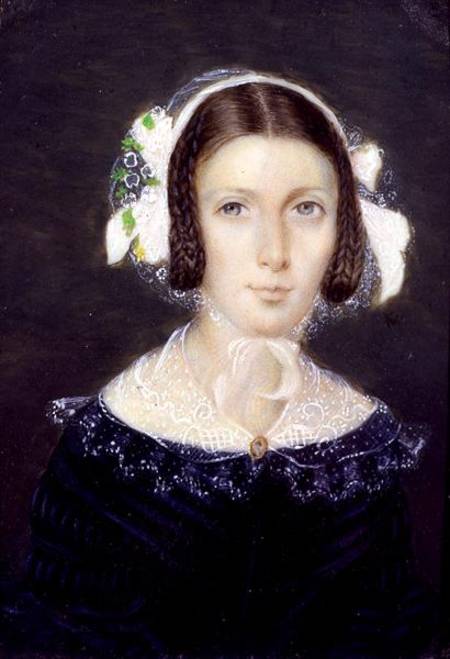
                                                            Keats's unrequited love Fanny Brawne, still lovely in this early ambrotype thirty years after his death.

He consoled himself on a walking tour of Northern England and Scotland the following year before returning home to nurse his brother who was dying of consumption.  He fell in doomed love with Fanny Brawne, who inspired a creative spurt of some of Keats’s most enduring work, including his famous Odes

He contracted the disease from his brother, if he was not already exposed, and began his own decline.

                                                                Lamia, Isabella, The Eve of St. Agners, and Other Poems was Keat's final crowning glory.

 In 1820 his final collection, Lamia, Isabella, The Eve of St. Agnes, and Other Poems was published.  The title poems were rooted in semi-mythical historic pasts.  The collection also included his Odes and a fragment of the epic poem Hyperion on which he had been working for years but would never complete.

                                        A life mask of Keats in 1816.

 His health failing and his hopes for marriage to Fanny doomed, friends financed a trip to Italy to get him out of the cold and damp of England.  The sun cure failed and he died in Rome at the home of the painter Joseph Severn

He was buried in the Protestant Cemetery where a number of notable British and American expatriates  and tourists found final rest.

                                                        A wall plaque for John Keats near his grave in the Protestant Cemetery in Rome.

                            The day is gone, and all its sweets are gone!

          The day is gone, and all its sweets are gone.Sweet voice, sweet lips, soft hand, and softer breast,

Warm breath, light whisper, tender semi-tone,
   Bright eyes, accomplish’d shape, and lang’rous waist!
Faded the flower and all its budded charms,
   Faded the sight of beauty from my eyes,
Faded the shape of beauty from my arms,
   Faded the voice, warmth, whiteness, paradise –
Vanish’d unseasonably at shut of eve,
   When the dusk holiday – or holinight
Of fragrant-curtain’d love begins to weave
   The woof of darkness thick, for hid delight,
But, as I’ve read love’s missal through to-day,
He’ll let me sleep, seeing I fast and pray.

John Keats

                         When I have Fears That I May Cease to Be

When I have fears that I may cease to be
   Before my pen has gleaned my teeming brain,
Before high-pilèd books, in charactery,
   Hold like rich garners the full ripened grain;
When I behold, upon the night’s starred face,
   Huge cloudy symbols of a high romance,
And think that I may never live to trace
   Their shadows with the magic hand of chance;
And when I feel, fair creature of an hour,
   That I shall never look upon thee more,
Never have relish in the faery power
   Of unreflecting love—then on the shore
Of the wide world I stand alone, and think
Till love and fame to nothingness do sink.

John Keats


Friday, April 8, 2022

Strolling With that Old Romantic William Wordsworth—Me! for National Poetry Month 2022


William Wordsworth is often considered the godfather of English romantic poets.  Older than the rest of the pack, he was born on April 7, 1770 in Cockermouth, Cumberland.  He was not dashing like John Keats or heroic like Lord Byron.  He was a writing partner, mentor, and benefactor to Samuel Coleridge but did not share his enthusiasm for the epic and esoteric. Instead, often enthused about nature and the beautiful Lake District where he lived and tramped on foot.  This identification with nature deeply influenced American Ralph Waldo Emerson who visited him on his Grand Tour of Europe.  He was raised to Poet Laureate of the United Kingdom and served from 1843 until his death on April 23, 1850.  He remains widely anthologized and admired in Britain.  His star dimmed in the U.S. with changing tastes and the almost complete abandonment of studying poetry as literature in American schools.  Interest has somewhat revived with the ecological movement which sees him as a pioneering voice.

Early April is the perfect time for Wordsworth, not only for his birthday, but for his nature verse, the best known of which is Daffodils.


Daffodils

I wandered lonely as a cloud

That floats on high o’er vales and hills,

When all at once I saw a crowd,

A host, of golden daffodils;

Beside the lake, beneath the trees,

Fluttering and dancing in the breeze.


Continuous as the stars that shine

And twinkle on the milky way,

They stretched in never-ending line

Along the margin of a bay:

Ten thousand saw I at a glance,

Tossing their heads in sprightly dance.


The waves beside them danced; but they

Out-did the sparkling waves in glee:

A poet could not but be gay,

In such a jocund company:

I gazed—and gazed—but little thought

What wealth the show to me had brought:


For oft, when on my couch I lie

In vacant or in pensive mood,

They flash upon that inward eye

Which is the bliss of solitude;

And then my heart with pleasure fills,

And dances with the daffodils


William Wordsworth


Wordsworth setting off on one of his tramps from Dove Cottage in the English Lake District.

This poem plows that ground as well but is a useful reminder to us now so concerned with the science and technology of trying to save the Earth from eminent destruction to literally take time to smell the flowers.


The Tables Turned


UP! up! my Friend, and quit your books;

Or surely you'll grow double:

Up! up! my Friend, and clear your looks;

Why all this toil and trouble?


The sun, above the mountain's head,

A freshening lustre mellow

Through all the long green fields has spread,

His first sweet evening yellow.


Books! ‘tis a dull and endless strife:

Come, hear the woodland linnet,

How sweet his music! on my life,

There’s more of wisdom in it.


And hark! how blithe the throstle sings!

He, too, is no mean preacher:

Come forth into the light of things,

Let Nature be your teacher.


She has a world of ready wealth,

Our minds and hearts to bless—

Spontaneous wisdom breathed by health,

Truth breathed by cheerfulness.


One impulse from a vernal wood

May teach you more of man,

Of moral evil and of good,

Than all the sages can.


Sweet is the lore which Nature brings;

Our meddling intellect

Mis-shapes the beauteous forms of things:—

We murder to dissect.


Enough of Science and of Art;

Close up those barren leaves;

Come forth, and bring with you a heart

That watches and receives.


—William Wordsworth


An uncharacteristically dour portrait of William Wadsworth now remembered best for his sunny nature verse inspired by the English Lake District.

This late life verse puts nature in the perspective of his own mortality.


I Have Thoughts that Are Fed by the Sun


I have thoughts that are fed by the sun:

The things which I see

Are welcome to me,

Welcome every one –

I do not wish to lie

Dead, dead,

Dead, without any company.

Here alone on my bed

With thoughts that are fed by the sun,

And hopes that are welcome every one,

Happy am I.

Oh life there is about thee

A deep delicious peace;

I would not be without thee,

Stay, oh stay!

Yet be thou ever as now –

Sweetness and breath, with the quiet of death –

Be but thou ever as now,

Peace, peace, peace.


—William Wordsworth 

Saturday, February 23, 2019

John Keats—Quintessential Tragic Romantic

John Keats--a postumous portratby Joseph Hilton in 1822 based on life images.

On February 23, 1821 John Keats, the quintessential English Romantic poet, died in Rome of the poignantly tragic disease of the era, consumption (tuberculosis), at the age of 25.
The orphaned son of a livery stable keeper and a consumptive mother, young Keats fell under the guardianship of a pair of tea brokers who provided him with some of a gentleman’s education before binding him to an apprenticeship with an apothecary-surgeon in London.  Keats dutifully completed the apprenticeship but never practiced the profession.
Instead, he threw himself into writing poetry.  After his first sonnets were published and respectably received, he was introduced into the Romantic literary circle that included William Wordsworth and Percy Bysshe Shelley.  With their help and encouragement he published his first collection, Poems by John Keats to a generally favorable reception in 1817.  His follow-up, Endimion, however, was savaged by establishment critics.  

Keats's unrequited love Fanny Brawne, still lovely in this early ambrotype thirts years after his death.
He consoled himself on a walking tour of Northern England and Scotland the following year before returning home to nurse his brother who was dying of consumption.  He fell in doomed love with Fanny Brawne, who inspired a creative spurt of some of Keats’s most enduring work, including his famous Odes.
He contracted the disease from his brother, if he was not already exposed, and began his own decline. 

Lamia, Isabella, The Eve of St. Agners, and Other Poems was Keat's final crowning glory.
In 1820 his final collection, Lamia, Isabella, The Eve of St. Agnes, and Other Poems was published.  The title poems were rooted in semi-mythical historic pasts.  The collection also included his Odes and a fragment of the epic poem Hyperion on which he had been working for years but would never complete.

A life mask of Keats in 1816.
His health failing and his hopes for marriage to Fanny doomed, friends financed a trip to Italy to get him out of the cold and damp of England.  The sun cure failed and he died in Rome at the home of the painter Joseph Severn.
He was buried in the Protestant Cemetery where a number of notable British and American expatriates  and tourists found final rest.

A wall plaque for John Keats near his grave in the Protestant Cemetery in Rome.

The day is gone, and all its sweets are gone!
   Sweet voice, sweet lips, soft hand, and softer breast,
Warm breath, light whisper, tender semi-tone,
   Bright eyes, accomplish’d shape, and lang’rous waist!
Faded the flower and all its budded charms,
   Faded the sight of beauty from my eyes,
Faded the shape of beauty from my arms,
   Faded the voice, warmth, whiteness, paradise –
Vanish’d unseasonably at shut of eve,
   When the dusk holiday – or holinight
Of fragrant-curtain’d love begins to weave
   The woof of darkness thick, for hid delight,
But, as I’ve read love’s missal through to-day,
He’ll let me sleep, seeing I fast and pray.

—John Keats

When I have Fears That I May Cease to Be

When I have fears that I may cease to be
   Before my pen has gleaned my teeming brain,
Before high-pilèd books, in charactery,
   Hold like rich garners the full ripened grain;
When I behold, upon the night’s starred face,
   Huge cloudy symbols of a high romance,
And think that I may never live to trace
   Their shadows with the magic hand of chance;
And when I feel, fair creature of an hour,
   That I shall never look upon thee more,
Never have relish in the faery power
   Of unreflecting love—then on the shore
Of the wide world I stand alone, and think
Till love and fame to nothingness do sink.

—John Keats

Monday, February 23, 2015

John Keats— Till Love and Fame to Nothingness Did Sink

John Keats by William Hinton.


On February 23, 1821 John Keats, the quintessential English Romantic poet, died in Rome of the poignantly tragic disease of the era, consumption (tuberculosis), at the age of 25. 
The orphaned son of a livery stable keeper and a consumptive mother, young Keats fell under the guardianship of a pair of tea brokers who provided him with some of a gentleman’s education before binding him to an apprenticeship with an apothecary-surgeon in London.  Keats dutifully completed the apprenticeship but never practiced the profession. 
Instead, he threw himself into writing poetry.  After his first sonnets were published and respectably received, he was introduced into the Romantic literary circle that included William Wordsworth and Percy Bysshe Shelley.  With their help and encouragement he published his first collection, Poems by John Keats to a generally favorable reception in 1817.  His follow-up, Endimion, however, was savaged by establishment critics. 
  
A miniature portrait of Keats's great but unrequited love, Fanny Brawn.

He consoled himself on a walking tour or Northern England and Scotland the following year before returning home to nurse his brother who was dying of consumption.  He fell in doomed love with Fanny Brawne, who inspired a creative spurt of some of Keats’s most enduring work, including his famous Odes. 
He contracted the disease from his brother, if he was not already exposed, and began his own decline. 
In 1820 his final collection, Lamia, Isabella, The Eve of St. Agnes, and Other Poems was published.  The title poems were rooted in semi-mythical historic pasts.  The collection also included his Odes and a fragment of the epic poem Hyperion on which he had been working for years but would never complete.
 His health failing and his hopes for marriage to Fanny doomed, friends financed a trip to Italy to get him out of the cold and damp of England.  The sun cure failed and he died in Rome at the home of the painter Joseph Severn. 
He was buried in the Protestant Cemetery where a number of British and American ex-patritubots and tourists of note found final rest.

A life mask of  John Keats.

The day is gone, and all its sweets are gone!
   Sweet voice, sweet lips, soft hand, and softer breast,
Warm breath, light whisper, tender semi-tone,
   Bright eyes, accomplish’d shape, and lang’rous waist!
Faded the flower and all its budded charms,
   Faded the sight of beauty from my eyes,
Faded the shape of beauty from my arms,
   Faded the voice, warmth, whiteness, paradise –
Vanish’d unseasonably at shut of eve,
   When the dusk holiday – or holinight
Of fragrant-curtain’d love begins to weave
   The woof of darkness thick, for hid delight,
But, as I’ve read love’s missal through to-day,
He’ll let me sleep, seeing I fast and pray.

—John Keats

When I have Fears That I May Cease to Be

When I have fears that I may cease to be
   Before my pen has gleaned my teeming brain,
Before high-pilèd books, in charactery,
   Hold like rich garners the full ripened grain;
When I behold, upon the night’s starred face,
   Huge cloudy symbols of a high romance,
And think that I may never live to trace
   Their shadows with the magic hand of chance;
And when I feel, fair creature of an hour,
   That I shall never look upon thee more,
Never have relish in the faery power
   Of unreflecting love—then on the shore
Of the wide world I stand alone, and think
Till love and fame to nothingness do sink.

—John Keats