Showing posts with label Rome. Show all posts

Sunday, February 23, 2025

John Keats Was the Quintessential Tragic Romantic

                    John Keats--a posthumous portrait by Joseph Hilton in 1822 based on life images. 

On February 23, 1821 John Keats, the quintessential English Romantic poet, died in Rome of the poignantly tragic disease of the era, consumption (tuberculosis), at the age of 25. 

The orphaned son of a livery stable keeper and a consumptive mother, young Keats fell under the guardianship of a pair of tea brokers who provided him with some of a gentleman’s education before binding him to an apprenticeship with an apothecary-surgeon in London.  Keats dutifully completed the apprenticeship but never practiced the profession. 

Instead, he threw himself into writing poetry.  After his first sonnets were published and respectably received, he was introduced into the Romantic literary circle that included William Wordsworth and Percy Bysshe Shelley.  With their help and encouragement he published his first collection, Poems by John Keats to a generally favorable reception in 1817.  His follow-up, Endimion, however, was savaged by establishment critics.

                                                            Keats's unrequited love Fanny Brawne, still lovely in this early ambrotype thirty years after his death.

He consoled himself on a walking tour of Northern England and Scotland the following year before returning home to nurse his brother who was dying of consumption.  He fell in doomed love with Fanny Brawne, who inspired a creative spurt of some of Keats’s most enduring work, including his famous Odes

He contracted the disease from his brother, if he was not already exposed, and began his own decline.

                                                                Lamia, Isabella, The Eve of St. Agners, and Other Poems was Keat's final crowning glory.

 In 1820 his final collection, Lamia, Isabella, The Eve of St. Agnes, and Other Poems was published.  The title poems were rooted in semi-mythical historic pasts.  The collection also included his Odes and a fragment of the epic poem Hyperion on which he had been working for years but would never complete.

                                        A life mask of Keats in 1816.

 His health failing and his hopes for marriage to Fanny doomed, friends financed a trip to Italy to get him out of the cold and damp of England.  The sun cure failed and he died in Rome at the home of the painter Joseph Severn

He was buried in the Protestant Cemetery where a number of notable British and American expatriates  and tourists found final rest.

                                                        A wall plaque for John Keats near his grave in the Protestant Cemetery in Rome.

                            The day is gone, and all its sweets are gone!

          The day is gone, and all its sweets are gone.Sweet voice, sweet lips, soft hand, and softer breast,

Warm breath, light whisper, tender semi-tone,
   Bright eyes, accomplish’d shape, and lang’rous waist!
Faded the flower and all its budded charms,
   Faded the sight of beauty from my eyes,
Faded the shape of beauty from my arms,
   Faded the voice, warmth, whiteness, paradise –
Vanish’d unseasonably at shut of eve,
   When the dusk holiday – or holinight
Of fragrant-curtain’d love begins to weave
   The woof of darkness thick, for hid delight,
But, as I’ve read love’s missal through to-day,
He’ll let me sleep, seeing I fast and pray.

John Keats

                         When I have Fears That I May Cease to Be

When I have fears that I may cease to be
   Before my pen has gleaned my teeming brain,
Before high-pilèd books, in charactery,
   Hold like rich garners the full ripened grain;
When I behold, upon the night’s starred face,
   Huge cloudy symbols of a high romance,
And think that I may never live to trace
   Their shadows with the magic hand of chance;
And when I feel, fair creature of an hour,
   That I shall never look upon thee more,
Never have relish in the faery power
   Of unreflecting love—then on the shore
Of the wide world I stand alone, and think
Till love and fame to nothingness do sink.

John Keats


Sunday, August 4, 2019

The Temple in Flames—The Enduring Effects of the Fall of Jerusalem

As the Temple and City of Jerusalem burn Titus's Legions make off with the loot including the Menorah from the Holy of Holies. 
By tradition it was on this date in 70 CE that Roman Legions under the command of Titus Flavius Vespasianus, the future Emperor Titus, set fire to the Second Temple in Jerusalem destroying it and much of the city.  The date is commemorated by Tisha B’Av, the saddest day of the Hebrew Calendar.
In 66 the Zealots had risen up and expelled the Romans from the Judean capital.  They had held sway there for four years.  But they were divided by factionalism and were actively opposed by the Pharisees and the Sadducees who were bitter about the Zealot’s lack of obedience to traditional Jewish law and to the authority of the priests of the Temple.  They also felt that the Zealots uncompromising anti-Roman militancy put the whole the Jewish people at risk.
Of course the Romans were not used to losing territory that they considered their own.  Titus arrived with his Legions earlier in the year and began to lay siege to the city.  They choked off most commerce to the city and encouraged starvation by allowing pilgrims from the countryside to enter the city then not allowing them to return swelling the population.  Starvation and suffering in the city was reportedly made worse by the Zealots burning years of accumulated food and firewood reserves supposedly in order to make the people desperate to break the siege according by hostile Rabbinic scholars writing a century later.
Titus leads The Conquest of Jerusalem by Nicola Poussin.
Much of what we know about the siege and the destruction of the Temple, in fact, comes from hostile sources because the Zealots in the city were largely massacred and survivors died later in the Siege of Masada.  
In addition to the rabbinic accounts we have the writings of Josephus, a former leader of the uprising in the north who was captured by the Romans in 67 CE.  Eventually he was freed by the Emperor Vespasian and became a Roman citizen.  He accompanied the Emperor’s son Titus as a translator on the expedition and took the Roman name Titus Flavius Josephus.  He is the same historian who made the only near-contemporary notice of the life of Jesus.  Thus the most detailed account that we have, the one most relied on by contemporary historians was written by a turn coat and courtier trying to keep and win favors from his Roman masters.
Historian Josephus--The Jewish turn coat as Roman citizen Titus Flavius Josephus left the most detailed account of the burning of the Temple and the destruction of Jerusalem.
Josephus was dispatched by Titus to enter the city and attempt to negotiate a settlement.  Not only was the overture repulsed, but Josephus was wounded by an arrow.  Titus then stepped up the siege, breaching the third and second city walls by battering ram in May.  
Turning their attention to the Fortress of Antonia just north of the Temple Mount, the Legions engaged in vicious street fighting, slowly pushing the Zealots back to a last stand in the Temple itself while taking heavy casualties.  The casualties, along with others sustained in various break-outs to secure food and hector the Roman rear, enraged the Legionnaires who were clamping at the bit against Titus’s supposed policy of moderation and eventual conciliation with the Jews.  At least as Josephus told it later.
The last stand of the Zealots on the walls of the Temple.
The Fortress of Antonia finally fell giving the Romans a commanding presence over the Temple.  While the Temple walls were too thick to be breached by battering ram, Legionnaires could pepper the Temple compound with arrows, stones and other missiles.  Despite Titus’s orders that the Temple not be destroyed, it was set ablaze by burning fagots which ignited the roofs of adjacent buildings.  It was engulfed in flames, as was much of the city.  The walls were breached and defenders threw the stones from them onto adjacent streets to impede the Romans where some of them can still be seen.  When the fire went out, only the Western Wall was left standing of the Second Temple, which had been built by Herod the Great only 90 earlier on the site of the Temple of Solomon which itself was destroyed 700 years earlier.
Carrying the spoils of the Temple, including the sacred Menorah from the Holy of Holies in a Roman Triumph as depicted on the Arch of Titus.
Some of the Zealots escaped the city.  Most of the survivors retreated to the north of the city for a last stand.  The Romans constructed siege towers and breached the final wall to the north, eradicating resistance by early September.
Titus ordered the complete destruction of the city, its suburbs, what was left of the Temple, and the slaughter of the inhabitants.  According to Josephus over a million were killed, an impossible number, but surely tens of the thousands.  Here is a bit of his account:
  Now as soon as the army had no more people to slay or to plunder, because there remained none to be the objects of their fury (for they would not have spared any, had there remained any other work to be done), [Titus] Caesar gave orders that they should now demolish the entire city and Temple, but should leave as many of the towers standing as they were of the greatest eminence; that is, Phasaelus, and Hippicus, and Mariamne; and so much of the wall enclosed the city on the west side. This wall was spared, in order to afford a camp for such as were to lie in garrison [in the Upper City], as were the towers [the three forts] also spared, in order to demonstrate to posterity what kind of city it was, and how well fortified, which the Roman valor had subdued; but for all the rest of the wall [surrounding Jerusalem], it was so thoroughly laid even with the ground by those that dug it up to the foundation, that there was left nothing to make those that came thither believe it [Jerusalem] had ever been inhabited. This was the end which Jerusalem came to by the madness of those that were for innovations; a city otherwise of great magnificence, and of mighty fame among all mankind…
And truly, the very view itself was a melancholy thing; for those places which were adorned with trees and pleasant gardens, were now become desolate country every way, and its trees were all cut down. Nor could any foreigner that had formerly seen Judaea and the most beautiful suburbs of the city, and now saw it as a desert, but lament and mourn sadly at so great a change. For the war had laid all signs of beauty quite waste. Nor had anyone who had known the place before, had come on a sudden to it now, would he have known it again. But though he [a foreigner] were at the city itself, yet would he have inquired for it…
The slaughter within was even more dreadful than the spectacle from without. Men and women, old and young, insurgents and priests, those who fought and those who entreated mercy, were hewn down in indiscriminate carnage. The number of the slain exceeded that of the slayers. The legionaries had to clamber over heaps of dead to carry on the work of extermination.
For his part, Titus was lionized as a hero in Rome, although he modestly—or perhaps politically shrewdly—declined the Laurel wreath claiming that he was only acting on the will of the gods.  Still he allowed a triumphant arch to be erected, which still stands to this day.  On it can be seen the looting of the Temple including carrying away as treasure the holy Menorah from the Holy of Holies.
The Arch of Titus stood amid the ruins of a Roman wall when painted during the Renaissance.  It stands alone today in modern Rome. 
The Siege of Masada in 73 or 74 CE effectively ended Jewish resistance to Roman rule.  Although some remained, even in the destroyed city of Jerusalem itself, many survivors fled to the east, the north and around the Mediterranean, where there were already well established Jewish communities, many, ironically within the Empire.  Within centuries the Diaspora had spread as far east as China and India, into Abyssinia and points south in Africa, through the lands occupied by the spread of Islam, and deep into Europe.
Judea was repopulated mostly by waves of neighboring Semitic peoples of various origins, including after the Muslim conquest, Arabs.  Together these disparate people would eventually forge an identity as Palestinians.
So much even modern history is thus tied up with the foggy events of antiquity.


Saturday, February 23, 2019

John Keats—Quintessential Tragic Romantic

John Keats--a postumous portratby Joseph Hilton in 1822 based on life images.

On February 23, 1821 John Keats, the quintessential English Romantic poet, died in Rome of the poignantly tragic disease of the era, consumption (tuberculosis), at the age of 25.
The orphaned son of a livery stable keeper and a consumptive mother, young Keats fell under the guardianship of a pair of tea brokers who provided him with some of a gentleman’s education before binding him to an apprenticeship with an apothecary-surgeon in London.  Keats dutifully completed the apprenticeship but never practiced the profession.
Instead, he threw himself into writing poetry.  After his first sonnets were published and respectably received, he was introduced into the Romantic literary circle that included William Wordsworth and Percy Bysshe Shelley.  With their help and encouragement he published his first collection, Poems by John Keats to a generally favorable reception in 1817.  His follow-up, Endimion, however, was savaged by establishment critics.  

Keats's unrequited love Fanny Brawne, still lovely in this early ambrotype thirts years after his death.
He consoled himself on a walking tour of Northern England and Scotland the following year before returning home to nurse his brother who was dying of consumption.  He fell in doomed love with Fanny Brawne, who inspired a creative spurt of some of Keats’s most enduring work, including his famous Odes.
He contracted the disease from his brother, if he was not already exposed, and began his own decline. 

Lamia, Isabella, The Eve of St. Agners, and Other Poems was Keat's final crowning glory.
In 1820 his final collection, Lamia, Isabella, The Eve of St. Agnes, and Other Poems was published.  The title poems were rooted in semi-mythical historic pasts.  The collection also included his Odes and a fragment of the epic poem Hyperion on which he had been working for years but would never complete.

A life mask of Keats in 1816.
His health failing and his hopes for marriage to Fanny doomed, friends financed a trip to Italy to get him out of the cold and damp of England.  The sun cure failed and he died in Rome at the home of the painter Joseph Severn.
He was buried in the Protestant Cemetery where a number of notable British and American expatriates  and tourists found final rest.

A wall plaque for John Keats near his grave in the Protestant Cemetery in Rome.

The day is gone, and all its sweets are gone!
   Sweet voice, sweet lips, soft hand, and softer breast,
Warm breath, light whisper, tender semi-tone,
   Bright eyes, accomplish’d shape, and lang’rous waist!
Faded the flower and all its budded charms,
   Faded the sight of beauty from my eyes,
Faded the shape of beauty from my arms,
   Faded the voice, warmth, whiteness, paradise –
Vanish’d unseasonably at shut of eve,
   When the dusk holiday – or holinight
Of fragrant-curtain’d love begins to weave
   The woof of darkness thick, for hid delight,
But, as I’ve read love’s missal through to-day,
He’ll let me sleep, seeing I fast and pray.

—John Keats

When I have Fears That I May Cease to Be

When I have fears that I may cease to be
   Before my pen has gleaned my teeming brain,
Before high-pilèd books, in charactery,
   Hold like rich garners the full ripened grain;
When I behold, upon the night’s starred face,
   Huge cloudy symbols of a high romance,
And think that I may never live to trace
   Their shadows with the magic hand of chance;
And when I feel, fair creature of an hour,
   That I shall never look upon thee more,
Never have relish in the faery power
   Of unreflecting love—then on the shore
Of the wide world I stand alone, and think
Till love and fame to nothingness do sink.

—John Keats

Tuesday, February 2, 2016

Rodent Redux—Groundhog Day

On her Facebook cartoonis Sandra Boynton said that the Ground hod decided not to come out this year but to stay home and "Watch Bill Murray over, and over again.  When were were first married my wife Kathy worked for Recycled Paper Products in Chicago where Boynton's work was the main attraction with her whimsical animals appearing not only on cards but on coffee mugs and all sorts of other merchandise.  I still wear a turkey tie she designed every Thanksgiving.


Well, it’s Groundhog Day again.  In the Chicago area that means a familiar ritual.  No, not that one.  A certain moon faced and bald TV weatherman will go apoplexic over folks making a huge deal over the faux meteorological prognosticative powers of a lethargic rodent.  Tom Skilling rose to prominence decades ago bantering about the weather on Bob Collins’s hugely popular WGN Radio morning show. 
In 1990 he cemented glory and fame when he predicted the likelihood of severe tornados from a supercell thunderstorm moving out of Wisconsin and into Illinois.  He stayed on the air with Collins accurately charting and predicting the path of the storm while the official Weather Service office in Chicago sat on its thumbs and issued no warnings.  His early advice to the people of Plainfield to take cover was the only warning they got saving at least some lives when a Category 5 twister destroyed much of the town and killed 27 on August 28.
After that Skilling became something of a folk hero.  He added WGN TV news broadcasts to his daily schedule and was so popular that the station began building their early-at-9pm news around his forecasts, which were and are ridiculously detailed with more meteorological data and scientific interpretation than his competitors on the network affiliates.
Skilling really, really hates Groundhog Day.  Old Chicagoans now tune in just to see if his head really does explode this year, which annually seems more likely as he has grown fatter year by year.  Sadly for him, it is a losing battle.  Instead of withering under scientific scorn and the weight of irrefutable evidence, Groundhog Day continues to grow in popularity and spread every year.  From an obscure folk custom observed by a handful of German immigrants and their decedents in isolate pockets of Pennsylvania in the late 18th and 19th Centuries it has spread nationwide. 
In 2015 Wikipedia identified no fewer than 38 woodchucks dragged from their winter hibernation and exposed to the sky across the U.S. and Canada.  Come hell or high water or the Iowa Caucuses virtually every news broadcast in North America today, including Skillings’s own WGN, will feature stories about one or more of the creatures and whether he—almost always identified as a male but most frequently a she—will see his shadow supposedly signifying six more weeks of winter weather.
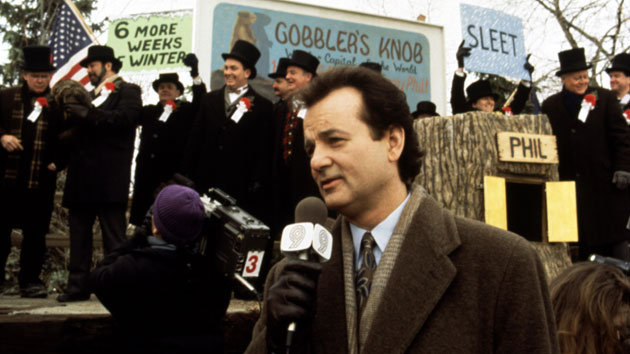
These local observations got big boost with the release of the movie Groundhog Day starring Bill Murray and Andie MacDowell in 1992.  The film has become a beloved classic with a cult following often compared to Frank Capra’s It’s A Wonderful Life.  It was filmed in my neck of the woods, as another TV weatherman used to say, in Woodstock, Illinois.  Just after 7 am Woodstock Willie will make his grumpy appearance from the Gazebo as he has every year since the film came out.  The city has stretched the celebration into a week-long festival in hopes of luring pilgrims and tourists.  It works.  The Woodstock ritual is now the second-most famous celebration in the country behind the original at Punxsutawney, Pennsylvania, which the McHenry County town portrayed in the film.

Bill Murray in the film Groundhog Day shot in Woodstock, Illinois.

This year a fog and dense cloud  cover which will give way to a cold rain later will obscure the Sun.  Which is good news to the superstitious, supposedly heralding an early spring.
Part of the spreading appeal of the celebrations is because they are a welcome, if silly, relief from the dreary tedium of the depths of the winter, long after the razzmatazz of the Holidays have past when everyone in cold climes are sick to death of snow, ice, howling winds, and leaden skies.  But a philosopher might speculate that the surging popularity of Groundhog Days mirrors the growing anti-intellectualism of modern America and the spreading animus to science now officially embraced by a major political party and reflected in rejection of evolution, denial of climate change, anti-vaccine hokum, and a general rejection of rationality.  Or maybe that would be reading too much into a harmless custom.
So how did all of this come to pass?  Some claim religious roots stretching back to Neolithic Europe.  The growing neo-pagan movement is explicit in laying claim to it, but Catholics have their own customs which may, or may not have been cribbed from older traditions.
Groundhog Day has been traced to pre-Christian Northern European folk traditions stretching back in the mists of time.  It is notoriously difficult to pin down precise origins of such oral traditions or to know the complete religious significance of them.  Tales about a beast—usually envisioned as a bear or a badger that had powers to predict or control the weather seem to have originated in Norse and/or Germanic tribal societies and spread by diffusion or osmosis to other European peoples including the Slavs to the east and the Celts to the south and west.  The celebration of the animal was tied to the half-way point between Winter Solstice—Yule—and the Spring Equinox.  

Imbolc--The Goddess Awakens.
Although most of the animal and weather lore that leads directly to Groundhog Day are of Northern European origins, modern Wiccans and neo-pagans have identified it with the Celtic festival of Imbolc one of the four seasonal quarter festivals along with Beltane (Spring/Easter), Lughnasadh (Mid-Summer) and Samhain (Fall/Halloween) that fall between the solstices and equinoxes.  Traditionally it was a festival marking the first glimmers of spring while still in the grip of the cold and dark of winter.  As such it was distantly related to transition predicted by the Norse totem animal, but had no known direct corresponding myth.
Instead it celebrated the Goddess Brigid patroness of poetry, healing, smith crafts, midwifery, and all arts of hand.  In some stories her feast on February 1 celebrated her recovery after giving birth to the God—the Green Manwho will come into his own and rule from Lughnasadh to winter. 
In Ireland with the coming of Christianity the Goddess and her festival became identified with St. Brigid of Kildare, along with Patrick and Brendon one of the three Patron Saints of the country.  Now thought to be apocryphal, St. Brigid in lore was first recorded in the 7th Century and expanded upon by later monks and scribes.  She was described as the daughter of a Pict slave woman converted by Patrick himself. Born in 451 in Faughart, County Louth  she became a holy woman, nun, and abbess who founded a monastery on the site of an ancient temple to the Goddess Brigid in Kildare.  She assumed many of the pagan goddess’s attributes and performed many miracles.  Stories about the Goddess and the Nun are so intertwined that it is impossible to figure out if the holy woman was real or an invention of the Church intended to comfort converts with familiar and beloved tradition.

St. Brigiid's Cross.

Today the best known tradition associated with the Feast of St. Brigid is the making of the off-center straw crosses from last season’s straw that are hung as talismans in Irish homes through Lent until Easter.
Almost all of the original traditions associated with the Goddess Brigid and Imbolc had been eradicated or simply faded away 18th Century even in Gaelic speaking regions.  In the 20th Century Wiccans and other neo-pagans have attempted to revive the old Celtic traditions and in the process invented rituals and lore to fill in the lost gaps.  Many believe the Quarter Festivals and old Gods and Goddesses are accessible spiritual metaphors for worship of the natural world and the timeless rhythm of the seasons.
That included borrowing from St. Brigid, as well.  Her straw crosses are now described as not Christian at all but as ancient symbols representing the Four Quarter Festivals and the Four Cardinal Directions.  There is no way to prove or disprove that assertion.
The Rev. Catharine Clarenbach, a Unitarian Universalist minister explained how modern practitioners view Imbolc in an entry on Nature’s Path, a U.U. pagan experience and earth centered blog hosted by the religious site Patheos.  She called it “a light not heat holiday” in which the slowly lengthening days and first tenuous hints at Spring-to-come give hope to those trudging through the hard days. “When people are desperately ill, hope can fuel the long slog toward wholeness and healing, even if that healing is not a cure.
That certainly ennobles the day beyond the giddy fantasy of groundhog magic.
But our trail to modern Groundhog Day does not end with the re-invention of Imbolc.  Indeed other than sharing a date, the two celebrations have little in common.
Over in England and Scotland a different Christian tradition evolved—Candlemas observed on February 1, the eve of St. Brigid’s Day and often confused as British equivalent.  But Candlemas has very early 4th Century Christmas roots as The Feast of the Presentation celebrated by early Church patriarchs including Methodius of Patara, Cyril of Jerusalem, Gregory the Theologian, Amphilochius of Iconium, Gregory of Nyssa, and John Chrysostom.  It celebrated the presentation of Jesus at the Temple in Jerusalem as an infant. 

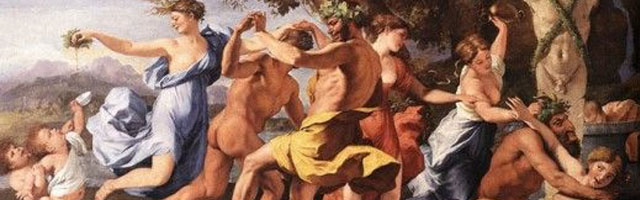
As was often the case, things tended to get out of hand during the Roman festival of Lupercalia, which also became associated with later St. Valentine's Day and the beginning of the pre-Lenten Carnival season.
The celebration slowly spread from the Levant to the rest of the Church and Roman Empire.  When the date of Christmas was finally fixed on December 25, the Feast of the Presentation was added to the liturgical calendar forty days later on February 2.  That date by happenstance nearly coincided with the old Roman festival Lupercalia which simultaneously celebrated the Roman version of the Greek God Pan who was sacred to shepherds in the Spring lambing festival and Lupa the she-wolf who suckled Romulus and Remus, legendary twin founders of Rome.  In evolving Roman practice it had become a major popular holiday in Rome itself and associated with the revelry and abandon of other feasts.  Lupercalia was outlawed by the ascendant Christians but still widely, if covertly, celebrated by ordinary Romans.  The official Feast of the Presentation, coming just before Lent was hoped to ease acceptance of Church teachings.
Pope Gelasius I began calling this festival, which set off the carnival season, the Feast of the Candles, later known as Chandelours in parts of France, the Alps, and the Pyrenees and as Candlemas in Britain.  It connections to Lupercalia have caused some modern neo-pagans to view that celebration as a Latin equivalent of the German and Norse totem animal observations.  That is highly speculative and tenuous at best.
But in Scotland we do find Candlemas as the first indication that the Northern European custom had been introduced to Britain.  An early Scots Gaelic proverb went:
The serpent will come from the hole
On the brown Day of Bríde,
Though there should be three feet of snow
On the flat surface of the ground.
Although it was a serpent, not a bear, that was mentioned, the emergence of a totem animal to herald Spring was clearly there.  Over time looking for badgers stretching their legs at Candlemas became a folk tradition in rural areas of Scotland and England. 
Without mention of an animal witness this early English verse asserts
If Candlemas be fair and bright,
Winter has another flight.
If Candlemas brings clouds and rain,
Winter will not come again.
But that custom was never wide spread and did not seem to have traveled to the New World with early settlers from the colonies.
It took German peasants lured to frontier areas of Pennsylvania in the late 1700s to do that.  The use of groundhogs for prognostication rather than bears or badgers—both of which were far more dangerous and hard to manage than the lumbering and common local rodents—was well established when the first recorded note of the celebration was made in English in an 1841 diary entry by Morgantown shopkeeper James Morris:
Last Tuesday, the 2nd, was Candlemas day, the day on which, according to the Germans, the Groundhog peeps out of his winter quarters and if he sees his shadow he pops back for another six weeks nap, but if the day be cloudy he remains out, as the weather is to be moderate.
All across central and western Pennsylvania where Germans had settled in large numbers local Groundhog lodges sprang up in many towns to celebrate the annual appearance of the weather predicting critters.  An elaborate communal meal called a Fersommling featuring groaning tables, orations, skits, and music led up to a ritual presentation of the local groundhog.  These lodges and festival gatherings were also an important tools to preserve German cultural identity in communities pressed hard by Englanders—native English speakers.  Only the Pennsylvania Dutch dialect was allowed to be spoken at 19th Century Fersommlings fines levied for each English word uttered.
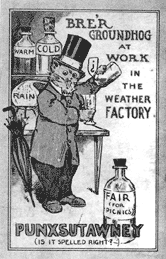
An early Punxsutawney Groundhog cartoon.


In 1887 in a burst of civic boosterism Colby Camps, editor of the Punxsutawney Spirit promoted his home town as the official Groundhog Day home and the local beast, always named Phil generation after generation regardless of gender, as the town’s official meteorologist.  The first story rapidly got picked up by other local and national publications which eagerly reported the result of Phil’s observation.  It became an annual tradition and publicity for the event and town grew year after year.
By the 1920 towns from the East Texas Hill Country and North Carolina, many with their own German immigrant populations, to Ontario and French speaking Quebec were hosting their own celebrations. 
Then, as noted, the 1993 movie inspired still more.
Today the accuracy of the various groundhogs is in dispute.  Backers, including local Groundhog society boost accuracy rates of between 80 and 90%.  Cold hard statistical analysis refutes that unsubstantiated claim.  A study of several Canadian towns with Groundhog celebrations dating back 30 to 40 years found only 37% rate of accuracy.  The record at  Punxsutawney dating all the way back to that first 1887 outing is hardly better—only 38%.  Both are much worse than random 50/50 odds.
But this year our local Woodstock Willie might catch a break.  Because of this year’s unusually strong El Niño the National Weather Service is predicting much warmer than usual weather for the late Winter  and Spring for the Upper Midwest and Great Lakes Region.