Showing posts with label Jr. Show all posts

Monday, January 6, 2025

We Three Kings The Feast of the Epiphany—Murfin Winter Holidays Music Festival 2024-‘25

                                                     We Three Kings by The Roaches lived on David Letterman.

The Christmas season officially ended yesterday as the Catholic Church and Western Christian denominations that borrow its liturgical calendar observe the Feast of the Epiphany today.  Theologically it is a celebration of the revelation to the world of Jesus as the fully human God the Son.  As such it celebrates a facet of the Trinity.  Little wonder that my Unitarian Universalists, who deny the whole Three-in-one God deal, don’t make much of the day.

There are several components of the revelation.  The first is the visit by the Magi to the Child in Bethlehem—the announcement of the Holy presence to the Gentile world.  Second is the baptism of Jesus in the River Jordan by his cousin John, the half-mad preacher.  Third is the marriage party in Cana where Jesus was said to have performed his first miracles—proof of his divine power.


El Día de Los Reyes Magosthe Day of the Three Wise Kings is celebrated across Latin America with unique customs including a feast featuring a cake with a hidden king or baby Jesus and the person who finds the object hosts the feast the next year.  It is also the primary gift event of the season for children.

Despite the complexity of the multiple stories, in the West the Feast of the Epiphany is largely all about those Magi.  In fact, in most Latin American countries it is most commonly known as the Feast of the Three Kings, which sort of diverts attention from the alleged star.  On the Eve the Magi are finally added to Nativity scenes and on January 6, children wake up to gifts from the Kings.  It was the main gift giving occasion of the Christmas season, or at least was until ubiquitous Santa Claus began invading traditional cultures.


The story of the Magi from the 
Bible morphed into three specific Eastern rulers in Western tradition.

Now about those alleged Kings…First, it they existed at all they were surely not rulers of any sort.  What we know of them comes from the Gospel of Mathew as described in the King James Version of the Bible'

2 Now when Jesus was born in Bethlehem of Judaea in the days of Herod the king, behold, there came wise men from the east to Jerusalem,

2 Saying, Where is he that is born King of the Jews? for we have seen his star in the east, and are come to worship him.

3 When Herod the king had heard these things, he was troubled, and all Jerusalem with him.

4 And when he had gathered all the chief priests and scribes of the people together, he demanded of them where Christ should be born.

5 And they said unto him, In Bethlehem of Judaea: for thus it is written by the prophet,

6 And thou Bethlehem, in the land of Juda, art not the least among the princes of Juda: for out of thee shall come a Governor, that shall rule my people Israel.

7 Then Herod, when he had privily called the wise men, enquired of them diligently what time the star appeared.

8 And he sent them to Bethlehem, and said, Go and search diligently for the young child; and when ye have found him, bring me word again, that I may come and worship him also.

9 When they had heard the king, they departed; and, lo, the star, which they saw in the east, went before them, till it came and stood over where the young child was.

10 When they saw the star, they rejoiced with exceeding great joy.

11 And when they were come into the house, they saw the young child with Mary his mother, and fell down, and worshipped him: and when they had opened their treasures, they presented unto him gifts; gold, and frankincense and myrrh.

12 And being warned of God in a dream that they should not return to Herod, they departed into their own country another way.

Note that they are not identified in any way as kings.  They are said to be from the East, so it is likely that they were meant to represent Persian priests or Asian astrologers.  Nor is any number set.  The early Church sometimes used figures up to twelve.  Eventually the number was settled at three and totally un-Biblical tales sprang up around them.  They even grew names and origin storiesMelchior, a Persian; Caspar, an Indian; and Balthazar from Arabia—perhaps from Yemen which then had Jewish kings.  

            
                                        The Adoration of the Magi 
by Carlo Dolci.

There is no reason to believe that their visit fit neatly into the later liturgical calendar twelve days after a mid-winter birth.  In fact, the kind of Biblical scholars who try to find historical accuracy in the Bible think that the visit may have been up to two years after the birth and that the Holy family may have been in residence in Bethlehem for that long.  They infer this from the fact that Herod ordered the massacre of all male children under two years of age, not just infants.

Then there is the issue of the Star.  Of course, if you are a literalist, you believe that an actual star either hovered over the City of David, or actually moved, leading the Magi on their journey.  But those seeking natural explanations for the phenomena have proposed various possibilities, most commonly a comet or the appearance of a near-solar system super nova.  The problem with either of these suggestions is that the very careful records kept by Chinese astrologers make no note of either phenomenon in a five year window around the time of Jesus’s presumed birth.  And they surely would have noted it.

One explanation that has gained some traction is that the Star was actually a triple conjunction of Jupiter and Saturn in the constellation Pisces, which is known to have occurred in 7 BCE, a little late for the story but close enough for some.  But contemporary Babylonian records show little interest in the event and do not suggest that the planets converged closely enough in the sky to create a super bright object.

Then perhaps it was a UFO.  That will probably be a History Channel two hour special next year.

Or the Star and the Magi are all pious fiction and poetry meant to inform the understanding of the birth of the Messiah to the Gentile world.  No mention of the Magi can be found in the simple nativity story found in Luke.  Presumably the sudden presence of well-dressed strangers in the stable would have been noted by those shepherds.  And why did they have to follow a Star when God apparently had no shortage of herald angels to tell the travelers just where to go?

But I don’t want to nit-pick a treasured story.  After all, much fiction can be truth in a broader sense, or at least symbolic of a truth. 

Back to the Feast of the Epiphany.  The Copts and Eastern Orthodox also celebrate the feast but on different dates dependent on their calendars.  They also celebrate the incarnation of God in Man but build their observances not so much on the Kings.  They concentrate on the Baptism as the great announcement.  


                                An icon of the Baptism of Jesus by his cousin John shows the focus of the Orthodox Feast of the Epiphany.

It was also much more celebrated in the Medieval Western church as evidenced by many pre-Renaissance paintings of the Baptism and concerning Jesus’s relations with his cousin John. 

But those virtually disappeared signaling a change of Christology in the Catholic Church.  Emphasis on John and other earthy relatives of Jesus such as his siblings like James of Jerusalem seemed uncomfortably close to viewing Jesus as a wholly mortal man, not a partner in a godhead.

Anyway, there you have it—The Feast of the Epiphany.  Celebrate or not as you choose.  


                                                        We Three Kings 
author and composer the Rev. John Henry Hopkins, Jr.

The song most associated with the Epiphany is, of course, We Three Kings of Orient Are.  It   was written in 1857 by John Henry Hopkins Jr., Rector of Christ Episcopal Church in Williamsport, Pennsylvania. He wrote the carol for a Christmas pageant in New York City at his alma mater, the General Theological Seminary.  He published the carol in 1863 in his book Carols, Hymns, and Songs. It was the first American Christmas carol to achieve international popularity, as well as the first to be featured in Christmas Carols Old and New, the prestigious and influential collection published in Britain in 1916 and was printed in the hymnal of the Episcopal Church.  


The Roaches went from small clubs and college dates to stars of Americana, the then new niche musical category for folk infused singer-songwriters and acts exploring "roots music on the strength of their Christmas album  We Three Kings.

It has been recorded countless times.  In 1990 the American indie-folk act The Roches went from a semi-obscure trio with a cult following to broader stardom in the acoustic and Americana niches with their Christmas album We Three Kings.  Sisters Maggie, Terre, and Suzzy Roche performed the title song on one of David Lettermans holiday shows.


Monday, July 28, 2014

A Bomber, a Building, and the Fog

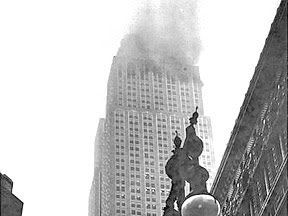
Smoke and flames engulf the higher floors of the Empire State Building after being struck by a B-25 Bomber.


On the morning of September 11, 2001 I was in the office of Briargate Elementary School in Cary, Illinois where I was head building custodian.  It was a few minutes before the beginning of classes.  Busses were beginning to pull up to the front of the school with their full loads.  Teachers were flitting in an out to check their mailboxes.  I was leaning on the front counter chatting with the school secretary and the nurse.  As usual a radio was quietly playing.  We weren’t paying close attention.  The nurse first realized something was amiss and darted over to turn up the volume.  After a bit of confusion we learned that an airplane had slammed into the World Trade Center Towers in New York City.  None of us knew quite what that meant.  And none of us suspected that it might be a terrorist attack.  Almost the first words out of my mouth were something like, “A bomber hit the Empire State Building during World War II.”  Then all hell broke loose, the telephones began to ring off the hook, and shaken teacher began pouring into the office, some crying, wondering what to do…
The event that I dredged from my memory that morning occurred on Saturday, July 28, 1944.  On that distant morning the skies over the Big Apple were not a crystalline, perfect blue, but engulfed in a deep fog.  The confused pilot of a B-25 Mitchel Army Air Force bomber took a wrong turn and slammed into the side of the world tallest building between its 78th and 80th floors.
 
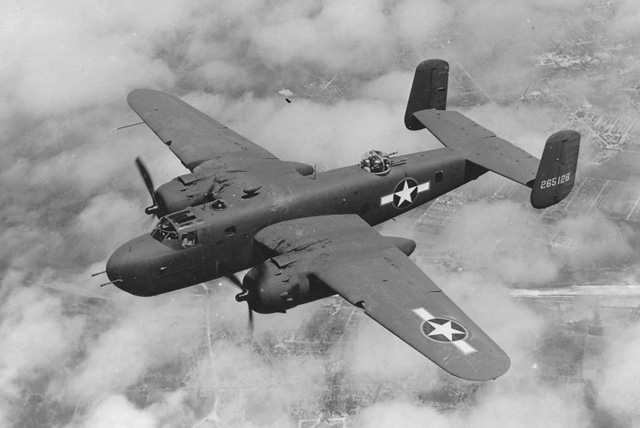
An Army Air Force B-25 Mitchel medium bomber in flight.

Earlier that morning the B-25 with the name Old John Feather Merchant painted on its nose took off from Bedford Army Air Field in Massachusetts on a routine personnel transportation mission bound for Newark, New Jersey.  In the pilot’s seat was Lt. Colonel William Franklin Smith, Jr, an experience combat veteran who had miraculously completed his 25 missions over Europe and was now back in the states flying non stressful milk runs like this one.  The flight was so routine that Smith had neither a co-pilot nor a navigator.  Staff Sargent Christopher Domitrovich, a radio operator, was the only other crew member.  There was one passenger, Navy Aviation Mate Albert Perna who had hitched a ride on what was supposed to be a dead head flight to pick up other passengers.
As Col. Smith approached metropolitan New York he flew into a dense fog.  He radioed for permission to land in Newark.  The tower strongly recommended against it.  “We can’t even see the Empire State Building” a controller said.  Instead he was directed to land at New York Municipal Airport, now known as LaGuardia, which is on the north end of the Borough of Queens on Long Island jutting out into the East River.  But Smith, with the single mindedness of a veteran bomber pilot, was determined to complete his mission as assigned.  He would not land at LaGuardia.  He did not directly refuse the request not to proceed to Newark.  His last transmission was a simple if cryptic, “Thank you very much.”
He began a descent toward the New Jersey field but somehow got confused and turned in toward Manhattan’s dense forest of skyscrapers instead of over open water for the approach to the field.  About the time he passed the Chrysler Building there is evidence that the fog lifted enough for him to realize that he was fly amid the buildings.  He began to try to correct.  But it was too late.  Moments later at 9:40 am, his plane slammed into the Empire State Building.
The plane smacked into the offices of National Catholic Welfare Services on the 79th floor which were quickly engulfed in a ball of flame.  Therese Fortier Willig a twenty year old clerk recalled:
In the other side of the office, all I could see was flames Mr. Fountain [her boss] was walking through the office when the plane hit the building and he was on fire — I mean, his clothes were on fire, his head was on fire. Six of us managed to get into this one office that seemed to be untouched by the fire and close the door before it engulfed us. There was no doubt that the other people must have been killed.
And indeed they were.  Most of the 11 people in the building who were killed were on this floor and in this office.  Some were incinerated at their desks.  Others were engulfed by the fire wall as they tried to escape.  Mr. Fountain continued walking, on fire until co-workers put him out.  He was taken to a hospital where he died in agony days later.  Willig and her cohorts behind that door survived with only smoke inhalation injuries until rescued by firefighters.
On board the plane Col. Smith and Sgt. Domitrovich, each strapped into their seats, were killed instantly and their bodies burnt.  Perna, the young sailor, was thrown clear of the wreckage and his body fell down an elevator shaft and was not discovered for two days.
The force of the impact tore the two engines, from the wings.  One tore completely through the building from the north façade where impact was made, out the south wall.  It landed on the penthouse of a building across the street which was destroyed by fire.  The second engine severed the cables of two elevators before falling down a shaft.  Betty Lou Oliver, a 19 year old elevator operator dropped 73 floors in her car.  Miraculously she was not killed but sustained a broken pelvis, back and neck.  She continues to hold an unenviable recordfor surviving the longest free fall in an elevator.
On dozens of floors of the building the force of the impact hurled office workers to the floor or against walls.  Many sustained injuries from being struck by falling furniture and other objects, in addition to those who were struck by debris from the crash its self.  The fire and smoke and the damage to the elevators trapped hundreds in their offices where many suffered smoke inhalation.  There was naturally panic.  One man, Paul Dearing, leapt to his death from a window in fear of being caught in the fire.
On the ground outside and in buildings in the area, the collision stunned observers, who were shaken by the impact.  They could see the rear third of the bomber, with its distinctive dual wide spaced vertical tail stabilizers clearly visible as smoke and flames billowed from the building.
The response by the New York City Fire Department was stellar despite the fact that this fire was higher and more intense than any they had ever experienced—or trained for.  Fire fighters had to trudge up staircases carrying hoses and heavy gear.  Survivor Willig recalled:
…and all of a sudden here were firemen and they’re coming to rescue us, all dressed up in their raincoats, whatever they wear.  It was just wonderful. We climbed out through the broken glass. I was just grateful to be alive.
Firemen led—or carried hundreds to safety and fought the intensely hot blaze.  Within 40 minutes of reaching the blaze they had the fire under control.  Damage from the flames was confined to only two floors.  The fire remains the highest major blaze ever successfully extinguished.
Damage to the 78th and 79th floors was naturally substantial.  But the building itself was structurally sound and as soon as elevator service was restored tenants in most of the building were able to open for business on the following Monday.  In three short months crews repaired bent girders, closed and sealed the holes in the outer walls, and restored the two floors of offices.  Some damage to the outer stone walls can still be seen.  Cost of the repairs was estimated at the time to be about $1 million—$13 million in current value.
When the repairs were complete, National Catholic Welfare Services, now known as Catholic Relief Services, moved right back into their former space.  The organization continues to occupy the suit to this day.
 
Lt. Colonel William Franklin Smith, Jr
Subsequent investigations lay the blame for the accident squarely on the shoulders of the late and unfortunate Col. Smith.  They found that aircraft crossing Manhattan at that point were expected to maintain an altitude of at least 2,000 feet.  He struck the building at only 913 feet.  There were also questions about why the Army would allow such a low priority mission be flown at all to a destination known the likely be souped in.
Within eight months of the collision the Federal government offered cash settlements to victims and their surviving family members.  Most accepted the payments, but some sought to sue the Army for negligence.  But in those days it was illegal for private citizens to sue the Federal government or any of its agencies for damage.  The accident helped speed the new Federal Tort Claims Act of 1946, with provisions making it retroactively apply to victims of the Empire State crash.
After 9/11 I was not the only one to remember the 1944 crash.  Conspiracy theorists seized on the survival of the Empire State Building with minimal structural damage while the two towers of the World Trade center each collapsed after being hit by a jet liner as proof that something nefarious happened in the latter crashes.  Of course the theorists were stupidly wrong.  The severity of the impacts can hardly be compared, and the buildings were of very different construction.
The B-25 weighed about 27,000 pounds and was traveling at an air speed of around 200 miles per hour, carrying a normal fuel load of 974 gallons at take-off, much of which had been used in the flight.  By contrast each 9/11 Boeing 727-200 jet weighed around 274000 pounds, one striking a tower at 470 mph and the other a 590 mph, and were each carrying about 10,000 gallons of jet fuel on impact.  The kinetic energy of the 2001 collisions were exponentially greater than the 1944 crash.
And the Empire State Building, constructed on a skeleton of relatively closely spaced steel beams and clad in thick layers of limestone was much sturdier that the Twin Towers which were built with lighter weight manganese alloy steel spaced wider apart and clad in essentially a glass curtain.  The manganese alloy also actually burned more readily than the old steel of the classic skyscraper. 
Of course these facts will not stop any ignoramuses from flapping their jaws.


Sunday, November 25, 2012

Greenbacks Rebelled Against the Power of Banks—Sound Familiar?

Handbill for 1876 candidate Peter Cooper.


Note—This post first ran one year ago today but still seems like a timely reminder of a long struggle in this country against the power of banks.

On November 25, 1874 a new political party was born at a convention held in Indianapolis, Indiana.  They called themselves the Independent Party.  In some states they would first appear on the ballot as the National Party.  But within months the new party was widely known as the Greenbacks as they grew at an astonishing rate challenging the entrenched Republican and Democratic Parties.

The Party was formed out of frustration with both major parties as major eastern banking interests demanded that the Federal Government stop issuing paper money and return the issuance of currency to the banks.  Federal paper money, popularly known as greenbacks, had been first issued under Secretary of the Treasury Salmon P. Chase to help finance the Civil War.  Inflation had been an inevitable result.

The banks and conservative hard money politicians in both parties, wanted not only to stop the government printing presses, they wanted to require that bills be redeemed in specie--gold.  This would create instant deflation.  But farmers and others who took out loans in inflated dollars would be required to repay the full face value of the loan plus interest in the much more expensive new currency or gold.  This alone would wipe out many farmers and small businesses.  It was also a blow at western mining interests by demonetizing silver coinage.  Silver coins would continue to circulate, but notes—printed currency—would have to be paid in gold.

The banks got their way with the passage of the Coinage Act of 1873.  Facing ruin, borrowers and their soft money supporters in both parties, organized to challenge the banking oligarch of the Gilded Age.

Within months the new party was established and running under different names in most states.  Although its greatest strength was in the Mid-West and West, it also found support among small farmers in the South, and Northeast.  In fact, with Democrats and Republicans fracturing mainly along the lines of the Civil War, it looked for a time like the Greenbacks were the only truly national party.

The Species Payment Restoration Act of 1875 completed what the Coinage Act had begun.  It limited remaining Greenbacks in circulation to $300 million and The Secretary of the Treasury was directed to ‘redeem, in coin” legal-tender notes presented for redemption 1 January 1, 1879.

In 1876 the new party nominated the distinguished, but eccentric 85 year old Peter Cooper as its candidate for President.  Cooper was an industrialist who had built the first practical railroad in the U.S.; a philanthropist who had founded Cooper Union, a college open to students of all economic, religious, racial, and ethnic backgrounds; and a leading liberal voice in New York City politics.  The party knew it had no chance to win the presidency, but the prestige of Cooper led to success in getting on the ballot in most states and helping elect local office holders.

The Greenbacks crested in the off-presidential year of 1876 when they elected 13 members of Congress. Thomas Ewing, Jr. of Ohio a pre war Kansas Free Soil leader and post war soft money Democrat, was the leading spokesman for the party in Congress and the most widely known and influential public figure.

In 1880 the party broadened its base and attracted new support from industrial workers in the Northeast, especially the politically savvy Irish, by adopting a staunchly pro-labor platform advocating a progressive income tax and the eight hour day.  It also made a bid for the support of middle class reformers, previously primarily Republican, by endorsing women’s suffrage.  The rise of the Grange Movement mirrored Greenback popularity among its original farmer base.

The 1880 Presidential Candidate was Iowa’s James B. Weaver. He received 305,997 popular votes, 3.3% of the total and the high water mark of the Greenbacks in Presidential elections.

Despite the continued popularity of their core demand—the return to a system of government issued currency detached from gold—in some areas, the party began a decline.  Those middle class reformers never did abandon the Republicans in any significant degree.  Southern Democrats gained in popularity as Reconstruction ended and they seized state governments from Black Republicans and fusion or pro-union whites leading to the Jim Crow Era.

Meanwhile the Knights of Labor largely collapsed following the Great Railroad Strike of 1877 and the rising craft union movement was both conservative and actually hostile to mass industrial workers greatly weakening their political power and influence.  The Irish returned to the traditional Democratic loyalties in most big cities.

Back in Indianapolis the 1884 Party convention nominated Benjamin F. Butler for President.  Butler had also received the nomination of an even smaller Anti-Monopoly Party.  The sitting Governor of Massachusetts, Butler was a polarizing figure in American politics.  A pre-war Democrat, Butler was a political general famous for his occupation command of New Orleans and the order to treat “disrespectful” ladies as “women of the streets plying their trade.”  He had a later command of the Department of Virginia where he refused to return runaway slaves that reached his lines to their owners, declaring the “contraband of war.”  He was also widely suspected of corruption.  Elected to Congress after the war he became a leading Radical Republican and one of the managers of the President Andrew Johnson’s unsuccessful impeachment trial before the Senate.  Back in his home state of Massachusetts he ran three times for Governor, finally winning in 1882 on a Democrat-Greenback fusion ticket. 

Butler’s presence on the ticket, despite a Mississippi running mate, virtually killed the Greenbacks in the South.  As head of the ticket he won only 177,096 popular votes, just 1.7% of the total.  The party was also reduced to just two seats in Congress, one of them taken by former Presidential candidate Weaver.

By 1888 local party apparatus around the country had collapsed.  Only 8 delegates showed up for a nominating convention.  They gave up and went home.  The party was essentially dead.  But not its ideas.

In the 1890’s the new Populist Party took up most of its core platform.  The Populists’ first Presidential Candidate in 1892 was the last Greenback in Congress—James B. Weaver.  In 1896 fiery Nebraska orator William Jennings Bryan got the nomination of both the Populists and Democrats, campaigning on the old Greenback demand of the free coinage of silver and end to the de-facto gold standard.