Showing posts with label L. Frank Baum. Show all posts

Friday, May 15, 2020

Somewhere Over the Rainbow—Murfin Home Confinement Music Festival 2020

Somewhere Over the Rainbow sung by Judy Garland with Harold Arlen on piano for a 1940 San Francisco concert.


We are celebrating the birthday of L. Frank Baum, the creator of the Wonderful Wizard of Oz and his surprising prairie populist and feminist credentials in a blog post earlier today.  His children’s book series is still well beloved but his creation is best remembered for the 1939 film The Wizard of Oz which is revered as one of the great classics of American film and for a song Judy Garland sang early in the movie which became her theme song.
The song was composed by Harold Arlen for the MGM musical fantasy with lyrics by Yip Harburg.  Arlen’s music perfectly captured both wistful longing and hope.  Harburg’ words, however, came closer to reflecting Baum’s idealistic radicalism than anything else in the film.  It resonated perfectly with a nation just emerging from a grim decade of the Great Depression.  Harburg, who had collaborated successfully with several composers, was known for the social commentary of his lyrics, and his left/liberal sensibilities. He championed racial and gender equality, labor movement, and was also an ardent critic of organized religion.  Baum would have heartily approved of it all.

Somewhere Over the Rainbow collaborators Yip Harburg (left) and Harold Arlen.
Although he was never a member of the Communist Party and critical of its authoritarianism, Harburg he was a member of the Socialist Party, and joked that Yip referred to the Young People’s Socialist League, the Yipsels.  He was also involved with other radical, pro-labor and civil rights groups.  His best known Broadway show, Finian's Rainbow in 1947 was probably the first Broadway musical with a racially integrated chorus line, and featured his When the Idle Poor Become the Idle Rich. In 1950 he was hauled before the House Un-American Activities Committee and was blackballed in the entertainment industry for a while.  He was better able to return to work on the stage than in Hollywood.
He died of a heart attack while driving on Sunset Boulevard in Los Angeles, California, on March 5, 1981 at the age of 84.

Judy Garland as Dorothy Gale sang Over the Rainbow as a tornado threatened in the opening black-and-white sequence of The Wizard of Oz in 1939.
As for the song, it was the hands down winner of the 1940 Academy Award for Best Original Song.  Garland’s original recording—not the same version as in the film—was ranked the #1 recording of the 20th century in a poll conducted by the Recording Industry Association of America (RIAA) and the National Endowment for the Humanities.  The American Film Institute named it the best movie song on the AFI’s 100 Years...100 Songs list.  Garland sang the song at almost all of her concert performances and countless times on radio and TV broadcasts. 
Last year’s acclaimed late-life bio flic Judy   sang a gut wrenching version for a scene of Garland’s final Talk of the Town concert in London in 1969.  Zellweger reaped numerous awards including the Oscar for Best Actress for the performance.
Despite Garland’s almost total identification with the song, today the version most searched for on Google is the 1993 recording by Hawaiian ukulele player with a falsetto voice, Israel Kamakawiwoʻole.

The Prairie Radicalism of the Real Wizard of Oz—L. Frank Baum

L. Frank Baum looking far more prosperous than he ever was.  No matter how much money the Oz books and their stage adaptions made him, he promptly lost the cash in one failed business venture after another.

The 1939 classic The Wizard of Oz remains the one of the most popular films of all time, beloved by every new generation exposed to it.
But however entertaining, it obscures the raging Prairie Populism and open feminism that the creator of the original stories espoused. 
L. Frank Baum, one of America’s the most prolific and enduring children’s authors, was born on May 15, 1856 in Chittenango, New York.  His father had made his fortune in the Pennsylvania oil boom and manufactured lubricants.  His mother was an outspoken feminist.  The family lived comfortably in a large home. 
Frank, one of ten children, was a sickly boy with a heart condition.  Protected from strenuous activity, including usual childhood rough house play, he was tutored at home and spent most of his time reading and playing fantasy games with his siblings.  Although enthralled with the magic of fairy tales, he was repelled by the frightening violence of the Brothers Grimm and by the heavy moralizing.  At an early age he decided that he wanted to create magical stories for modern children that dispensed with the violence, stock characters, and monsters of the European tales and which reflected American attitudes and outlook. 

Baum as a very unhappy military school cadet in 1868.
After an unhappy two year brush with military school, Baum dropped out and decided to make his own way in the world.  He first took up journalism and quickly had some success, becoming a reporter on the New York World and shortly after founding a newspaper in Pennsylvania.  He also took up raising exotic chickens, edited a magazine for poultry farmers, and wrote a book on the Hamburg breed in which he specialized. 
At the age of 25 Baum went to New York to study acting and appeared in several shows.  Because of his family’s wealth Baum was pursued by producers to invest in their shows with promises of good roles.  His life-long interest in the theater brought him repeatedly to bankruptcy.  Baum’s father built him his own theater, or “Opera House” in Richberg, New York where he founded his own company and began writing plays for it. 
The Maid of Aaran was a modest success in 1882 which he wrote, produced, directed, and starred in.  He also composed the music.  The songs were integrated into the story, almost unheard of in American musical theater at the time.  While touring with this show, the Richberg theater burned down during a performance of another play, the ominously titled Matches. 

Baum--young actor and playwright, 1881
The same year he married Maude Gage, the daughter of Matilda Joslyn Gage, one of the leading Suffragists and feminists and close associate of Elizabeth Cady Stanton who Baum adored and who deeply influenced his political and religious thought—he was a consistent advocate of women’s rights and became, like Matilda, a Theosophist.  
With a new family to support, Baum left the theater to try his hand at business.  First he worked as an axle grease salesman for his father, and then in rapid succession he tried and failed at other businesses and occupations changing careers as “other men change their shirts.”  He opened a general merchandise store in Aberdeen, Dakota Territory where his willingness to extend credit to drought strapped local farmers led to failure.  He then returned to journalism as the editor and publisher of a weekly newspaper which, though nominally Republican was a staunch advocate for voting rights for women and was familiar with and sympathetic to emerging Populism.  His mother-in-law lived with his wife and growing family—four children—during this period. 
When the newspaper failed in 1891 the family moved to Chicago where Baum wrote for the Evening Post.  He founded and edited a journal for professional window dressers, published his first book—on breeding Hamburg rabbits, and became a traveling salesman.  Mathilda Gage encouraged Baum to write and publish the tales he was already telling his own children.
 His first effort in 1897, Mother Goose in Prose was a success with illustrations by leading artist Maxwell Parish.  With Parish in demand by leading national magazines, Baum teamed up with artist W.W. Denslow for Father Goose, His Book, which became the bestselling children’s book of 1898.

In 1900 The Wonderful Wizard of Oz made Baum famous.  The characters were symbolic--the Scarecrow stood for embattled farmers, the Tin Man industrial workers, and the Cowardly Lion the working class unaware of its own power and cowed mirage of invincibility of the robber Barron ruling class--the Wizard himself.
 But it was his next book in1900 which really established himThe Wonderful Wizard of Oz.  It was a sensation and the public demanded more.  And Baum gave it to them.  Baum collaborated with producer Fred R. Hamlin and composer Paul Tietjens on a “musical extravaganza” based on the book.  It opened in Chicago then on to Broadway for a very successful run.  The show toured the country for ten years. 
Modern critics have recognized the themes of populism in the Oz books and noted his strong female characters, both heroines and villinesses.
Baum returned to Oz in 1904 with the publication of The Marvelous Land of Oz and there after produced a new Oz book almost every year until he died—a total of 16 titles in all, the last published posthumously.  Several times he tried to end the series, but returned to it by popular demand or when one of his business ventures failed again. 
Meanwhile Baum wrote other children’s books under his own name and various nom-de-plumes.  In addition there were numerous short stories, poetry collections, adult novels, and theater pieces, and screen plays.  The output was prodigious. 
Braun moved his family to Hollywood in 1911 and was forced into bankruptcy the following year by the expenses of an odd lecture, film and theater piece called The Fairylogue and Radio-Plays and weak sales of some of his non-Oz books.  He had to sell the rights to many of his earlier works to recover and redoubled production of Oz books. 
But the siren call of the theater was irresistible to Baum.  He joined and wrote most of the material for Harry Marston Haldeman’s group The Uplifters, which also featured Will Rogers.  Baum’s last full scale play was The Tic Toc Man of Oz, which was successfully produced in Los Angeles but could not find a producer in New York. 

His Magesty the Scarecrow of Oz was one of  the most successful of the films written and directed by Baum for his own movie studio.  The earliest version of Wonderful Wizard of Oz came to the screen in 1902 and there was another version in 1910.  After Baum's death comic Larry Semon starred in another version in 1925, all long before the MGM Technicolor musical extravaganza in 1939.
Baum also was interested in motions pictures and in 1914 founded his own company, The Oz Film Manufacturing Company to produce Oz films.  Several were made to critical acclaim, but box office failure.  An attempt to reorient the company to adult audiences as Dramatic Feature Films by Baum’s son Frank Joslyn Baum ended in failure by 1917. 
The failure of his cinema dreams took a toll on Baum’s always fragile health.  On May 5, 1919 he suffered a stroke and died just days short of his 63rd birthday.


Monday, May 15, 2017

The Wonderful Wizard Was a Prairie Radical

L. Frank Baum looking far more prosperous than he ever was.  No matter how much money the Oz books and their stage adaptions made him, he promptly lost the cash in one failed business venture after another.


The 1939 classic The Wizard of Oz remains the one of the most popular films of all time, beloved by every new generation exposed to it.
But however entertaining, it obscures the raging Prairie Populism and open feminism that the creator of the original stories espoused. 
L. Frank Baum, one of America’s the most prolific and enduring children’s authors, was born on May 15, 1856 in Chittenango, New York.  His father had made his fortune in the Pennsylvania oil boom and manufactured lubricants.  His mother was an outspoken feminist.  The family lived comfortably in a large home. 
Frank, one of ten children, was a sickly boy with a heart condition.  Protected from strenuous activity, including usual childhood rough house play, he was tutored at home and spent most of his time reading and playing fantasy games with his siblings.  Although enthralled with the magic of fairy tales, he was repelled by the frightening violence of the Brothers Grimm and by the heavy moralizing.  At an early age he decided that he wanted to create magical stories for modern children that dispensed with the violence, stock characters, and monsters of the European tales and which reflected American attitudes and outlook.  

Baum as a very unhappy military school cadet in 1868.
After an unhappy two year brush with military school, Baum dropped out and decided to make his own way in the world.  He first took up journalism and quickly had some success, becoming a reporter on the New York World and shortly after founding a newspaper in Pennsylvania.  He also took up raising exotic chickens, edited a magazine for poultry farmers, and wrote a book on the Hamburg breed in which he specialized. 
At the age of 25 Baum went to New York to study acting and appeared in several shows.  Because of his family’s wealth Baum was pursued by producers to invest in their shows with promises of good roles.  His life-long interest in the theater brought him repeatedly to bankruptcy.  Baum’s father built him his own theater, or “Opera House” in Richberg, New York where he founded his own company and began writing plays for it. 
The Maid of Aaran was a modest success in 1882 which he wrote, produced, directed, and starred in.  He also composed the music.  The songs were integrated into the story, almost unheard of in American musical theater at the time.  While touring with this show, the Richberg theater burned down during a performance of another play, the ominously titled Matches. 
Baum--young actor and playwright, 1881.
The same year he married Maude Gage, the daughter of Matilda Joslyn Gage, one of the leading Suffragists and feminists and close associate of Elizabeth Cady Stanton who Baum adored and who deeply influenced his political and religious thought—he was a consistent advocate of women’s rights and became, like Matilda, a Theosophist.  
With a new family to support, Baum left the theater to try his hand at business.  First he worked as an axle grease salesman for his father, and then in rapid succession he tried and failed at other businesses and occupations changing careers as “other men change their shirts.”  He opened a general merchandise store in Aberdeen, Dakota Territory where his willingness to extend credit to drought strapped local farmers led to failure.  He then returned to journalism as the editor and publisher of a weekly newspaper which, though nominally Republican was a staunch advocate for voting rights for women and was familiar with and sympathetic to emerging Populism.  His mother in law lived with his wife and growing family—four children—during this period. 
When the newspaper failed in 1891 the family moved to Chicago where Baum wrote for the Evening Post.  He founded and edited a journal for professional Window Dressers, published his first book—on breeding Hamburg rabbits, and became a traveling salesman.  Mathilda Gage encouraged Baum to write and publish the tales he was already telling his own children.
 His first effort in 1897, Mother Goose in Prose was a success with illustrations by leading artist Maxwell Parish.  With Parish in demand by leading national magazines, Baum teamed up with artist W.W. Denslow for Father Goose, His Book, which became the bestselling children’s book of 1898.  
In 1900 The Wonderful Wizard of Oz made Baum famous.  The characters were symbolic--the Scarecrow stood for embattled farmers, the Tin Man industrial workers, and the Cowardly Lion the working class unaware of its own power and cowed mirage of invincibility of the robber barron ruling class--the Wizard himself.
But it was his next book in1900 which really established himThe Wonderful Wizard of Oz.  It was a sensation and the public demanded more.  And Baum gave it to them.  Baum collaborated with producer Fred R. Hamlin and composer Paul Tietjens on a “musical extravaganza” based on the book.  It opened in Chicago then on to Broadway for a very successful run.  The show toured the country for ten years. 
Modern critics have recognized the themes of populism in the Oz books and noted his strong female characters, both heroines and villainesses.
Baum returned to Oz in 1904 with the publication of The Marvelous Land of Oz and there after produced a new Oz book almost every year until he died—a total of 16 titles in all, the last published posthumously.  Several times he tried to end the series, but returned to it by popular demand or when one of his business ventures failed again. 
Meanwhile Baum wrote other children’s books under his own name and various nom-de-plumes.  In addition there were numerous short stories, poetry collections, adult novels, and theater pieces, and screen plays.  The output was prodigious. 
Braun moved his family to Hollywood in 1911 and was forced into bankruptcy the following year by the expenses of an odd lecture, film and theater piece called The Fairylogue and Radio-Plays and weak sales of some of his non-Oz books.  He had to sell the rights to many of his earlier works to recover and redoubled production of Oz books. 
But the siren call of the theater was irresistible to Baum.  He joined and wrote most of the material for Harry Marston Haldeman’s group The Uplifters, which also featured Will Rogers.  Baum’s last full scale play was The Tic Toc Man of Oz, which was successfully produced in Los Angeles but could not find a producer in New York.  

His Magesty the Scarecrow of Oz was one of  the most succesful of the films writen and directed byBaum for his own movie studio.  The earliest version of Wonderful Wizard of Oz came to the screen in 1902 and there was another version in 1910.  After Baum's death comic Larry Semon starred in another version in 1925, all long before the MGM Technicolor musical extravaganza in 1939.
Baum also was interested in motions pictures and in 1914 founded his own company, The Oz Film Manufacturing Company to produce Oz films.  Several were made to critical acclaim, but box office failure.  An attempt to reorient the company to adult audiences as Dramatic Feature Films by Baum’s son Frank Joslyn Baum ended in failure by 1917. 
The failure of his cinema dreams took a toll on Baum’s always fragile health.  On May 5, 1919 he suffered a stroke and died just days short of his 63rd birthday.

Saturday, December 6, 2014

Neat Trick--Fourth Century Bishop Becomes Santa Claus

An Icon of St. Nicholas of Myra in the Orthodox style.


Note:  We have a few hardy perennials here at the Blog, mostly noting some annual celebration.  One of the greenest and most hardy is this one, back around on a fifth orbit with a tweak or two.
When our children were young, they always found stockings filled on December 6, St. Nicholas Day.  It was a custom in my wife’s Polish family which originated in Prussia where the peasantry was Slavic and the aristocrats German. I’m told that Poles from southern parts of the country are mystified by this.
Today is St. Nicholas Day.  A traditional Catholic Feast Day in the West, it celebrates the day Nikolaos of Myra, the Greek Bishop of Myra in Asia Minor died in 346.  He is one of the most important Saints in the Orthodox tradition as well and is venerated in Greece and especially in Russia where he is the national patron.  The bishop was considered a vigorous defender of what became orthodox belief after the Council of Nicaea in 325.  As legend has it, Nicholas actually slapped the Presbyter Arius, the leader of a minority who held a crypto-unitarian theology.
Despite this, Nicholas is best remembered in the west for his kindness to children and his gifts of alms to the poor.  The major miracle attributed to him, told in many variations, is that he discovered the murder of three children by a butcher who was curing their bodies in a barrel to sell as ham.  Nicholas discovered the ruse, had the villain arrested and then resurrected the innocent children.
Nicholas came from a very wealthy family.  Orphaned at an early age, he was raised by an uncle, also named Nicholas who was Bishop of Patara.  Later the very devout young man began discretely using his wealth to make gifts to the poor.  He supposedly did so anonymously, often by throwing purses of coins over garden walls or through open windows in the dead of night. 
The most famous story, also told with many variations, is that he took pity on a poor man with three daughters who could not marry because they had no dowry.  For three nights running, or once a year for three years, or once each girl reached marriageable age depending on the version being told, Nicholas tossed a customary purse of gold into the man’s home.  The third time the man sought to hide himself so that he could thank his benefactor.  Seeing this, Nicholas supposedly tossed the final bag down the chimney, where it dropped into the stocking of the youngest girl who had hung it to dry.  This is the origin of gifts in shoes or stockings associated with Nicholas in later folklore.
In commemoration of this story, most icons of St. Nicholas show him with three purses tied to his belt, which were often stylized into three golden balls.  In the Netherlands, where so much of the gift giving tradition associated with him became popularized, the three golden balls became associated with oranges, which the Saint would bring with him on his annual visits from Spain.  This part of the legend is associated with the long rule of the Netherlands by the Spanish Hapsburg dynasty.
In an even stranger twist, the three balls morphed into the three balls traditional emblematic of pawn brokers.  St. Nicholas is the patron of these petty money lenders, supposedly because they, like him, are the last resort of the poor.  Nicholas is also venerated as the patron of sailors, children, scholars, and thieves as well Russia and several other nations.
Myra was overtaken by the Seljuk Turks early in the reign of the Byzantine Emperor Alexius I Comnenus around 1085.  To save them from the Islamic invaders sailors from Bari, an important port on the Adriatic coast of southern Italy, seized the relics of Saint Nicholas, from the Cathedral in Myra over the objections of the local monks.  They arrived on May 9, 1087, and a new tomb was built for the intact body of the Saint.  Bari became a pilgrimage site and the relocated Bishop is often called St. Nicholas of Bari in the west.
About this time, iconography in the Orthodox and Catholic traditions began to divide.  In the east he his generally shown bare headed and bald in rich golden vestments.  In the west he is usually portrayed in a bishop’s miter and red cloak, symbolic of his office.

Dutch SinterKlass and his helper Zwarte Piet give to good children and whip bad ones.

Much of the change to a folkloric figure took place in the Netherlands and spread across Northern Europe, where, particularly in eastern Germany, it was blended with even older pagan traditions associated with the worship of Odin.
As the Dutch story evolved, St. Nicholas would arrive every year by ship from Spain about two weeks before his feast day.  With the help of a small, dark skinned helper named Zwarte Piet, Black Peter, he would check on the behavior of children.  Carrying a pack of goodies on his white horse, St. Nicholas would travel from town to town on the eve of his feast day and leave gifts in the wooden shoes of poor children.  This story spread over much of northern Europe and was adapted to local customs.  The names of St. Nicholas and his helper also changed from place to place.  In Dutch he was called Sinterklass. 
St. Nicholas Day was a separate tradition from Christmas.  But because it fell early in the Advent season, it was probably inevitable that the celebrations and the Saint would become intertwined.  Scholars are unsure of exactly when St. Nicholas added Christmas to his rounds of gift giving, but most believe it did not take hold until the early years of the 19th Century in America.
The Dutch settlers of New Amsterdam undoubtedly brought the tradition of St. Nicholas Day with them to the New World.  By the post Revolutionary era it had passed on to English residents of  New York.  Washington Irving, who preserved the old Dutch folk tales—and made more than a few up himself—noted that at some point prior to the 1820’s, St. Nicholas had shifted his gift giving to Christmas in areas of the Hudson Valley.
In 1823 a newspaper in Troy, New York published an anonymous poem titled A Visit from St. Nicholas that was later attributed to Clement Clark Moore.  Within years it was being re-printed annually in newspapers across the United States.  In the poem, Moore invented many of the “traditions” associated with St. Nicholas’s visit on Christmas Eve, including his reindeer and sleigh transport and a physical description of the jolly old elf that strips him of his Bishop’s regalia, dresses him in fur, and transforms him from a tall, regal figure to a rotund, bearded little man.

A Thomas Nast Santa Claus from 1872

This new character was called Santa Claus, derived from the Dutch Sinterklass regionally, but remained better known as St. Nicholas through most of the following century.  Thomas Nast’s mid-century cartoons helped define his appearance, including the fur trimmed cap instead of the miter, top hat, or cowl depicted in earlier illustrations.  There was not much agreement on the color of his outfit, which was often pictured as brown fur trimmed in ermine or as green or blue, until the spread of cheap popular color lithography in which artists used the bishop’s red of Europe because it showed up so brilliantly.
Nast also dreamed up and illustrated for the first time Santa’s workshop and home located at the North Magnetic Pole, then—1872—located on ice packed land on an island in the Canadian Artic Archipeligo.  And he populated it with the industrious elves of Nordic and Germanic legend.
The name Santa Claus did not really begin to overtake St. Nicholas nationally until the New York Sun published its famous editorial Yes, Virginia, There is a Santa Claus in 1897.  It, too, “went viral” and became an annual event in papers across the country.  In 1902 L. Frank Baum, the creator of the Wizard of Oz published a now largely forgotten book, The Life and Adventures of Santa Claus, which was so popular at the time that it virtually completed the metamorphosis of St. Nicholas to Santa Claus.

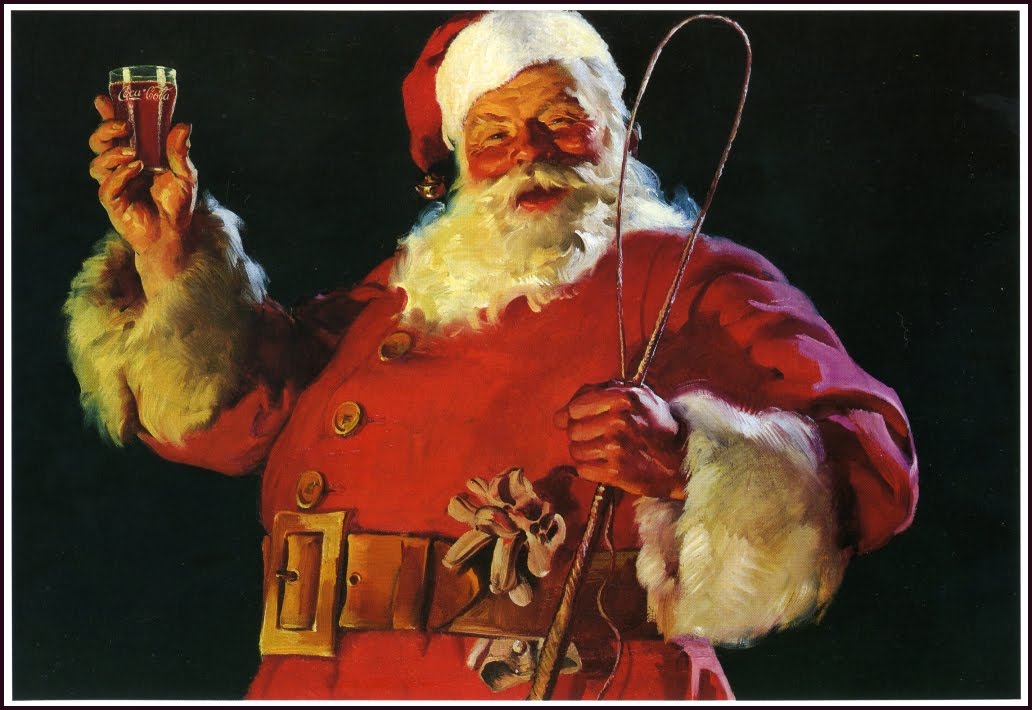
In 1931 Haddon Sundblom created what would become the definitive American Santa for Coka Cola ads which continued through 1964 and which the brand regularly recycles.


The physical image of Santa was refined by the illustrators of popular magazine covers in the early decades of the 20th Century, including many by Norman Rockwell.   The fully definitive modern Santa Claus was created by artist Haddon Sundblom for Coca Cola advertising that ran from 1931 to 1964.
Along the way Santa Claus picked up many accouterments that had nothing in common with the Bishop of Myra.  The most obvious of these is Mrs. Claus.  Although there were some passing references to a spouse for the gift giver as early as the 1850s, she first got wide exposure in a poem by Katherine Lee Bates, best known as the writer of America the Beautiful.  In Goody Santa Claus on a Sleigh Ride, she is an uncompromising feminist who shows Santa what she can do by making his deliveries one year.  She really took off as a separate character in stories and films from the 1950’s on, where she is stripped of Bates’s feminism and is pictured as an adoring, chubby helpmate to her husband.
The power of American film, music, and television has brought Santa Claus to every corner of the globe.  Even in countries with strong St. Nicholas traditions, he has taken on the characteristics of the American Santa.  He also appears in countries with no religious celebration of Christmas and is popular in Japan and Korea.  Under the Soviets, the Russians transformed their patron saint into Father Winter, as Santa Claus clone who visits on New Year’s Eve.
Symbolic of the eclipse of St. Nicholas by Santa Claus is the fate of the statue of St. Nicholas in the town of Demre, Turkey, near the site of historic Myra.  In order to facilitate tourism the now Muslim town commissioned a statue of St. Nicholas to be placed in the town square by a Russian Iconographer.  The Russian government made it a gift to the city and it was dedicated in 2000.  After just a few years, however, the local Mayor discovered that tourists were disappointed.  They had not come to venerate a Saint, but visit the home of Santa Claus.  So the mayor had the original statue removed and replaced by a plastic Santa in a red suit—a Santa modeled after Haddon Sundblom’s Coca Cola creation.