|
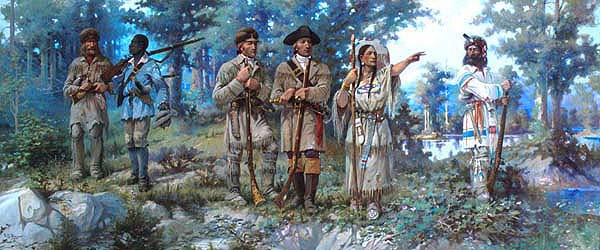
| In a famous mural, Sacajawea points the way to Lewis and Clark at Three Forks carrying her infant son. Her husband Toussaint Charbonneau is shown in white buckskins and Clark's slave York is in the background. | |
On
February 11, 1805 Captain Meriwether
Lewis recorded in his meticulous Journal
the birth of a baby boy to the young
wife of Toussaint Charbonneau, a French
Canadian trapper living with the Hidstsa. Lewis and Captain William Clark were wintering their Corps of Discovery at Ft.
Mandan in present day North Dakota before
their planned push to the Pacific
that spring.
The
young mother, Sacajawea, had been
born among the Agaidika tribe of Eastern Shoshone along the Snake River in present day Idaho and kidnapped by raiding Hidstsa at the age of 12. By 14 she was the second wife of Charbonneau.
Her
husband spoke most of the languages
of the tribes on the Eastern Slope of
the Rockies and her knowledge of Shoshone or, in Lewis’s terms Snake, was critical because the
expedition was relying on trading among her people for horses to take them further west after crossing the Great Divide. And their combined knowledge of the terrain
was important, although the woman was never considered a guide. The two captains
could only communicate with her through her husband.
 |
| Sacajawea and her son as imagined. |
She
and the baby accompanied the expedition when it set out in April. By May she had earned the leaders’ admiration
when her quick action saved Lewis’s Journals and other important equipment
after a canoe capsized. They named a near-by creek in her honor.
In
August the company finally contacted the Agaidika. To everyone’s astonishment the Chief turned out to be Sakajawea’s
brother Cameahwait. Needless to say, the good will created by
re-uniting the family greatly eased negotiations for horses.
She
continued with the party to the Pacific and her knowledge of edible plants
helped save the men from starvation.
On
the return trip she identified a key
pass over the mountains, Gibbons
Pass and later advised them to take the shortest direct route through Bozeman Pass.
She
and her husband stayed for three years at Ft. Mandan before she accepted Clark’s
offer to visit him at St. Louis. Clark adopted her son, Jean-Baptiste called Pompy, and
provided for his education. A daughter, Lizzette was born about 1810.
Later
resuming his natural father’s name, Jean Baptiste Charbonneau earned fame on
his own as an explorer, guide, fur trapper trader, military scout during the Mexican War, Alcalde—mayor—of Mission
San Luis Rey de Francia, and a gold
prospector and hotel operator in
Northern California. He spoke French and English, and learned German and Spanish during his six years in Europe from 1823 to 1829, a trip financed by Clark to round out his
education. He also spoke Shoshone and other western American Indian languages,
which he picked up during his years of trapping and guiding. He died.
Jean-Baptiste
fathered two children. At Wuerttemberg
in Germany during his European tour he fathered a child with Anastasia Katharina Fries, a soldier’s daughter. The baby, Anton Fries, died about three months
after his birth. On May 4, 1848, Maria Cantarina Charguana was born to Margarita Sobin, an Indian woman from
Mission San Luis Rey Luiseño woman, and Charbonneau. The infant girl's baptism, Father Blas Ordaz of the Mission San Fernando Rey de España near
Los Angeles. Margarita Sobin later married Gregory
Trujillo, who raised Maria.
Charbonneau’s daughter and Margarita other children were registered as
members of the La Jolla band of Mission Indians. She may have living descendants thus also the
descendants of Sakajawea.
Sakajawea
and her husband were living at Manuel
Lisa’s trading post on the Missouri where
a clerk recorded that she died of “putrid fever” on December 20, 1812,
aged about 24. Lizzette was killed in a Blackfoot attack on the fort soon after.
 |
| One of several monuments to Sacajawea, this one in Lemhi County, Idaho shows her with her baby. |
The
resolute young woman has entered the realm of folk tale and romantic myth. She was adopted by Suffragists as an icon for womanly strength and independence. She was portrayed by blue eyed Donna Reed in the 1952 film Far
Horizons. In 2000 the U.S. Mint began production of a dollar coin with an idolized portrait
of her with her infant son.