Showing posts with label Marines. Show all posts

Wednesday, June 10, 2026

Planting the Stars and Stripes in Asia--The Korean War They Didn't Teach You


A Korean map of the Hermit Kingdom.  The Han is the second major river from the south pictured on the map, the water way to the capital Hanyang (modern Seoul.)

A fat book could be made of forgotten and neglected American foreign wars or interventions. Take the war in Korea, for instance.  No, not the one when Harry Truman sent American forces to try to repel an invasion of the South by the Communist North in 1950, although I know veterans of that conflict have taken to calling it a forgotten war.  No, I have in mind an action nearly 80 years earlier.  Never heard of it?  Well pull up a stool and I will tell you all about it.

In American military and naval annals, it is listed, mostly as a footnote, as the United States Expedition to Korea of 1871.  It is best remembered as the first foreign conflict in which Medals of Honor were awarded.  The Koreans, who have a keener memory of such things, call it the Shinmiyangyo.

Korea in the late 19th Century was one of the most isolated nations on earth.  The history of this peninsular nation in northern Asia was a tragic one of repeated invasions or attempted invasions by neighboring China, Japan, and Manchuria.  The response of the ruling Joseon Dynasty which came to power in 1392 and had ruled and shaped the nation as a Confusion culture and state, was extreme isolationism—a virtual exclusion of all contact and trade with the rest of the world.  That policy was being tested again by pressure from Japan, the introduction of Catholicism by missionaries in the late 18th Century, and demands of European powers for concessions and trade privileges.  


In 1866 after eight fruitless week of battle a French expeditionary force failed to capture the citadel of Gsnghwua and was forced into a humiliating withdrawa
l.

In 1866 the French launched a punitive expedition against Korea in retaliation for a massacre of Catholics that included French Priests and to demand trade concessions.  A sizable French force landed on the fortress island of Ganghwa which guarded the approach to the capital of Hanyang, modern day Seoul.  After six weeks of fighting, the French were ignominiously forced to withdraw.  The ruling Joseon Dynasty, previously weakened by internal dissent was strengthened and but also deluded about its military capacity.  It re-affirmed its isolation and in the West became known as the Hermit Kingdom.

As for the United States, having spanned its own continent and emerged united from the Civil War, the country continued to look westward to the Pacific all the way to the shores of Asia to expand its influence and to secure free and equal access to the trade of all Asian ports.  Spurred on by the Navy, a force in search of a mission to keep it afloat in peace time, the government followed a policy to open trade relations with all nations and to check the growing power of its greatest rival the British Empire with its strong presence in China and naval superiority.

The first catalyst of the U.S action against Korea was the fate of the General Sherman, an American side wheel commercial steamer that was hired by an English firm in China to try to open trade with Korea in 1866, the same year as the French adventure.  The belligerent American captain of the ship would not take a refusal to allow it to dock and captured Korean officials sent to inform him of the government policy.  He then tried to move upriver firing cannons as he went.  The Koreans rallied and after several days of fighting and the loss of several junks, the General Sherman was destroyed and her surviving crew taken captive—and were likely executed.

Also of official concern was the possible fate of Americans who were shipwrecked in Korean waters, although in the one confirmed case, the survivors were well treated and sent to China from where they could be repatriated.  Finally, the U.S. sought to open Korean ports and sign a trade agreement.


The iron hulled and screw propelled steam frigate the USS Colorado was the flagship of the American squadron on the 1871 Korean expedition.

Early April 1871 what might be called a heavily muscular diplomatic mission set sail for Korea.  In Command was Rear Admiral John Rogers on board the USS Colorado, the flagship of the Navy’s Asiatic Squadron.  It was an iron-hulled three masted steam screw frigate which had seen service in the Civil War.  On board to handle negotiations was Frederick F. Low, the United States Ambassador to China.  Also in the squadron were four other warships—the sloop of war USS Alaska, the armed tug USS Palos, the side-wheel gunboat USS Monocacy, and the screw sloop USS Benicia

Admiral Rogers might be forgiven if he envisioned having the success and glory the Commodore Mathew Perry found in opening trade with Japan in 1854.


"Men in white" were encountered by Admiral Roger's crew.  These Korean officials later taken captive were photographed on the deck of the Colorado in their traditional attire.

On June 1st Rogers arrived in Korean waters and successfully put men ashore to attempt to contact authorities.  The crew reported encountering “men in white” who were reluctant to talk to him or take any message to the Emperor in his capital of Hanyang.  Rogers’s men ashore reportedly politely told the Koreans that they would be exploring the area and “meant no harm.”

The Admiral then led his ships to the entry of the Han River leading to the capital—where foreign ships were explicitly forbidden to go.  The flotilla came under ineffective cannon fire from fortresses on Ganghwa.  The ships were not badly damaged, due “to the bad gunnery of the Coreans, whose fire, although very hot for the fifteen minutes in which they maintained it, was ill-directed, and consequently without effect.”

Rogers hotly demanded an official apology for the “unprovoked attack” and gave the Koreans a ten-day deadline to reply.  When those days lapsed, he quickly swung into action with a punitive raid on Ganghwa Island.
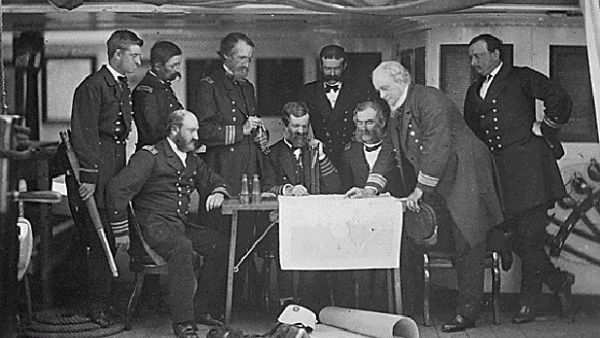
A council of war on board the USS Colorado.  Admiral John Rodgers is the one leaning over the chart.

On June 10 hostilities began with an attack on the lightly defended Choji Garrison on the Salee River.  The Koreans, members of the Tiger Hunters led by General Eo Jae-yeon were crudely armed with matchlock muskets which had been obsolete for nearly a hundred years in the West.

A force of 546 sailors and 105 Marines were put ashore to move on other objectives supported by 12-pound howitzers and guns from the flotilla.  They quickly moved on and captured Deokjin Garrison, and Deokjin Fort, which they found abandoned.  The Koreans fell back and regrouped at the well-fortified citadel of the Gwangseong Garrison.  As the Americans advanced on the fort an attempt to flank it was repulsed.

American forces established strong artillery batteries on two hills overlooking the fort which was pounded by extensive shelling abetted by fire from the USS Monocacy operating close to shore in shallow Han River waters.  


U.S. Sailors stormed the citadel of Gwangseong in heavy hand to hand fighting.

Navy Lt. Hugh McKee led a charge on the damaged fort.  The Korean defenders with their slow loading matchlocks were hardly able to get off a single volley of fire before McKee reached the top of the wall leading his troops. He was felled by a ball immediately.  Right behind him Commander Winfield Scott Schley personally shot the Korean who had wounded McKee.  Several seamen rushed to the aid of McKee, fatally wounded in the groin.  Meanwhile two Marines, Corporal Charles Brown of the USS Colorados guard and Private Hugh Purvis of the USS Alaska’s guard captured the personal flag of Eo Jae-yŏn and Private James Dougherty shot and killed the General.  Carpenter Cyrus Hayden, a sailor from the USS Colorado planted the American Flag on the ramparts under heavy fire.


Korean dead in the breached citadel.

The whole battle for the fortress lasted 15 minutes from the breach of the walls.  The surviving garrison, including the deputy commander, was taken prisoner.  In all of the action that day the Koreans lost 243 dead and 20 captured, most of them wounded.  American losses were three dead, including McKee, and ten wounded.

It was a brilliant military victory, especially considering that the Americans accomplished in a single day what the French had failed to do in six weeks.

Despite the military glory, the diplomatic mission ended in abject failure.  Rogers tried to use his prisoners as bargaining chips to demand negotiations with the Koreans.  The Koreans, for their part, flatly refused to negotiate, or even to take back the prisoners, who they considered traitors for surrendering.  The squadron stood off Korean waters until July 1 fruitlessly waiting to begin talks.  Frustrated and with fuel for his ships running low, Rogers had to break off contact and return with his primary objectives unmet.  In the end Rogers left as empty handed as the French.


Korean Headquarters Flag captured  by Marines Private Hugh Purvis, Corporal Charles Brown, and Captain McLain Tilton on board the USS Colorado after the battle.

The U.S. was unable to establish relations with Korea until 1886, after the Japanese forcibly opened trade there and the British had extracted concessions.

Nine sailors and six Marines including McKee, Brown, Purvis, Dougherty, Hayden, and three sailors who came to the aid of McKee were awarded the Medal of Honor.  Admiral Rogers never found the fame and glory of Commodore Perry and faded into historical obscurity.


North Koreans re-enact the Shinmiyangyo annually and celebrate the defenders as national martyrs and heroes.

For the Koreans, especially, in the Communist North, which now so closely resembles the Hermit Kingdom, the whole experience of 19th Century contact with the Americans is celebrated.  A story was invented making an ancestor of Kim Il Sung, the founder of the Peoples Republic of Korea and of the dynasty that has ruled ever since, the local commander who sank the General Sherman.  The American spy ship the USS Pueblo which was captured by the North Koreans in 1968 is now anchored at the site of the destruction of the General Sherman.  And the fallen garrison of Gwangseong are celebrated as martyr/heroes like the Texicans at the Alamo.

Which is why you probably never heard of America’s first Korean War.


Monday, June 3, 2024

Rampant Unchecked Racism During the Good War—The Zoot Suit Riots

Animator Tex Avery's Big Bad Woolf in a zoot suit--a lecherous predator of Red Riding Hood.

The mention of zoot suits these days conjures up fuzzy, even nostalgic memories—the ogling, lecherous Big Bad Wolf in Tex Averys classic Red Riding Hood cartoons; clips from old black and white Big Band movies with Lindy Hop and Jitterbug dancers; even teenage Dodie Stevens already anachronistic 1959 hit Tan Shoes and Pink Shoelaces.  But in the midst of World War II the flamboyant outfits had become youth culture symbols especially popular in minority communities from coast to coast and were widely viewed as flagrant defiance of war time austerity and patriotic rationing.

In 1943 they became the flashpoint of days of rioting as Marines and Sailors roamed the streets of Los Angeles assaulting zoot suiters—mostly Mexican youth—with the open encouragement of the city’s Newspapers and the abetted by the LAPDs notorious vigilante Vengeance Squad.

Zoot suits spread from Harlem and other East Coast Black centers with the assistance of Big Band hep cats like Cab Calloway

The zoot suit arose out of the Big Band Jazz scene and among vipers—marijuana users (think Cab Calloway)—in the late 1930’s as a mark of defiance to the squares.  Like many trends on the cutting edge of culture it probably started in Eastern Black communities, but quickly spread.  By 1940 the outfits had become especially popular with California’s Mexican Pachucos, youth who flaunted their flashy, expensive outfits and enjoyed a wild night life of partying and clubbing.  The term originated in El Paso, Texas and was brought to the Los Angeles area with the huge migration of Mexican-Americans—Chicanos—and Mexican immigrants to the area during the Depression which accelerated with the availability of war production jobs.  Pachucos and their female equivalent, Pachucas, who sometimes cross dressed in zoot suits, formed street gangs and became linked in the public mind with street crime.

Zoot suits featured a long coat tailored at the waist and billowing pleated pants pegged at the ankles.  Accessories included broad brimmed, low crowned hats with wide bands, brightly colored ties, pointed toe shoes with stacked heels and thick soles, and long watch chains.  No question about it, they were eye catching.

In 1942 in order to conserve wool for uniforms, the War Production Board issued strict regulations on how much material could be used in mens suits.  The regulations meant to reduce wool use in suits by 26% and encouraged “new streamlined suits by Uncle Sam.” They affected the voluminous pants and suit coats favored as pre-war business attire, but also effectively outlawed zoot suits.  Major manufacturers quickly complied and ended their production of the style.

But in California small tailor shops continued to supply the demand in apparent defiance of the regulations.  Young Latinos with money to spend from war jobs continued to buy the expensive suits.  And, of course, many had zoot suits produced before the restrictions.  The press railed against the unpatriotic defiance and spared no racial insults in singling out the Mexican community adding allegations of being slackers despite the fact that a much higher than average percentage of young men in the community were in the armed services and their workers were essential to war production.

An L.A. Pachuco zoot suiter and a fashionable Pachuca.

Tensions were further heightened by sensational press reports of Pachuco gang activity and street crime.  In one sensational case nine young gang members were accused of a murder in which the victim’s body was found in a dump.  Off-duty police acting as the Vengeance Squad began sweeps of the East LA barrio and popular night spots all over the city targeting zoot suit wearing suspected gang members for assault and summary punishment.

All over California tensions also rose between service men and zoot suiters because of the alleged lack of patriotism for defying rationing.  But typical conflicts between soldiers, sailors, and Marines and locals over women added fuel to the fire.  Attractive young Pachucas in sexy dresses, gowns, and their own versions of zoot suits were out on the streets frequenting night clubs, dance halls, and theaters.  They were often approached and harassed by groups of servicemen on leave.  Many fights resulted.

On May 30 a large group of sailors began hassling a group of young women and were attacked by zoot suit wearing men.  In the melee that resulted one sailor suffered serious injuries and several others were badly roughed up.

On the evening of June 3, 1943 11 sailors in Downtown Los Angeles got into a confrontation with a band of Pachucos and were beaten.  Once again the police Vengeance Squad swung into action in the word of the Los Angeles Times breathless reporting, “seeking to clean up Main Street from what they viewed as the loathsome influence of Pachuco gangs.”

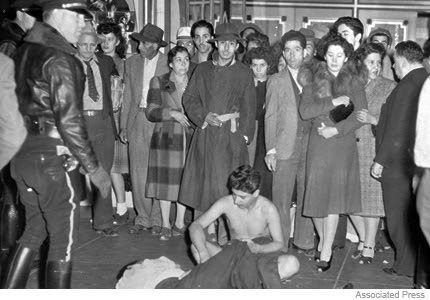
Hundreds of sailors rampaged against zoot suiters or any young Mexicans or Chicanos they could find, but as this picture shows they were joined by Army Air Corps men, Marines, and White civilian thugs.

The next day, with the apparent winking approval of base authorities, more than 200 sailors piled into taxis to invade East LA.  Their first victims were a group of 13 and 14 year olds, some of them wearing zoot suits who they attacked and beaten.  Those in zoot suits were stripped and their clothes burned on the streets.  Adults of both sexes in the neighborhood who tried to come to the boys’ defense were likewise attacked.  The sailors moved on to other targets, invading movie theaters, forcing the management to turn up the house lights, and dragging zoot suiters and other young men to the stage where they were stripped, beaten, and their clothes and bodies urinated on.  Night clubs were invaded.  Men were pulled off of busses.  And not just Mexicans—Filipinos, Blacks, and anyone with a dark complexion.

Zoot suiters were attacked, beaten, and publicly stripped as police looked on or actively participated.

As word spread hundreds more Sailors and large numbers of even more aggressive Marines converged on the city and on Barrios from San Diego to San Jose.  Mobs marched down streets accompanied and escorted by police who not only did not interfere but often participated.  No young Latin with or without a zoot suit was safe from attack.  Pachucas were especially targeted, and many were sexually assaulted.  When one young woman was arrested in possession of brass knuckles the press reacted hysterically.

Rioting continued for days and spread across Southern California.  The press, especially the Times applauded the rampaging sailors and Marines, spared no racial animus toward Mexicans, and generally threw gasoline on a roaring fire.

Pachucas were swept up by police out of dance halls and movie theaters, dragged off of buses just for their style.  But the gangs of service men also sexually assaulted many which fueled Pachuco resistance and escalated the violence.

Navy brass was slow to react.  They continued to issue passes in large numbers during the first days of the disturbances and maintained that their personnel were merely defending themselves.  The Shore Patrol was conspicuous for its absence on the streets in the heart of the riot zones.  Finally late on June 7, after the reeling Pachuco gangs rallied to organize resistance to the attacks and injuries to sailors and Marines began to climb, the Brass acted.  They cancelled all shore leave and confined men to their bases and ships.  The Shore Patrol was finally dispatched in numbers with orders to retrieve service members on the scene.  None were ever charged by the service for any offences committed during the riot.  In fact rumors later swirled that the Marines quickly promoted men who were reported to have shown “leadership ability under stress” during the fighting.

The Los Angeles City Council passed a resolution condemningpleated pants” as gang apparel in much the same way later municipal bodies would try to ban gang colors or drooping pants.  Despite the ballyhoo no actual ordinance banning zoot suits was adopted.

Many of the young men swept up by police remained cheerily defiant enraging White public opinion.

By mid-June rioting and fighting died down in L.A. Official reports indicate that more than 150 were injured badly enough to seek treatment and police had arrested more than 500 Latinos on charges ranging from rioting to vagrancy in the city alone.  Although the figures for the injured are probably grossly under reported, there were no known deaths during the disturbances due largely to the fact that neither the service men nor Pachuco gangs used fire arms. 

As things died down in California, copycat anti-zoot suit rioting spread across the country to cities in Texas and Arizona where Chicanos were targeted to Northern cities such as Detroit, New York City, and Philadelphia, where Blacks were often singled out.  But even white hipsters were not immune.  Two members of Gene Krupas big band were beaten up for wearing the band’s stage costumes.  In Harlem a young zoot suit street hustler named Malcolm Little—the future Malcolm X—was caught up in fighting. 

In Harlem a young street hustler named Malcolm Little was caught up in attacks on zoot suiters.

The Federal Government, which was trying to shore up relations with Latin America to counter Nazi activity there, became alarmed when the Mexican government vigorously protested the abuse of its nationals and warned of possible severe diplomatic consequences. The government was particularly concerned that Mexico might cut off the supply of bracero migrant farm workers who had become absolutely essential in bringing in the nation’s crops as traditional American migrants joined the military or flocked to cities for big paying defense jobs. 

Under Federal pressure California Governor Earl Warren ordered the creation of the McGucken Committee to investigate and determine the cause of the riots. Its 1943 report found racism to be a central cause and blamed the press for aggravating the situation by emphasizing zoot suits in any report of Latino crime.  In response appointed the Peace Officers Committee on Civil Disturbances, chaired by Robert W. Kenny, President of the National Lawyers Guild to make recommendations to the police.  In a tradition of post-riot soul searching familiar to us today, human relations commissions were established, and Police Departments were instructed to institute training on treating all residents equally.  You can draw your own conclusions about how effective that was.

But not everyone was on the same page.  L.A. Mayor Fletcher Bowron angrily dismissed the McGucken Committee conclusion of racism.  The fault for the riots, he maintained laid with the criminal culture of the Pachucos and zoot suiters on one hand sailors and Marines led by white Southerners, who came out of a region in with both overt legal and socially sanctioned racial discrimination.  It was just a clash of cultures, he maintained, with the good [White] citizens of the city, including the police, caught in the middle.

Anecdotal evidence does show that Southerners may have played leading roles in the violence, but it is clear that white sailors and Marines from all parts of the country were involved.

Also arriving in Los Angeles to cash in on the situation was California Un-American Activities Committee under State Senator Jack Tenney which declared that it had evidence that Nazi saboteurs were behind the riots.  That evidence was never produced, and the Committee did not even hold hearings.  Yet wide-spread publicity around the claim made sure that many Californians were convinced it was true.

The Los Angeles Times did everything in its power to inflame the riots as they continued, kept stoking racial animosity in every way possible throughout the War, and savagely attacked Eleanor Roosevelt for expressing concern and sympathy with the victims.

Eleanor Roosevelt in one of her My Day newspaper columns wrote:

The question goes deeper than just suits. It is a racial protest. I have been worried for a long time about the Mexican racial situation. It is a problem with roots going a long way back, and we do not always face these problems as we should.

The Times, owned by the rabidly anti-Roosevelt Chandler family, erupted with predictable fury.  It repeated the accusations of Nazi sabotage by the zoot suiters, and it accused Mrs. Roosevelt of having “Communist leanings and stirring race discord.”

Although the Zoot Suit Riots have been nearly obliterated from history for White Americans, for Chicanos and other Latinos they represent a critical cultural moment and are in enshrined in their collective memory.