Showing posts with label Korea. Show all posts

Wednesday, June 10, 2026

Planting the Stars and Stripes in Asia--The Korean War They Didn't Teach You


A Korean map of the Hermit Kingdom.  The Han is the second major river from the south pictured on the map, the water way to the capital Hanyang (modern Seoul.)

A fat book could be made of forgotten and neglected American foreign wars or interventions. Take the war in Korea, for instance.  No, not the one when Harry Truman sent American forces to try to repel an invasion of the South by the Communist North in 1950, although I know veterans of that conflict have taken to calling it a forgotten war.  No, I have in mind an action nearly 80 years earlier.  Never heard of it?  Well pull up a stool and I will tell you all about it.

In American military and naval annals, it is listed, mostly as a footnote, as the United States Expedition to Korea of 1871.  It is best remembered as the first foreign conflict in which Medals of Honor were awarded.  The Koreans, who have a keener memory of such things, call it the Shinmiyangyo.

Korea in the late 19th Century was one of the most isolated nations on earth.  The history of this peninsular nation in northern Asia was a tragic one of repeated invasions or attempted invasions by neighboring China, Japan, and Manchuria.  The response of the ruling Joseon Dynasty which came to power in 1392 and had ruled and shaped the nation as a Confusion culture and state, was extreme isolationism—a virtual exclusion of all contact and trade with the rest of the world.  That policy was being tested again by pressure from Japan, the introduction of Catholicism by missionaries in the late 18th Century, and demands of European powers for concessions and trade privileges.  


In 1866 after eight fruitless week of battle a French expeditionary force failed to capture the citadel of Gsnghwua and was forced into a humiliating withdrawa
l.

In 1866 the French launched a punitive expedition against Korea in retaliation for a massacre of Catholics that included French Priests and to demand trade concessions.  A sizable French force landed on the fortress island of Ganghwa which guarded the approach to the capital of Hanyang, modern day Seoul.  After six weeks of fighting, the French were ignominiously forced to withdraw.  The ruling Joseon Dynasty, previously weakened by internal dissent was strengthened and but also deluded about its military capacity.  It re-affirmed its isolation and in the West became known as the Hermit Kingdom.

As for the United States, having spanned its own continent and emerged united from the Civil War, the country continued to look westward to the Pacific all the way to the shores of Asia to expand its influence and to secure free and equal access to the trade of all Asian ports.  Spurred on by the Navy, a force in search of a mission to keep it afloat in peace time, the government followed a policy to open trade relations with all nations and to check the growing power of its greatest rival the British Empire with its strong presence in China and naval superiority.

The first catalyst of the U.S action against Korea was the fate of the General Sherman, an American side wheel commercial steamer that was hired by an English firm in China to try to open trade with Korea in 1866, the same year as the French adventure.  The belligerent American captain of the ship would not take a refusal to allow it to dock and captured Korean officials sent to inform him of the government policy.  He then tried to move upriver firing cannons as he went.  The Koreans rallied and after several days of fighting and the loss of several junks, the General Sherman was destroyed and her surviving crew taken captive—and were likely executed.

Also of official concern was the possible fate of Americans who were shipwrecked in Korean waters, although in the one confirmed case, the survivors were well treated and sent to China from where they could be repatriated.  Finally, the U.S. sought to open Korean ports and sign a trade agreement.


The iron hulled and screw propelled steam frigate the USS Colorado was the flagship of the American squadron on the 1871 Korean expedition.

Early April 1871 what might be called a heavily muscular diplomatic mission set sail for Korea.  In Command was Rear Admiral John Rogers on board the USS Colorado, the flagship of the Navy’s Asiatic Squadron.  It was an iron-hulled three masted steam screw frigate which had seen service in the Civil War.  On board to handle negotiations was Frederick F. Low, the United States Ambassador to China.  Also in the squadron were four other warships—the sloop of war USS Alaska, the armed tug USS Palos, the side-wheel gunboat USS Monocacy, and the screw sloop USS Benicia

Admiral Rogers might be forgiven if he envisioned having the success and glory the Commodore Mathew Perry found in opening trade with Japan in 1854.


"Men in white" were encountered by Admiral Roger's crew.  These Korean officials later taken captive were photographed on the deck of the Colorado in their traditional attire.

On June 1st Rogers arrived in Korean waters and successfully put men ashore to attempt to contact authorities.  The crew reported encountering “men in white” who were reluctant to talk to him or take any message to the Emperor in his capital of Hanyang.  Rogers’s men ashore reportedly politely told the Koreans that they would be exploring the area and “meant no harm.”

The Admiral then led his ships to the entry of the Han River leading to the capital—where foreign ships were explicitly forbidden to go.  The flotilla came under ineffective cannon fire from fortresses on Ganghwa.  The ships were not badly damaged, due “to the bad gunnery of the Coreans, whose fire, although very hot for the fifteen minutes in which they maintained it, was ill-directed, and consequently without effect.”

Rogers hotly demanded an official apology for the “unprovoked attack” and gave the Koreans a ten-day deadline to reply.  When those days lapsed, he quickly swung into action with a punitive raid on Ganghwa Island.
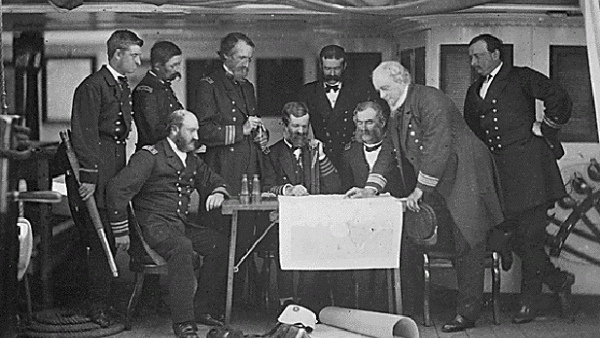
A council of war on board the USS Colorado.  Admiral John Rodgers is the one leaning over the chart.

On June 10 hostilities began with an attack on the lightly defended Choji Garrison on the Salee River.  The Koreans, members of the Tiger Hunters led by General Eo Jae-yeon were crudely armed with matchlock muskets which had been obsolete for nearly a hundred years in the West.

A force of 546 sailors and 105 Marines were put ashore to move on other objectives supported by 12-pound howitzers and guns from the flotilla.  They quickly moved on and captured Deokjin Garrison, and Deokjin Fort, which they found abandoned.  The Koreans fell back and regrouped at the well-fortified citadel of the Gwangseong Garrison.  As the Americans advanced on the fort an attempt to flank it was repulsed.

American forces established strong artillery batteries on two hills overlooking the fort which was pounded by extensive shelling abetted by fire from the USS Monocacy operating close to shore in shallow Han River waters.  


U.S. Sailors stormed the citadel of Gwangseong in heavy hand to hand fighting.

Navy Lt. Hugh McKee led a charge on the damaged fort.  The Korean defenders with their slow loading matchlocks were hardly able to get off a single volley of fire before McKee reached the top of the wall leading his troops. He was felled by a ball immediately.  Right behind him Commander Winfield Scott Schley personally shot the Korean who had wounded McKee.  Several seamen rushed to the aid of McKee, fatally wounded in the groin.  Meanwhile two Marines, Corporal Charles Brown of the USS Colorados guard and Private Hugh Purvis of the USS Alaska’s guard captured the personal flag of Eo Jae-yŏn and Private James Dougherty shot and killed the General.  Carpenter Cyrus Hayden, a sailor from the USS Colorado planted the American Flag on the ramparts under heavy fire.


Korean dead in the breached citadel.

The whole battle for the fortress lasted 15 minutes from the breach of the walls.  The surviving garrison, including the deputy commander, was taken prisoner.  In all of the action that day the Koreans lost 243 dead and 20 captured, most of them wounded.  American losses were three dead, including McKee, and ten wounded.

It was a brilliant military victory, especially considering that the Americans accomplished in a single day what the French had failed to do in six weeks.

Despite the military glory, the diplomatic mission ended in abject failure.  Rogers tried to use his prisoners as bargaining chips to demand negotiations with the Koreans.  The Koreans, for their part, flatly refused to negotiate, or even to take back the prisoners, who they considered traitors for surrendering.  The squadron stood off Korean waters until July 1 fruitlessly waiting to begin talks.  Frustrated and with fuel for his ships running low, Rogers had to break off contact and return with his primary objectives unmet.  In the end Rogers left as empty handed as the French.


Korean Headquarters Flag captured  by Marines Private Hugh Purvis, Corporal Charles Brown, and Captain McLain Tilton on board the USS Colorado after the battle.

The U.S. was unable to establish relations with Korea until 1886, after the Japanese forcibly opened trade there and the British had extracted concessions.

Nine sailors and six Marines including McKee, Brown, Purvis, Dougherty, Hayden, and three sailors who came to the aid of McKee were awarded the Medal of Honor.  Admiral Rogers never found the fame and glory of Commodore Perry and faded into historical obscurity.


North Koreans re-enact the Shinmiyangyo annually and celebrate the defenders as national martyrs and heroes.

For the Koreans, especially, in the Communist North, which now so closely resembles the Hermit Kingdom, the whole experience of 19th Century contact with the Americans is celebrated.  A story was invented making an ancestor of Kim Il Sung, the founder of the Peoples Republic of Korea and of the dynasty that has ruled ever since, the local commander who sank the General Sherman.  The American spy ship the USS Pueblo which was captured by the North Koreans in 1968 is now anchored at the site of the destruction of the General Sherman.  And the fallen garrison of Gwangseong are celebrated as martyr/heroes like the Texicans at the Alamo.

Which is why you probably never heard of America’s first Korean War.


Tuesday, May 26, 2026

First Singing Superstar--Al Jolson Had a Million of 'em


Al Jolson's signature pose from The Jazz Singer.

Record keeping was hit and miss and life perilous in Jewish village of Srednik near Kaunas in Lithuania, then part of Tsarist Russia around 1886 so Asa Yoelson was never sure about his birthday.  Years later he would pick May 26 out of a hat to serve, and it has been dutifully reported by biographers ever since.

He was the son of a Rabbi and Canter and had three surviving siblings including a brother Hirsh.  His father Moses immigrated to the United States in 1891 and was able to send for his family when he found employment at Washington, D.C.’s Talmud Torah Synagogue in 1894.

Asa and Hirsh became fascinated with American music and show business hanging out on streets outside taverns and music halls.  By 1897 they were performing for spare change on the sidewalks.

In 1902 Asa launched a paying career as a singing usher in a traveling circus.  Soon after he teamed with Hirsh and worked as Al and Harry Jolson were doing specialties on the burlesque circuit.

Over the next five decades Al Jolson would perform and triumph in every possible American show business venue—vaudeville, the Broadway stage, concerts, records, movies, and radio.  He would have conquered television as well, but he died before his planned debut.  In the process he revolutionized stage and popular music by popularizing blues and jazz forms he learned as a young touring vaudevillian in New Orleans.  His charismatic performance style was the first to “make each song an event.”  And one way or another influenced every singer who came after.

Today he is dimly remembered in the popular imagination as the star of the first sound feature film, The Jazz Singer and for his performances in black face.  His style is dismissed as hammy and old fashion.  His black face work makes him suspect as a racist to modern sensibilities.

But one of his closest friends from the streets of Washington as a kid grew up to be tap dancer Bill Bojangles Robinson.  He encouraged Black performers and featured them for the first time on the Broadway stage.  He brought Cab Calloway to Hollywood and not only insisted on equal billing but got adjoining suites in Beverly Hills penthouse hotel rooms during the filming of The Singing Kid.  Eubie Blake, with whom he never worked professionally, was one of his closest personal friends and companion at boxing matches and racetracks.  The home he shared with his then wife dancer Ruby Keeler was the only one among all the stars where Blacks were freely welcome and entertained.  His work was widely admired in the Black community, including his black face because he never performed the usual coon stereotypes, but treated black music with heartfelt earnestness and respect.  He saw the affinity of Jews and Blacks as oppressed outcasts and recognized Exodus as a common metaphorical experience.  At his funeral, the entire of Black Hollywood turned out, he was lauded in the Black press, and eulogized by the President of the Negro Actors Guild.

Jolson first donned blackface in 1904 while working in vaudeville in a trio with brother Harry and veteran performer Joe Palmer.  It not only boosted his career, but it freed Jolson to be more animated and emotional on the stage.

He was on his own as a touring vaudevillian by 1906 based out of San Francisco.  He claimed that he relocated there because the city needed cheering up after the famous earthquake and fire.

In 1909 with his first wife Henrietta, he returned to New York City where he joined the cast of the most popular minstrel show of the day, Dockstaders Minstrels.  He was quickly the main attraction.

                                
                                        Jolson in 1916.

La Belle Paree at the Wintergarden Theater in 1911 was Jolson’s first Broadway show.  Not the headliner, he did Stephen Foster classics in blackface and stole the show.  From then until 1926 Jolson appeared in an unbroken string of hits with shows like Vera Violetta,  The Whirl of Society, Robinson Caruso, Jr., Bombo, Sinbad, and Big Boy.  As his popularity soared so did his weekly paycheck which grew to thousands of dollars a week making him the best paid performer in America.  At the age of 35 he became the youngest actor ever to have a Broadway theater named after him.  Overcoming paralyzing stage fright on opening night for Bombo in 1921, an ecstatic audience called him back for 37 curtain calls.

In 1911 Jolson began his recording career featuring songs from his shows and scores of others.  Had there been a Hit Parade, he would have topped it multiple times almost every year.  His signature songs included Rock-a-Bye My Baby with a Dixie Melodie, My Buddy, Swannee, Avalon, April Showers, Toot-Toot-Tootsie Good-by, Juanita, California Here I Come, I Wonder Whats Become of Sally, Im Sittin on Top of the World, When the Red Red Robin Comes Bob-bob-bobbing Along, My Mammy, Back in Your Own Back Yard, Theres a Rainbow Round My Shoulder, Sonny Boy, and Liza (Let the Clouds Roll Away).  That list is far from definitive.  Over 80 of his hundreds of recordings became hits.  No matter how you slice it, a huge chunk of the classic American song bag.

                                            Jolson's image sold sheet music as fast as his recordings.  This one from 1922 struck a note with Great War vets.

In 1928 Jolson “retired” from the Broadway stage to try his hand in a new medium—movies.

The story of the Cantor’s son who defies his father and tradition to become The Jazz Singer closely paralleled Jolson’s own life.  The Warner Bros. Vitaphone release was the first feature film to include some sound dialogue and songs, although much of the picture was still silent.  The film also highlighted the parallels between the Jewish and Black experiences as expressed by Jolson’s blackface performance.  Legendarily it was a huge hit and doomed silent movies.


What ever was playing next door this crowd is going to The Jazz Singer.

His second film The Singing Fool was his first all talking picture and even a bigger hit because more theaters had been outfitted for Vitaphone sound.  Made and shown in 1928 it held the box office record until Walt Disneys Snow White and the Seven Dwarves ten years later.  The film also introduced the tearjerker, Sonny Boy.

Jolson made four more features for Warner’s, did a short, and made cameo appearances through 1930.  Repetitive and poor quality scripts plus rapidly changing public taste made the last couple of films less successful.  Jolson decided to return to Broadway in a new show, Wonder Bar in 1931.  Although due to the Depression ticket sales to the new show did not match his earlier long string of hits, reviews were positive and helped re-boot his career.

After storied concerts in New Orleans with jazz greats, Jolson returned to Hollywood where Warner’s leant him to United Artists for his most unusual, and many believe finest, film, Hallelujah, Im a Bum.  This Depression Era comedy/drama only takes its title from the Haywire Mac McClintock IWW song.  Songs were by Richard Rogers and Lorenz Hart with the script by Ben Hecht.  Jolson played a happy-go-lucky bum living with a bunch of others in Central Park who saves the Mayors girlfriend from suicide.  She loses her memory.  He falls for her, but also befriends the suffering Mayor, Frank Morgan channeling Jimmy Walker.  Much of the dialogue is in couplets. 


Despite the difference in their ages Jolson and Ruby Keeler, shown shipboard on the return from their 1928 Paris honeymoon, were described as the happiest couple in Hollywood.

His wife Ruby Keeler turned down the female lead fearing that if she made her film debut in her husband’s film she would be dismissed.  Instead, she made Forty Second Street and became an overnight top star.  Jolson’s picture, although now considered a minor classic, was a box office flop and led to a decline in his film career.

Back at Warner Bros. the next year he made a film version of his stage show Wonder Bar.  It incorporated more of the elaborate production numbers fans were now demanding in their musicals and was a moderate success.

The final film for his original studio was The Singing Kid, the film in which he showcased and co-starred Cab Calloway.  Busby Berkley, unaccredited, choreographed and shot the production numbers.

Although he appeared in several films in cameo, Jolson only starred in one more picture, Rose of Washington Square for Paramount in 1939.  He shared top billing with rising stars Tyrone Power and Alice Faye.  The film reprised some of his most famous numbers.

His film career might be winding down and changing public taste for crooners like Bing Crosby and Big Band singers might have cut deeply into his record sales, but Jolson still was a major star on radio.  He had started making broadcast appearances from the time he began making films.  He made a famous appearance on the Dodge Victory Hour early in 1928 live from New Orleans reaching an audience of 35 million over 47 radio stations, a landmark in early broadcasting.  He fronted his own network shows twice in the ’30s.  But he was most in demand as a guest on shows hosted by all band leaders, singers, and comics.  Singers like Crosby, who had eclipsed his popularity, adored him and were glad to share a microphone.  These programs also showed off his considerable comedic talents and ability to ad lib with the best of them.  For those who know Jolson only from his sometimes stiff acting in his hyper sentimental early Warner Bros. films, audio from some of these radio shows is a revelation.

                           
                                     Jolson making a 1938 NBC broadcast.

Still, in the early ‘40s Jolson was restless and depressed.  Occasional radio broadcasts and concerts were not enough to keep him busy.  His fading career and Ruby Keeler’s success mirrored the fictional story in A Star is Born.  By the late ‘30s their marriage, once considered the happiest in Hollywood was over.

World War II gave Jolson something to do.  As soon the fires of Pearl Harbor blew away, he was pressing the War Department for permission to entertain the troops anywhere in the world.  Before the USO was up and running, he became the first star to perform at a GI base in early 1942.  In fact, it was a letter he wrote to Franklin Roosevelts press secretary that is credited with the creation of the USO, into which he was later commissioned.  His first out of country tour took him to Central America and Naval bases in the Caribbean.  Not long after he was in Britain playing to packed and cheering GI audiences.  He would go anywhere—remote Alaskan stations, North Africa, the South Pacific.  He was out of the gate long before his friend Bob Hope and did many more shows.  His tireless work damaged his health.  He contracted malaria and lost most of a lung.

Jolson also found personal happiness.  He met Erle Galbraith, a young x-ray technician in an Arkansas Army camp.  Late in the war he tracked her down and got her work as an actress at Columbia.  They were married in March of 1945.

When the war was over, Jolson found his career was resurrected.  He had gained legions of new young fans among returning GIs and publicity surrounding his shows had endeared him to the public.  Columbia Pictures was eager to produce a bio-pic and in 1946 Larry Parks was tapped to play the singer in The Jolson Story.  Parks carefully studied his performances to match his signature moves and style, but Jolson himself did the singing.  He even managed to play himself in one scene—Suwannee filmed entirely in a long shot showing him dancing and doing his famous runs into the audience on a special runway extending into the theater auditorium.  The Technicolor film was one of the biggest hits of the year.  Parks even earned an Academy Award nomination for the role.

                     
                     Larry Parks won an Oscar nomination playing Jolson, but Al did the singing.

Jolson was back in the big time.  He got a new contract with Decca Records where he not only recreated many of his most famous songs, but also recorded new ones.  He had hits with both.  Among the post war hits were Carolina in the Morning, Waiting for the Robert E. Lee, When Your Were Sweet Sixteen, After Your Gone, Is It True What They Say About Dixie, and Are You Lonesome Tonight.

He was back on radio in a big way too.   From 1947 to ’49 he co-hosted the Kraft Music Hall with Oscar Levant. In 1948 he bested Crosby, Frank Sinatra, Perry Como, and others in a Most Popular Male Vocalist poll by Variety.

Jolson Sings Again, with Parks reprising his role was released in 1949 and was another huge hit.  Jolson toured in support of the film and sang before thousands in special shows in New York and in Chicago.

He distrusted the emerging new medium of television and resisted going on as a guest star.  He wanted to have his own platform.  A proposal to introduce himself with a live two-hour concert broadcast uninterrupted by commercials was naturally greeted coolly by network executives.  But talks were under way for a program of his own.

Those plans were laid aside when President Harry Truman announced he was sending troops to defend South Korea from an attack by the North in the summer of 1950.  Jolson called the White House and simply announced, “I’m going to Korea.”  With the USO officially disbanded Defense Secretary Harold Johnson tried to call him off.  There were no funds for entertainment, he was told. “Funds? Who needs funds? I got funds! I’ll pay myself!” Jolson told reporters.


Jolson in Korea.  The exhausting tour shattered his health.

By September he was on the ground with the troops.  He did 42 shows in 15 days.  He was presented with a medal by General Douglas MacArthur as he returned. 

But he paid a heavy price.  Dust settled into his remaining good lung and he was exhausted.

While playing poker in a San Francisco hotel room just a few weeks later on October 22, 1950 Al Jolson suffered a massive heart attack.  He lived long enough to tell his pals, “Boys, I’m going.”  He was 64. 

Saturday, June 10, 2023

The First American War in Korea Planted the Flag in Asia

A Korean map of the Hermit Kingdom.  The Han is the second major river from the south pictured on the map, the water  way to the capital Hanyang (modern Seoul.)

A fat book could be made of forgotten and neglected American foreign wars or interventions. Take the war in Korea, for instance.  No, not the one when Harry Truman sent American forces to try to repel an invasion of the South by the Communist North in 1950, although I know veterans of that conflict have taken to calling it a forgotten war.  No, I have in mind an action nearly 80 years earlier.  Never heard of it?  Well pull up a stool and I will tell you all about it.

In American military and naval annals, it is listed, mostly as a footnote, as the United States expedition to Korea of 1871.  It is best remembered as the first foreign conflict in which Medals of Honor were awarded.  The Koreans, who have a keener memory of such things, call it the Shinmiyangyo.

Korea in the late 19th Century was one of the most isolated nations on earth.  The history of this peninsular nation in northern Asia was a tragic one of repeated invasions or attempted invasions by neighboring China, Japan, and Manchuria.  The response of the ruling Joseon Dynasty which came to power in 1392 and had ruled and shaped the nation as a Confusion culture and state, was extreme isolationism—a virtual exclusion of all contact and trade with the rest of the world.  That policy was being tested again by pressure from Japan, the introduction of Catholicism by missionaries in the late 18th Century, and demands of European powers for concessions and trade privileges.  

In 1866 after eight fruitless week of battle a French expeditionary force failed to capture the citadel of Gsnghwua and was forced into a humiliating withdrawal.

In 1866 the French launched a punitive expedition against Korea in retaliation for a massacre of Catholics that included French Priests and to demand trade concessions.  A sizable French force landed on the fortress island of Ganghwa which guarded the approach to the capital of Hanyang, modern day Seoul.  After six weeks of fighting, the French were ignominiously forced to withdraw.  The ruling Joseon Dynasty, previously weakened by internal dissent was strengthened and but also deluded about its military capacity.  It re-affirmed its isolation and in the West became known as the Hermit Kingdom.

As for the United States, having spanned its own continent and emerged united from the Civil War, the country continued to look westward to the Pacific all the way to the shores of Asia to expand its influence and to secure free and equal access to the trade of all Asian ports.  Spurred on by the Navy, a force in search of a mission to keep it afloat in peace time, the government followed a policy to open trade relations with all nations and to check the growing power of its greatest rival the British Empire with its strong presence in China and naval superiority.

The first catalyst of the U.S action against Korea was the fate of the General Sherman, an American side wheel commercial steamer that had been hired by an English firm in China to try to open trade with Korea in 1866, the same year as the French adventure.  The belligerent American captain of the ship would not take a refusal to allow it to dock and captured Korean officials sent to inform him of the government policy.  He then tried to move upriver firing cannons as he went.  The Koreans rallied and after several days of fighting and the loss of several junks, the General Sherman was destroyed and her surviving crew taken captive—and were likely executed.

Also of official concern was the possible fate of Americans who were shipwrecked in Korean waters, although in the one confirmed case, the survivors were well treated and sent to China from where they could be repatriated.  Finally, the U.S. sought to open Korean ports and sign a trade agreement.

The iron hulled and screw propelled steam frigate the USS Colorado was the flagship of the American squadron on the 1871 Korean expedition.

Early April 1871 what might be called a heavily muscular diplomatic mission set sail for Korea.  In Command was Rear Admiral John Rogers on board the USS Colorado, the flagship of the Navy’s Asiatic Squadron.  It was an iron-hulled three masted steam screw frigate which had seen service in the Civil War.  On board to handle negotiations was Frederick F. Low, the United States Ambassador to China.  Also in the squadron were four other warships—the sloop of war USS Alaska, the armed tug USS Palos, the side-wheel gunboat USS Monocacy, and the screw sloop USS Benicia. 

Admiral Rogers might be forgiven if he envisioned having the success and glory the Commodore Mathew Perry found in opening trade with Japan in 1854.

 "Men in white" were encountered by Admiral Roger's crew.  These Korean officials later taken captive were photographed on the deck of the Colorado in their traditional attire

On June 1st Rogers arrived in Korean waters and successfully put men ashore to attempt to contact authorities.  The crew reported encountering men in white who were reluctant to talk to him or take any message to the Emperor in his capital of Hanyang.  Rogers’s men ashore reportedly politely told the Koreans that they would be exploring the area and “meant no harm.”

The Admiral then led his ships to the entry of the Han River leading to the capital—where foreign ships were explicitly forbidden to go.  The flotilla came under ineffective cannon fire from fortresses on Ganghwa.  The ships were not badly damaged, due “to the bad gunnery of the Coreans, whose fire, although very hot for the fifteen minutes in which they maintained it, was ill-directed, and consequently without effect.”

Rogers hotly demanded an official apology for the “unprovoked attack” and gave the Koreans a ten day deadline to reply.  When those days lapsed, he quickly swung into action with a punitive raid on Ganghwa Island.

A council of war on board the USS Colorado.  Admiral John Rodgers is the one leaning over the chart.

On June 10 hostilities began with an attack on the lightly defended Choji Garrison on the Salee River.  The Koreans, members of the Tiger Hunters led by General Eo Jae-yeon were crudely armed with matchlock muskets which had been obsolete for nearly a hundred years in the West.

A force of 546 sailors and 105 Marines were put ashore to move on other objectives supported by 12-pound howitzers and guns from the flotilla.  They quickly moved on and captured Deokjin Garrison, and Deokjin Fort, which they found abandoned.  The Koreans fell back and regrouped at the well-fortified citadel of the Gwangseong Garrison.  As the Americans advanced on the fort an attempt to flank it was repulsed.

American forces established strong artillery batteries on two hills overlooking the fort which was pounded by extensive shelling abetted by fire from the USS Monocacy operating close to shore in shallow Han River waters.  

U.S. Sailors stormed the citadel of Gwangseong in heavy hand to hand fighting.

Navy Lt. Hugh McKee led a charge on the damaged fort.  The Korean defenders with their slow loading matchlocks were hardly able to get off a single volley of fire before McKee reached the top of the wall leading his troops. He was felled by a ball immediately.  Right behind him Commander Winfield Scott Schley personally shot the Korean who had wounded McKee.  Several seamen rushed to the aid of McKee, fatally wounded in the groin.  Meanwhile two Marines, Corporal Charles Brown of the USS Colorados guard and Private Hugh Purvis of the USS Alaska’s guard captured the personal flag of Eo Jae-yŏn and Private James Dougherty shot and killed the General.  Carpenter Cyrus Hayden, a sailor from the USS Colorado planted the American Flag on the ramparts under heavy fire.

Korean dead in the breached citadel.

The whole battle for the fortress lasted 15 minutes from the breach of the walls.  The surviving garrison, including the deputy commander, was taken prisoner.  In all of the action that day the Koreans lost 243 dead and 20 captured, most of them wounded.  American losses were three dead, including McKee, and ten wounded.

It was a brilliant military victory, especially considering that the Americans accomplished in a single day what the French had failed to do in six weeks.

Despite the military glory, the diplomatic mission ended in abject failure.  Rogers tried to use his prisoners as bargaining chips to demand negotiations with the Koreans.  The Koreans, for their part, flatly refused to negotiate, or even to take back the prisoners, who they considered traitors for surrendering.  The squadron stood off Korean waters until July 1 fruitlessly waiting to begin talks.  Frustrated and with fuel for his ships running low, Rogers had to break off contact and return with his primary objectives unmet.  In the end Rogers left as empty handed as the French.

Korean Headquarters Flag captured  by Marines Private Hugh Purvis, Corporal Charles Brown, and Captain McLain Tilton on board the USS Colorado after the battle.

The U.S. was unable to establish relations with Korea until 1886, after the Japanese forcibly opened trade there and the British had extracted concessions.

Nine sailors and six Marines including McKee, Brown, Purvis, Dougherty, Hayden, and three sailors who came to the aid of McKee were awarded the Medal of Honor.  Admiral Rogers never found the fame and glory of Commodore Perry and faded into historical obscurity.

North Koreans re-enact the Shinmiyangyo annually and celebrate the defenders as national martyrs and heroes.

For the Koreans, especially, in the Communist North, which now so closely resembles the Hermit Kingdom, the whole experience of 19th Century contact with the Americans is celebrated.  A story was invented making an ancestor of Kim Il Sung, the founder of the Peoples Republic of Korea and of the dynasty that has ruled ever since, the local commander who sank the General Sherman.  The American spy ship the USS Pueblo which was captured by the North Koreans in 1968 is now anchored at the site of the destruction of the General Sherman.  And the fallen garrison of Gwangseong are celebrated as martyr/heroes like the Texicans at the Alamo.

Which is why you probably never heard of America’s first Korean War.