Showing posts with label Martha's Vineyard. Show all posts

Wednesday, July 8, 2026

Jonathan Mayhew Was the Neglected Prophet of Pre-Revolutionary Boston


The Rev. Jonathan Mayhew--a religious and political radical and visionary of old Boston.

When the Rev. Jonathan Mayhew died in Boston on July 9, 1766 his moral, religious, and political legacy was far from accomplished.  Indeed, years and decades would unfold before the depth of his influence became apparent in a new nation and in a new faith.  Mayhew, then only 46-years-old, was the minister of Old West Church, and much beloved by his congregation and admired by the hot heads and radicals being rallied by Samuel Adams who would soon become the Sons of Liberty.  He was decidedly unpopular with the majority of his ministerial peers, conservative civic leaders, and with the Royal Governor of Massachusetts and his Council. 
Mayhew was born on Martha’s Vineyard on October 8, 1720, a fifth generation descendent of Thomas Mayhew, the Elder who first arrived in the New World with the Great Migration fleet of Puritan settlers in 1631.  Ten years later the original Mayhew secured a proprietary colony grant for Martha's Vineyard, Nantucket, the Elizabeth Islands, and other small islands.  Installing himself as governor he began populating his grant with new immigrants and also established his own farm and whaling operations.  Thomas, his son, and grandson also were missionaries among the local Wampanoag and established such fair and friendly relations with the natives.  They made it clear that religion and governance were separate.  The tribe was welcome to embrace Christianity, but Mayhew was at pains to assure them that their governance and lands were secure on their own.  Relations were so good that despite vastly outnumbering the settlers the local Wampanoag did not join the general uprising known as King Philips War that almost wiped out the Massachusetts Bay Colony of 1675-76.
Although the small proprietary colony was absorbed by Massachusetts after 1688, the family, or much of it, remained on the island in relative isolation from the mainstream of Puritan society.  Devoutly religious, their local version of the Congregationalist New England Standing Order drifted from the harsh and rigid Calvinism of the mainland.
Young Jonathan, noted for his scholarly bent, left the island to pursue the Lords work as a student at the factory of divines, Harvard College.  Upon graduation Mayhew he found New England in a religious upheaval.  


Puritan firebrand Rev. Jonathan Edwards appalled Mayhew.
The Connecticut minister and theologian Jonathan Edwards helped inaugurate the first round of revival meetings in the 1730’s. In 1841 he scared the hell out New England with his fiery sermon Sinners in the Hands of an Angry God which quickly became the first big best seller in the Colonies in pamphlet form.  Mayhew rejected Edwards view declaring that “total depravity [is] both dishonourable to the character of God and a libel on human nature.”  He likewise rejected the five points of Calvinism including the doctrine of irresistible grace and the doctrine of the Trinity as taught by the Athanasian and Nicene Creeds.
At the same time Mayhew also rejected the Great Awakening—the first of a series of huge revival movements that have periodically swept Americans up into a religious frenzy.  Mayhew saw the principal mover of the Awakening, the English preacher and revivalist George Whitefield, an Anglican preacher who became a founding figure in Methodism, at camp meetings in what is now Maine.  He was repulsed by the mindless emotionalism he witnessed which he suspected would burn brightly but soon extinguish itself.  He found Whitefield’s followers, ‘of the more illiterate sort,” and the preaching “confused, conceited and enthusiastic.”  He was repelled by the “extravagance and fanaticism, and violent gestures and shrieks” of people in the throes of religious ecstasy.
Mayhew made his views publicly know.  He proposed a third path based on religious rationalism and a view of a loving, but firm God as Father as revealed in a careful reading and analysis of The Bible.  


Boston's Old West Church called Mayhew.  It's working-class members responded to Mayhew's radicalism.  The steeple shown was torn down by the British during the Siege of Boston in the American Revolution in part to prevent it from being used to signal Colonial troops in Cambridge and in part as punishment for being Mayhew's pulpit of rebellion.
These views made it difficult for the young minister to find a parish.  But in 1747 West Church in Boston, one of the city’s nine Congregational Churches—and the least prosperous—called him to be their minister.  Only two of the other ministers in the city would even agree, as was customary, to be at the service of installation and ordination for the customary laying on of hands, symbolizing a welcome into the ministerial community.  One prominent minister is known to have scolded his barber when the man expressed interest in hearing Mayhew warning him not to go hear “that heretic.” 
Shortly after assuming the pulpit Mayhew crossed the ocean to pursue his Doctor of Divinity at the University of Aberdeen in Scotland, an intellectual hot bed of the Scottish Enlightenment.  Although the liberal ideas of the Scottish Enlightenment were taking hold among a young and rising generation of Virginia Tidewater aristocrats, they were a novelty in New England where most ministers who pursued advanced degrees in the Mother Country did so at firmly Puritan institutions.
Despite the cold shoulder of his colleagues, Mayhew perused a ministry that presaged Unitarianism—a theological position that did not even yet have a name—by more than two decades.  His belief in a firm, fair, and loving God/king led him to believe that even the worst sinners, after a period of punishment and reflection, could be reconciled and dwell thereafter in Heaven with the saints and the angels.  This was a kind of universalism, making Mayhew probably the first North American preacher to combine the two ideas which became the two streams of modern Unitarian Universalism. 
But Mayhew, however far seeing as a religious pioneer, is best remembered for the political sermons that helped stir rebellion. 
His most famous and influential sermon was preached on the centennial of the execution of King Charles I, January 30, 1750.  Discourse Concerning Unlimited Submission and Non-Resistance to the Higher Powers refuted the growing opinion that the king was a martyr.  It was a long, scholarly history of the monarchy and the development of the English constitution and built a Biblical argument against the Devine Right of Kings and in favor of popular resistance to unjust government in answer to a higher law.  He concluded that the execution of Charles was justified when he when he “too greatly infringed upon British liberties."  It was also a lesson for any future monarch with inclinations to despotism.
The sermon was widely printed and circulatead pamphlet, for a while supplanting Jonathan Edwards's old screed in popularity.  It was also reprinted in London in 1752 and again in 1767 as relations between the Mother Country and the Colonies were reaching crisis.  Mayhew became an international celebrity, albeit a highly controversial one.  His radicalism was denounced from other pulpits, and, of course, condemned by authorities.
But Sam Adams and his boys and a rising generation of patriots did listen.  Years later Sam’s cousin John Adams recalled, that Mayhew’s sermon “was read by everybody.”  Some would call it the intellectual opening salvo in the run-up to the American Revolution.  


Mayhew's words inspired the Sons of Liberty, seen here burning copies of the Stamp Act.  They were "read by everybody" recalled John Adams.
Mayhew continued to preach influential, widely circulated sermons including two election day charges in 1750 and 1754 espousing colonial rights and the civic duty to resist tyranny.  He became particularly aroused with the imposition of the Stamp Act in 1765.  The essence of slavery, he argued in a new sermon, consists in subjection to others—“whether many, few, or but one, it matters not.” The day after his sermon, a Boston mob attacked and destroyed Lieutenant Governor Thomas Hutchinson’s house.  Mayhew and his sermon were held responsible by the “respectable citizens of Boston.” 


Powerful Lt. Governor Thomas Hutchinson blamed Mayhew's sermon for the mob that burned down his house.
In 1763 Mayhew rebuked the Anglican Society for the Propagation of the Gospel for its plans to dispatch missionaries, priests, and teachers to the Colonies as well as the eminent appointment of an Anglican Bishop.  He regarded all of this as a camel’s nose under the tent meant to bring the colonies back into conformity with the Crown and its institutions.
In 1765 Mayhew was invited by Harvard to deliver the annual Dudlean Lecture on religion. This was a rare show of approval from the New England establishment and an acknowledgement of his popular leadership against the Crown.
The Snare Broken was a thanksgiving discourse preached by Mayhew on May 23, 1766 occasioned by Parliament’s repeal of the Stamp Act.  It was a warning to William Pitt and others in England who he knew would read it that taking self-government into private hands in some circumstances must surely proceed from “self-preservation, being a great and primary law of nature.”
Weeks after delivering this last famous salvo, Mayhew died.  Most of the Boston clergy still avoided his funeral as did virtually all officeholders.

In addition to his influence on the Sons of Liberty and the American Revolution, Mayhew’s religious ideas, except for his proto-universalism, were quietly adopted by a new generation of Harvard graduates and ministers.  In the years following the revolution all most all Boston churches affiliated with the Standing Order were quietly but unofficially unitarian.  An open break with the Congregationalists however did not come until William Ellery Channing’s Baltimore sermon in 1819.  Ironically Mayhew’s old congregation Old West was one of only two Boston churches to remain with the orthodox Congregationalists. 

Sunday, July 9, 2017

A Forgotten Prophet of Pre-Revolutionary Boston—Jonathan Mayhew

The Rev. Jonathan Mayhew--a religious and political radical and visionary of old Boston.


When the Rev. Jonathan Mayhew died in Boston on July 9, 1766 his moral, religious, and political legacy was far from accomplished.  Indeed years and decades would unfold before the depth of his influence became apparent in a new nation and in a new faith.  Mayhew, then only 46 years old, was the minister of Old West Church, and much beloved by his congregation and admired by the hot heads and radicals being rallied by Samuel Adams who would soon become the Sons of Liberty.  He was decidedly unpopular among the majority of his ministerial peers, conservative civic leaders, and with the Royal Governor of Massachusetts and his Council. 
Mayhew was born on Martha’s Vineyard on October 8, 1720, a fifth generation descendent of Thomas Mayhew, the Elder who first arrived in the New World with the Great Migration fleet of Puritan settlers in 1631.  Ten years later the original Mayhew secured a proprietary colony grant for Martha's Vineyard, Nantucket, the Elizabeth Islands, and other small islands.  Installing himself as governor he began populating his grant with new immigrants and also established his own farm and whaling operations.  Thomas, his son, and grandson also were missionaries among the local Wampanoag and established such fair and friendly relations with the natives.  They made clear that religion and governance were separate.  The tribe was welcome to embrace Christianity, but Mayhew was at pains to assure them that their governance and lands were secure on their own.  Relations were so good that despite vastly outnumbering the settlers the local Wampanoag did not join the general uprising known as King Philips War that almost wiped out the Massachusetts Bay Colony of 1675-76.
Although the small proprietary colony was absorbed by Massachusetts after 1688, the family, or much of it, remained on the island in relative isolation from the mainstream of Puritan society.  Devoutly religious, their local version of the Congregationalist New England Standing Order drifted from the harsh and rigid Calvinism of the mainland.
Young Jonathan, noted for his scholarly bent, left the island to pursue the Lord’s work as a student at the factory of divines, Harvard College.  Upon graduation Mayhew he found New England in a religious upheaval.  

Puritan firebrand Rev. Jonathan Edwards appalled Mayhew.
The Connecticut minister and Theologian Jonathan Edwards had helped inaugurate the first round of revival meetings in the 1730’s. In 1841 he scared the hell out New England with his fiery sermon Sinners in the Hands of an Angry God which quickly became the first big best seller in the Colonies in pamphlet form.  Mayhew rejected Edwards view declaring that “total depravity [is] both dishonourable to the character of God and a libel on human nature.”  He likewise rejected the five points of Calvinism including the doctrine of irresistible grace and the doctrine of the Trinity as taught by the Athanasian and Nicene Creeds.
At the same time Mayhew also rejected the Great Awakening—the first of a series of huge revival movements that have periodically swept Americans up into a religious frenzy.  Mayhew had seen the principle mover of the Awakening, the English preacher and revivalist George Whitefield, an Anglican preacher who became a founding figure in Methodism, at camp meetings in what is now Maine.  He was repulsed by the mindless emotionalism he witnessed which he suspected would burn brightly but soon extinguish itself.  He found Whitefield’s followers, ‘of the more illiterate sort,” and the preaching “confused, conceited and enthusiastic.”  He was repelled by the “extravagance and fanaticism, and violent gestures and shrieks” of people in the throes of religious ecstasy.
Mayhew made his views publicly know.  He proposed a third path based on religious rationalism and a view of a loving, but firm God as Father as revealed in a careful reading and analysis of The Bible.  
Boston's Old West Church called Mayhew.  It working class members responded to Mayhews radicalism.  The steeple shown was torn down by the British during the Seige of Boston in the American Revolution in part to prevent it from being used to signal Colonial troops in Cambridge and in part as punishment for being Mayhew's pulpit of rebellion.
These view made it difficult for the young minister to find a parish.  But in 1747 West Church in Boston, one of the city’s nine Congregational Churches—and the least prosperouscalled him to be their minister.  Only two of the other ministers in the city would even agree, as was customary, to be at the service of installation and ordination for the customary laying on of hands, symbolizing a welcome into the ministerial community.  One prominent minister is known to have scolded his barber when the man expressed interest in hearing Mayhew warning him not to go hear “that heretic.” 
Shortly after assuming the pulpit Mayhew crossed the ocean to pursue his doctorate of divinity at the University of Aberdeen in Scotland, an intellectual hot bed of the Scottish Enlightenment.  Although the liberal ideas of the Scottish Enlightenment were taking hold among a young and rising generation of Virginia Tidewater aristocrats, they were a novelty in New England where most ministers who pursued advanced degrees in the Mother Country did so at firmly Puritan institutions.
Despite the cold shoulder of his colleagues, Mayhew perused a ministry that presaged Unitarianism—a theological position that did not even yet have a name—by more than two decades.  His belief in a firm, fair, and loving God/king led him to believe that even the worst sinners, after a period of punishment and reflection, could be reconciled and dwell thereafter in Heaven with the saints and the angels.  This was a kind of universalism, making Mayhew probably the first North American preacher to combine the two ideas which became the two streams of modern Unitarian Universalism. 
But Mayhew, however far seeing and a religious pioneer, is best remembered for the political sermons that helped stir rebellion. 
His most famous and influential sermon was preached on the centennial of the execution of King Charles I, January 30, 1750.  Discourse Concerning Unlimited Submission and Non-Resistance to the Higher Powers refuted the growing opinion that the king was a martyr.  It was a long, scholarly history of the monarchy and the development of the English constitution and built a Biblical argument against the Devine Right of Kings and in favor of popular resistance to unjust government in answer to a higher law.  He concluded that the execution of Charles was justified when he when he “too greatly infringed upon British liberties.  It was also a lesson for any future monarch with inclinations to despotism.
The sermon was widely printed and circulated as a pamphlet, for a while supplanting Jonathan Edwards old screed in popularity.  It was also reprinted in London in 1752 and again in 1767 as relations between the Mother Country and the Colonies were reaching crisis.  Mayhew became an international celebrity, albeit a highly controversial one.  His radicalism was denounced from other pulpits, and, of course, condemned by authorities.
But Sam Adams and his boys and a rising generation of patriots did listen.  Years later Sam’s cousin John Adams would recall, that Mayhew’s sermon “was read by everybody.”  Some would call it the intellectual opening salvo in the run-up to the American Revolution.  

Mayhew's words inspired the Sons of Liberty, seen here burning copies of the Stamp Act.  They were "read by everybody" recalled John Adams.
Mayhew continued to preach influential, widely circulated sermons including two election day charges in 1750 and 1754 espousing colonial rights and the civic duty to resist tyranny.  He became particularly aroused with the imposition of the Stamp Act in 1765.  The essence of slavery, he argued in a new sermon, consists in subjection to others—“whether many, few, or but one, it matters not.” The day after his sermon, a Boston mob attacked and destroyed Lieutenant Governor Thomas Hutchinson’s house.  Mayhew and his sermon were held responsible by the “respectable citizens of Boston.” 

Powerful Lt. Governor Thomas Hutchinson blamed Mayhew's sermon for the mob that burned down his house.
In 1763 Mayhew rebuked the Anglican Society for the Propagation of the Gospel for its plans to dispatch missionaries, priests, and teachers to the Colonies as well as the eminent appointment of an Anglican Bishop.  He regarded all of this as a camel’s nose under the tent meant to bring the colonies back into conformity with the Crown and its institutions.
In 1765 Mayhew was invited by Harvard to deliver the annual Dudlean Lecture on religion. This was a rare show of approval from the New England establishment and an acknowledgement of his popular leadership against the Crown.
The Snare Broken was a thanksgiving discourse preached by Mayhew on May 23, 1766 occasioned by Parliament’s repeal of the Stamp Act.  It was a warning to William Pitt and others in England who he knew would read it that taking self-government into private hands in some circumstances must surely proceed fromself-preservation, being a great and primary law of nature.”
Weeks after delivering this last famous salvo, Mayhew died.  Most of the Boston clergy still avoided his funeral as did virtually all officeholders.
In addition to his influence on the Sons of Liberty and the American Revolution, Mayhew’s religious ideas, except for his proto-universalism, were quietly adopted by a new generation of Harvard graduates and ministers.  In the years following the revolution all most all Boston churches affiliated with the Standing Order were quietly but unofficially unitarian.  An open break with the Congregationalists however would not come until William Ellery Channing’s Baltimore sermon in 1819.  Ironically Mayhew’s old congregation Old West would be one of only two Boston churches to remain with the orthodox Congregationalists.

Wednesday, March 11, 2015

The Last of Booming Ben

A male Heath Hen like Booming Been in mating display.


The old bachelor was out doing his duty.  If it was a typical March day on Martha’s Vineyard, the island just south of Cape Cod that even then was beloved of summer people and the year-round home of a few hearty souls, the wind was brisk and chilly off of the Atlantic, the skies gray, but the winter snows mostly melted, lingering in shaded spots here and there.  Booming Ben, as he fruitlessly did every year, strutted his stuff proudly, fanning his tail, his pinnae—horns—proudly pointed and erect behind his head, and, as his name implied, booming from the inflated pouches on his throat.  Alas, no mate heard his call.  None ever did.
A sharp eyed bird watcher noted Ben’s presence on the lekkingbreedinggrounds on the special reserve that had been set aside to preserve his kind.  After that, Ben vanished, probably dead within hours of his last performance.  And with him came the end of Heath Hens.  After March 11, 1932 they were extinct.
The Heath Hen, a member of the ground dwelling grouse family, was once not only common, but plentiful.  They ranged in the scrubby heathland barrens of coastal America from southern New Hampshire to northern Virginia and likely as far south as Florida in pre-Columbian times.  They flourished in a limited, but common coastal habitat with few natural predators.  Native American tribes hunted them but did not damage the populations, except perhaps in the Deep South from which the birds had vanished or retreated long ago.  But that could also be due to climate or other change.
Early European settlers found the birds to be a welcome—and easily harvested—food source.  Many scholars believe that Heath Hen was the fowl on the table at the inter-communal harvest feast at Plymouth later mythologized as the First Thanksgiving.  In early Colonial times they were so ubiquitous that they were regularly observed on Boston Common when it was a communal grazing ground for sheep and cattle.  In such abundance, Heath Hens became a protein staple, particularly for the class of laborers, apprentices, household and other indentured servants, and slaves. 
Thomas L. Winthrop, a politician and member of a distinguished Massachusetts family, studied the Heath Hen and its history and reported in a paper delivered to the American Academy of Arts and Sciences in the early 19th Century reported that some Colonial servants were so sick of a diet of Heath Hen that they bargained with their employers not to be fed the bird more than two or three times a week.
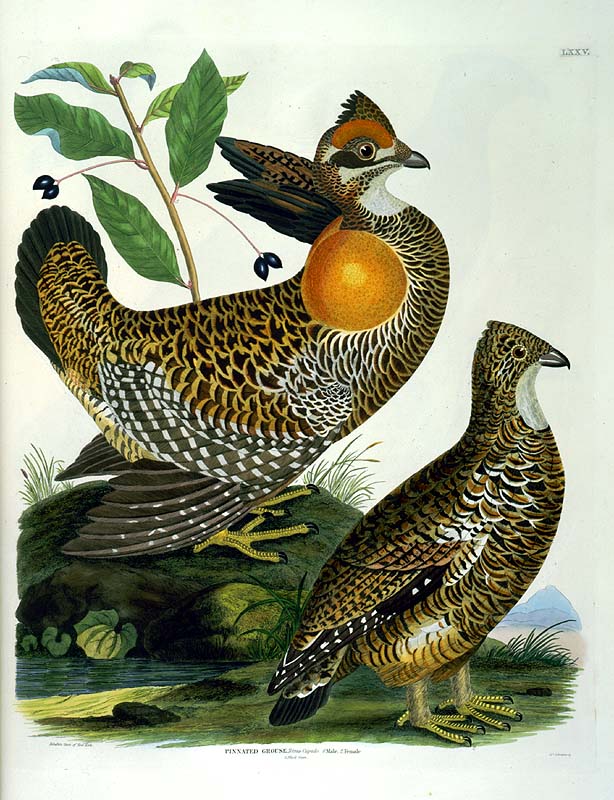
An artist's rendition of a mating pair.


Consumption on that level obviously began to take a drastic toll on Heath Hen populations.  So did other factors and stresses, especially the introduction of a significant new predator—feral cats, the widespread destruction of their habitat, and introduction of diseases from domestic fowl.  Mainland populations fell dramatically all through the 19th Century.
Pressure on the population was severe enough even at the end of the 18th Century for the New York State Legislature to pass a bill for “the preservation of heath-hen and other game.”  It was the first legislation in the fledgling nation designed to preserve a threatened species.  Unfortunately its provisions limiting hunting were virtually unenforceable and the population continued it precipitous decline.
Other efforts and proposal dotted the coming century.  But preservation efforts were complicated by confusion of just what the Heath Hen was.  

A male Prairie Chicken--the same species?
In 1806 Lewis and Clark brought back from their great Western expedition, the first samples of the Prairie Chicken seen on the East Coast.  Although larger and with somewhat different markings and colorings, scientist  quickly recognized it as a close relative of the Heath Hen—or perhaps they were variations on the same species, or the Heath Hen and  another bird, the Lesser Prairie Chicken found southward from the plains of Kansas through Oklahoma and the Texas Panhandle, are sub-species of the Prairie Chicken.  Although today generally classified as a sub-species, Tympanuchus cupido cupido the debate rages on among ornithologists. 
Whether a species or a sup-species, the mystery is how two populations so widely separated—the Prairie Chicken thrived on the High Plaines roughly west of the Mississippi and east of the Rocky Mountains from the Dakotas  to Texas—could have a common origin.  No fossil evidence has ever been found of a common ancestor or overlapping territory at any point.
This was important because after it became apparent that the Heath Hen was all but doomed, efforts were made as early as 1820 and continuing through the century to introduce the Prairie Chicken to occupy the same ecological mix and perhaps to strengthen and boost Heath Hen population by the introduction of vigorous new genes.
But the Prairie Chickens not only failed to thrive, they generally quickly died out of areas where they were introduced.  The diets available on the arid High Plains and in the soggy, humid costal heath wastes were evidently too different.  The Prairie Chickens also were susceptible to the same stresses from feral cats, domestic fowl diseases, and human preditation as the Heath Hen.
Scientists, however, are unsure if there was any interbreeding between the introduced birds and the natives.  Some think it was unlikely due to differences in courtship rituals so important to both species and to the relatively limited time they were exposed to one another.  Others believe that interbreeding was inevitable and that long before the Heath Hen disappeared on the mainland it was genetically no longer distinct.
At any rate sometime between 1840 and 1870 the Heath Hen went extinct on the mainland.  That left only the isolated population on Martha’s Vineyard.  And between mid-century and 1900 numbers there dwindled from about 300 to 15-200 in 1890 and only 70 at the dawn of the 20th Century.  That meant that the population was deeply interbred and probably already doomed.
But valiant efforts by conservationists were made to save the bird.  A complete hunting ban was instituted and enforcement against poachers was drastically increased.  In 1909 the Heath Hen Reserve was established protecting much of its remaining territory and lekking grounds.  At first efforts seemed to pay off.  The population seemed to recover to almost 2000 birds by 1916. 
Then that year disaster struck in the form of a raging brush fire that consumed much of the park in the middle of the breading season.  A succession of unusually harsh winters followed.  The population again took a nose dive.
Ironically, the preservation efforts themselves contributed to the fire that precipitated the population collapse.  The ecology of the saltwater heaths was not well understood.  It depended on regular natural lightning ignited to rapidly scorch the ground and burn off encroaching woody plants and vines.  The fire helped the seeds dropped the previous season from sedge grasses and other plants open up and provide food and nesting for the birds.  Their cousins the Prairie Chickens out on the High Plains similarly depended on regular natural fires.
But conservation practice of the day was to prevent or immediately extinguish all fires.  Fire breaks were mandated in the development of the reserve and local fire companies extended their service to the park.  As a result undergrowth began choking the lekking grounds which provided cover for their worst predators—cats and was fuel for a really big fire which could not be easily controlled.
The population rallied one last time rising back to 600 in 1920 than began the steady march to extinction. 1927, only about a dozen were left an only two were females.  The next year only a solitary male—Ben—returned to the lekking grounds.  He returned for five more lonely years before vanishing.

Monument to Boombing Ben and the Heath Hen.

There have been serious proposals to restore what is now the Manuel F. Correllus State Forest to its original condition, recreating the lost habitat of the Heath Hen.  Some then want to attempt to re-introduce Prairie Chickens an umbrella species occupying the niche of the Heath Hen as a monitor of habitat quality.  That remains highly controversial given the lack of success in introducing Prairie Chickens more than 100 years ago on the mainland and because Prairie Chickens themselves are under stress and threatened throughout much of their range.
Sometimes with the best of intentions you just cannot squeeze the toothpaste back into the tube.