Showing posts with label New England Standing Order. Show all posts

Wednesday, July 8, 2026

Jonathan Mayhew Was the Neglected Prophet of Pre-Revolutionary Boston


The Rev. Jonathan Mayhew--a religious and political radical and visionary of old Boston.

When the Rev. Jonathan Mayhew died in Boston on July 9, 1766 his moral, religious, and political legacy was far from accomplished.  Indeed, years and decades would unfold before the depth of his influence became apparent in a new nation and in a new faith.  Mayhew, then only 46-years-old, was the minister of Old West Church, and much beloved by his congregation and admired by the hot heads and radicals being rallied by Samuel Adams who would soon become the Sons of Liberty.  He was decidedly unpopular with the majority of his ministerial peers, conservative civic leaders, and with the Royal Governor of Massachusetts and his Council. 
Mayhew was born on Martha’s Vineyard on October 8, 1720, a fifth generation descendent of Thomas Mayhew, the Elder who first arrived in the New World with the Great Migration fleet of Puritan settlers in 1631.  Ten years later the original Mayhew secured a proprietary colony grant for Martha's Vineyard, Nantucket, the Elizabeth Islands, and other small islands.  Installing himself as governor he began populating his grant with new immigrants and also established his own farm and whaling operations.  Thomas, his son, and grandson also were missionaries among the local Wampanoag and established such fair and friendly relations with the natives.  They made it clear that religion and governance were separate.  The tribe was welcome to embrace Christianity, but Mayhew was at pains to assure them that their governance and lands were secure on their own.  Relations were so good that despite vastly outnumbering the settlers the local Wampanoag did not join the general uprising known as King Philips War that almost wiped out the Massachusetts Bay Colony of 1675-76.
Although the small proprietary colony was absorbed by Massachusetts after 1688, the family, or much of it, remained on the island in relative isolation from the mainstream of Puritan society.  Devoutly religious, their local version of the Congregationalist New England Standing Order drifted from the harsh and rigid Calvinism of the mainland.
Young Jonathan, noted for his scholarly bent, left the island to pursue the Lords work as a student at the factory of divines, Harvard College.  Upon graduation Mayhew he found New England in a religious upheaval.  


Puritan firebrand Rev. Jonathan Edwards appalled Mayhew.
The Connecticut minister and theologian Jonathan Edwards helped inaugurate the first round of revival meetings in the 1730’s. In 1841 he scared the hell out New England with his fiery sermon Sinners in the Hands of an Angry God which quickly became the first big best seller in the Colonies in pamphlet form.  Mayhew rejected Edwards view declaring that “total depravity [is] both dishonourable to the character of God and a libel on human nature.”  He likewise rejected the five points of Calvinism including the doctrine of irresistible grace and the doctrine of the Trinity as taught by the Athanasian and Nicene Creeds.
At the same time Mayhew also rejected the Great Awakening—the first of a series of huge revival movements that have periodically swept Americans up into a religious frenzy.  Mayhew saw the principal mover of the Awakening, the English preacher and revivalist George Whitefield, an Anglican preacher who became a founding figure in Methodism, at camp meetings in what is now Maine.  He was repulsed by the mindless emotionalism he witnessed which he suspected would burn brightly but soon extinguish itself.  He found Whitefield’s followers, ‘of the more illiterate sort,” and the preaching “confused, conceited and enthusiastic.”  He was repelled by the “extravagance and fanaticism, and violent gestures and shrieks” of people in the throes of religious ecstasy.
Mayhew made his views publicly know.  He proposed a third path based on religious rationalism and a view of a loving, but firm God as Father as revealed in a careful reading and analysis of The Bible.  


Boston's Old West Church called Mayhew.  It's working-class members responded to Mayhew's radicalism.  The steeple shown was torn down by the British during the Siege of Boston in the American Revolution in part to prevent it from being used to signal Colonial troops in Cambridge and in part as punishment for being Mayhew's pulpit of rebellion.
These views made it difficult for the young minister to find a parish.  But in 1747 West Church in Boston, one of the city’s nine Congregational Churches—and the least prosperous—called him to be their minister.  Only two of the other ministers in the city would even agree, as was customary, to be at the service of installation and ordination for the customary laying on of hands, symbolizing a welcome into the ministerial community.  One prominent minister is known to have scolded his barber when the man expressed interest in hearing Mayhew warning him not to go hear “that heretic.” 
Shortly after assuming the pulpit Mayhew crossed the ocean to pursue his Doctor of Divinity at the University of Aberdeen in Scotland, an intellectual hot bed of the Scottish Enlightenment.  Although the liberal ideas of the Scottish Enlightenment were taking hold among a young and rising generation of Virginia Tidewater aristocrats, they were a novelty in New England where most ministers who pursued advanced degrees in the Mother Country did so at firmly Puritan institutions.
Despite the cold shoulder of his colleagues, Mayhew perused a ministry that presaged Unitarianism—a theological position that did not even yet have a name—by more than two decades.  His belief in a firm, fair, and loving God/king led him to believe that even the worst sinners, after a period of punishment and reflection, could be reconciled and dwell thereafter in Heaven with the saints and the angels.  This was a kind of universalism, making Mayhew probably the first North American preacher to combine the two ideas which became the two streams of modern Unitarian Universalism. 
But Mayhew, however far seeing as a religious pioneer, is best remembered for the political sermons that helped stir rebellion. 
His most famous and influential sermon was preached on the centennial of the execution of King Charles I, January 30, 1750.  Discourse Concerning Unlimited Submission and Non-Resistance to the Higher Powers refuted the growing opinion that the king was a martyr.  It was a long, scholarly history of the monarchy and the development of the English constitution and built a Biblical argument against the Devine Right of Kings and in favor of popular resistance to unjust government in answer to a higher law.  He concluded that the execution of Charles was justified when he when he “too greatly infringed upon British liberties."  It was also a lesson for any future monarch with inclinations to despotism.
The sermon was widely printed and circulatead pamphlet, for a while supplanting Jonathan Edwards's old screed in popularity.  It was also reprinted in London in 1752 and again in 1767 as relations between the Mother Country and the Colonies were reaching crisis.  Mayhew became an international celebrity, albeit a highly controversial one.  His radicalism was denounced from other pulpits, and, of course, condemned by authorities.
But Sam Adams and his boys and a rising generation of patriots did listen.  Years later Sam’s cousin John Adams recalled, that Mayhew’s sermon “was read by everybody.”  Some would call it the intellectual opening salvo in the run-up to the American Revolution.  


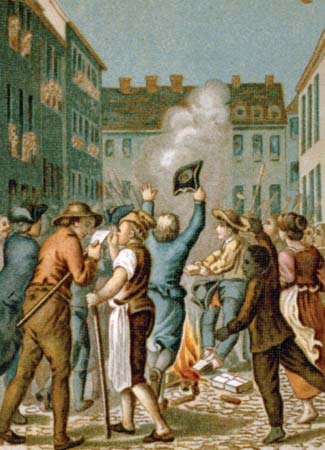
Mayhew's words inspired the Sons of Liberty, seen here burning copies of the Stamp Act.  They were "read by everybody" recalled John Adams.
Mayhew continued to preach influential, widely circulated sermons including two election day charges in 1750 and 1754 espousing colonial rights and the civic duty to resist tyranny.  He became particularly aroused with the imposition of the Stamp Act in 1765.  The essence of slavery, he argued in a new sermon, consists in subjection to others—“whether many, few, or but one, it matters not.” The day after his sermon, a Boston mob attacked and destroyed Lieutenant Governor Thomas Hutchinson’s house.  Mayhew and his sermon were held responsible by the “respectable citizens of Boston.” 


Powerful Lt. Governor Thomas Hutchinson blamed Mayhew's sermon for the mob that burned down his house.
In 1763 Mayhew rebuked the Anglican Society for the Propagation of the Gospel for its plans to dispatch missionaries, priests, and teachers to the Colonies as well as the eminent appointment of an Anglican Bishop.  He regarded all of this as a camel’s nose under the tent meant to bring the colonies back into conformity with the Crown and its institutions.
In 1765 Mayhew was invited by Harvard to deliver the annual Dudlean Lecture on religion. This was a rare show of approval from the New England establishment and an acknowledgement of his popular leadership against the Crown.
The Snare Broken was a thanksgiving discourse preached by Mayhew on May 23, 1766 occasioned by Parliament’s repeal of the Stamp Act.  It was a warning to William Pitt and others in England who he knew would read it that taking self-government into private hands in some circumstances must surely proceed from “self-preservation, being a great and primary law of nature.”
Weeks after delivering this last famous salvo, Mayhew died.  Most of the Boston clergy still avoided his funeral as did virtually all officeholders.

In addition to his influence on the Sons of Liberty and the American Revolution, Mayhew’s religious ideas, except for his proto-universalism, were quietly adopted by a new generation of Harvard graduates and ministers.  In the years following the revolution all most all Boston churches affiliated with the Standing Order were quietly but unofficially unitarian.  An open break with the Congregationalists however did not come until William Ellery Channing’s Baltimore sermon in 1819.  Ironically Mayhew’s old congregation Old West was one of only two Boston churches to remain with the orthodox Congregationalists. 

Thursday, July 9, 2020

The Early Outlier—A Forgotten Prophet of Pre-Revolutionary Boston

The Rev. Jonathan Mayhew--a religious and political radical and visionary of old Boston.

When the Rev. Jonathan Mayhew died in Boston on July 9, 1766 his moral, religious, and political legacy was far from accomplished.  Indeed years and decades would unfold before the depth of his influence became apparent in a new nation and in a new faith.  Mayhew, then only 46 years old, was the minister of Old West Church, and much beloved by his congregation and admired by the hot heads and radicals being rallied by Samuel Adams who would soon become the Sons of Liberty.  He was decidedly unpopular among the majority of his ministerial peers, conservative civic leaders, and with the Royal Governor of Massachusetts and his Council. 
Mayhew was born on Martha’s Vineyard on October 8, 1720, a fifth generation descendent of Thomas Mayhew, the Elder who first arrived in the New World with the Great Migration fleet of Puritan settlers in 1631.  Ten years later the original Mayhew secured a proprietary colony grant for Martha's Vineyard, Nantucket, the Elizabeth Islands, and other small islands.  Installing himself as governor he began populating his grant with new immigrants and also established his own farm and whaling operations.  Thomas, his son, and grandson also were missionaries among the local Wampanoag and established such fair and friendly relations with the natives.  They made clear that religion and governance were separate.  The tribe was welcome to embrace Christianity, but Mayhew was at pains to assure them that their governance and lands were secure on their own.  Relations were so good that despite vastly outnumbering the settlers the local Wampanoag did not join the general uprising known as King Philips War that almost wiped out the Massachusetts Bay Colony of 1675-76.
Although the small proprietary colony was absorbed by Massachusetts after 1688, the family, or much of it, remained on the island in relative isolation from the mainstream of Puritan society.  Devoutly religious, their local version of the Congregationalist New England Standing Order drifted from the harsh and rigid Calvinism of the mainland.
Young Jonathan, noted for his scholarly bent, left the island to pursue the Lord’s work as a student at the factory of divines, Harvard College.  Upon graduation Mayhew he found New England in a religious upheaval. 

Puritan firebrand Rev. Jonathan Edwards appalled Mayhew.

The Connecticut minister and Theologian Jonathan Edwards had helped inaugurate the first round of revival meetings in the 1730’s. In 1641 he scared the hell out of New England with his fiery sermon Sinners in the Hands of an Angry God which quickly became the first big best seller in the Colonies in pamphlet form.  Mayhew rejected Edwards view declaring that “total depravity [is] both dishonourable to the character of God and a libel on human nature.”  He likewise rejected the five points of Calvinism including the doctrine of irresistible grace and the doctrine of the Trinity as taught by the Athanasian and Nicene Creeds.
At the same time Mayhew also rejected the Great Awakening—the first of a series of huge revival movements that have periodically swept Americans up into religious frenzies.  Mayhew had seen the principle mover of the Awakening, the English preacher and revivalist George Whitefield, an Anglican preacher who became a founding figure in Methodism, at camp meetings in what is now Maine.  He was repulsed by the mindless emotionalism he witnessed which he suspected would burn brightly but soon extinguish itself.  He found Whitefield’s followers, ‘of the more illiterate sort,” and the preaching “confused, conceited and enthusiastic.”  He was repelled by the “extravagance and fanaticism, and violent gestures and shrieks” of people in the throes of religious ecstasy.
Mayhew made his views publicly know.  He proposed a third path based on religious rationalism and a view of a loving, but firm God as Father as revealed in his careful reading and analysis of The Bible. 

Boston's Old West Church called Mayhew to its pulpit..  Its working class members responded to Mayhews radicalism.  The steeple shown was torn down by the British during the Seige of Boston in the American Revolution in part to prevent it from being used to signal Colonial troops in Cambridge and in part as punishment for being Mayhew's pulpit of rebellion.
hese view made it difficult for the young minister to find a parish.  But in 1747 West Church in Boston, one of the city’s nine Congregational Churches—and the least prosperouscalled him to be their minister.  Only two of the other ministers in the city would even agree, as was customary, to be at the service of installation and ordination for the customary laying on of hands, symbolizing a welcome into the ministerial community.  One prominent minister is known to have scolded his barber when the man expressed interest in hearing Mayhew warning him not to go hear “that heretic.” 
Shortly after assuming the pulpit Mayhew crossed the ocean to pursue his doctorate of divinity at the University of Aberdeen in Scotland, an intellectual hot bed of the Scottish Enlightenment.  Although the liberal ideas of the Scottish Enlightenment were taking hold among a young and rising generation of Virginia Tidewater aristocrats, they were a novelty in New England where most ministers who pursued advanced degrees in the Mother Country did so at firmly Puritan institutions.
Despite the cold shoulder of his colleagues, Mayhew perused a ministry that presaged Unitarianism—a theological position that did not even yet have a name—by more than two decades.  His belief in a firm, fair, and loving God/king led him to believe that even the worst sinners, after a period of punishment and reflection, could be reconciled and dwell thereafter in Heaven with the saints and the angels.  This was a kind of universalism, making Mayhew probably the first North American preacher to combine the two ideas which became the two streams of modern Unitarian Universalism. 
But Mayhew, however far seeing and a religious pioneer, is best remembered for the political sermons that helped stir rebellion. 
His most famous and influential sermon was preached on the centennial of the execution of King Charles I, January 30, 1750.  Discourse Concerning Unlimited Submission and Non-Resistance to the Higher Powers refuted the growing opinion that the king was a martyr.  It was a long, scholarly history of the monarchy and the development of the English constitution and built a Biblical argument against the Devine Right of Kings and in favor of popular resistance to unjust government in answer to a higher law.  He concluded that the execution of Charles was justified when he when he “too greatly infringed upon British liberties.  It was also a lesson for any future monarch with inclinations to despotism. 
While the justification for regicide may have been in line with the Puritan inheritors of Oliver Cromwell, his reasoning was far more radical and seemed pointed as much at the existing monarchy as the headless Stuart.
The sermon was widely printed and circulated as a pamphlet, for a while supplanting Jonathan Edwards old screed in popularity.  It was also reprinted in London in 1752 and again in 1767 as relations between the Mother Country and the Colonies were reaching crisis.  Mayhew became an international celebrity, albeit a highly controversial one.  His radicalism was denounced from other pulpits, and, of course, condemned by authorities.
But Sam Adams and his boys and a rising generation of patriots did listen.  Years later Sam’s cousin John Adams would recall, that Mayhew’s sermon “was read by everybody.”  Some would call it the intellectual opening salvo in the run-up to the American Revolution. 

Mayhew's words inspired the Sons of Liberty, seen here burning copies of the Stamp Act.  They were "read by everybody" recalled John Adams.
Mayhew continued to preach influential, widely circulated sermons including two election day charges in 1750 and 1754 espousing colonial rights and the civic duty to resist tyranny.  He became particularly aroused with the imposition of the Stamp Act in 1765.  The essence of slavery, he argued in a new sermon, consists in subjection to others—“whether many, few, or but one, it matters not.” The day after his sermon, a Boston mob attacked and destroyed Lieutenant Governor Thomas Hutchinson’s house.  Mayhew and his sermon were held responsible by the “respectable citizens of Boston.”

Powerful Lt. Governor Thomas Hutchinson blamed Mayhew's sermon for the mob that burned down his house.
In 1763 Mayhew rebuked the Anglican Society for the Propagation of the Gospel for its plans to dispatch missionaries, priests, and teachers to the Colonies as well as the eminent appointment of an Anglican Bishop.  He regarded all of this as a camel’s nose under the tent meant to bring the colonies back into conformity with the Crown and its institutions.
In 1765 Mayhew was invited by Harvard to deliver the annual Dudlean Lecture on religion. This was a rare show of approval from the New England establishment and an acknowledgement of his popular leadership against the Crown.
The Snare Broken was a thanksgiving discourse preached by Mayhew on May 23, 1766 occasioned by Parliament’s repeal of the Stamp Act.  It was a warning to William Pitt and others in England who he knew would read it that taking self-government into private hands in some circumstances must surely proceed from “self-preservation, being a great and primary law of nature.”
Weeks after delivering this last famous salvo, Mayhew died.  Most of the Boston clergy still avoided his funeral as did virtually all officeholders.
In addition to his influence on the Sons of Liberty and the American Revolution, Mayhew’s religious ideas, except for his proto-universalism, were quietly adopted by a new generation of Harvard graduates and ministers.  In the years following the revolution all most all Boston churches affiliated with the Standing Order were quietly but unofficially unitarian.  An open break with the Congregationalists however would not come until William Ellery Channing’s Baltimore sermon in 1819.  Ironically Mayhew’s old congregation Old West would be one of only two Boston churches to remain with the orthodox Congregationalists.

Thursday, May 9, 2019

Jared Sparks—Most Famous for Just Sitting Through His Ordination Sermon

Jared Sparks by Thomas Sully shortly after his ordination in Baltimore.
Note—An old internet friend and mentor in the history, polity, and mores of Unitarianism stepped back onto the denominational stage last Sunday taking the pulpit for the 200th anniversary of William Ellery Channing’s Unitarian Christianity at the ordination of Jared Sparks in  on May 5, 1819.  It was considered a declaration of independence by liberal ministers mostly from the old Puritan New England Standing Order—the Congregationalists. For Rev. Elizabeth Curtis the occasion was also her re-entry into active Unitarian Universalist life after several years as the full-time caretaker of her beloved wife Lynn Mathews who died earlier this year and her own not-yet-completed recovery from a serious knee injury.  Elz, as she signed articles on her influential blog Polity Wonk and in discussions of the Unitarian Universalist Historical Society, was the perfect choice for the historic occasion.  And plenty reason enough for me to re-cycle my own blog post about the sermon and Jared Sparks.
Rev. Elizabeth Curtis.

Jared Sparks may be best remembered for just sitting and listening to a speech.  The speech was really a sermon by the Rev. William Ellery Channing given at the First Independent Church of Baltimore on May 5, 1819 on the occasion of Spark’s ordination and installation as minister.  The sermon, known as Unitarian Christianity, was the final declaration of independence for what had been called liberal Christianity from the Calvinist orthodoxy of the New England Standing Order.  Essentially it was the foundational document of American Unitarianism.

Why Channing chose far-off Baltimore and the ordination of a young man brought up in Connecticut’s strict orthodoxy has puzzled many.  The answer may lie in the remarkable life of Sparks himself.


Sparks was born on May 10, 1789 in Willington, Connecticut, a younger son of a large and struggling family with few prospects of his own.  He grew up in the post-Revolutionary period steeped in the lore of that struggle and in the strict orthodoxy of the Congregationalists who dominated the state religiously and politically.

Unable to support or educate young Jared, his family sent him to live with relatives in Camden, New York when he was six.  His uncle and aunt were hardly in better shape to tend to his needs despite his obvious natural intelligence and eagerness to pick up any scrap of knowledge through haphazard reading and self-instruction.  In his teen years he returned to his parents and got some grammar school education where he showed a special passion for astronomy.  By age 18 he was helping support the family as carpenter and rural schoolmaster.

At age twenty he gained access to the personal library of a local pastor and began systematic study of Latin, mathematics, and astronomy.  Impressed with his progress, the pastor arranged for his admission to Phillips Exeter Academy on a scholarship.  His tutors and classmates began describing him as a genius and he gained his first public reputation writing articles on education and science for local newspapers.

Upon graduation from Phillips Exeter, Sparks was undoubtedly expected to enroll a Yale, the bastion of Orthodoxy where he would have prepared to dutifully join the Black Legion of Congregationalist clergy.  Instead, Sparks surprised everyone, perhaps even himself, by opting attend arch-rival Harvard, then already in the hands of restive theological liberals.  Sparks cast his lot with people who asked questions.

He had to drop out of school in 1812 for financial reasons.  He signed on as a private tutor of a plantation family in Havre de Grace, Maryland.  He was a witness in May of 1813 when the town at the head of Chesapeake Bay was shelled by British naval forces under Admiral George Cockburn.  Sparks later wrote a memorable account of the action.

With the money he earned as a tutor, Sparks was able to return to Harvard where he became a stand-out student leader.  He won the coveted Bowden Prize for his essay on Sir Isaac Newton, joined the Phi Beta Kappa society, and was a commencement speaker when he graduated in 1815.

Sparks stayed at Harvard to study in the Divinity School paying his way as a tutor in geometry, astronomy, and natural history.

The Independent Church of Baltimore was renamed the Unitarian Church shortly after Channings' famous sermon and was one of the few out post congregations away from New England shown circa 1820.


Upon graduation, he was called to the Baltimore congregation and to his rendezvous with American religious history.  Sparks was a respected minister and his carefully crafted sermons much admired.  He participated, as much as separation from the hub of the Unitarian universe in Boston permitted, in the affairs of Unitarianism.  He contributed to its vigorous press.  But he was not happy with the routine duties of a pastor and yearned for an academic or literary career.

He resigned his pulpit and left active ministry—although he would occasionally fill a pulpit as a guest or supply preacher—and returned to Cambridge in April of 1823.  Back in Massachusetts he became editor of the North American Review, already the young nation’s first and most distinguished literary magazine.  Under Spark’s stewardship it further cemented its reputation and printed not only literary criticism and poetry, but what would today be called policy-wonk articles about national and international events and politics.

Sparks also honed a new interest in history and biography, particularly concentrating on the Revolutionary period.  His first book, in 1827, was a biography of American explorer John Ledyard.  

To prepare for a planned biography of George Washington, Sparks traveled to Mt. Vernon to examine his papers.  Fascinated by what he found he went on a search for everything Washington wrote, interviewing and collecting letters and materials from survivors of the Revolution and from archives and libraries around the country.  The result was the massive 12 volume The Writings of George Washington published between 1834 and ’37.  No one had ever done anything quite like it before.  It was a revolutionary step forward in historical scholarship.

Eight of the twelve volumes of Jared Sparks' Writing of George Washington.  The massive effort represented a breakthrough in using source material in history.

Sparks applied editing standards of his day—correcting spelling, punctuation, and grammar; polishing rough phrasings, and omitting passages that might embarrass or demean the Old Hero.  Modern editors have had to re-plow Sparks’ ground to restore the original voice, warts and all, but that would have been impossible without his original efforts.

Sparks followed with other important books—The Diplomatic Correspondence of the American Revolution, The Life of Governeur Morris, The Works of Benjamin Franklin,  The Library of American Biography. To gather materials for the book on diplomacy, he became the first American to travel to Europe to examine and collect source material there.

The books not only were essential contributions to understanding American history, they were popular enough to actually make money, making Sparks one of the few literary men in the country to be able to make a comfortable living from his private scholarship and pen.

In 1839 Sparks returned to Harvard as the McLean Professor of Ancient and Modern History.  He offered the first course in American history at any university and abandoned the traditional pedagogy of teaching from texts and requiring recitation by students instead using a combination of lectures, assigned reading from various materials including original sources, and small group discussion.  This refreshing change made his classes among the most popular with Harvard students.

Jared Sparks in a carte de visit during his tenure as Harvard President.

Despite opposition of some disgruntled traditionalists, Sparks was elected President of Harvard in 1849.  He instituted several campus reforms.  He personally oversaw the organization and preservation of Harvard’s own institutional history documents, a bonanza for future historians.  But Sparks hated the petty politics of academia, the drudgery of a mountain of routine clerical work, and being disciplinarian to notoriously rowdy Harvard students.  He resigned in 1853 after only four years.

In retirement Sparks privately tutored and mentored Harvard students and continued his historical research.  His last major book was Correspondence of the American Revolution, Being Letters of Eminent Men to George Washington in 1853.  In 1857 he took an extended tour of Europe concentrating on museums, libraries, and archives where the raw material of history could be found.  He published articles on those travels.

Jared Sparks died on March 14, 1866 at the age of 77.  He was honored as America’s premier historian—and the as the guy at whose ordination William Ellery Channing spoke.