.jpg)
Roger Connor of the Troy Trojans hits the first big league grand slam in 1880.
In
the early years of Major League Baseball
home runs were hard to come
by. Ball parks were small, but the ball was dead—much softer
with a less elastic core than modern balls.
Bats were heavy slowing
down bat speed. Pitchers had yet to perfect a 90 mile per hour fast ball. It
took a dead eye, prodigious strength, a bit of luck, and usually a tail wind to get a ball over the fences. Instead of waiting
for big innings where sluggers clear the bases, as in the modern
game, it was small ball—singles, doubles, stolen bases, daring slides
with sharpened spikes high, plus
a lot of walks and hit batsmen.
Before
there was a Babe Ruth, there was Roger
Connor, a towering first
baseman—said to be 6’3’’ in an age when
men were generally much shorter—who started his career with the Troy, New
York Trojans in 1880 at the age of 22.
Then, as now, there were cash poor teams in small markets who could not afford to pay the kind of
stars playing on teams like Chicago White Stockings and clubs in Boston, New York, and Philadelphia. The Trojans were one of them. They packed their teams with promising
amateurs like Conner, a kid who had
played club ball in his hometown
of Waterbury, Connecticut.
On September 10, 1881 the Trojans were playing
another down-at-the-heels small city team, the Worcester
Ruby Legs. Down three runs in the 9th inning, their
cause looked hopeless. But the plucky
team managed to load the bases. With two
outs Connor strode to the plate—and blasted the first grand slam home run in major league history.
The thrilling storybook ending attracted the attention of the mighty New York Gothams. By the 1882 season Connor was playing in the Big Apple for one of the National League’s elite teams. Soon he was the star of the team not only hitting
for average and power,
but despite his size a lithe and
speedy base runner. Sports
writers began to refer to the team as the Giants in his honor. The nickname stuck.
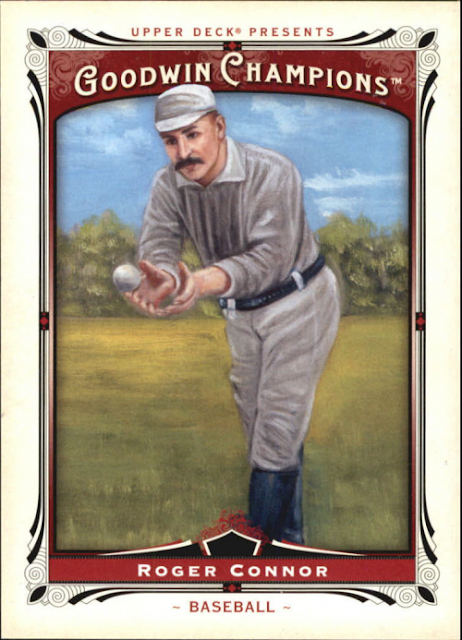
Connor played first base barehanded in the era before fielding gloves.
In
1886 Connor gained fame for being the first person to hit a homerun entirely
out of the Polo Grounds, a ballpark
in which it was notoriously hard to hit homers.
In
1890 Connor was part of the revolt
against National League owners
that resulted in the short lived Players
League. As a member of a team made
up of rebellious Giants, he led the new league in home runs with 14, the only
time he ever held a single season home
run title. But he was consistent
over an 18 year career. He came in
second four times in the National League and amassed a total of career total of
138 homers—a record that stood until Ruth broke it 23
years after Connor’s retirement in 1897.

The towering 6'3" Connor inspired the new nickname for the New York City
National League club--the Giants. He was the beau ideal of a Gilded
Age baseball star.
Ruth
actually thought he broke the record when he smashed homer number 132. Due to incomplete record keeping Connor was
then only credited with 131. Subsequent
research shows that the real total was 138.
By
the time Connor retired after
spending his last seasons with the Philadelphia
Phillies and St. Louis
Browns, he had racked up an impressive record: 233 triples (still No. 4 on the all-time list
after all of these years), 244 stolen bases, National League batting crown in
1885 with a .371 average, in the top ten for batting average 10 times, led the
league in doubles ten times and triples 7, batted in 1,321 runs, and had a
career average of .317.

Connor's Hall of Fame plaque.
After
his retirement from the majors, Connor returned to his Waterbury where he managed minor league teams and basked in the admiration of his hometown. He lived to see Ruth break his career home
run record. He died in Waterbury in 1931
at the age of 73.
In
1976 the great left handed hitter was elected to the Baseball Hall of Fame by the Veterans’ Committee—a fitting tribute for the onetime Home Run King.


.jpg)