Showing posts with label New York Yankees. Show all posts

Monday, May 11, 2026

An AI Test About Yogi


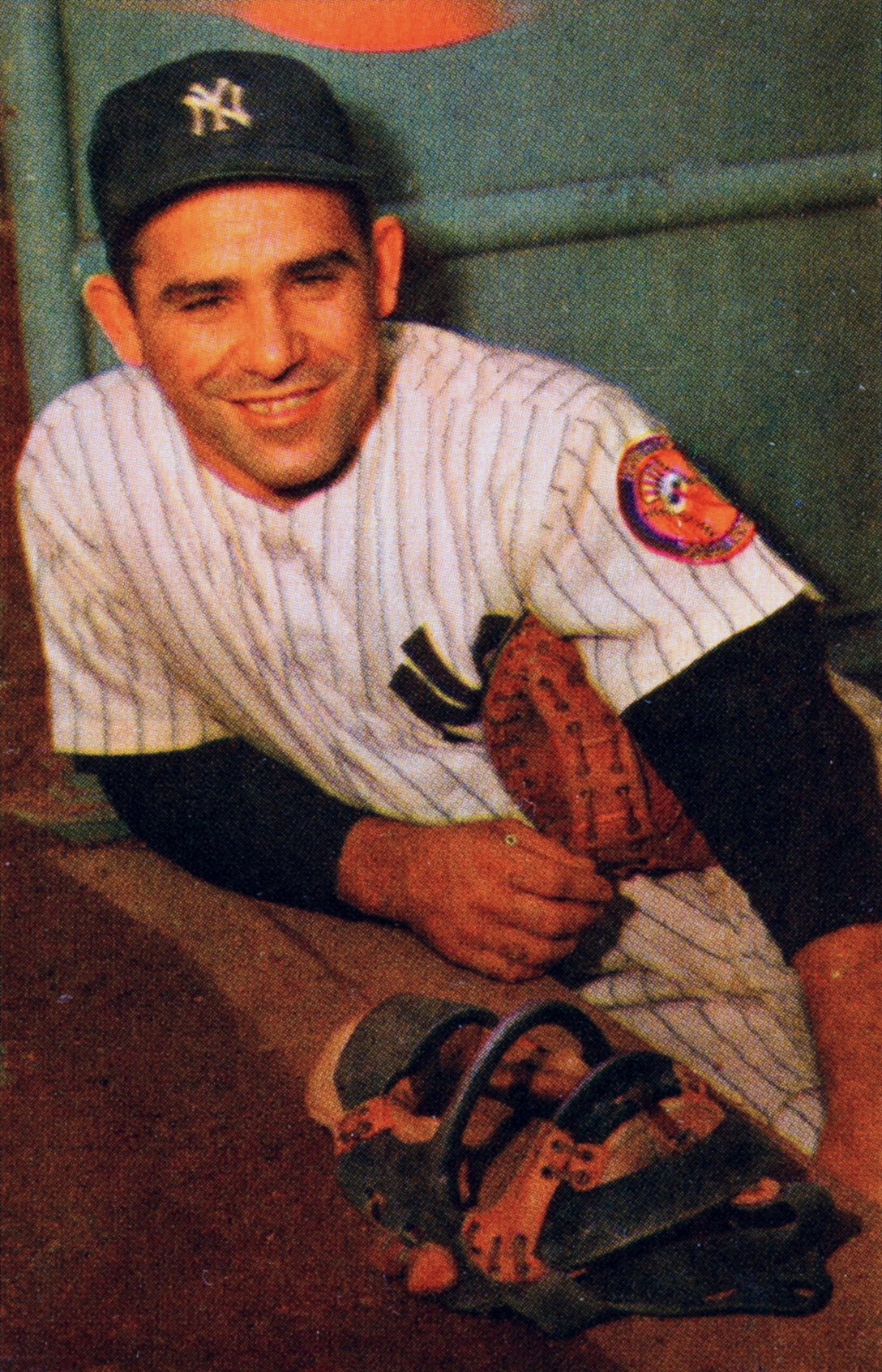
                                                         Yogi Berra in 1953.

Note—Back in 2024 all the buzz was about Artificial Intelligence (AI).  Word was that it would make most of us obsolete--especially writers.  So this as an experiment.  The following blog post on Yogi Berra for his birthday was not written by your reliable scribe but created, including the title, by the  program AI Article Writer 4.0 which is already obsolete.  I did not edit it in any way.  What say you?  Should the Old Man turn over his posts to this electronic gizmo, which undoubtedly contains fewer spelling errors and typos, or should he continue to bang out stuff the old fashion way?

Lawrence Peter “Yogi” Berra was an American professional baseball catcher, coach, and manager. He was born on May 12, 1925, in St. Louis, Missouri. Yogi Berra was one of the most successful and popular baseball players of his era, playing for the New York Yankees and the New York Mets. He played in more World Series games than any other player in history.

Yogi Berra grew up in a working-class family in St. Louis, Missouri. He dropped out of school after the eighth grade to help support his family. In his teens, he played baseball for a local team, and he was eventually signed by the New York Yankees.

                           Young Yogi with aging Babe Ruth at Yankee Stadium.

Berra made his Major League Baseball debut in 1946. He quickly became known for his excellent defensive skills as a catcher and his ability to hit for power. He was a 15-time All-Star and won three American League Most Valuable Player Awards.

Yogi Berra’s impact on the game of baseball cannot be overstated. He was a key player for the New York Yankees during their dynasty years in the 1950s and 1960s, helping them win 10 World Series championships. He was also a successful manager, leading the Yankees and the Mets to the postseason.

Berra was known for his “smart” play on the field. He was an excellent defensive catcher who could read the opposing team’s hitters and pitchers. He was also a great hitter, with a career batting average of .285 and 358 home runs.

Yogi quotes are the inspiration of untold memes.

Yogi Berra was famous for his witticisms and malapropisms. Many of his quotes have become timeless classics. Some of his most famous quotes include:

    It ain’t over ‘til it’s over.

    When you come to a fork in the road, take it.

    It’s like déjà vu all over again.

   I never said most of the things I said.

While some of his quotes may seem nonsensical, they often contain hidden wisdom. For example, “It ain’t over ‘til it’s over” means that anything can happen until the game is over, and you should never give up hope.

Yogi Berra was known for his leadership and coaching style. He was a players’ manager who treated his team like family. He was tough but fair and always had his players’ backs. He was also a great motivator who knew how to get the best out of his players.

Berra’s coaching style was based on his own experience as a player. He knew what it took to win, and he passed that knowledge on to his players. He was also a great communicator who could explain complex concepts in simple terms.

Berra with Yankee's owner George Steinbrenner in has managing years.

Yogi Berra's legacy goes beyond the game of baseball. He was a beloved figure who was known for his kindness, humility, and sense of humor. He was a family man who was devoted to his wife and children.

Berra was also a philanthropist who gave back to his community. He was involved in many charitable organizations, including the Yogi Berra Museum and Learning Center, which is dedicated to promoting the values of respect, perseverance, sportsmanship, and excellence through the lens of baseball.

Yogi Berra’s impact on popular culture cannot be understated. His quotes have become part of the American lexicon, and his name is synonymous with baseball. He has appeared in movies, TV shows, and commercials, and his likeness has been used in advertising and marketing campaigns.
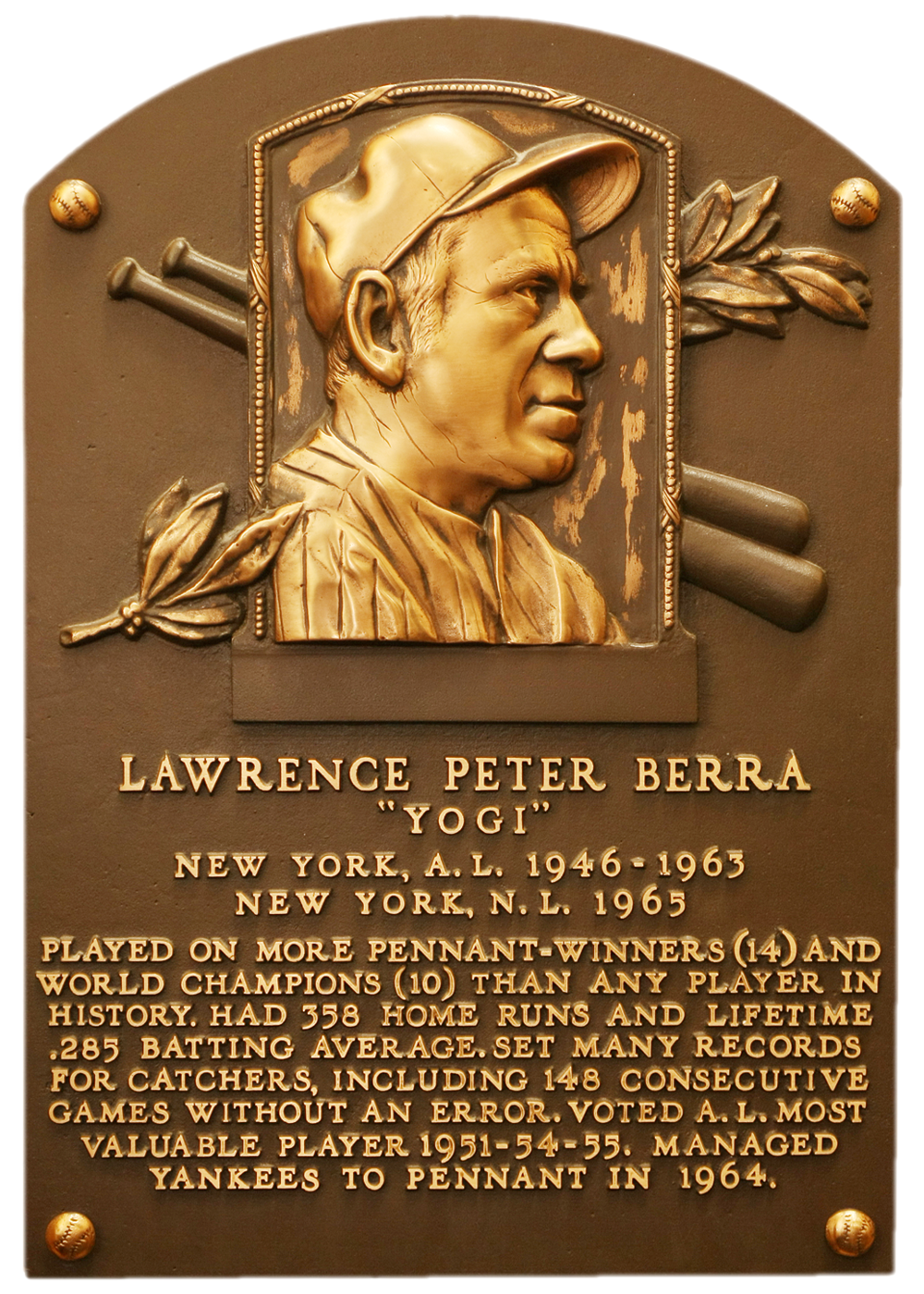
                                        Berra's Baseball Hall of Fame plaque.

Berra was also a cultural icon who represented the values of the American Dream. He was a self-made man who overcame adversity to achieve success. He embodied the spirit of hard work, determination, and perseverance that is so important in American culture.

Yogi Berra’s lessons go beyond the game of baseball. His quotes contain wisdom that can be applied to all areas of life. For example, “If you don’t know where you are going, you’ll end up someplace else” means that you need to have a plan if you want to succeed.

                                                Berra honored on a U.S.P.S. stamp.

Berra's leadership and coaching style also provide valuable lessons for life. He believed in treating people with respect and kindness, and he knew how to motivate and inspire his team. These are qualities that are important in all areas of life, whether you are a coach, a teacher, or a business leader.

Yogi Berra continues to inspire and influence people today. His quotes are still quoted by sports fans and non-sports fans alike, and his legacy lives on through the Yogi Berra Museum and Learning Center. His leadership and coaching style have also inspired many coaches and managers in all areas of life.

Berra's legacy is also a reminder of the importance of hard work, determination, and perseverance. He overcame many obstacles in his life to achieve success, and his story is a testament to the power of the American Dream.

                                Berra's death was big news.

Yogi Berra was a true legend who left a lasting impact on the game of baseball and on popular culture. His famous quotes and his leadership and coaching style have inspired generations of players, coaches, and fans. His legacy is a reminder of the importance of hard work, determination, and perseverance, and his spirit lives on through the Yogi Berra Museum and Learning Center.

P.S--the experiment was never repeated.  

Sunday, July 6, 2025

Hustling Chicago Reporter Gave Birth to the Baseball All Star Game


Nosebleed seats at Comiskey Park for the All Star Game went for just a buck plus tax, affordable to many ordinary stiffs even in a Depression year.

The election of Pete Crow-Armstrong and Kyle Tucker to the National League team for the upcoming All Star Game is creating a lot of excitement among Cubs fans.  The duo will patrol 2/3 of the outfield and provide plenty of power at the plate.  The last time the team sent two outfielders to the starting lineup was 1936 when now largely forgotten Augie Galan and Frank Demaree made the squad.  That was just three years after the first game in 1933.  Their selection might well have been influenced by the game’s founder and the Tribs long and murky shadow over the selection process for the game on June 6, 1933

Give credit where credit was due.  It was all Arch Wards original idea.  He was the sports editor and principle baseball writer for the Chicago Tribune, the 800 lb. gorilla of Second City and Mid-Western newspapers.  Why not, he suggested, stage a mid-summer exhibition game featuring the biggest stars of the American and National Leagues to coincide with the Century of Progress—the Worlds Fair on the Lake—in 1933.  


Chicago Tribune reporter and promoter of the first All Star Game, Arch Ward even eventually got his own baseball card. 

At first the two leagues, which had, at best, an uneasy relationship with each other were reluctant.  But the Depression was cutting into attendance at all but a handful of ballparks and Ward and his supporters soon convinced owners that the national attention could boost ticket sales.  It also helped that Ward was a crony of Tribune owner Col. Robert R. McCormick and a political powerhouse in the Republican Party and hyper-conservative circles on his own—views fervently shared by most owners.

The concept of All-Star teams was not unknown.  Back in the earliest days of the National League Albert Spaulding toured nationally and even internationally with hand selected squads in the off-season.  Various star players were still assembling all-star teams—usually made up more of cronies than a full squad of actual stars—and barnstorming against local teams.  And the chance to see Big Leaguers in tank towns and back waters did bring out fans in droves.  Now a lot of those same small town fans would be flocking to the big city for the fair.

Otherwise there was scant play between the two leagues except in spring training where many teams saw each other in the Florida Grapefruit League.  Except, of course, for the goofy Cubs who trained in far off Catalina Island, California for no good reason except that the Wrigley family owned property there.   Sometimes in cities with teams in both leagues—Boston, New York, Philadelphia, St. Louis, and Chicago—inter-city exhibition games were scheduled, usually at the end of spring training or after the regular season was over. 


 More than 49,000 fans jammed Comiskey Park for the 1933 All Star Game.

In the days when players tended to spend all or most of their careers with one team, even the players were unfamiliar with each other unless they had played with or against each other in the minor leagues.

Players for the exhibition game, which was expected to be a once-in-a-life-time extravaganza, were selected in a system that somehow combined the choices of each league’s managers with a fan poll conducted not-too-scientifically or reliably by the Tribune and a handful of other newspapers.  The results were predictable.


The power house of an American League team was dominated by the heart of the New York Yankee line-up.  

The American League team under Philadelphia manager Connie Mack was a heavy hitting power house long on home run hitters  and dominated by the princes of baseball—New York Yankees sluggers Babe Ruth, Lou Gehrig, and Ben Chapman in addition to hurler Lefty Gomez.  The starting squad also included two members of the White Sox—Jimmy Dykes and Al Simmons, both new to the team that year from a trade with the Philadelphia Athletics.

The National League, by contrast, still relied on small ballslap hitting, singles, doubles, steals, aggressive base running, bunts and sacrifices, working the count for walks.  Pitching was aggressive, brush backs and intentional bean balls a part of the game.  The whole style of play was aggressive, rhubarbs with umpires and bench clearing brawls were common.  The team, while talented and suited for such play, did not feature the kind of legends-in-the-making on the American roster.  Veteran Giants manager John McGraw fielded a team that included Pepper Martin, Frankie Fritche, and Jimmie Wilson all of the league dominating St. Louis Cardinals along with starting pitcher Bill Hallahan.  The Cubs placed no players among the starters.  Their biggest star, catcher Gabby Harnett and short stop Woody English were reserves along with pitcher Lon Warneke.


The scrappy National League featured small ball specialists. 

Since the game was to be played at the White Sox home of Comiskey Park, the umpires were from the American League.  And that made a difference, too, because umpiring styles were very different between the two leagues.  American umpires squatted behind enormous, inflated chest protectors behind the plate.  That caused them to have a high strike zone friendly to sluggers.  Sluggers whaling away also reduced walks.  National League players were used to umpires with padded chest protectors worn discretely under their wool suit coats.  That enabled them to get down low behind the plate and their strike zone was low—from the knees to just above the belt, barely.  They called more balls working the count up and causing hurlers to throw more pitches.

With huge national advance publicity, fans flocked to standing-room-only Comiskey Park and milled around on the streets outside.  In downtown areas of major cities fans gathered to watch play-by-play coverage flashed on electronic scroll signs just as they did for World Series games.  Millions hunkered by their radios as the game was broadcast nationally by both the NBC and CBS radio networks.  Cameras from all of the major Newsreel companies ground away from the grandstand roof.  The press box was jammed to overflowing scores of sportswriters from every major and most minor cities plus national magazines.

As for the game itself, it was not quite the American League blowout almost everyone expected.

 A White Sox bat boy greets Babe Ruth at home after his first ever All Star /Game home run.  The Babe even made a rare stellar defensive play later in the game. 

In the bottom of the second the American League got on the board when pitcher Hallahan issued one-out walks to Jimmy Dykes and Joe Cronin. Two batters later, pitcher Lefty Gomez singled home Dykes for the first run. In the bottom of the third, after a walk to Charlie Gehringer, Babe Ruth famously hit the first home run in All-Star Game history, putting the AL up 3-0. Hallahan was chased from the game after walking Lou Gehrig immediately afterward and was replaced by Cub Lon Warneke.  General Crowder replaced Gomez to start the fourth inning. In the sixth, Warneke hit a one-out triple and scored on a Pepper Martin groundout. Frankie Frisch followed with a home run to bring the NL to within a run, but after a Chuck Klein single, Crowder would escape the inning without giving up any more damage.

Cronin led off the bottom of the sixth with a single. After advancing on a bunt, he scored on an Earl Averill single to extend the lead to 4-2. Crowder was replaced by Lefty Grove in the top of the seventh, while Warneke was replaced by Carl Hubbell in the bottom of the inning. The NL looked like they had a chance in the top of the eighth. With Frisch on first with two outs, Chick Hafey lined a shot to right field that looked like it could be home run, but Ruth, in rare defensive acrobatics, reached over the wall to catch it, denying the NL a chance to tie the game. Grove retired the side in order in the ninth to secure the American League’s victory.

MLB Inaugural All Star Game Program (1933) Art Poster - 8x10 Color Photo 

Fans could purchase this souvenir program book and score card with a complimentary stub of a pencil at the first contest.  Intended as a one-and-off fan enthusiasm encouraged regular inter-league contests.

All in all an exciting, if kind of old fashion, baseball game that left fans satisfied and wanting more.

And more they got.  The game became an annual event and as predicted raised interest in baseball and ticket sales across the country.


Sunday, June 23, 2024

When Pitching Phenom Babe Ruth Didn’t Get an Out and Still Shared No-Hitter


                            Boston hurlers Ernie Shore and Babe Ruth.  At 6' 4" Shore toward over the sizable Ruth.

Things went to hell in a hurry for the Boston Red Sox in the first game of a Sunday double header on June 23, 1917.  The team’s young phenom Babe Ruth took to the mound against the Washington Senators at Fenway Park.  The big baby faced hurler was just 22 years old and in his third full season in the majors.  But he was already attracting attention for the blazing fastball that caused American League hitters to whiff futilely more often than not.

Lead off for the Senators was second baseman Ray Morgan who like Ruth had come up to the Big Leagues from the old Baltimore Orioles of the International League.  Either Ruth was a bit wild that day or Morgan had a discerning eye and laid off some pitches that seemed to flirt with the edge of the plate.   Home plate umpire Brick Owens gave Morgan a base on balls.  Ruth begged to differ.  Voraciously.

As Morgan trotted to his base, Ruth and Owens exchanged words.  Owens threatened to toss Ruth if he did not “get down and pitch.”  Ruth yelled back, “Toss me and I will break your nose!”  That, of course drew the thumb.  Ruth charged the plate and clipped Owen with a glancing blow to the head.     Player/manager Jack Barry and a bunch of Boston police had to drag the enraged Ruth off the field.  Also ejected was catcher Pinch Thomas.

                                                    Ernie Shore 1916 baseball card.

In those days way before teams carried boat loads of relief pitchers and specialists, Barry had few good options, especially with a second game coming up that afternoon. To keep from completely busting his rotation, he called right hander Ernie Shore to the mound.  Shore had come from Baltimore in the same trade with Ruth.  And he was even bigger than his team mate, standing 6’4” and tipping the scales at 220.  If Ruth was star of the future for the team, Shore was decent journeyman, the kind of hurler modern sportswriters call an inning eater.

Shore had to take the mound with hardly any warm up.  At first base Morgan probably felt he could get a leg up on the new battery.  But catcher Sam Agnew quickly threw him out trying to steal second.  With that out Shore settled into facing the rest of the rotation.  And settled he did.  He proceeded to retire the remaining 26 Senators without allowing a base runner, earning a 4–0 Red Sox win.  He fanned only two and it did not seem as if he was working hard, but he handled a number of bunt attempts and kept hit balls mostly to grounders that his defense ate up.

For some years the official record books credited Shore with a perfect game.  But since Ruth coughed up the walk the game is now officially listed as a shared no-hitter.  Still, it was one of the game’s epic accomplishments and set a record for a relief appearance that will probably never be matched.

As for Ruth, he was fined $100 and suspended for 10 games.  Owner Harry Frazee also ordered him to make a humiliating public apology.

The team went on to a 90-win season, finishing in second place to the Chicago White Sox.  Manager Barry and four of his team mates enlisted in the Navy and were called to service at the end of the season and spent the war year of 1918 in a gobs navy blue instead of baseball flannels.

Shore was one of the team’s Navy enlistees.

The big pitcher was born in East Bend, North Carolina on March 21, 1891.  He was scouted for professional ball while pitching for Guilford College, a Quaker liberal arts school in Greensboro.  Despite offers, he stayed in school until he graduated in 1913.  At a time when most players did not even complete high school he was among a tiny minority of college men.

                            Ernie  Shore and Grover Cleveland Alexander, starting pitchers of game one of the 1915 World Series.

Shore made a Big League debut with the New York Giants in June of 1912, but he was back in the minors at Baltimore when he got packaged in the deal that featured Ruth.  Shore’s best year with the Red Sox was 1915, when he won 18, lost 8 and compiled a 1.64 earned run average. He was 3–1 in World Series action in 1915 and 1916.

After returning from his war service in 1919 Shore became part of owner Frazees famous fire sale to the New York Yankees that transferred most of the team’s talent, starting with Ruth, to the Bronx.  Shore finished his career with the Yankees in August of 1920.

Over his career he racked up a record of 65 wins and 45 losses, a respectable 2.47 ERA, and 309 strike outs.  He was never considered for the Baseball Hall of Fame.

When he ran for Sheriff of Forsyth County, North Carolina, Shore signed this campaign palm card as if it were a baseball card.

He returned to North Carolina where he was elected Sheriff of Forsyth County serving for many years.  In the 1950’s he led efforts to build a new minor league stadium in Winston-Salem.  The ball park was named for him and is still in use as the home field of the Wake Forest University Demon Deacons.  

Ernie Shore Field today.

Shore died on September 24, 1980, aged 89.